Those ranges are a starting point, not a valuation of an individual aircraft.
The asking price is only one part of the decision. Flight hours, maintenance history, equipment, and the scope of a pre-purchase inspection can all affect an aircraft’s value and the work involved in acquiring it.
This guide explains how to assess an asking price against a helicopter’s condition and configuration, what an inspection is intended to establish, and which practical factors matter when an acquisition crosses borders. It offers a clearer way to assess the aircraft and the transaction before deciding whether a particular opportunity merits closer consideration.
Key Takeaways
- Compare asking prices with aircraft age, configuration, equipment and records to judge whether a listing merits closer review.
- Assess flight hours alongside maintenance history and component status; a low total-time figure alone doesn’t establish an aircraft’s condition.
- Structure a pre-purchase inspection around records, a physical examination and a flight test, with clear scope and acceptance criteria.
- Weigh a new aircraft against a pre-owned one by considering its configuration, condition and likely refurbishment needs, not just the initial asking price.
- For a private U.S. sale, prepare a precise aircraft description and organize the transaction documents and handover details before finalizing terms.
Asking prices for pre-owned turbine helicopters
Pre-owned turbine helicopter asking prices span a wide range, from older single-engine models to newer, more extensively equipped aircraft. Compare listings by model, engine configuration, age, condition, and stated equipment rather than treating any one advertised price as a market benchmark.
For a private sale of a helicopter, prepare a transaction file with ownership and registration records, maintenance logs, airworthiness records, and a written purchase agreement or bill of sale. These documents identify the aircraft, show its recorded history, and set out the terms agreed by buyer and seller.
Asking Price Range and Average
Those figures describe asking prices, not guaranteed sale values.
Prices by Helicopter Type and Condition
Used helicopters can cost 40-60% less than new ones, but that difference must be weighed against condition, equipment and maintenance requirements.
Compare the intended mission and configuration before comparing prices.
Review each listing for engine type, installed equipment, total time, and maintenance status. Without those details, an asking price offers little basis for comparison. For example, a twin-engine aircraft may have a higher asking price than a piston model, but its suitability depends on the buyer’s operational needs and the aircraft’s documented condition. Separate the acquisition price from the work required to prepare the helicopter for its intended role.
Build a like-for-like shortlist by aligning engine type, model, age, equipment, and condition. Note each aircraft’s asking price and supporting records. This gives buyers a clearer basis for comparing listings across countries and determining whether a price difference reflects configuration rather than value alone.
Aircraft condition, flight hours, and equipment
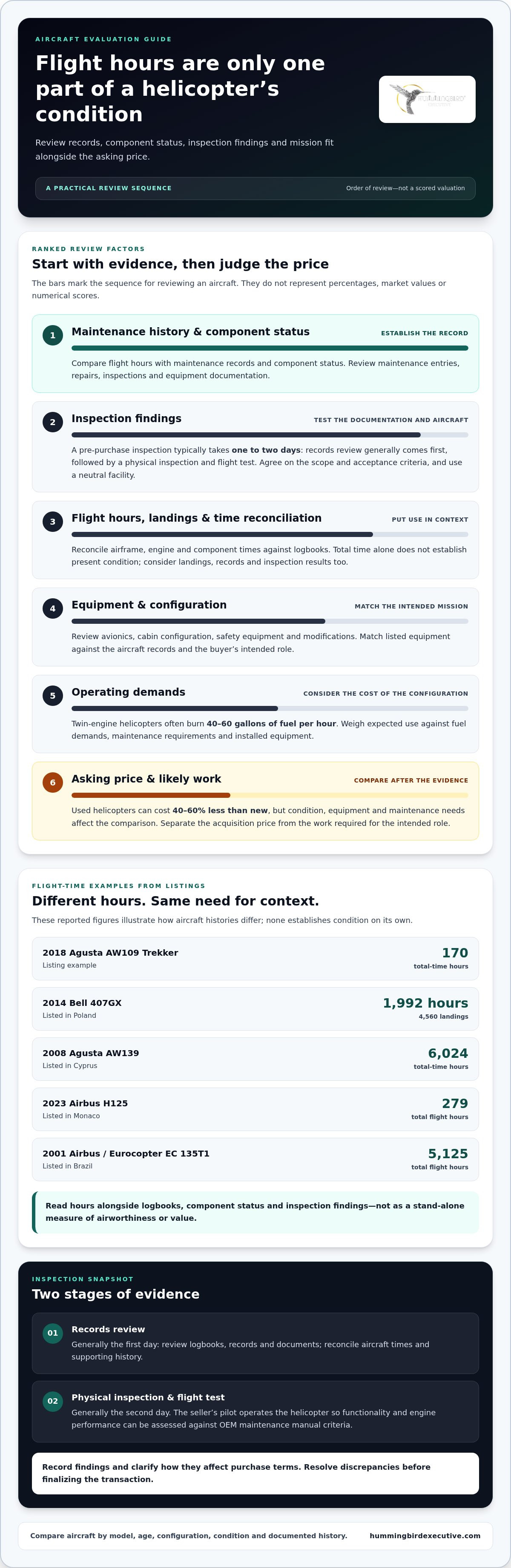
Flight hours help describe an aircraft’s use, but do not establish its condition on their own. Compare total time with maintenance records, component status, landings, installed equipment, and the model’s operating history.
Listings illustrate how widely aircraft histories can differ. A 2018 Agusta AW109 Trekker reported 170 total-time hours. A 2014 Bell 407GX listed in Poland reported 1,992 hours and 4,560 landings. A 2008 Agusta AW139 listed in Cyprus reported 6,024 total-time hours. These figures become meaningful when read alongside the aircraft’s records and maintenance status.
Equipment affects how well a helicopter suits its intended role. Review the listed avionics, cabin configuration, safety equipment, and modifications, then match each item against the aircraft records and intended mission. The same model can present a different ownership proposition depending on its equipment and maintenance history.
In the United States, the Federal Aviation Administration requires a minimum of 40 flight hours to obtain a Private Pilot Certificate for helicopters. That licensing requirement concerns pilot qualification, not the aircraft’s airworthiness or the buyer’s operating needs. A prospective owner should distinguish the pilot’s credentials from the aircraft’s condition and intended use.
A pre-purchase inspection typically takes one to two days. The first day is generally spent reviewing logbooks, records, and documents; the second is generally used for a physical inspection and flight test. During the test, the seller’s pilot operates the helicopter so its functionality and engine performance can be assessed against OEM maintenance manual criteria. Agree on the inspection scope and acceptance criteria, and use a neutral facility.
Cost per flight hour adds another dimension to the decision. Twin-engine helicopters often burn 40-60 gallons of fuel per hour, so engine configuration affects operating economics. Compare the aircraft’s expected use with its fuel demands, maintenance requirements and installed equipment before settling on a particular configuration.
Before proceeding, organize the review around specific records and findings:
- Reconcile airframe, engine and component times against logbooks.
- Review maintenance entries, repairs, inspections and equipment documentation.
- Record inspection findings and clarify how they affect the purchase terms.
This process helps distinguish an appealing listing from a well-supported acquisition decision. Consider the flight test and records review together, and resolve discrepancies before finalizing the transaction.
Listings also show why hours need context: a 2023 Airbus H125 helicopter listed for sale in Monaco had 279 total flight hours, while a 2001 Airbus/Eurocopter EC 135T1 helicopter listed for sale in Brazil had 5125 total flight hours. Neither figure alone establishes present condition; connect it to records, component status and inspection findings.
A typical helicopter pre-purchase inspection uses one day to review and assess logbooks, records, and documents, followed generally by a second day for a physical inspection and flight test. Include potential work in the ownership assessment, and clarify which findings or upgrades are reflected in the asking terms.
Listing evaluation and pre-purchase inspections
Listings are a starting point, but location, seller type, and documentation determine what can be established before inspection. Compare the aircraft’s description with its records and the practical requirements of completing a domestic or international transaction.
Evaluating Listings and Available Inventory
Review listings from private sellers and brokers using the same criteria: model, year, location, configuration, flight hours, equipment, and maintenance history. A broker may coordinate the presentation and transaction steps, while a private seller deals directly with the buyer. In either case, require clear, consistent aircraft information. Note each helicopter’s location and whether the listing describes its current condition.
Listings illustrate how widely the market is distributed. These examples help frame international searches, but do not establish comparable values.
A seller can offer a helicopter through aviation marketplaces, specialist aircraft publications, or a broker’s sales network. Choose an approach that reaches the intended buyer profile and supports an accurate presentation of the specifications, location, and records.
Inspections and Maintenance Records
Organize the airframe, engine, and component logbooks, maintenance entries, inspection history, repair records, and equipment documentation. Records should let a prospective buyer trace the aircraft’s operating history and compare listed flight hours with recorded entries. Include relevant avionics details and modification records so the physical inspection can assess the aircraft against its documented configuration.
Arrange a pre-purchase inspection with an agreed scope and acceptance criteria at a neutral facility. It can combine document review, physical examination, and a flight test with the seller’s pilot. Record the findings clearly, including discrepancies that may affect the transaction terms.
In a private sale, the seller manages direct negotiations and document coordination; a broker or dealer may assist with presentation and transaction facilitation. Describe known defects accurately, set out representations and responsibilities in the written agreement, and understand how insurance coverage applies during operation, storage, and handover. Liability depends on the facts, contract terms, and applicable law, so precise disclosure and clearly defined transfer arrangements matter.
For location-based screening, record the aircraft’s country, current registration details, seller identity, and inspection location. International listings may require additional logistics and document coordination. For example, an aircraft in China or South Africa requires planning around its location before inspection and transfer can proceed.
New and used helicopters for sale
New and pre-owned listings suit different acquisition priorities. Compare the asking price with the aircraft’s age, configuration, equipment, condition, and intended role rather than treating “new” or “used” as a complete measure of value.
That spread reflects different aircraft categories, not a like-for-like comparison. Buyers considering a piston model should assess its capacity and mission against turbine alternatives. For a twin-turbine or offshore aircraft, the intended role and configuration are central to determining whether its scale and price are appropriate.
Pre-owned examples show how age and model influence asking prices. These aircraft represent different models and configurations, so their figures are not direct substitutes for one another.
Read the listing as a specification, not simply a price tag. Note the model year, engine type, total-time hours, equipment and stated maintenance status. A 2020 Bell 407GXi listing, for example, reported five total-time hours. Low hours offer one data point; they don’t replace review of records, equipment and aircraft condition.
Warranty terms can also distinguish individual listings. A 2026 Bell 407 GXI listing includes a factory warranty of 1,000 hours or three years, through October 2029. Compare those stated terms with the aircraft’s age, operating history and your intended use. The listing’s specific coverage matters more than assuming every new or nearly new aircraft carries identical terms.
For a practical comparison, create a shortlist with separate columns for new and pre-owned candidates. Record the price, model, engine configuration, location, hours, equipment, and any stated warranty. Identify which differences affect the mission directly, such as passenger capacity or equipment requirements. This keeps the comparison grounded in verifiable listing details and prevents a lower advertised price from obscuring an aircraft’s suitability.
The clearest takeaway is to compare aircraft by category and configuration first, then examine each listing’s records and terms. A new piston helicopter and a pre-owned turbine model may occupy very different price tiers, but the right choice depends on the intended use and the specific aircraft.
How do you sell a helicopter privately in the United States?
A private sale of a helicopter works best as a documented process: prepare the aircraft file, set an evidence-based asking price, present the listing accurately, and record the agreed terms. In the United States, keep the aircraft’s identity, ownership records, and maintenance history aligned throughout the transaction.
Begin with a complete sale file. Assemble ownership and registration records, airframe and engine logbooks, maintenance entries, inspection history, equipment details, and repair or modification records. Keep the model, serial number, total time, and current configuration consistent across the documents and listing. Clear records help prospective buyers compare the description with the aircraft.
Set an asking price using comparable aircraft, not a broad category alone. Compare the same model and engine configuration, then account for age, equipment, condition, location, and documented maintenance. For example, a turbine helicopter and a piston model serve different missions, so their asking prices are not direct comparisons. Keep the reasoning behind your asking price available for buyer discussions.
Prepare a concise listing that states the aircraft’s location, model, configuration, flight hours, and equipment. Describe its condition accurately and distinguish installed features from optional or planned work. Use clear photographs and organized records to support the description. A private listing can reach prospective buyers directly, while a broker or dealer may help present the aircraft and coordinate transaction discussions.
Once a buyer expresses serious interest, agree on the evaluation process and the transaction sequence before moving toward final terms. Specify who coordinates the inspection, how findings are recorded, and how the parties will handle any changes to the agreement. Keep communications and revisions organized. A helicopter purchase agreement typically ranges from 8 to 50 pages, reflecting the aircraft details, representations, conditions and handover terms that may need careful treatment.
Before signing, make the written agreement clear about the aircraft being sold, agreed price, included equipment, payment arrangements, responsibilities, and delivery conditions. Define when possession and operational responsibilities change hands. Do not rely on informal messages for material terms; a signed agreement gives both sides a clear record of what they accepted.
At handover, assemble the agreed records and equipment, document the aircraft’s condition, and record the delivery date and terms. Coordinate the ownership and registration documents as part of the transfer. Keep copies of the signed agreement and exchanged records. For a cross-border buyer, account for the aircraft’s location and transport arrangements before finalizing the handover.
A measured sale brings clarity to each stage. A well-prepared file, precise listing, and carefully drafted agreement help buyers assess the helicopter and understand the transaction before committing.
Hummingbird Executive: platinum Membership full access to rare assets ,investments, buy surch or sale plus 25/7 dedicated concierge services world wide at no extra charge,
Hummingbird Executive offers a discreet route when a helicopter purchase or sale forms part of a wider search for rare assets and investments. Platinum Membership provides full access to rare assets and investments to buy or sell, with dedicated concierge services worldwide at no extra charge.
For members seeking white-glove assistance, Gold Membership offers service seven days a week during business hours. Free access to white-glove service is also available worldwide during standard operating hours. These options provide different levels of access as you consider an aircraft transaction alongside other opportunities.
If a curated route to rare assets would be useful, contact Hummingbird Executive to discuss membership.
Set the Mandate for Your Next Move
Before committing to a particular listing, define what the aircraft must enable. Clarify the mission, preferred configuration, acceptable condition, and boundaries of the transaction. A clear mandate keeps the decision anchored to practical priorities, even when attractive alternatives emerge.
For a private sale of a helicopter, this discipline helps align everyone involved around the same expectations. Buyers and sellers can address material questions earlier, keep negotiations focused, and maintain a clear record of the terms under discussion. Discretion works best when paired with precision.
If your search or sale forms part of a wider pursuit of rare assets, Hummingbird Executive offers a discreet point of engagement. Platinum Membership provides access to rare assets and investments to buy or sell, alongside dedicated concierge services worldwide at no extra charge.
Contact Hummingbird Executive to discuss your next step. A considered beginning can bring clarity to the decisions ahead.
Frequently Asked Questions
How do you determine the market value and asking price of a used helicopter?
Estimate value by comparing closely matched aircraft, then account for differences that affect buyer demand. Prioritize the same model and engine configuration, and distinguish advertised asking prices from documented completed transactions where available. Consider location, equipment, maintenance status, component life, and inspection findings. For example, two aircraft of the same model may warrant different asking prices if their configurations differ materially or one has upcoming maintenance needs.
How do FAA aircraft registration and title transfer work when selling a helicopter?
Prepare ownership and registration records, maintenance and airworthiness records, and a written purchase agreement or bill of sale. The transaction file should identify the aircraft and record the terms agreed by buyer and seller.
What legal liabilities and insurance issues should helicopter sellers consider?
Check insurance coverage if the helicopter will be shipped, as most aircraft insurance policies do not cover ground, sea, or air freight. Seller liability depends on the facts, contract terms, and applicable law.