The rarest opportunity may be a place in production, not a car already built. Access to pre-production supercars can mean pursuing a limited-edition build slot before delivery, which is different from acquiring an automaker’s development or pilot vehicle. Such cars may be displayed at events, retained for testing, or scrapped.
That distinction matters. A private offer may concern a future allocation rather than a finished car, with separate considerations around the slot and the vehicle’s specification.
This article explains how private supercar opportunities work, what a build-slot offer involves, and why acquiring a true pre-production vehicle is a different proposition. It also covers confidentiality and acquisition support, helping you assess which route fits your objective.
Key Takeaways
- Distinguish a build slot from an automaker’s pre-production vehicle: one is an opportunity to acquire a future car, while the other may remain under manufacturer control.
- Private deal flow can begin with a selected group of buyers before a car or allocation is offered publicly.
- Public viewing and test access depend on the vehicle’s purpose; some are displayed, while others are used for development or scrapped.
- In the United States, vehicles at or under 6,000 pounds fall under Internal Revenue Service luxury-auto limits.
- Hummingbird Executive’s platinum Membership provides full access to rare assets and investments for buying or selling, with 25/7 dedicated concierge services worldwide at no extra charge.
How private supercar deal flow works
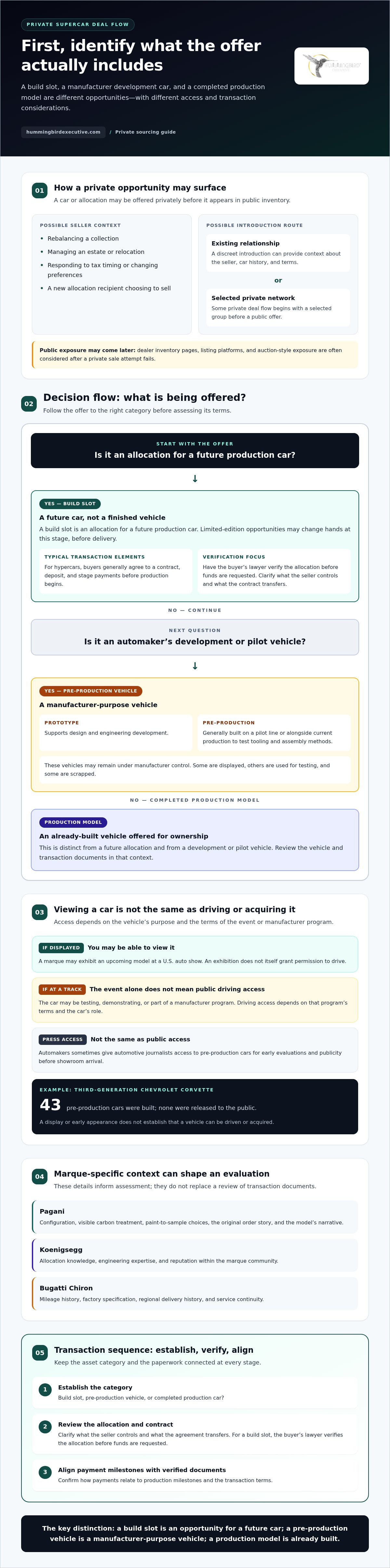
Private opportunities may arise before a car is offered for sale. An owner could be rebalancing a collection, managing an estate or relocation, responding to tax timing, or changing preferences. A new allocation may also become available when its recipient chooses to sell. The opportunity may be introduced through an existing relationship or a selected private network.
That sequence matters. Public dealer inventory pages, listing platforms, and auction-style exposure are often considered only after a private sale attempt fails. Buyers may therefore encounter an opportunity through an existing relationship rather than a searchable listing. A discreet introduction can provide context about the seller’s reason for selling, the car’s history, and the terms under consideration. Those details help distinguish a substantive offer from an incomplete lead.
A build slot is not the same as an automaker’s prototype or pre-production vehicle. A prototype supports design and engineering development; a pre-production car is generally built on a pilot line or alongside current production to test tooling and assembly methods. A build slot is an allocation for a future production car, while a production model is an already-built vehicle offered for ownership.
Limited-edition opportunities may change hands at the build-slot stage, before delivery. Buyers of hypercars generally agree to a contract, deposit, and stage payments before production begins. The sequence makes allocation verification central to the transaction. A prudent structure uses a specialist that handles build-slot sales on a lawyer-to-lawyer basis, with the buyer’s lawyer verifying the allocation before funds are requested. That review should clarify what the seller controls, what the contract transfers, and how payments relate to production milestones.
Marque-specific knowledge can shape an evaluation. A Pagani negotiation may consider configuration, visible carbon treatment, paint-to-sample choices, the original order story, and the model’s narrative. Koenigsegg transactions can depend on allocation knowledge, engineering expertise, and reputation within the marque community. For a privately traded Bugatti Chiron, mileage history, factory specification, regional delivery history, and service continuity can inform assessment. These considerations do not replace a review of the transaction documents.
U.S. auto shows may offer a chance to view an upcoming model when a marque exhibits it. Track events provide access only when the manufacturer’s program includes the vehicle. An exhibition does not itself grant permission to drive. Driving access is separate from viewing and depends on the program’s terms and the car’s role. Automakers sometimes give automotive journalists access to pre-production cars for early evaluations and publicity before showroom arrival.
Tax treatment is a separate question from sourcing or ownership. According to the Internal Revenue Service, vehicles at or under 6,000 pounds fall under United States IRS luxury-auto limits. The Internal Revenue Service states that the 2026 Section 179 sport-utility-vehicle cap is $32,000. These rules do not establish whether a particular private deal is suitable; they frame separate tax considerations for eligible vehicles and buyers.
For an acquisition, follow a clear sequence: establish whether the offer concerns a build slot, a pre-production vehicle, or a completed car; review the allocation and contract; then align payment milestones with verified transaction documents. This distinction is the foundation of informed private sourcing.
Can the public drive or view pre-production supercars at events or dealerships?
Sometimes the public can view a pre-production car at an auto show. Driving access is separate. An exhibition places a vehicle before visitors but does not mean it is available for test drives. This distinction is especially important when a vehicle remains part of development rather than being prepared for customer use.
Automakers use pre-production cars for purposes that can limit public access. Some are exhibited; others undergo crash testing or are scrapped. Chevrolet built 43 pre-production third-generation Corvettes, and none were released to the public. That example shows why seeing a prototype or early-build model on display doesn’t mean a similar vehicle can be driven or acquired.
At an auto show, first identify what the display represents. A concept, prototype, pre-production car, and production model are not interchangeable categories. The vehicle’s label and presentation may explain its role, but an upcoming design alone does not establish its production status. Seeing the car in person offers a chance to observe it, not proof of access beyond the display.
A dealership visit calls for the same distinction. A showroom vehicle may be a production model displayed before broad customer deliveries, while a development car serves a different purpose. The make, model, and display context help identify what is being shown. Treating every early appearance as a pre-production vehicle can cause confusion about whether it is a development unit, show car, or retail vehicle.
Track events also separate observation from driving. A car at a circuit may be participating in testing, a demonstration, or a manufacturer program. That setting alone does not indicate that public participants can drive it. Automakers sometimes give automotive journalists access to pre-production cars for early model experiences and publicity before dealer showroom arrivals. Press access is distinct from public driving access.
For a specific event, assess access in stages: determine whether the car is identified as pre-production, establish whether the public can view it, then distinguish viewing from any driving activity. An advertised appearance may concern the vehicle alone, while driving participation belongs to a separate program. A viewing opportunity does not imply a drive.
For example, Chevrolet’s 43 third-generation pre-production Corvettes illustrate a clear limit: the cars existed, yet none entered public hands. A show display can offer a rare close view, but it doesn’t change the vehicle’s status or intended use. Similarly, a car on a track may be visible from an audience area without being part of a public driving session.
For collectors, the practical conclusion is straightforward. Public events can offer a glimpse of selected pre-production vehicles, but the vehicle’s purpose determines what access means. Viewing, journalist evaluation, and public driving are distinct. The Chevrolet example makes the boundary concrete: a display may be possible, but exhibition alone does not assure release to the public.
The public may sometimes view pre-production cars at auto shows, while track appearances may involve testing or demonstrations. Automaker programs can give journalists early access, but neither those appearances nor programs establish public driving access.
Some pre-production cars are exhibited at auto shows, while others may be destroyed in crash tests or scrapped. That range of outcomes underscores that a development vehicle’s presence is not assured beyond a particular display: an opportunity to see one does not establish that it will later be available for public viewing or driving.
What qualifications or credentials are required to test pre-production supercars?
The phrase “test drive” can refer to different things. An automaker’s engineering evaluation, an automotive press drive, and a public demonstration serve different purposes. For a prospective buyer, interest in acquiring a vehicle is not the same as authorization to test a development car. Start by identifying the purpose: engineering, journalism, or customer access.
Engineering evaluation is tied to the vehicle’s development work. Automakers use pre-production cars to assess tooling and assembly methods, while automotive hardware maturity progresses from A samples for initial evaluations through D samples representing pilot production and confirming production flow rate. These stages describe engineering purposes, not an open invitation to outside drivers. Testing follows the manufacturer’s development program.
Training can also take place before a vehicle’s assembly. Automakers may use pre-production cars to train foremen and supervisors as much as ten months before pilot assembly of new cars. This is a workplace function: staff prepare for production processes rather than receiving access as members of the public. Engineering experience is relevant when the task involves evaluating a system or reporting technical observations.
Automotive journalists form a distinct group. Automakers sometimes provide the press with pre-production cars so journalists can experience models and create publicity before showroom arrival. The relevant qualification is a professional press role within an automaker’s media program, not simply ownership of a comparable supercar. Press access is different from engineering sign-off or a retail test drive.
A buyer considering a limited-edition model should distinguish three permissions before treating a drive as part of an acquisition:
- Viewing: permission to see a vehicle at an event or display.
- Driving: specific authorization to operate that vehicle in a defined setting.
- Evaluation: a role in assessing engineering, production readiness, or press performance.
These permissions serve different purposes. An invitation to view a car does not itself grant driving access, and an allocation does not turn a development vehicle into a customer test car.
For a private collector, credentials are best understood as transaction context, not a universal license. The seller’s authority over the car, its development status, and the stated purpose of access all shape what can be arranged. A build slot concerns a future production vehicle; testing a pre-production unit concerns a car used before normal customer delivery. The distinction affects what the buyer is actually being offered.
Frame the request precisely. Identify whether the objective is a technical assessment, press experience, event viewing, or consideration of a production allocation. The manufacturer controls access to its development vehicles; a journalist’s invitation or an engineering assignment does not transfer ownership rights. Clear terminology keeps “test,” “view,” and “acquire” distinct.
The most credible qualification is the one that matches the purpose. Engineers evaluate development work, journalists experience models for coverage, and prospective buyers pursue acquisitions through the relevant sale or allocation process. A pre-production supercar is not automatically a customer demonstrator. The vehicle’s development role determines the nature of access.
Automakers may use a specialized small facility and hand assembly to test new tooling and vehicle assembly methods. The AMC Pacer was designed to meet crash speeds higher than those required by final U.S. regulations for the 1975 model year. These examples concern development and testing practices; they do not establish a general credential for an outside driver.
Tax treatment is separate from permission to drive a development car. In the United States, business use of a vehicle must exceed 50 percent in the year it is placed in service and in every year of its recovery period to meet the stated business-use test. For a car, the United States IRS Section 280F weight test uses unloaded gross vehicle weight, described as roughly curb weight. The Internal Revenue Service states that 100% bonus depreciation under Section 168(k) was restored permanently for qualifying property acquired after 19 January 2025. If business use falls below the required level in a later recovery-period year, the taxpayer switches to straight-line depreciation and recaptures the excess as ordinary income. These rules concern vehicle use and depreciation, not driving qualifications.
What rules, NDAs, and confidentiality restrictions apply to pre-production car access
Access to an automaker’s pre-production car may involve confidentiality terms because the vehicle can reveal details before showroom arrival. An agreement can define what a visitor may see, photograph, discuss, or share. Restrictions depend on the access arrangement. A press drive, engineering evaluation, and private viewing can each have a different purpose and set of permissions.
Automotive journalists may receive pre-production cars to experience models and create publicity before they reach dealer showrooms. Publication terms are therefore especially relevant. An agreement or media instruction can set boundaries around photography, technical descriptions, publication timing, and driving impressions. Journalists should distinguish information cleared for publication from material identified as confidential.
For a private viewing, distinguish seeing a vehicle from documenting it. A host may restrict photography, recording, passenger access, or discussion of identifying details. Images, for example, can reveal a car’s interior, bodywork, prototype components, or location. Clarifying permitted activities before entering the viewing space helps avoid treating an invitation as unrestricted access.
Written terms are most useful when they identify the protected information and permitted audience. A confidentiality document can address:
- Scope: whether restrictions cover the vehicle, its engineering, specifications, images, location, or related conversations.
- Permitted use: whether information may be used for reporting, evaluation, or another stated purpose.
- Disclosure: which people, if any, may receive information or materials.
- Media: whether photographs, recordings, notes, or public posts are allowed.
- Materials: how documents, images, or other supplied items must be handled after access.
These points matter because a pre-production vehicle can contain visible engineering choices that differ from a production model. A photograph of a prototype component, for instance, may disclose more than a general description of the car. The agreement should clarify whether that material is restricted and how the restriction applies to later discussion. Precise language is more useful than assumptions made during a brief visit.
Build-slot transactions create a separate confidentiality context. A buyer may receive information about an allocation, contract, or seller before a finished car exists. Confidentiality around those materials does not establish that the seller controls the allocation. Transaction review should distinguish privacy obligations from verification of the underlying rights and documents. A non-disclosure agreement alone is not evidence of ownership or authority to transfer a slot.
Before signing, identify the parties, covered materials, permitted disclosures, and stated purpose. Read the complete document, including definitions and any provisions governing duration or permitted recipients. If an attorney is already reviewing the acquisition, that review can address how the confidentiality terms interact with the purchase documents. Keep a copy of the signed version and follow its handling instructions for any materials received.
Discretion works best when expectations are specific. Understanding whether you may photograph, publish, or share information helps you distinguish private access from unrestricted use. For collectors pursuing a rare vehicle, separating confidentiality terms, viewing permissions, and acquisition rights keeps the process clear.
Hummingbird Executive: platinum Membership full access to rare assets, investments, buy, search, or sale plus 24/7 dedicated concierge services worldwide at no extra charge
Hummingbird Executive provides a private route for pursuing rare assets and investment opportunities when a discreet sourcing and transaction framework is relevant. Its platinum Membership offers full access to rare assets and investments for buying or selling, alongside 24/7 dedicated concierge services worldwide at no extra charge.
For collectors considering a pre-production vehicle, this membership can support broader private deal-flow needs, while access to a specific car depends on the opportunity and its terms. Gold Membership offers white-glove services seven days a week during opening hours. Free access to white-glove service is also available worldwide during opening hours.
For a considered discussion of private sourcing and rare-asset transactions, visit Hummingbird Executive.
Set Your Acquisition Mandate With Precision
The next step is to define what access means in practical terms. Is your priority a future build slot, a completed production car, or a legitimate opportunity to view a development vehicle? That distinction gives a private search a clearer mandate and helps align expectations with the seller’s authority, the car’s purpose, and the confidentiality terms involved.
For access to pre-production supercars, precision matters more than broad interest. Identify the marque or model, the nature of the opportunity, and the level of discretion required. A focused brief can help assess relevant private opportunities and determine whether the route suits your acquisition objectives.
Hummingbird Executive can be a discreet point of engagement for a broader search across rare assets and investments. When you are ready to discuss your objectives, contact Hummingbird Executive. Begin with a considered mandate, and let the next step follow from it.
Frequently Asked Questions
What does access to pre-production supercars mean?
Access to pre-production supercars means an opportunity to see, evaluate, or pursue a vehicle before regular customer delivery, with the specific opportunity defined by its purpose. An invitation, for example, may cover viewing a development car, while a private offer may concern a future build allocation. Before treating an offer as an acquisition, identify the vehicle or allocation, the rights being offered, and who has authority to offer them.