A classic-car portfolio should begin with discernment, not a shopping list. To understand how to build a classic car portfolio, define what qualifies for your collection, set a realistic ownership budget, and select cars you genuinely want to live with. Classic cars are typically at least 20 years old, but age alone doesn’t make a vehicle the right addition.
The appeal is clear: a carefully chosen car can carry history, design and personal meaning. Yet collecting brings ongoing responsibilities, from maintenance and storage to insurance and restoration. Include those costs in every purchase decision so you can compare candidates by more than their asking price.
This guide explains how to weigh ownership costs against your preferences, assess expert support and compare individual purchases with broader portfolio choices. Enjoyment matters, too: classic-car collecting is not a dependable route to quick profit, so your strategy should make sense even when market outcomes vary. Aim for a collection shaped by clear criteria, informed choices and enduring interest.
Key Takeaways
- Build a full ownership budget that accounts for maintenance, restoration, insurance and storage, not just the purchase price.
- Use a qualified appraiser’s perspective to assess condition, originality, provenance and potential issues before acquisition.
- Prioritise cars you genuinely enjoy, and research each candidate carefully rather than buying on impulse or expecting quick profit.
- Compare age-based labels thoughtfully: “classic,” “modern classic” and “antique” can refer to different age ranges.
- Shape the collection around a clear rationale, considering each car’s history, rarity, condition and role in the wider portfolio.
Maintenance, restoration, insurance, and storage costs
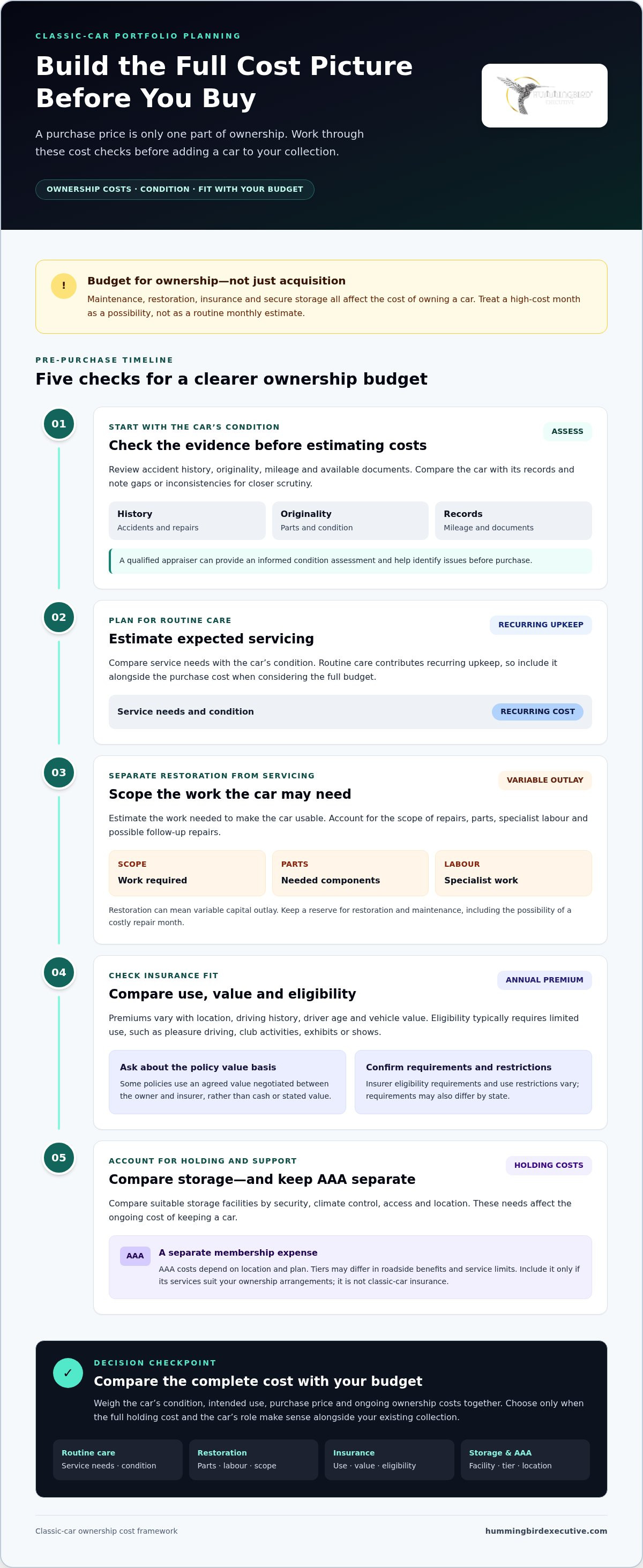
A portfolio budget must cover more than acquisition costs. Maintenance, restoration, insurance and secure storage all affect the cost of owning a car. Treat a high-cost month as a possibility, not a routine monthly estimate.
Before buying, distinguish expected servicing from restoration work. Review accident history, originality, mileage and available documents to identify possible condition issues and assess value. Estimate the work needed to make the car usable, including parts, specialist labour and follow-up repairs. Include storage in your budget, comparing suitable facilities by security, climate control, access and location.
AAA membership costs depend on location and plan. Tiers may differ in roadside benefits and service limits, so compare the level with your intended use. AAA is a separate membership expense, not classic-car insurance; include it only if its services suit your ownership arrangements.
Premiums vary with location, driving history, driver age and vehicle value. Eligibility typically requires limited use, such as pleasure driving, club activities, exhibits or shows. Insurers may also have different eligibility requirements, including by state. Some policies use an agreed value negotiated between the owner and insurer rather than cash or stated value.
Which classic cars have the strongest investment potential? Rarity, history, original parts, mileage, documentation and accident history can influence value. Compare these attributes carefully; no make or model guarantees a particular outcome.
What insurance and registration rules apply to classic cars in the United States? Insurance eligibility and use restrictions vary among insurers and may vary by state. Registration requirements also depend on the state, so distinguish a registration classification from an insurer’s limited-use conditions.
How do I set investment goals and a budget for classic cars? Decide whether enjoyment, preservation or potential resale matters most, then budget for purchase and ongoing ownership. Keep a reserve for restoration and maintenance, including the possibility of a costly repair month.
How should I diversify by make, model, year, and price? Compare cars across different makes, models and production years, and set acquisition limits that fit your total budget. Add another car only when its ownership costs and role make sense alongside your existing holdings.
What are the risks, taxes, and selling costs? Unexpected condition issues, restoration needs, storage and insurance can reduce net proceeds. Taxes and transaction costs depend on the sale and applicable circumstances, so include them in your exit calculation.
| Cost option | What to compare | Portfolio effect |
|---|---|---|
| Routine care | Service needs and condition | Recurring upkeep |
| Restoration | Parts, labour, and scope | Variable capital outlay |
| Insurance | Use, value, and eligibility | Annual premium |
| Storage and AAA | Facility needs; membership tier and location | Holding and support costs |
Choose a car only after comparing its condition, intended use and full holding costs with your budget.
Appraisers and vehicle managers
A qualified appraiser or consultant can help identify issues early and provide an informed assessment before purchase. Share the car’s records, known repair history and available original documents. Ask for written findings on condition concerns, evidence of repairs and details affecting originality. A specialist review complements your research; it does not replace a careful review of the car’s history.
What inspections and history checks should I do before buying a classic car? Have a qualified professional inspect the vehicle and review its accident history, mileage, original parts and documents. Compare the car with its records, noting any gaps or inconsistencies for closer scrutiny.
Break the inspection into practical areas. A mechanical review considers how the engine, transmission, brakes and other major systems operate. A body and chassis review looks for visible evidence of repairs, corrosion and previous damage. A records review compares invoices and ownership documents with the vehicle’s claimed history. For example, a mismatch between documented repairs and visible replacement parts merits closer appraisal.
- Before purchase: Request an independent condition assessment and assemble the car’s service and ownership records.
- At acquisition: Record the purchase price, appraisal findings, mileage, and immediate work required.
- During ownership: Keep invoices, restoration notes, photographs, and storage records together for future reference.
A vehicle manager can coordinate practical ownership tasks, such as maintaining a service calendar, arranging access for inspections and keeping records current. Set responsibilities clearly. For example, the owner may approve restoration work while a manager tracks appointments and collects invoices. Clear records help you understand the car’s condition and prepare a complete account for a future buyer.
Track each car separately, then review the collection as a whole. A simple ledger can record acquisition cost, maintenance, restoration, insurance, storage, appraisal notes and sale proceeds. Keep market estimates separate from realised sale prices: an estimate is not cash received. This overview helps reveal which cars require sustained investment and which remain aligned with your collecting objectives.
How can I track classic car portfolio performance and decide when to sell? Keep a separate ownership ledger for every vehicle, including purchase, upkeep, restoration and sale figures. Reassess each car against its condition, documented history, ownership costs and your reason for holding it. Consider selling when it no longer fits your goals.
An updated appraisal can support a sale decision when a car’s condition or documentation changes. Consider it alongside your ledger and reasons for holding the car. Base the decision on the vehicle itself, not a single optimistic valuation.
Keep a record for each car, bringing together costs, condition notes and sale proceeds so you can review performance against your objectives. Include insurance costs when assessing ongoing commitments. Classic-car insurance usually costs less than regular car insurance because classic cars are driven less than vehicles used for commuting or errands. Consider this alongside each car’s other recorded expenses.
Buying cars you enjoy
A classic car portfolio is more rewarding when each addition reflects genuine interest. Choose for design, engineering, history or the experience of driving, rather than an assumed resale gain. Collecting is not a dependable route to quick profit. A car you value for its character can remain meaningful when market attention shifts, giving you a reason to hold it beyond short-term expectations.
Begin with a written brief for each candidate. Note what attracts you, how you intend to use the car and which compromises you will accept. The question of how to build a classic car portfolio is easier to answer when your preferences are explicit. For example, a buyer drawn to a marque’s design may prefer a well-documented example over a rarer car that inspires less interest.
- Record your interest: Identify the design, engineering, history, or driving experience that makes the car meaningful.
- Research before viewing: Compare its make, model, year, condition, mileage, and available original documents.
- Seek informed perspectives: Ask previous owners and collector or enthusiast networks about ownership experience.
- Set a decision rule: Walk away if the car’s appeal depends mainly on a quick resale.
Research turns enthusiasm into a considered choice. Read the available history and compare examples of the same make and model. Note how originality and mileage inform your assessment. Collector networks can reveal recurring ownership concerns, while a previous owner may explain repairs or use patterns absent from a listing. Compare these accounts with the vehicle’s records before forming a view.
Keep investment expectations measured. Classic cars were characterized as one of the best-performing alternative investments over the previous 15 years, outpacing stock and bond markets and real estate. That historical comparison isn’t a forecast for a particular car. Treat it as context, not a substitute for research or a reason to buy a vehicle you don’t enjoy.
Acquire more than one car only if you can afford it and want to collect for potential returns. Each addition should serve a clear purpose, such as representing another marque, period or personal interest. Compare candidates by history and condition rather than chasing a larger collection. A practical answer to how to build a classic car portfolio should reflect both your interests and the responsibilities each vehicle brings.
Before committing, revisit your brief after reviewing the car and speaking with knowledgeable owners. Ask whether you would still want it without anticipated appreciation. If yes, and the vehicle fits your means and collecting goals, the decision rests on more than speculation. This balance keeps personal enjoyment central while supporting disciplined choices.
Defining a classic car
Age offers a useful starting point, but it doesn’t settle every classification. Classic cars are typically at least 20 years old. Modern classic cars should be at least 15 years old, while antique cars are generally over 45 years old. These descriptions can overlap, so identify the category you mean before comparing vehicles or setting portfolio criteria.
A broader description places a classic car at 15 to 25 years old, with distinctive qualities that make it interesting to collect. That range includes vehicles younger than the typical 20-year threshold. The difference reflects how the term is used, rather than a single definition that neatly sorts every car. A 20-year-old vehicle, for example, fits the typical classic age description and the broader age range.
Use age as a screening tool, not a verdict on collectability. A vehicle can meet a classic-car age description without being distinctive or personally compelling. Consider its design, history, originality, and place in your collecting rationale. A 15-year-old modern classic may appeal for its character, while a vehicle over 45 years old may fit the antique description. Neither label alone establishes value.
- At least 15 years old: A possible modern classic under the stated age description.
- 15 to 25 years old: A broader classic-car range when distinctive qualities attract collectors.
- At least 20 years old: The typical age threshold for a classic car.
- Over 45 years old: The general age description for an antique car.
For portfolio planning, choose a consistent working definition and apply it to every candidate. Record the vehicle’s year, the category you’re using, and the distinctive quality that supports its place in the collection. This makes comparisons clearer when one candidate is 18 years old and another is 30. It also prevents an age label from substituting for research into the individual car.
Keep the language precise in acquisition notes. Describe a car as a “modern classic” when using that age description, or as an “antique” when it is over 45 years old. If you use “classic” broadly, state the 15-to-25-year range and the qualities that make the car collectible. Clear terms help you assess whether each addition fits your intended portfolio.
The best definition for your collection is one you apply consistently, while recognising that the stated age ranges overlap. A disciplined classification gives you a common basis for comparing candidates, but the vehicle’s history, condition and distinctive appeal still determine whether it belongs in your portfolio.
What should a classic car portfolio include?
A coherent portfolio needs a rationale for every vehicle, not a checklist of fashionable models. Decide what you want the collection to represent: a marque, a design period, an engineering style or cars connected to personal history. Nostalgia affects the classic-car market, so a vehicle’s cultural or personal associations may matter alongside its condition and rarity.
Build variety deliberately. Compare make, model and year, then consider whether each candidate adds a distinct perspective or duplicates an existing holding. Research how many examples of a particular make, model and year exist when assessing rarity. A scarce specification may broaden the collection’s character, but rarity alone does not establish suitability. Its history, documentation and role in your collecting rationale still matter.
Think in terms of portfolio roles. One car might express a marque’s design language; another could represent a different period or engineering approach. A third might have a history that carries particular meaning for you. These are selection lenses, not prescribed categories. They help explain why each addition belongs and reveal gaps without buying a car merely to complete a set.
| Portfolio approach | Structure | Key consideration |
|---|---|---|
| Individual ownership | You acquire and hold each car directly | Control and direct responsibility for each vehicle |
| Partnership | Ownership is shared among participants | Shared decisions and an agreed ownership arrangement |
| Fund structure | Exposure is held through a fund | Understand the structure and its potential liquidity |
Cars can be acquired individually or through partnership or fund structures that may provide some liquidity. These approaches differ in ownership, decision-making and how an interest might be realised. Compare the structure before committing: direct ownership gives you the vehicle itself, while shared arrangements divide participation. Liquidity is a possible feature, not a substitute for understanding the terms.
Keep a portfolio register recording each car’s make, model, year, history, rarity rationale, ownership structure and intended role. Add acquisition records and current condition notes, then review the collection as a whole whenever you consider another purchase. This process shows whether a candidate adds a new dimension or concentrates the collection further in one area.
A strong portfolio can be compact or extensive; dedicated investors are known to hold collections of upwards of 300 cars. That scale isn’t a target. Choose a structure and number of vehicles that fit your collecting purpose, available resources, and appetite for direct ownership. The decision guide is straightforward: add a car when its distinct qualities strengthen the collection’s rationale, not merely its size.
Scale the collection to suit your aims, but do not let size replace selection discipline. Keep the rationale for each car visible in the register, and revisit it when condition, history or the collection’s direction changes. Since nostalgia affects the classic-car market, history can explain an attachment, but it does not remove the need to assess how a vehicle fits the whole. Before adding another holding, compare its role with those already represented and consider whether it contributes a genuinely different perspective. If not, patience may preserve a more coherent collection than another acquisition.
Hummingbird Executive: platinum Membership full access to rare assets ,investments, buy surch or sale plus 25/7 dedicated concierge services world wide at no extra charge,
Hummingbird Executive is a natural next step when your collecting plan moves from evaluation to sourcing or selling a rare asset. Platinum Membership provides full access to rare assets and investments to search, buy, or sell, plus 24/7 dedicated concierge services worldwide at no extra charge. For a collector weighing a classic-car addition, this membership connects a search or sale objective with access to rare assets and investments. It complements, rather than replaces, independent appraisal, condition review, and ownership planning.
Gold membership offers white-glove services 7 days a week during opening hours. The appropriate membership depends on whether you seek Platinum access to rare assets and investments or Gold white-glove service.
To explore membership options, visit Hummingbird Executive.
Put Your Collecting Intentions Into Motion
The next useful step is to turn your collecting intentions into a private acquisition brief. Define what would make a car worthy of consideration, which compromises you would accept and what would prompt you to walk away. A written brief gives future decisions a consistent reference point, even as your interests evolve.
For a considered approach to how to build a classic car portfolio, let your criteria guide the search rather than the urgency of a particular opportunity. If you’re ready to explore rare-asset opportunities or discuss a potential sale, contact Hummingbird Executive. A clear mandate is a strong beginning, and your next decision can reflect it.
Frequently Asked Questions
How do I research classic car values and price trends?
Compare completed sales of closely matched cars, not just asking prices. Record the model, year, specification, condition, originality and sale date for each comparable. Separate asking prices from confirmed transactions, then note whether differences reflect equipment, provenance or restoration quality. Review the same comparison set periodically; a few carefully matched examples are more useful than a broad average combining unlike vehicles.
Where can I buy classic cars: auctions, dealers, or private sellers?
Classic cars can be sourced through auctions, specialist dealers, private sellers or private asset networks. Auctions provide a defined bidding process; dealers may present cars for inspection and sale; private sellers can offer direct ownership histories and documentation. Compare each route’s transaction terms, available records, inspection access and sale conditions before proceeding. Qualified Hummingbird Executive members can also access rare assets and investments to search, buy or sell.