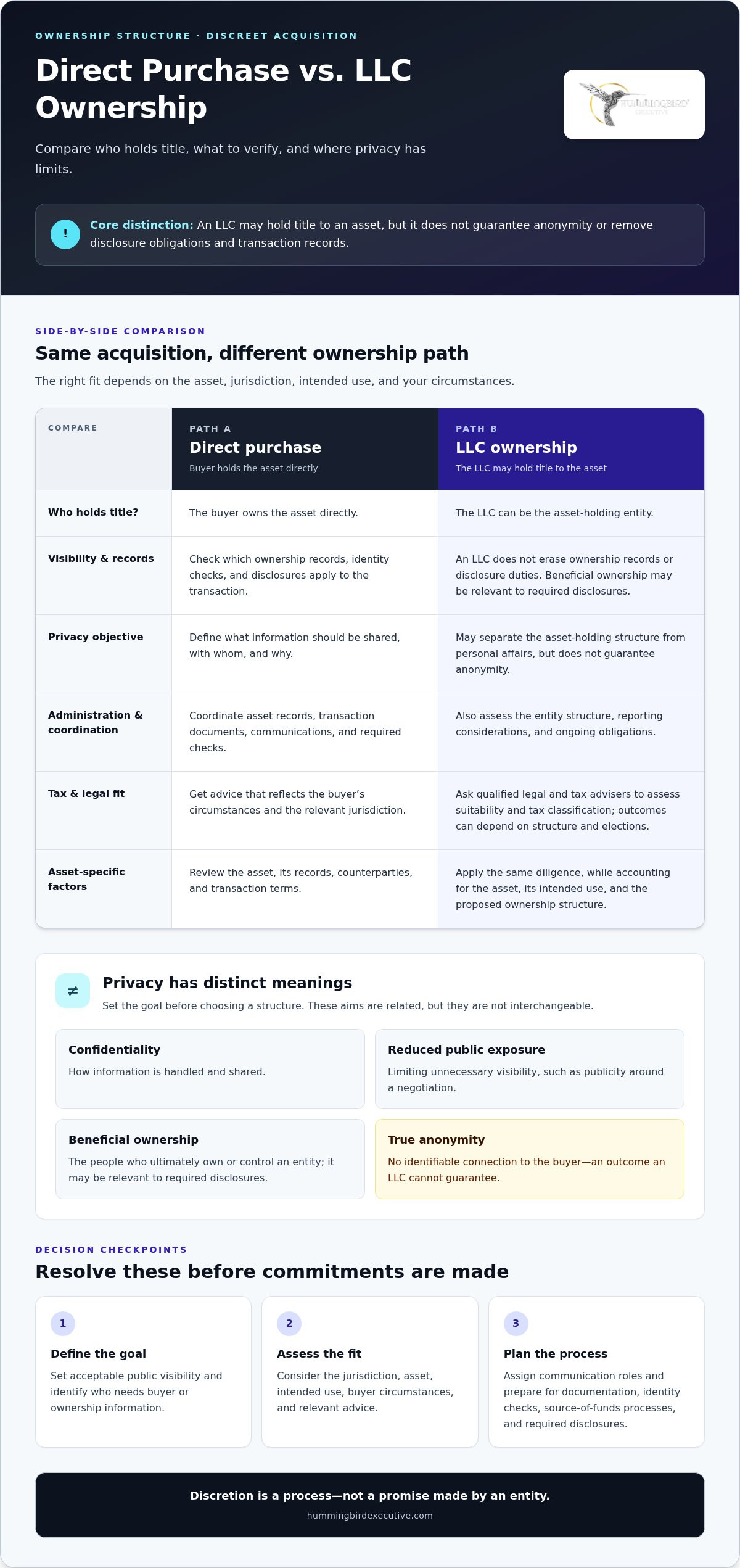
What if the entity holding a luxury asset creates some separation from its owner’s personal affairs without making the owner invisible? That distinction sits at the heart of discreet luxury asset acquisition. An LLC may hold title to an asset, but it does not guarantee anonymity or remove disclosure obligations and transaction records.
If you’re concerned that a public transaction could expose personal details, the first step is to define what you want to keep private. The right structure depends on more than privacy alone. This guide explains what an LLC may do, where its limits lie, and how legal, tax, and asset-specific advice can inform a decision before a purchase proceeds.
You’ll also find practical steps for diligence and coordinating the people involved, whether the opportunity concerns property, aviation, maritime assets, or a luxury vehicle. Hummingbird Executive provides members with a private hub for exploring off-market assets and worldwide concierge support through its membership offering. A considered acquisition begins with clear expectations: discretion is a process, not a promise made by an entity.
Key Takeaways
- Set a clear privacy objective before selecting an ownership structure. Distinguish reduced public exposure from confidentiality and anonymity.
- Assess whether an LLC fits the asset, jurisdiction, intended use, and your circumstances with qualified legal and tax advice.
- Compare direct and LLC ownership across administration, visibility, and coordination. Disclosure requirements depend on the relevant jurisdiction and transaction.
- Prepare for a discreet luxury asset acquisition by organizing asset records, defining professional roles, and planning for identity checks, source-of-funds processes, and required disclosures.
- Treat sourcing and ownership structure as separate parts of the process. Hummingbird Executive provides a private hub for exploring off-market property, yachts, jets, and luxury cars.
Discreet luxury asset acquisition: define the privacy objective before choosing an LLC
An LLC is an ownership structure, not a promise of anonymity. It can hold title to an asset, but its role is distinct from the rules governing public records, beneficial ownership disclosures, and transaction checks. For a concise overview of the entity itself, see Limited Liability Company (LLC), a structure combining elements associated with corporations and partnerships.
Privacy can mean different things. Confidentiality concerns how information is handled and shared. Reduced public exposure means limiting unnecessary visibility, such as publicity around a negotiation. Beneficial ownership identifies the people who ultimately own or control an entity, which may be relevant to required disclosures. True anonymity would mean no identifiable connection to the buyer, an outcome an LLC cannot guarantee.
A useful principle is to limit unnecessary exposure while meeting legitimate disclosure and transaction requirements. That applies whether the asset is a premium property, yacht, aircraft, or collectible vehicle. A buyer may value privacy for personal security, to keep negotiations measured, or to avoid public attention around a significant purchase. The records and transaction practices that apply can differ by jurisdiction and asset type.
What does discreet luxury asset acquisition mean?
In practice, discreet luxury asset acquisition means managing information deliberately while completing a lawful purchase. Private negotiations may keep commercial discussions limited to relevant parties, but they do not erase ownership records, reporting duties, or identity checks that apply to a transaction.
For example, a buyer discussing a premium property through representatives may keep early negotiations out of public view. Later steps may involve records or disclosures governed by local requirements. A yacht purchase can involve different ownership, registration, and transaction considerations. Neither scenario has one universal privacy rule.
Which privacy objective are you trying to achieve?
Define the desired outcome before considering an entity. Is your priority limiting publicity, separating personal ownership from the asset-holding structure, or managing who receives transaction communications? These are distinct aims and may call for different legal, tax, or transaction advice.
- Set an acceptable level of public visibility.
- Identify which parties need buyer or ownership information, and why.
- Decide who will coordinate communications and required documentation.
With that boundary established, qualified advisers can assess the relevant jurisdiction, asset, intended use, and buyer circumstances. A clear objective helps keep discretion aligned with compliance throughout the acquisition.
How an LLC may fit into a luxury asset purchase
An LLC may provide a way to hold an asset, but it does not by itself make negotiations confidential or determine who must receive ownership information. Treat the ownership structure and the handling of transaction communications as related but separate questions. The right approach depends on the jurisdiction, the asset, its intended use, and your circumstances.
Tax treatment is another distinct consideration. The IRS definition of an LLC explains that federal tax classification can depend on the LLC’s structure and elections. Do not assume an LLC will produce the same result for every buyer or acquisition.
A practical sequence for considering an LLC
Keep the process deliberate. Define the acquisition goal and how you expect to own or use the asset before choosing a structure. A yacht intended for personal use may raise different questions from an aircraft used in a business, while a property purchase may involve its own local records and transaction procedures.
- Define objectives: Clarify the intended owner, use, and acceptable level of visibility.
- Obtain advice: Ask qualified legal and tax advisers to assess the relevant jurisdiction, reporting considerations, and ongoing obligations.
- Assess the structure: Review whether an LLC fits the specific asset and buyer circumstances without assuming a particular jurisdiction is suitable.
- Conduct diligence: Once the proposed ownership structure is clear, examine the asset, records, counterparties, and transaction terms.
- Transact: Coordinate documentation and communications through the appropriate transaction professionals.
This sequence can surface structural questions before commitments or transaction records are prepared. It also ties the entity decision to the acquisition’s practical purpose instead of treating it as a shortcut to privacy.
Where specialist advice belongs in the process
Each adviser has a distinct role. Legal counsel can assess the proposed structure, relevant ownership and disclosure rules, and transaction documents. A tax adviser can evaluate classification and potential tax consequences. Financial advisers can consider how the purchase fits broader financial arrangements, while asset-specific transaction professionals can address relevant records, condition, and transfer steps.
Coordination matters. Establish a clear point of contact and agree how information will move among advisers, sellers, and transaction professionals. Hummingbird Executive supports access to off-market opportunities and concierge coordination. Keep legal and tax decisions with qualified advisers. For buyers beginning a discreet luxury asset acquisition, a private hub can help bring opportunities into view while specialists assess the ownership approach. Explore off-market luxury assets through Hummingbird Executive.
LLC ownership versus direct purchase: compare privacy, administration, and fit
Direct ownership and ownership through an LLC are different routes, not a ranking from less to more private. The legal structure of an LLC can separate an entity from its members for certain purposes, but the structure alone does not determine what information becomes public or must be disclosed. Compare the routes against your objectives, the asset’s use, and how long you expect to hold it.
What to compare before deciding on an ownership route
Consider the practical demands of each option. Direct ownership may involve fewer entity-related administrative tasks, while an LLC can require separate records and ongoing administration. Responsibilities depend on the structure and jurisdiction. Ask qualified legal and tax advisers to assess formation, compliance, and reporting considerations for your circumstances.
| Consideration | Direct purchase | LLC ownership |
|---|---|---|
| Administration | Ownership and asset records are maintained in the buyer’s name, with requirements depending on the asset and transaction. | May involve entity records and ongoing administration in addition to asset-related responsibilities. |
| Visibility | The buyer’s name may appear in relevant records or transaction documents. The extent depends on applicable rules. | The entity may appear as the owner in some contexts, but disclosure and reporting requirements vary by jurisdiction and transaction. |
| Coordination | Transaction communications and documentation are coordinated around the buyer and relevant professionals. | Professionals may need to coordinate the entity’s authority, ownership information, and transaction documentation as well as asset matters. |
Neither route is universally more private, suitable, or efficient. A buyer considering a yacht for personal use, for example, may weigh different administrative and operational factors from someone acquiring property as part of a broader ownership plan. Intended use and expected ownership horizon matter, as does the buyer’s willingness to maintain an entity alongside the asset.
Why an LLC does not guarantee anonymity
An entity alone cannot guarantee transaction anonymity. Public records, beneficial ownership rules, reporting duties, counterparties’ due diligence, and closing procedures can all affect what information is requested or recorded. The precise requirements depend on the jurisdiction, asset type, and transaction.
Use an ownership structure for a legitimate purpose, not to evade disclosure, tax, sanctions, or other legal obligations. Before committing, have qualified advisers assess the likely visibility and administration of each route against your priorities. For a discreet luxury asset acquisition, the useful comparison is not which option promises more privacy, but which fits the buyer’s goals while meeting applicable obligations.
A discreet acquisition checklist: diligence, communications, and transaction controls
A well-managed purchase depends on more than keeping the audience small. Identity checks, source-of-funds processes, and required disclosures are legitimate parts of many transactions. Plan for them rather than treating them as obstacles to discretion. Due diligence supports the integrity of an acquisition, while disciplined communication limits unnecessary exposure.
Prepare the acquisition brief and diligence plan
Before reviewing an opportunity in depth, put the mandate in writing. Include the asset criteria, intended use, decision-makers, preferred communication process, and who can authorize each next step. Ask the relevant advisers to identify applicable diligence and disclosure requirements, then tailor the review to the asset rather than relying on a single generic checklist.
- Property: Organize title and ownership records, property information, and relevant transaction documents. For more context, read the off-market property acquisition guide.
- Aircraft or yacht: Coordinate asset-specific records and technical, legal, and commercial review with the appropriate specialists. The private jet acquisition guide and private superyacht sale guide offer category-specific context.
- Any transaction: Identify the counterparties, confirm professional roles, and establish how identity verification, source-of-funds requests, and required disclosures will be handled.
Keep transaction coordination controlled and practical
Agree on communication channels and share sensitive material only with participants who need it for their role. Maintain a clear record of documents shared, approvals given, and decisions made. A controlled process supports orderly coordination, but it does not guarantee complete secrecy or remove required checks.
Set expectations with the transaction team about who responds to requests, who approves changes, and how updated documents are distributed. This can reduce duplication and confusion, especially when legal, financial, technical, and transaction professionals are working in parallel. Keep communications concise and factual, and make sure each participant understands their responsibilities.
For a discreet luxury asset acquisition, disciplined coordination should support both privacy and proper diligence. Hummingbird Executive gives members a private hub for exploring off-market opportunities across property, aviation, maritime, and luxury cars, with concierge support to help coordinate the acquisition journey. Explore off-market luxury assets.
Access off-market assets with a discreet acquisition process
An ownership structure and an asset-sourcing platform address different parts of a purchase. An LLC may serve as the legal owner if advisers determine it fits the buyer’s circumstances. A platform helps surface opportunities and coordinate the search. Neither replaces the other, and access to an opportunity does not guarantee a particular asset, transaction, or outcome.
How a private asset platform supports the search
Hummingbird Executive provides members a private hub to search, buy, or sell rare assets, including off-market property, yachts, private jets, and luxury cars. Its secure platform does not use cookies, and personal information is never sold. These are specific platform privacy attributes, not a promise of anonymity across negotiations, public records, or the wider transaction.
Concierge support can help coordinate the member experience around an acquisition, bringing asset exploration and related communications into a more considered process. Legal, tax, and technical diligence remain with the buyer’s qualified advisers and relevant transaction professionals. Keep the roles distinct: sourcing can introduce an opportunity, while professional review helps assess its suitability and the steps required to proceed.
Choose a membership path suited to the level of support
Platinum membership includes full access to search, buy, or sell rare assets and investments, along with dedicated worldwide concierge support available 24/7 at no extra charge. Gold membership offers white-glove services seven days a week during standard opening hours. For more detail, explore the Platinum membership and rare-asset access guide.
The right level of support depends on how you want to engage with the search and coordinate the service experience. Neither membership changes an asset’s disclosure requirements or substitutes for independent advice on ownership structure. A measured process keeps access, diligence, and transaction decisions aligned without overstating what a platform or entity can ensure.
For a discreet luxury asset acquisition, begin by exploring opportunities while keeping ownership and transaction decisions with the appropriate advisers. Explore private asset access with Hummingbird Executive.
Move forward with a considered acquisition plan
A discreet luxury asset acquisition starts with a defined privacy objective, not an assumption that an LLC guarantees anonymity. Compare direct and entity ownership against your circumstances, the asset, and its intended use, then work with qualified legal and tax advisers to assess the structure and obligations. Keep diligence and need-to-know communication central throughout the transaction.
Once your acquisition framework is clear, a private sourcing platform can serve a different purpose: helping you explore opportunities. Hummingbird Executive provides members private access to off-market luxury assets worldwide, including property, yachts, private jets, and luxury cars. Its secure platform does not use cookies, and personal information is never sold. Platinum membership includes full access to rare assets and investments, with dedicated worldwide 24/7 concierge support at no extra charge. Legal and tax decisions remain with your qualified advisers.
Take the next step by exploring opportunities with Hummingbird Executive and setting a clear acquisition plan. Explore private access to rare assets with Hummingbird Executive.
Frequently Asked Questions
Can an LLC make a luxury asset purchase anonymous?
No. An LLC does not, by itself, guarantee anonymity. Ownership records, reporting rules, transaction procedures, and counterparties’ requirements can vary by jurisdiction and asset type. An entity may form part of a buyer’s privacy planning, but it should not be used to avoid lawful disclosure. Before a transaction begins, ask qualified legal and tax advisers to assess the proposed arrangement and explain what information may need to be shared or reported.
Is buying a luxury asset through an LLC more discreet than buying personally?
It depends on the jurisdiction, asset, transaction, and buyer’s circumstances. An entity may change how ownership is recorded, but it does not ensure that a buyer’s identity remains undisclosed to authorities, financial institutions, advisers, or transaction participants. Compare the privacy objective with the administration and compliance responsibilities involved. Qualified advisers can assess both routes for the specific purchase, rather than assuming one structure is automatically more discreet.
What information may be required when an LLC buys a high-value asset?
Requirements vary by jurisdiction, asset class, seller, intermediary, and transaction structure. The parties involved may request identity, ownership, funding, or other information for due diligence or applicable reporting processes. These requests can be legitimate parts of a transaction. An LLC should not be used to evade them. Before signing documents or transferring funds, ask legal and tax advisers to clarify which requirements apply to the proposed purchase.
How do I acquire an off-market luxury asset discreetly?
Begin by defining the asset criteria, ownership objective, decision-makers, and preferred communication process. Arrange appropriate legal, tax, and asset-specific advice, then conduct relevant diligence and meet applicable identity and disclosure requirements. Keep communications controlled and limited to participants who need the information. A private asset platform can support sourcing and coordination, but it cannot guarantee secrecy or replace professional advice. A considered discreet luxury asset acquisition balances privacy with proper process.
Can an LLC buy a yacht, private jet, or luxury property?
An LLC may be considered as an ownership vehicle for these assets, but suitability depends on the asset, jurisdiction, intended use, and buyer. Property, aircraft, and maritime transactions can involve different records, diligence, and operational considerations. There is no universal recommendation. Before proceeding, ask qualified advisers to assess the proposed structure and asset-specific requirements, including how ownership, ongoing administration, and transaction obligations may apply to your circumstances.
What should I consider before using an LLC to purchase a luxury asset?
Clarify why you’re considering an entity, how you intend to use the asset, which jurisdictions are relevant, and who will manage ongoing administration. Ask advisers to explain privacy limitations, reporting and compliance responsibilities, tax considerations, and potential transaction impacts. Then compare those implications with direct ownership. The decision should reflect your circumstances and qualified professional advice, not an assumption that an LLC automatically provides anonymity or is the right fit.