


Privacy can narrow the audience for a yacht, but it should not narrow the scrutiny. A sea trial for an off-market yacht deserves the same disciplined attention as any other acquisition. Public records may offer fewer points of comparison, and the outing may feel more like a pleasure cruise than due diligence, but the buyer still needs a clear plan and a useful record.
It’s worth looking beyond first impressions. A composed passage can leave important questions unanswered if performance, handling, and onboard systems aren’t assessed methodically. This checklist explains how to prepare, record what you observe, and use those findings to decide what comes next. A sea trial evaluates the yacht underway; it complements, rather than replaces, a professional survey.
We’ll cover what to observe in the conditions agreed for the trial, how to compare findings with the yacht’s specifications, and how to keep sensitive information within the appropriate circle. Hummingbird Executive members can also use the private marketplace and concierge support to help coordinate acquisition communications and next steps discreetly.
Key Takeaways
- Set a clear test plan before departure, with assigned roles and a findings log tailored to the yacht’s specifications and your intended use.
- During a sea trial for an off-market yacht, assess handling, propulsion, navigation, onboard systems, and comfort within the agreed test conditions.
- Compare observations with yacht-specific documentation and seller representations instead of relying on an overall impression of the outing.
- Classify findings as satisfactory, requiring clarification, or needing further assessment, then prioritize them by their relevance to your intended use.
- Use documented observations to inform your next acquisition decision, keeping technical review separate from transaction coordination.
Why a sea trial matters when buying an off-market yacht
An off-market yacht may come with fewer public reference points than a widely advertised vessel. A sea trial gives the buyer a firsthand opportunity to observe how the yacht behaves underway and compare those observations with the seller’s representations, available records, and the buyer’s intended use. The goal isn’t to validate every claim in one outing. It’s to gather useful evidence before deciding what should happen next in the transaction.
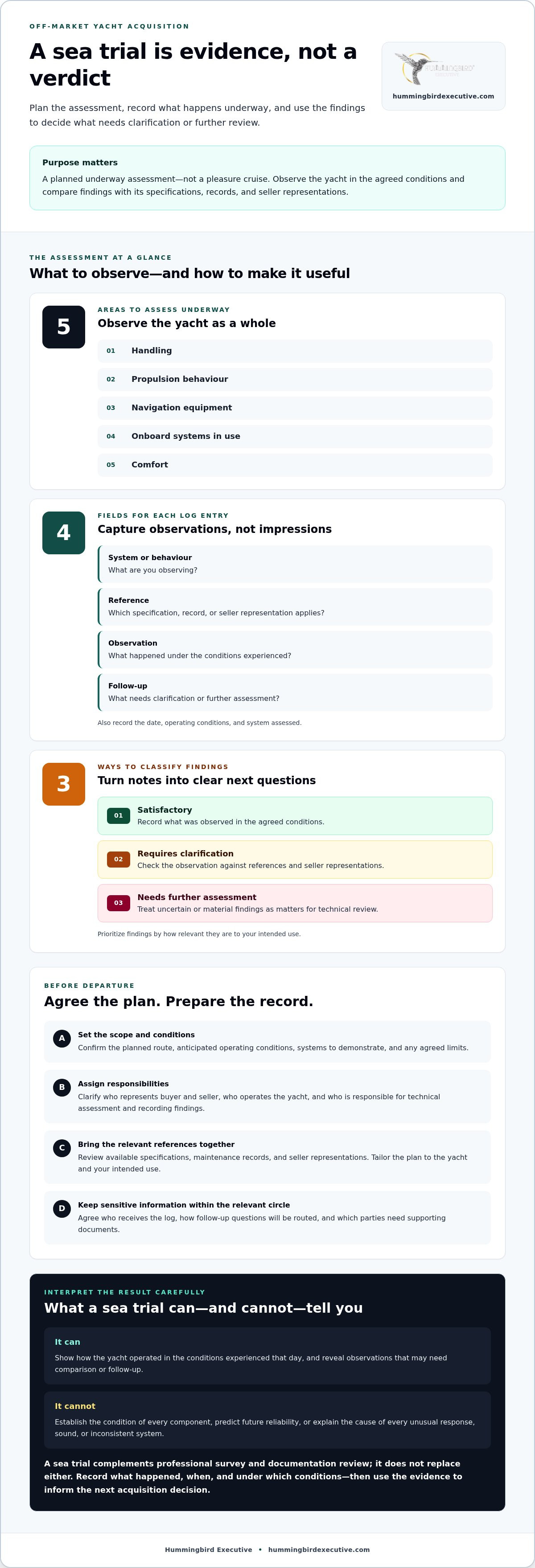
A sea trial is a planned underway assessment of a yacht’s observable performance and systems, not a leisure cruise. The difference is purpose. A pleasant passage can be enjoyable without testing the vessel against agreed expectations. A trial has a defined scope, specific observations, and a record of what occurred. For a sea trial for an off-market yacht, that structure helps make up for the limited comparison material often available outside a public listing.
A sea trial is one part of due diligence. Documentation review can provide information about the yacht’s history, equipment, and stated specifications; technical inspection can assess condition in ways that observation underway cannot. Neither replaces the other. A sea trial shows how the yacht operated in the conditions experienced that day. On its own, it cannot establish the condition of every component or resolve a discrepancy that needs technical interpretation. For general background on the purpose and conduct of trials, see Understanding Sea Trials.
Keep that distinction in mind when interpreting results. A response at the helm, an unusual sound, or a system that behaves inconsistently is an observation to document, not automatically a diagnosis. Record what happened, when it happened, and the operating conditions. Then compare the observation with the yacht’s specifications and available documentation. Use those materials, rather than assumptions based on another vessel, to assess whether the result differs from what was represented.
What a sea trial can, and cannot, establish
Underway, the buyer can observe handling, propulsion behaviour, navigation equipment, and onboard systems in use. A trial may bring questions to light that wouldn’t arise at the dock, but an observation alone may not explain its cause or significance. The outing also represents only the conditions encountered that day. It cannot establish every aspect of the yacht’s condition or predict future reliability. Treat uncertain or material findings as matters for further assessment.
Why private-sale context changes the preparation
With limited listing detail, the buyer may have less public information against which to check expectations. Before departure, agree on the trial’s scope, the systems and operating conditions to be observed, and who will record findings. Keep the resulting notes within the relevant transaction circle, sharing them only with the buyer’s representatives and other necessary parties. Discreet coordination protects confidentiality while ensuring observations can inform the acquisition decision.
Prepare for an off-market yacht sea trial with a clear test plan
Preparation turns time underway into a useful record. Before the sea trial for an off-market yacht, agree on the scope, review the available records, assign responsibilities, and prepare a log for consistent observations. That gives the buyer’s representatives a shared reference and keeps the assessment focused on the vessel.
Tailor the plan to the yacht’s stated specifications and your intended use. A buyer considering extended cruising, for example, may want different systems demonstrated from someone focused on shorter coastal passages. The aim isn’t to create a universal pass mark. It’s to make expectations explicit before departure.
Agree the scope, roles, and conditions before departure
Record who represents the buyer, who represents the seller, who will operate the yacht, and who is responsible for technical assessment. Confirm the planned route, anticipated operating conditions, and systems to be demonstrated. Identify the specifications or seller representations that will serve as references, and note any agreed limits on the trial. A shared scope helps distinguish an item that wasn’t tested from one that was observed and recorded.
Prepare records and a buyer’s observation log
Gather the available specifications, maintenance records, and relevant seller representations in one controlled working set. For each observation, record what happened, what the reference material says to expect, and what question or follow-up may be needed. Include the date, operating conditions, and system assessed. Specific notes are more useful later than a broad impression such as “performed well.”
A simple log can use these prompts:
- System or behaviour: What are you observing?
- Reference: Which specification, record, or representation applies?
- Observation: What happened under the conditions experienced?
- Follow-up: What needs clarification or further assessment?
Agree how sensitive records and trial notes will be handled. Decide who receives the log, how follow-up questions will be routed, and which parties need access to supporting documents. Keep working copies and communications within that defined group. This protects discretion while giving the buyer’s representatives the information needed to assess the findings.
Before departure, settle the scope, reference documents, roles, route and conditions, systems to be demonstrated, and how findings will be recorded and shared. For members coordinating acquisition communications alongside this preparation, Hummingbird Executive concierge support can help keep relevant parties and follow-up organized.
What to assess underway, and how to interpret the results
Assess the yacht against the agreed plan, not a universal standard. During a sea trial for an off-market yacht, note how it handles, how propulsion behaves, whether navigation equipment and selected onboard systems function as demonstrated, and whether the ride suits your intended use. Compare each observation with the vessel’s specifications, seller representations, and the conditions experienced. A figure or response that matters on one yacht may not apply to another.
Assess handling and propulsion without treating the trial as a race
Observe acceleration, manoeuvring, helm response, and operation across the conditions included in the agreed scope. Record what you perceive, when it occurred, and what the yacht was doing. If you hear an unusual sound, feel vibration, or see an alarm, capture the circumstances without assigning a cause. The buyer’s designated technical representative can interpret whether the observation warrants further assessment.
| Expected behaviour | Observed result | Item needing follow-up |
|---|---|---|
| Reference the relevant vessel specification or representation. | Record what occurred and the conditions at the time. | Note a question, discrepancy, or need for technical interpretation. |
For example, if you notice vibration under a particular operating condition, record the condition and what you observed. Don’t label it a fault based on the trial alone, but don’t dismiss it because the yacht otherwise feels composed. Avoid applying universal speed, temperature, or performance thresholds. Check any relevant tolerance against the yacht’s documentation and the agreed test conditions.
Check navigation and onboard systems in real use
Observe navigation equipment and the onboard systems selected for demonstration while the yacht is underway. Record whether each behaved as expected within the agreed scope and matched the stated capability being assessed. Note whether a system was tested, demonstrated only in part, or not demonstrated. That distinction keeps the final record precise.
Give comfort the same practical attention. Consider how the yacht feels in the conditions encountered and whether noise, vibration, movement, or access to frequently used areas suits your intended use. These are observations, not universal pass criteria. Their significance depends on your priorities and the vessel’s documented design and capabilities.
Keep entries specific and neutral. “Navigation display appeared to lose information during the demonstration” is more useful than “navigation system unreliable”: it records what you saw without turning an observation into a technical conclusion. If an item differs from a representation, identify the relevant document or statement and route the question through the agreed transaction process. This comparison helps separate what the trial established from what remains unresolved.
Turn sea-trial observations into a documented buyer decision
The value of a trial depends on how the buyer uses its findings. For a sea trial for an off-market yacht, turn raw notes into a concise decision record: preserve what was observed, identify what remains uncertain, and rank follow-up by its relevance to the yacht’s operation and your intended use. A measured record supports discussion, but it doesn’t turn an observation into a diagnosis or dictate the transaction outcome.
Use three classifications to keep the record clear:
- Satisfactory observation: The item behaved as expected under the conditions observed and within the agreed scope.
- Clarification request: The observation or available information leaves a specific question unanswered.
- Further assessment: The finding may require documentation, a repeat demonstration, or technical interpretation before its significance is understood.
Then prioritize each entry. A finding that affects a system central to your planned use may need prompt attention; a minor point with little operational relevance can be recorded without displacing more material questions. Base the ranking on your requirements, not assumptions about what every buyer should consider important.
Separate observations from concerns that need follow-up
Make each note factual and dated. Record what happened, when, which system was involved, and the operating conditions. Then state what remains to be resolved: a document to review, a behaviour to demonstrate again, or a question for technical interpretation. An isolated sound or momentary response may merit attention, but it isn’t a confirmed defect without supporting assessment. Keep conclusions separate from the original observation.
Build a decision record for the acquisition
Prepare a short summary for the buyer and authorized transaction representatives. Include material findings, open questions, who is responsible for each follow-up, and any agreed milestone for addressing it. Attach or clearly reference supporting records so the summary remains traceable. Restrict circulation to the buyer’s authorized communication circle, particularly when confidentiality matters in a private sale.
Coordinate next steps with the purchase agreement and transaction timeline. The trial record can help the buyer’s representatives identify which questions need resolution and when, while the agreement and its applicable process govern how those matters are handled. Don’t treat the log as a substitute for specialist review or as a predetermined negotiation position. It’s a decision aid: organized evidence the buyer can use to consider whether to proceed, seek clarification, or pause for further assessment.
For discreet support coordinating acquisition communications and follow-up, explore Hummingbird Executive membership.
Coordinate the next steps in a discreet off-market yacht acquisition
A documented sea trial gives the buyer a clearer basis for deciding what to do next. It can identify satisfactory observations, open questions, and matters that warrant further technical assessment. It cannot replace specialist review, establish the condition of every system, or determine the transaction’s outcome. Use the record to inform the buyer’s representatives, then consider each finding alongside the yacht’s documentation and the agreed purchase process.
Keep the workstreams distinct. Technical assessment addresses the significance of observations; commercial discussions address the parties’ positions; transaction documents govern the agreed process and timing. Combining them too early can blur a recorded fact with an interpretation or negotiation proposal. A sea trial for an off-market yacht is one input to a considered acquisition decision, not a substitute for other due-diligence steps.
Coordinate follow-up without losing transaction discipline
Bring the findings summary, outstanding questions, and agreed next actions into one controlled record. For each open item, note who is responsible for follow-up and any agreed milestone. If an observation needs technical interpretation, keep that assessment distinct from commercial discussion. If a document or further demonstration is needed, record it as a separate action. Align the sequence with the purchase agreement and transaction timeline rather than assuming a particular legal outcome.
Discretion requires structure. Identify which buyer representatives and transaction parties should receive the summary, supporting records, or follow-up correspondence. Share sensitive acquisition information only within that authorized circle, and keep a clear record of what was circulated. This helps the buyer maintain oversight without widening access unnecessarily.
Use concierge support as an acquisition coordination layer
Hummingbird Executive membership provides private access to rare-asset opportunities, supported by worldwide concierge services. For members, concierge support can help organize acquisition communications, relevant parties, and follow-up around the buyer’s needs. It complements technical due diligence; specialist assessment remains essential for interpreting technical findings.
Buyers considering both sides of a discreet transaction may also find the private superyacht sale guide useful for understanding the seller’s perspective and the importance of controlled communication.
For a more coordinated approach to private asset access, learn about Platinum membership and private asset access.
Move forward with a clear acquisition path
The next step after a sea trial for an off-market yacht isn’t necessarily a decision to proceed. It’s a deliberate choice about what evidence, coordination, or discussion would bring greater clarity to the acquisition. Anchor that choice to your intended use and the transaction’s agreed process, and use specialist review to inform technical questions.
For buyers pursuing rare assets discreetly, Hummingbird Executive’s private marketplace supports access to off-market opportunities. Platinum membership includes worldwide dedicated concierge services around the clock. This coordination can help keep relevant communications and acquisition steps organized without replacing technical due diligence.
For private access to rare assets and worldwide concierge support, explore Hummingbird Executive membership.
Frequently Asked Questions
Is a sea trial necessary when buying an off-market yacht?
A sea trial is a prudent part of evaluating an off-market yacht, though the purchase process and agreement determine the steps involved. It lets the buyer observe the vessel in operation before deciding how to proceed. For a sea trial for an off-market yacht, consider whether the planned demonstration reflects your intended use. A coastal passage, for example, may not address questions relevant to longer-range cruising. Treat the trial as one source of evidence, not a final verdict.
Can a sea trial reveal every problem with a yacht?
No. A trial reveals only behaviour observable during the conditions and demonstrations it covers. A system that isn’t used, or a concern that appears intermittently, may not be apparent during the outing. If an observation raises a question, preserve its context and identify what evidence could resolve it, such as a relevant maintenance entry or a focused technical assessment. This helps prevent both false reassurance and premature conclusions.
What happens if an issue appears during a yacht sea trial?
Document the event and its context, then identify what follow-up could clarify it. For example, note whether an alarm appeared during a particular manoeuvre and whether it cleared, rather than recording only “alarm.” The buyer’s representatives can distinguish a request for an explanation from a matter that needs technical review. Keep any proposed response separate from the recorded fact and consider timing alongside the transaction documents.
Who should be present during a sea trial for an off-market yacht?
Attendance should reflect the agreed trial scope and transaction arrangements. The buyer or a designated representative can observe; the captain or seller’s representative may operate the yacht; and the buyer’s technical representative can focus on relevant observations. Before departure, clarify who may ask questions, who will record responses, and who receives the resulting notes. In a private transaction, limiting distribution to authorized participants helps protect sensitive details without disrupting the assessment.
How long does a yacht sea trial take?
Many sea trials take about 1.5 to 3 hours, according to Boat Tomorrow’s August 27, 2026 guidance, but the duration depends on the yacht and agreed test plan. A short trial may leave some planned demonstrations incomplete; a longer one may be needed to cover the agreed conditions. Confirm what the available window is intended to include, and record any system or operating condition that wasn’t tested.
Should a sea trial replace a marine survey?
No. A sea trial and a marine survey address different questions. The trial provides observations of the yacht underway, while a survey offers a broader technical assessment within its defined scope. A system may appear to function during a demonstration without that alone establishing its overall condition. Keep the trial record distinct from survey findings and document review so each source of information can be considered on its own terms.
Can a buyer negotiate after a sea trial identifies concerns?
Trial findings can inform further discussion, but they don’t automatically determine a negotiation or the transaction’s outcome. First establish what is known, what needs assessment, and whether the concern is material to your intended use. Then review the evidence and applicable purchase agreement with the relevant transaction representatives. A documented observation may support a request for clarification or further review; any commercial response should remain distinct from the technical record.


