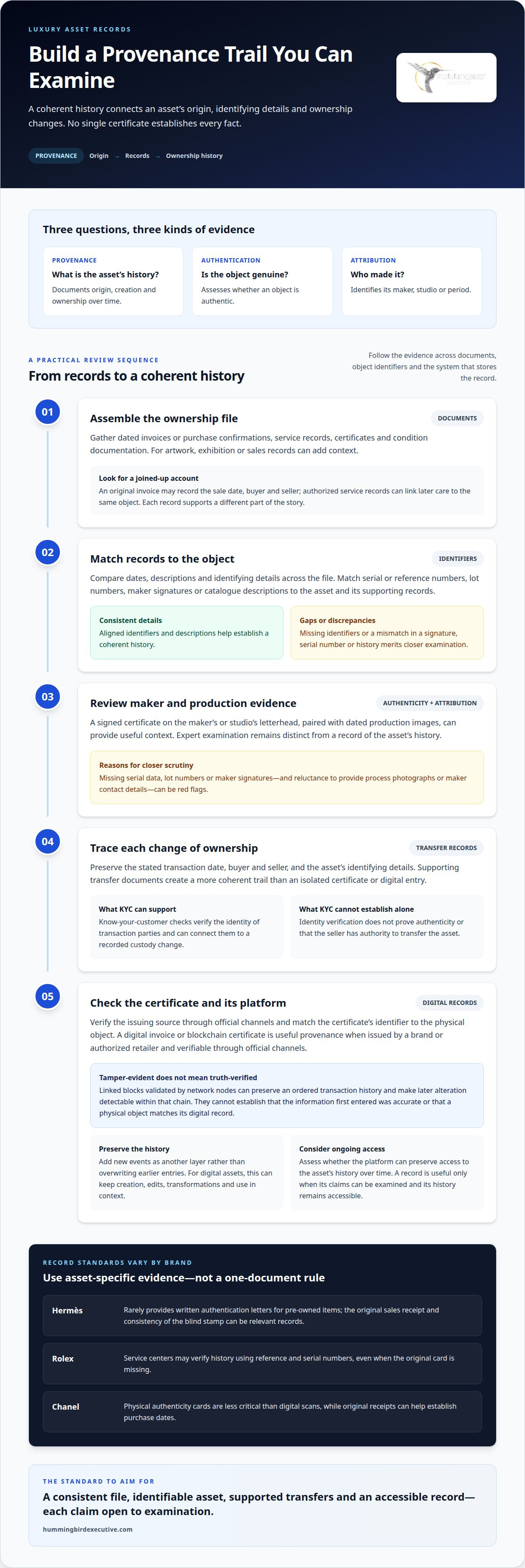
A blockchain certificate can preserve a claim, but it cannot make that claim true. Verifying provenance of a luxury asset means establishing a coherent record of who created it, when it was made and how ownership changed over time. Provenance documents an asset’s history; authentication assesses whether it is genuine, while attribution identifies its maker.
A well-supported history helps a buyer understand what they are acquiring and assess the records behind it. Invoices, service records and certificates each support different parts of an asset’s story. This article explains what provenance verification establishes, how it differs from authentication and attribution, and how to assess blockchain certificates without overlooking the platform that preserves and provides access to them. A record is useful only when its claims can be examined and its history remains accessible.
Key Takeaways
- Build a coherent ownership file from purchase records, service history, certificates and condition documentation, with each record supporting a specific part of the asset’s history.
- Distinguish evidence of authenticity from evidence of who made an object, and treat missing identifiers or reluctance to provide production records as reasons for closer scrutiny.
- Assess a blockchain certificate alongside the issuing source, the way records are added, and whether the platform can preserve access to the asset’s history over time.
- Understand that professional research costs depend on the asset, the scope of the investigation and the records available, rather than a single standard fee.
What Is Provenance Verification?
Provenance verification assembles evidence of an asset’s origin, creation and ownership history. For buyers, verifying provenance of a luxury asset means examining how records support each part of its story, rather than relying on a single certificate.
Ownership History and Documentation
Ownership history is the documented sequence of an asset’s custody, from its creator or first sale to its current holder. It matters because dated invoices, purchase confirmations, service records and certificates can support the account of how an object reached its present owner. Each document contributes evidence; together, consistent details can help establish authenticity and reveal gaps that merit closer examination.
An original invoice may record the sale date, buyer and seller, while authorized servicing records can link later care to the same object. Exhibition or sales records may add context to an artwork’s history. No single document establishes every fact. A file is strongest when dates, descriptions and identifying details align across records.
Cryptographically Tamper-Evident Histories
A blockchain history links transactions in a way designed to make later alteration evident. In the system described, ownership or asset-status changes are recorded in linked blocks and validated by network nodes. This can preserve an ordered record of transfers, but it cannot establish that the information first entered was accurate or that a physical object matches its digital record.
For a digital asset, provenance can document its journey from creation through edits, transformations and use. Records should add each new event as another layer rather than overwrite earlier entries. This preserves context: a later edit remains visible alongside the original creation record, supporting a clearer account of origin and subsequent changes.
KYC Checks and Ownership Transfers
KYC, or know-your-customer verification, checks the identity of parties involved in a transaction. During an ownership transfer, it can connect a named seller and buyer to the recorded change of custody. That helps identify transaction participants, but identity verification alone does not establish authenticity or prove that the seller has authority to transfer an asset.
When verifying provenance of a luxury asset, a transfer record can link the parties to identifying details, such as a serial number or catalogue description. Supporting transfer documents can preserve the stated ownership change and transaction date, creating a more coherent trail than an isolated certificate or digital entry.
Authentication, attribution, and counterfeiting risks
Authentication asks whether an object is genuine; attribution identifies its maker, studio or period. Provenance records support both inquiries, but do not replace expert examination. For a signed work, a certificate may identify the maker and completion date, while production photographs can document its making process and workshop attribution.
Buyers can check whether an asset has been reported stolen by comparing its serial, reference or other identifying details with relevant official stolen-property records or law-enforcement channels, where searchable. A possible match calls for pausing the transaction and resolving the record and the seller’s title before proceeding.
Specific identifiers matter. Missing serial data, lot numbers or maker signatures can be red flags, as can a seller’s reluctance to provide process photographs or maker contact details. A signed certificate on the maker’s or studio’s letterhead, paired with dated production images, offers more useful context than an unsupported authenticity claim. Buyers can also establish who made an object and whether the maker or studio can be contacted.
Brand practices differ. Hermès rarely provides written authentication letters for pre-owned items; the original sales receipt and consistency of the blind stamp can be relevant records. For Rolex watches, service centers may verify history using reference and serial numbers, even when the original card is missing. Chanel’s physical authenticity cards are less critical than digital scans, while original receipts can help establish purchase dates. These examples show why one document standard cannot fit every asset.
At auction, compare the catalogue description and identifiers with the asset and its supporting records. A discrepancy in a signature, serial number or documented history deserves attention before bidding, since a convincing certificate alone cannot resolve every counterfeiting risk. For access to rare assets and investments, explore private asset opportunities with discretion.
Blockchain certificates and platform longevity
Blockchain certificates add a traceable layer to provenance records, but establish only what their entries support. For luxury goods, a digital record may connect an item’s origin, creator and later ownership changes. Collectors should distinguish that recorded history from independent proof that the physical piece matches its description.
In a blockchain system, ownership or asset-status changes enter linked blocks validated by network nodes. Each addition forms a chronological record, making later alteration detectable within that chain. This can show that one transaction followed another, but cannot establish whether the original description was accurate. A record might link a sculpture to a named studio without proving the studio made it.
Verify the issuer separately. A digital invoice or blockchain authenticity certificate counts as provenance when issued by a brand or authorized retailer and verifiable through official channels. Match its identifier to the physical object, such as a watch serial number or artwork reference. If the certificate describes another piece, a valid signature will not resolve the mismatch.
Platform longevity matters because a collector may need records after a sale. Consider whether the certificate can be exported in readable form, whether supporting documents remain accessible independently and how a future owner can locate the record. A ledger entry may persist while its interface or linked files change. Retaining a copy of the certificate and original documents provides a practical reference.
For physical pieces, preserve digital certificates alongside purchase documents, service records and condition notes. Where a digital twin is available, register it without discarding the paper trail. Digital asset provenance should record creation, edits, transformations and use as additive events, rather than overwrite earlier history. This creates a clearer account of the asset and the records supporting it.
How much does professional authentication or provenance research cost?
There is no single standard fee for examining every luxury asset. The cost depends on the case and is provided after a quote request; factors include asset type, research scope and available records. A watch with a service history presents a different task from an artwork requiring maker attribution and a review of exhibition records.
Scope is the first cost driver. Authentication focuses on whether an object is genuine, while provenance research traces its origin and ownership history. A combined assignment may require examination of the object, review of invoices and certificates, and checks against records held by a brand, studio or approved service provider. Each additional line of inquiry adds work.
Expertise also matters. An appraiser should understand the specific asset category and explain the valuation method used. A market-comparison approach, for example, draws on comparable sales or auction results and explains how they inform the assessment. A report may also describe the asset’s model, materials, condition and distinctive features, supported by photographs.
Before commissioning work, define the decision the report must support: purchase, insurance, resale or collection records. Then assemble available invoices, service documentation, certificates and prior valuations. A coherent file can help focus the investigation; conflicting descriptions or gaps may require further examination. The deliverable should identify its subject clearly and explain the evidence and methodology behind its conclusions.
For an acquisition or sale involving rare assets, explore private asset opportunities and the related membership access.
Hummingbird Executive: platinum Membership full access to rare assets ,investments, buy surch or sale plus 25/7 dedicated concierge services world wide at no extra charge,
Hummingbird Executive offers a natural next step when you are considering a rare-asset acquisition or sale and need access to relevant opportunities. Platinum Membership provides full access to rare assets and investments for buying or selling, alongside dedicated worldwide concierge services at no extra charge. It connects the provenance work described above with the broader transaction decision, without treating a certificate as a substitute for your own due diligence.
For those seeking white-glove support during opening hours, Gold Membership offers service seven days a week. The appropriate membership depends on the level of access and support you require as you assess an opportunity or prepare an asset for sale.
For a discreet conversation about rare-asset opportunities, contact Hummingbird Executive.
Make Provenance Part of Your Next Decision
A disciplined approach to verifying provenance of a luxury asset begins before a transaction and continues through each change in ownership. Treat its record as part of the asset’s long-term stewardship: preserve a clear account, keep supporting material accessible and establish how future updates will be added. That continuity can inform later decisions, whether an asset remains in a collection or moves to a new owner.
The next step is to connect sound documentation with the opportunity itself. Hummingbird Executive’s Platinum Membership provides access to rare assets and investments for purchase or sale, with dedicated worldwide concierge services. For a considered acquisition or disposition, this offers a discreet route from evaluating an opportunity to deciding how to proceed.
Contact Hummingbird Executive to discuss your next rare-asset decision. A measured start can help you move forward with clarity.
Frequently Asked Questions
How does provenance affect price, insurance, and resale?
A well-supported history can strengthen a buyer’s confidence and inform an asset’s valuation, insurance assessment and resale presentation. For example, a dated condition report gives an insurer or appraiser a record of the object’s state at that time. Provenance does not set a price by itself; rarity, condition, demand and the quality of supporting evidence also shape an asset’s assessment.
How is provenance actually documented?
Document provenance by maintaining an organized record of an asset’s origin, ownership changes and relevant events. Keep original invoices, transfer records, service documents and certificates together, with dates and identifiers that connect each item to the asset. For a digital file, preserve earlier entries when adding new information. This creates a traceable record rather than a file that obscures changes over time.
What Is Proof of Provenance and How Does It Work?
Proof of Provenance is a blockchain record used to document an asset’s creator, creation date and ownership history. Each recorded transfer or status change becomes part of a linked sequence validated by network nodes. The system can make changes to recorded entries evident, but it cannot independently prove that the original information was accurate or that a physical object corresponds to its digital certificate.
What documents establish the provenance of a luxury asset?
Useful documents include an original invoice, purchase confirmation, ownership-transfer records, authenticity certificates, approved service records, valuations, inspection reports and warranty documents. The relevant file varies by asset. For artwork, exhibition history, conservation notes or laboratory results may add context; for a watch, service documentation can be especially informative. Keep supporting material that links each record to the specific object.
How can you verify a luxury asset’s authenticity and ownership history?
Use independent evidence to test both the object and its ownership trail. Compare identifying details with purchase and service records, then seek relevant confirmation from the maker, studio or authorized service channel. A consistent account across those sources is more informative than relying on a seller’s statement alone. For a valuable acquisition, a specialist familiar with that asset category can assess its particular features.
How do serial numbers, hallmarks, and certificates help verify provenance?
Serial numbers and hallmarks help distinguish an object and connect it to records, while certificates describe claims about its origin or authenticity. Their value comes from consistency: a watch’s serial should correspond with its service documentation, and a hallmark should fit the object’s maker and material. A certificate without a matching identifier offers less useful evidence than one clearly tied to the piece.