A yacht may be free of a mortgage while its owning company carries liabilities of its own. Private yacht acquisition due diligence should begin by asking marine finance institutions about outstanding debts, then clarifying whether the transaction is for the vessel or the company that owns it.
That distinction matters. Buyers and sellers need a clear picture of ownership, potential liens, the yacht’s condition and the obligations in the sale documents before committing. This guide covers how to examine those points, compare a vessel sale agreement with a company purchase agreement, review compliance considerations and assess the implications of buying the company. The goal is an informed decision that weighs legal and commercial risks alongside the asset itself.
Key Takeaways
- Trace the yacht’s ownership and financing, then review its maintenance history and survey findings for signs of debt or condition risks.
- Understand how the chosen sale agreement sets deposit, sea-trial, withdrawal and closing terms before committing.
- Assess flag, registration, tax and licensing obligations in light of the yacht’s intended use and operating locations.
- Decide whether to acquire the vessel or its owning company, since a company purchase requires scrutiny of both the business and the yacht.
1. What are the common legal red flags in second-hand superyacht transactions for buyers and sellers?
Start with title and debt. For a UK-registered yacht, the UK Ship Register can help establish whether the seller owns the vessel and has the right to sell it. For an unregistered yacht, obtain the original builder’s certificate and ownership records, including bills of sale. Ask marine finance institutions about outstanding debts, and check the yacht and equipment against the stolen-boats register. Unpaid mooring charges can also become the buyer’s liability, so request the relevant records.
What are typical yacht purchase prices by size, age, and condition? There is no single figure that applies across these factors. Size, age, condition, equipment, maintenance history and work identified during inspection all influence valuation. Assess the specific vessel rather than relying on a broad estimate.
Condition needs independent scrutiny. Make the offer subject to a dry-dock survey, engine testing and a seal trial. Review service records to understand previous repairs and identify recurring faults or possible construction weaknesses. For a charter fleet, a qualified marine surveyor can assess vessel condition and estimate future capital expenditure. The findings help both parties distinguish documented maintenance from outstanding work and support a reasoned discussion of warranties and sale terms.
Define the survey scope before inspection begins. A pre-purchase survey on a 40-metre yacht typically takes 4 to 7 days afloat, plus haul-out. Engine surveys, oil analysis and other specialist inspections are additional costs. Confirm the surveyor’s professional-body membership and indemnity insurance before engagement.
Sellers can make the yacht’s condition easier to assess by providing complete records and access for inspection. Buyers should preserve the opportunity to inspect and test the yacht before acceptance. Skipping a sea trial can mean the buyer is deemed to accept the condition described in the survey. An independent report gives both sides a clearer basis for resolving defects, adjusting terms or deciding whether to proceed.
2. MYBA MOA and PSA contract differences
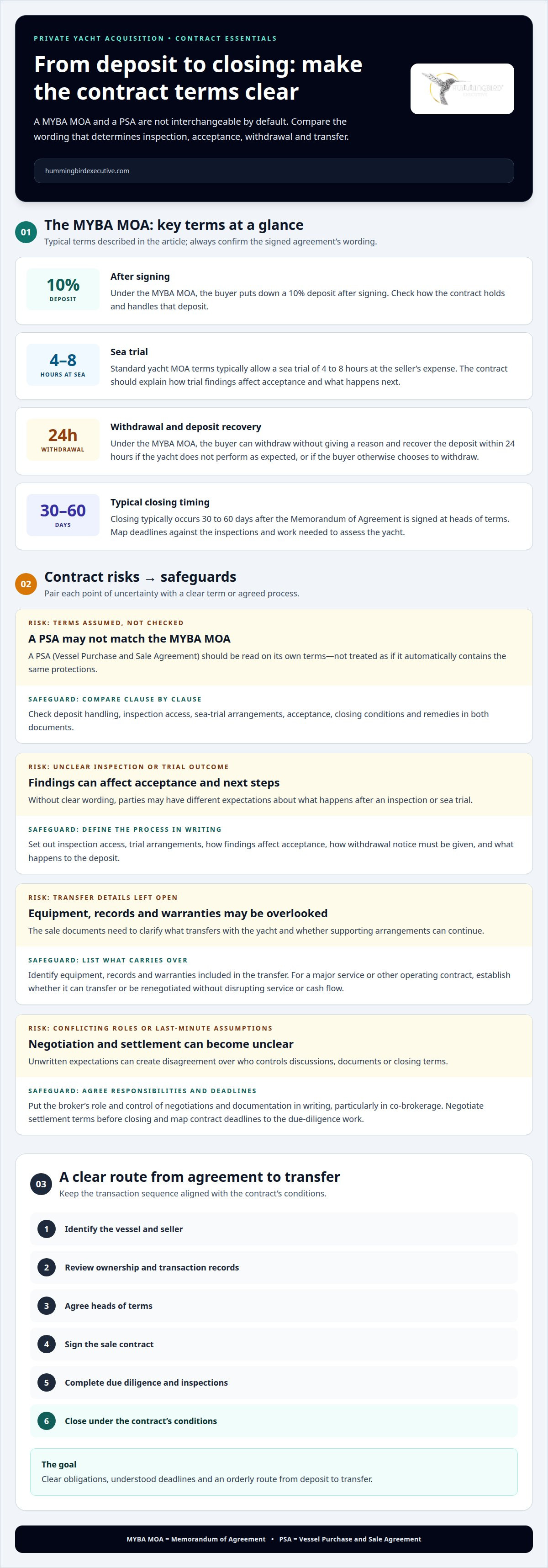
For a brokerage yacht sale, the MYBA Memorandum of Agreement (MOA) sets out key transaction terms. After signing, the buyer puts down a 10% deposit. Standard yacht Memorandum of Agreement terms typically allow a sea trial of 4 to 8 hours at the seller’s expense. The contract should make clear how trial findings affect acceptance and the next steps.
Under the MYBA MOA, a buyer can withdraw without giving a reason and recover the deposit within 24 hours if the yacht doesn’t perform as expected, or the buyer otherwise chooses to withdraw. Closing typically occurs 30 to 60 days after the Memorandum of Agreement is signed at heads of terms. The agreement’s wording matters: parties should understand when a withdrawal is permitted, how notice must be given, and what happens to the deposit.
Read a PSA, or Vessel Purchase and Sale Agreement, according to its specific terms rather than assuming it matches the MYBA MOA. Compare the documents clause by clause, including deposit handling, inspection access, sea-trial arrangements, acceptance, closing conditions and remedies. The contract should also identify which equipment, records and warranties transfer with the yacht. If a major service or other contract supports the vessel’s operation, establish whether it can transfer or be renegotiated without disrupting service or cash flow.
The acquisition sequence is straightforward: identify the vessel and seller, review ownership and transaction records, agree heads of terms, sign the sale contract, complete due diligence and inspections, then close under the contract’s conditions. Agree the broker’s role and who controls negotiations and documentation in writing, particularly in co-brokerage arrangements. A clear agreement reduces the scope for conflicting interpretations.
Before signing, map the contract deadlines against the work needed to assess the yacht and its operation. Negotiate settlement terms before closing instead of leaving them to last-minute assumptions. The right structure fits the intended purchase, gives each party clear obligations and provides an orderly route from deposit to transfer.
3. Maritime regulatory compliance and licensing
Review registration, flag and cruising plans together before purchase. A buyer’s state of residence can affect applicable national registration and tax requirements; the yacht’s flag and intended cruising area shape the compliance review. Record these questions separately in the transaction documents, since ownership paperwork alone does not establish compliance for every operating area.
For United States purchases, account separately for applicable state or local taxes, registration charges and import duties. Requirements and amounts depend on the buyer’s jurisdiction, the yacht’s origin and the transaction structure. Include these costs in the acquisition budget alongside ongoing ownership expenses.
For U.S. vessel documentation, vessels are generally 26 feet and over, or 5 net tons and above. A documented vessel’s ownership transfer uses Coast Guard Form CG-1258, the Application for Exchange/Transfer, and Coast Guard Bill of Sale Form CG-1340. Processing through the National Vessel Documentation Center typically takes two to four weeks. Buyers should align closing documents with that process.
International acquisitions require a separate review of flag, location and intended use. In the EU, privately owned yachts must have VAT paid; VAT is payable on new yachts bought from VAT-registered sellers in the UK or another EU country, and on yachts imported from outside the EU. A yacht kept outside the EU for more than three years may have to pay VAT again on re-entry. Yachts bought from outside the EU may need to comply with the Recreational Craft Directive and carry CE marking in certain circumstances.
For UK registration, the builder’s certificate is identified as form MSF 4743. The Boat Safety Scheme and a valid compliance certificate from the relevant navigation authority also matter for UK yachts. Buyers should have the seller’s compliance documents and projected recurring obligations set out separately before closing.
4. Buying a yacht versus its owning company
Buying the vessel transfers the yacht; buying its owning company transfers the entity and its liabilities. The company-purchase route requires scrutiny of both. Review corporate records, confirm shareholders are authorized to sell, and arrange a yacht survey and sea trial. Depending on the law of the build country and the registration or perfection requirements, a contract stating that title to the hull has passed may not establish effective ownership.
For a company acquisition, parties typically sign a Letter of Intent outlining business terms before preparing an Agreement to Purchase the Company. That agreement should specify included assets, purchase price and allocation, payment terms, inspections, inventory, representations and warranties, contingencies, fees and closing date. A Vessel Purchase and Sale Agreement is for a yacht purchase, not a company sale. An attorney and yacht broker can address the distinct legal and vessel considerations.
Company records can reveal exposures that a vessel-only transaction may leave behind. Review financial statements, outstanding obligations, insurance, charter permits and major operating contracts. Lenders financing a purchase of a yacht-owning company will usually require the company’s accounts for the last three years. Establish whether essential contracts can transfer or be renegotiated without disrupting cash flow or operations. Include commission arrangements and relevant vessel records in the transaction review.
New yachts generally have a different acquisition cost profile from used vessels, while warranty terms depend on the sale documents and applicable coverage. For a used yacht, condition, maintenance history and outstanding work shape value; resale prospects depend on its condition and future marketability. Compare these factors with intended use instead of treating age alone as a reliable measure.
The choice turns on what the buyer intends to acquire: a vessel with a defined title transfer, or a company with its history, contracts and obligations. For access to rare yacht opportunities, explore private asset opportunities.
Hummingbird Executive
Hummingbird Executive gives members private access to rare assets and investments, including opportunities to buy or sell yachts. For buyers weighing a vessel acquisition against a company purchase, this provides a discreet way to explore relevant opportunities while keeping the ownership structure central to the decision.
Platinum Membership includes full access to rare assets and investments, with dedicated concierge services worldwide. Gold Membership offers white-glove services during opening hours. These memberships support access and concierge needs; legal, financial and technical reviews remain distinct parts of a considered acquisition.
For a discreet conversation about yacht opportunities and membership, contact Hummingbird Executive.
Make the Next Decision Deliberately
Begin by defining what ownership should make possible. Set out the yacht’s intended use, the ownership structure that supports it and the circumstances that would prompt a future sale. This gives private yacht acquisition due diligence a practical frame: assess each document, contractual condition and operating obligation against the same plan.
Keep the decision process coherent. Record why you are choosing an asset purchase or company acquisition, identify unresolved points that could affect the transaction, and align the closing timetable with the work still required. A considered pause can protect the quality of a decision as effectively as moving forward.
For access to rare yacht opportunities and a discreet concierge relationship, contact Hummingbird Executive. Take the next step with a clear view of the ownership you want to build.
Frequently Asked Questions
How do I check if there are outstanding mortgages or liens on the yacht?
Use the yacht’s flag and registration details to identify the relevant registry and records for a title search. Reconcile any recorded security interests with lender statements and the seller’s closing documents. Registration systems differ across jurisdictions, so a clean result in one register may not resolve every claim. Make the release of identified debts part of the closing arrangements before transferring funds.
What are the common legal red flags in second-hand superyacht transactions for buyers and sellers?
Look for inconsistencies between the seller’s stated ownership, transaction history and documents, along with unexplained gaps in maintenance or charter records. A yacht offered by someone without clear authority to sell needs particular scrutiny. Sellers should address undisclosed damage, disputed equipment ownership and unresolved service obligations before signing. These discrepancies can affect valuation, delivery and the parties’ responsibilities after the sale.
What are the legal implications and buyer protections when purchasing a repossessed or distressed yacht?
A distressed sale can bring uncertainty about who has authority to transfer the yacht, which debts remain attached, and what condition or warranties the sale contract covers. Establish the seller’s authority and how title will pass, then define delivery, debt releases, inventory and accepted condition in writing. A reduced or urgent sale process does not replace these checks; the contract should allocate each risk clearly.
What clauses help limit post-sale liability for buyers and sellers?
Use precise clauses to define the yacht’s condition at delivery, included equipment, disclosed defects, representations, warranties and the process for raising claims. Liability caps, time limits, indemnities and exclusions can clarify which losses each party bears, but their effect depends on the contract and applicable law. Set out agreed repairs or retained obligations expressly rather than relying on informal assurances or assumptions made during negotiations.
What is the difference between buying a yacht and buying the company that owns it?
A vessel purchase transfers the asset under the sale agreement; a company purchase transfers ownership of the entity that holds it. The latter can also leave the buyer with the company’s contractual commitments, financial history and unresolved obligations. For example, a charter operation may depend on agreements held by the company. Let the intended ownership structure, not simply the yacht’s title, guide the choice.
What documents should buyers review before purchasing a yacht?
Alongside title and sale records, examine insurance policies, inventory, repair invoices, service agreements and any charter or management contracts. Review correspondence about significant defects or claims, as well as records related to the yacht’s intended operation. For a company-owned vessel, include corporate accounts, shareholder approvals and company contracts. Organize documents by asset, ownership entity and operating obligation to make gaps or conflicting terms easier to identify.