The purchase price is only the starting point. A cross-border luxury real estate acquisition is also shaped by the ownership structure, the destination country’s tax and compliance rules, financing, and how the property will be used or held. Each decision can affect transaction costs and obligations after completion.
That complexity matters: a structure suited to one jurisdiction or investment objective may not suit another. Assess the property, ownership plan, and financing together rather than treating them as separate decisions.
This article explains how ownership structures influence an acquisition, what due diligence and compliance should cover, and how currency and financing choices affect the transaction. It also considers residential investment arrangements, so you can identify the decisions to make before committing.
Key Takeaways
- Assess whether direct ownership or a holding company better aligns with the acquisition’s tax, legal, and strategic considerations.
- Map due diligence across local tax, employment, environmental, and compliance obligations before structuring the purchase.
- Weigh currency exposure alongside loan terms, since the borrowing currency can affect the transaction’s overall financing risk.
- Choose a residential investment structure with the intended use, ownership arrangements, and potential tax treatment in view.
1. Acquisition ownership and holding-company structures
Luxury property prices in London, Paris, New York, and Singapore vary by location and asset. A central apartment, a waterfront residence, and a country estate are not comparable purchases. Asking prices reflect location, condition, scale, and market position; transaction costs also depend on local rules and the ownership structure.
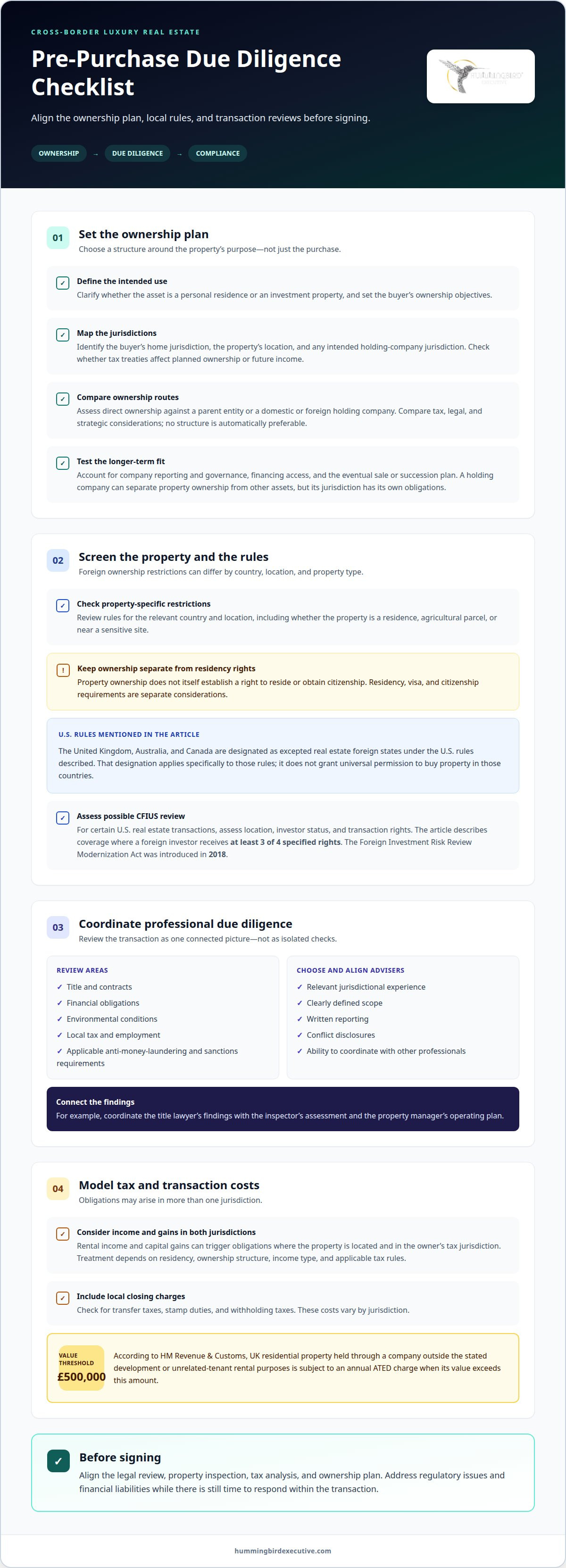
For a cross-border luxury real estate acquisition, ownership may sit with the buyer, a parent entity, or a domestic or foreign holding company. The right structure depends on tax, legal, and strategic considerations. A holding company can separate property ownership from other assets, but its jurisdiction brings its own reporting and governance requirements. Before choosing a vehicle, map the buyer’s home jurisdiction, the property’s location, and any intended holding jurisdiction. Then assess whether tax treaties affect the planned ownership or future income. The structure should reflect how the property will be used, financed, and eventually transferred, not just how it will be purchased.
Start by defining the property’s intended use and the buyer’s ownership objectives. Then screen markets and properties, compare direct ownership with a holding vehicle, and conduct legal, financial, and property due diligence. Complete financing and compliance planning before signing, then execute the purchase and register ownership under the chosen structure.
For example, a buyer acquiring a residence through a company should model the company’s local obligations alongside the buyer’s home-country tax position. A domestic vehicle may simplify some local administration, while a foreign vehicle may align better with an existing investment structure. Neither is automatically preferable. Compare expected tax treatment, regulatory obligations, governance, financing access, and the eventual sale or succession plan. Keep the choice aligned with the asset: a personal residence and an investment property may call for different ownership approaches. This analysis can help prevent a convenient acquisition structure from becoming an expensive constraint later.
2. Cross-border due diligence and compliance
Foreign ownership rules vary by country, location, and property type. A residence, agricultural parcel, or property near a sensitive site may face different restrictions. The United Kingdom, Australia, and Canada are designated as excepted real estate foreign states under the U.S. rules described here. That designation applies specifically to those rules; it does not grant universal permission to buy property in those countries. Residency, visa, and citizenship requirements are separate considerations: owning property does not itself establish a right to reside or obtain citizenship.
For certain U.S. real estate transactions, the Committee on Foreign Investment in the United States (CFIUS), U.S. Department of Treasury, defines coverage by whether a foreign investor receives at least three of four specified rights. The Foreign Investment Risk Review Modernization Act was introduced in 2018, according to U.S. Congress. Buyers should assess whether location, investor status, and transaction rights create a review issue before committing.
Due diligence should cover title, contracts, financial obligations, environmental conditions, local tax, employment, and applicable anti-money-laundering and sanctions requirements. Compare local lawyers, agents, inspectors, and property managers by their relevant jurisdictional experience, clearly defined scope, written reporting, conflict disclosures, and ability to coordinate with other professionals. For example, the lawyer reviewing title should coordinate findings with the inspector’s assessment and the manager’s operating plan.
Rental income and capital gains from overseas property can trigger obligations in the property’s jurisdiction and the owner’s tax jurisdiction. Applicable treatment depends on residency, ownership structure, income type, and relevant tax rules. Closing costs can include transfer taxes, stamp duties, and withholding taxes, which vary by jurisdiction. According to HM Revenue & Customs, UK residential property held through a company outside the stated development or unrelated-tenant rental purposes is subject to an annual ATED charge when its value exceeds £500,000.
Before signing, align the legal review, property inspection, tax analysis, and ownership plan. This sequence can surface regulatory issues and financial liabilities while there is still time to address them in the transaction.
The United Kingdom, Australia, and Canada are designated as excepted real estate foreign states under the U.S. rules described here. That designation does not establish universal permission for foreign buyers to purchase property there.
3. Cross-border financing challenges
Financing across jurisdictions brings currency exposure into the property decision. If a buyer earns income in U.S. dollars but purchases a home priced in euros, exchange-rate movements can change the effective purchase and repayment burden. Borrowing in the property’s currency can reduce conversion losses between income and debt, while leaving the buyer exposed to exchange rates on funds transferred from elsewhere. Model both sides before choosing a loan currency.
A forward contract can lock an exchange rate for a planned transfer, helping limit losses from currency volatility. Match its timing to the payment schedule, including the deposit and completion payment. If funds will arrive in stages, coordinate the transfer plan with the financing timetable. Currency planning should account for the period between committing to a purchase and completing it.
If a conventional mortgage cannot be arranged in time, an international bridging loan can fund an acquisition before the buyer transitions to a traditional mortgage. This approach needs a clear refinancing path: assess the expected repayment source, lender criteria, and property documentation before relying on the bridge. Interest-only loans can also reduce short-term obligations because initial payments cover interest rather than principal. They may suit renovation periods or markets where appreciation is anticipated, but the principal remains outstanding.
Multi-currency loans let borrowers take on debt in a foreign currency and may offer access to lower interest rates. Weigh any apparent rate advantage against exchange-rate movements and repayment capacity in the borrower’s income currency. Local banks may offer terms or options tailored to foreign buyers. Compare the loan currency, repayment basis, collateral requirements, and refinancing conditions with other available structures.
Review the financing structure as interest rates, tax policies, or currency markets change. A useful sequence is to confirm the acquisition currency, match the debt currency to available cash flow, compare bridging and mortgage options, then revisit the plan as market conditions shift. This keeps financing decisions tied to the property’s jurisdiction and the buyer’s wider liquidity needs.
4. Cross-border residential property investment structures
For residential property, the investment structure should reflect its intended use, ownership horizon, and exit plan. Direct personal ownership can keep the arrangement straightforward, while a company may separate the property from other personal assets. A trust or shared ownership arrangement may suit different succession or co-investment objectives. Each structure has distinct legal, tax, reporting, and administrative consequences across the countries involved.
Begin with the intended outcome. An owner-occupied residence raises different planning questions from a property held for rental income or resale. Identify who will occupy the property, who will fund the acquisition, and how income or eventual sale proceeds will be allocated. Then compare personal and company ownership under the rules where the property is located and where each owner is tax-resident. If ownership is shared, also decide how decisions will be made.
Acquiring a property-owning company instead of purchasing the property directly creates another structural choice. Transaction planning should compare a stock purchase with an asset purchase because each has different tax and legal implications. A stock purchase transfers ownership of the company, while an asset purchase transfers the property itself. The distinction affects what is acquired and which existing company obligations may remain relevant. Legal and tax reviews should therefore examine the target company, its contracts, and the property as separate but connected elements.
Some U.S. rules also make ownership percentages relevant to eligibility. Foreign nationals of non-excepted states may hold no more than a 10 percent voting interest in an entity seeking excepted real estate investor status. Where that status matters, the entity’s ownership and governance arrangements need careful alignment with the applicable criteria.
A disciplined sequence is to define the property’s purpose, select the ownership model, assess tax and legal treatment, then align governance and exit planning. To refine your acquisition strategy, consider your residential investment structure.
Hummingbird Executive
Hummingbird Executive gives members access to rare assets and investment opportunities, including premium properties sourced through private relationships with owners and decision-makers. For buyers considering an international residential acquisition, this is a discreet way to explore off-market opportunities and potential purchases or sales alongside their ownership and financing plans.
Platinum Membership provides full access to rare assets and investments for buying or selling, with dedicated worldwide concierge services at no extra charge. Gold Membership includes white-glove services during opening hours, seven days a week. Complimentary worldwide white-glove service is also available during opening hours. These services offer curated access and assistance as members consider property investments, but do not replace jurisdiction-specific legal or tax advice.
For a considered conversation about your acquisition objectives, contact Hummingbird Executive.
Set the Mandate Before the Next Move
A useful next step is to turn your acquisition thesis into a clear mandate. Define the intended use, preferred jurisdictions, ownership priorities, funding approach, and investment horizon. These decisions give each opportunity a consistent frame of reference and keep the search aligned with your wider objectives.
A cross-border luxury real estate acquisition is more than a property choice. It is a long-term commitment shaped by how the asset fits your personal or investment plans. As those plans evolve, the criteria for a suitable property may change too. A well-defined mandate helps make that evolution deliberate rather than reactive.
Hummingbird Executive provides access to rare assets and investment opportunities, including properties not publicly advertised. If you’re ready to discuss your objectives and explore the next step, contact Hummingbird Executive. A considered beginning can bring greater clarity to the opportunities ahead.
Frequently Asked Questions
What challenges come with cross-border property acquisitions?
The main challenges are coordinating different legal systems, tax obligations, transaction practices, and currencies. Timing can be complicated: a local title review, lender approval, and property inspection may follow separate procedures, yet each can affect the same completion date. Buyers should also account for language differences in contracts and records, ownership eligibility, and how rental or sale proceeds will be reported across relevant jurisdictions.
What is cross-border real estate investing?
Cross-border real estate investing means acquiring or holding property in a country different from the investor’s residence or principal financial base. Depending on the objective and local rules, ownership may be direct, through a company, or through a shared investment vehicle. An overseas residence used personally is an international property investment, even if it generates no rental income.
Why do investors choose international property?
Investors may seek geographic diversification, a residence for personal use, rental income, or exposure to a market they know well. Property abroad can also support family, business, or lifestyle plans connected to that country. Make the rationale specific: a coastal home intended for seasonal use has different operating needs from an apartment selected primarily for rental returns.
How can buyers finance an international luxury property purchase?
Buyers can use cash, financing from a lender in the property’s country, or borrowing arranged in their home jurisdiction. A local lender may assess the property and borrower under its own underwriting practices, while an existing private banking relationship may offer another route. Compare loan currency, repayment terms, collateral, and funding timing with the purchase contract.
How should buyers verify title, zoning, permits, and property condition overseas?
Use a coordinated review that matches local records to the specific property. A local property lawyer can examine title documents, ownership history, liens, and planning records; an inspector can assess structural and building-system condition. For a renovated villa, compare permits with the completed work and confirm that the boundaries and permitted use match the transaction documents. Document findings before completion.
What currency, banking, and international wire transfer risks should buyers consider?
Exchange-rate changes can alter the amount received or owed, while bank processing times can affect completion funding. Wire transfers also require careful control of recipient details, payment instructions, and approvals. Independently verify any changed account instructions through a trusted, previously established channel before transferring funds. Coordinate transfer timing with the receiving bank and contractual deadlines, and retain transaction records.