A UK VAT-paid yacht isn’t automatically VAT-paid for circulation in the EU. For owners navigating VAT on yacht purchases in Europe, the key questions are where VAT was paid and whether the vessel has retained the relevant status, not simply its flag or the owner’s nationality. EU VAT-paid status requires VAT to have been fully paid in an EU country.
A VAT invoice may seem like lasting assurance, but a sale outside the EU, a change in ownership or registration, or the yacht’s return to EU waters can affect its status. This guide explains how VAT applies to new and used purchases, what can put VAT-paid status at risk, and how residence, flag and cruising plans shape the position. The aim is to help you assess a yacht’s tax status before purchase or a change in use, with the key distinctions in view.
Key Takeaways
- A sale outside the EU can put a yacht’s VAT-paid status at risk, and bringing it back may have VAT consequences. Relief on return can depend on the circumstances and timing.
- According to the European Union, a yacht over 7.5 metres in length overall is treated as new under the New Means of Transport rules if it has been in service for less than 3 months or travelled under its own power for less than 100 hours.
- Flag alone doesn’t determine VAT treatment. Residency, private or commercial use, and intended cruising grounds all shape the relevant tax position.
- For a non-VAT-paid purchase, the delivery location can determine where VAT is payable. Keep evidence of EU VAT payment readily available onboard.
Loss of VAT-paid status after sale outside the EU
EU VAT-paid status depends on VAT having been fully paid in an EU country. A yacht’s flag or its owner’s nationality alone doesn’t establish that status.
Ending VAT-Paid Status
A yacht may lose EU VAT-paid status after a sale outside the EU, and VAT may become due when it returns. A period outside the EU exceeding three years may also mean VAT is required again. A change of ownership or registration can prompt reassessment, depending on the jurisdiction. A previous VAT payment doesn’t, by itself, settle the vessel’s treatment after circumstances change.
UK and EU VAT-paid status aren’t interchangeable. A UK VAT-paid yacht doesn’t automatically have free circulation in the EU, and an EU VAT-paid yacht doesn’t automatically have free circulation in the UK. Consider where the yacht will be kept and cruised. If you plan to use it in the EU, EU status is particularly relevant; UK status alone doesn’t establish EU circulation.
Customs Status and Proof of VAT Payment
EU customs status concerns whether a yacht is treated as Union goods, while VAT-paid status records payment of VAT in an EU country. Pleasure craft operating within the EU are generally presumed to have Union goods status, so owners aren’t routinely required to prove it whenever a vessel returns to its berth. Keep documentation showing EU VAT payment readily available onboard.
The proof is documentation that evidences VAT payment; the key point is that it should show EU VAT was fully paid. Retain it with the yacht’s onboard records, especially when ownership changes or the vessel leaves EU waters. The EU’s May 2026 guidance addresses customs and VAT treatment of recreational craft, but a UK VAT record alone doesn’t establish EU VAT-paid status. For a yacht sold outside the EU, preserve its payment records and consider the return journey in light of any ownership or registration change.
VAT treatment of new vessels and New Means of Transport
VAT treatment depends on a yacht’s classification, use and place of supply. The New Means of Transport rules can affect a purchase even when the vessel has seen limited use.
Pleasure Yachts and Business-Use Reclaims
A pleasure yacht acquired or imported within the EU is generally subject to the full VAT rate in the relevant country. Personal ownership alone doesn’t provide a basis for reclaiming VAT. If you’re considering whether VAT is recoverable, distinguish private use from genuine commercial operation.
Reclaim or exemption treatment depends on the applicable national framework and whether the yacht meets its conditions. Some EU jurisdictions, including Malta, France and Spain, provide frameworks for commercially registered yachts. Commercial registration doesn’t automatically create a universal exemption. The yacht’s use and the relevant jurisdiction’s conditions determine the VAT implications.
Temporary Admission and Leasing Schemes
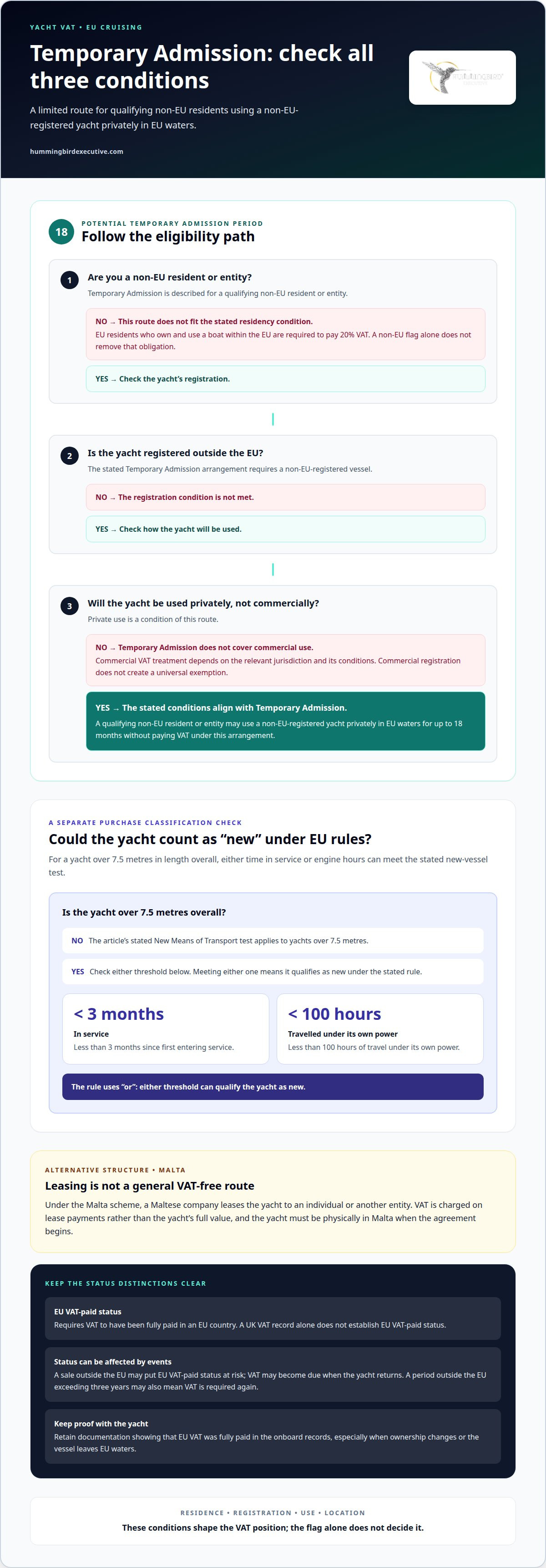
Temporary Admission allows a qualifying non-EU resident to use a non-EU-registered yacht in EU waters for 18 months without paying VAT. The vessel must be used privately, not commercially. This answers a practical planning question: a non-EU resident’s private cruising arrangement may be treated differently from an EU resident’s purchase or commercial charter.
Leasing is another ownership structure, not a general VAT-free route. Under the Malta scheme, a Maltese company leases the yacht to an individual or another entity, with VAT charged on lease payments rather than the yacht’s full value. The yacht must be physically in Malta when the agreement begins.
According to the European Union, a yacht over 7.5 metres in length overall qualifies as a new vessel if it has been in service for less than 3 months or travelled under its own power for less than 100 hours. The rules therefore use either threshold. A yacht qualifies if under 3 months have elapsed since first entering service, or if it has travelled under its own power for less than 100 hours.
For EU yacht charters, VAT is applied based on where the charter starts; the stated average rate is 20-22%. Commercial frameworks in Malta, France, and Spain may also affect purchase and supply treatment when their conditions are met. Chartering and private cruising are distinct uses, with different implications.
On sale, the yacht’s use and VAT status matter to the transaction. A European buyer of a non-VAT-paid yacht pays VAT on the purchase price. For buyers considering rare yacht opportunities, access to off-market yacht opportunities can sit alongside careful tax planning.
Yacht tax planning across flag state, residency, and cruising grounds
VAT planning depends on the owner’s residence, the yacht’s location and its intended use. Choosing a flag alone doesn’t settle the tax treatment.
Residence and Yacht Location
Residence and yacht location are central to determining which VAT arrangements may apply. A non-EU resident with a yacht registered outside the EU may qualify for Temporary Admission while privately cruising EU waters. By contrast, someone transferring residence to the EU while permanently importing a yacht may be eligible for VAT relief. The timing of the residence transfer and importation matters.
VAT Obligations for EU Residents
EU residents who own and use a boat within the EU are required to pay 20% VAT. A non-EU flag doesn’t, by itself, remove that obligation. For a private owner, the relevant considerations include residence, where the yacht is used, and whether the arrangement meets a specific customs or VAT framework. Commercial use follows different conditions from private cruising.
Temporary Admission permits a non-EU resident to cruise a non-EU-flagged yacht in the EU tax-free for 18 months, provided the yacht is used privately, not commercially. The owner must be a non-EU resident or entity, and the vessel must be registered outside the EU. An EU resident can’t rely on this arrangement simply by choosing a foreign flag.
May 2026 guidance says pleasure craft operating within the EU are generally presumed to have Union goods status. Owners aren’t routinely required to prove that status every time a vessel returns to its berth. The flag, registration country, or owner’s nationality alone doesn’t determine Union goods status under this interpretation.
For a yacht kept or cruised in EU waters, a key VAT risk is failing to meet the conditions of a claimed relief or temporary arrangement, leaving VAT due. Treatment depends on residence, registration, use and importation circumstances, so a breach can have tax consequences. No single penalty amount applies across these situations.
EU VAT on yacht purchases
When navigating VAT on yacht purchases in Europe, establish whether VAT has already been paid and where the yacht will be delivered. The seller’s type matters less than the vessel’s VAT status and the circumstances of the transaction.
Whether the seller is a private owner or a dealer doesn’t, by itself, determine the buyer’s VAT treatment. An EU resident buying a new or used yacht for personal use without VAT paid is responsible for VAT at the rate applicable where the yacht is delivered. Transfer tax or import duties may also apply. A European buyer of a non-VAT-paid yacht pays VAT on the purchase price.
There is no single standard VAT rate for every European country. The applicable rate depends on the Member State where delivery takes place, so the purchase location affects the amount payable. Pleasure yachts imported or acquired within the EU are generally subject to the full VAT rate in most EU countries. The rate may therefore differ depending on the delivery Member State.
For a new yacht, the New Means of Transport test can affect where VAT is due. According to the European Union, a yacht over 7.5 metres qualifies if it has been in service for less than 3 months or travelled under its own power for less than 100 hours. Either threshold can apply. A practical approach to navigating VAT on yacht purchases in Europe distinguishes this classification from a yacht’s VAT-paid status.
Age-related relief may also matter for older vessels. Under the described EU scheme, a yacht must have been moored in the EU on 31st December 1992 to qualify for deemed VAT-paid status. For Austria, Finland, and Sweden, the relevant mooring date is 31st December 1994. These dates can be significant when evaluating a yacht’s ownership and records.
Temporary Admission covers eligible temporary use; it isn’t a general way to purchase a yacht without VAT. When navigating VAT on yacht purchases in Europe, establish the vessel’s existing status, delivery Member State and applicable relief before agreeing terms or paying. A seller’s description alone doesn’t replace the evidence and transaction details needed to establish the tax position.
Hummingbird Executive
Hummingbird Executive provides members with access to rare assets, including yachts, for purchase or sale. Its Asset Sourcing service and concierge support can assist as a transaction takes shape; VAT treatment still depends on the yacht, transaction, owner and applicable jurisdiction.
Platinum Membership provides full access to rare assets and investments to buy or sell, with dedicated worldwide concierge services at no extra charge. Gold Membership offers white-glove services seven days a week during opening hours. Free access to worldwide white-glove service is also available during opening hours. These membership options provide discreet support as an acquisition or sale takes shape, without replacing tax analysis of the vessel’s status or intended use.
For a yacht purchase or sale, contact Hummingbird Executive to discuss access to rare assets and concierge support.
Make Your Next Yacht Decision Deliberately
A yacht acquisition is also a decision about how you intend to own, use and eventually sell the vessel. Before committing, bring those intentions together in a clear transaction brief. This can help identify where the purchase structure, expected cruising pattern and supporting records need to align, rather than treating each choice in isolation.
A disciplined approach to navigating VAT on yacht purchases in Europe treats tax status as part of the asset’s wider ownership plan. This perspective is useful whether you’re assessing a particular yacht or considering a future sale. Keep the commercial objective in view, and make each decision with the vessel’s intended role in mind.
For discreet support as you consider a yacht purchase or sale, contact Hummingbird Executive for advice. A considered next step can bring greater clarity to the opportunity ahead.
Frequently Asked Questions
So what is best VAT paid in UK?
UK VAT-paid status isn’t a substitute for EU VAT-paid status. If you intend to use the yacht primarily in EU waters, UK status alone doesn’t establish free circulation there. The reverse applies to an EU VAT-paid yacht used in the UK. The more suitable status depends on where the yacht will be kept and cruised, and where VAT has been paid. Treat cruising plans as part of the ownership decision.
How is VAT calculated on a new or used yacht bought in Europe?
For a non-VAT-paid yacht bought for personal use by an EU resident, VAT is calculated using the purchase price and the rate applicable where the yacht is delivered. The delivery Member State therefore matters. New vessels may also fall under the New Means of Transport rules, so distinguish that classification from whether VAT has already been paid. Transfer tax or import duties may also apply.
When is VAT due on a yacht purchase, and who is responsible for paying it?
When an EU resident buys a new or used yacht for personal use without VAT paid, the buyer is responsible for VAT at the rate applicable where delivery occurs. VAT may also arise when a yacht is imported into the EU, depending on its status and circumstances. A sale by a private owner rather than a dealer doesn’t, on its own, establish that VAT has been paid or remove the buyer’s responsibility.
How do EU VAT rules differ for yachts bought or kept outside the European Union?
A yacht kept or bought outside the EU doesn’t automatically acquire EU VAT-paid status. If an EU VAT-paid yacht is sold outside the EU, it may lose that status, and VAT may be due if it later returns. A qualifying non-EU resident may use Temporary Admission for a non-EU-registered yacht during private cruising in the EU. That treatment depends on residence, registration and private use, not simply the yacht’s location outside the EU.
What steps and costs are involved in importing a yacht into the EU and paying VAT?
First establish the yacht’s existing VAT status, intended use, owner’s residence, and EU delivery or import location. These details determine the applicable VAT treatment. For an EU resident buying a non-VAT-paid yacht for personal use, VAT is based on the purchase price and the delivery Member State’s rate. Transfer tax or import duties may also apply. The amounts depend on the transaction and jurisdiction, so there is no single total for Europe.
What is the standard VAT rate in each European country for yacht purchases?
There is no single standard rate for every European country. VAT is charged at the applicable rate in the Member State where the yacht is delivered. Pleasure yachts are generally subject to the full rate in most EU countries.