The best moment to sell a passion asset isn’t simply when its value has risen. A considered exit strategy for passion investments weighs market appeal against your need for liquidity, portfolio balance, and long-term objectives. If you want to retain some exposure, reducing a holding may make more sense than selling it outright.
It’s natural to want the timing and terms to reflect both an asset’s distinct character and your wider financial plans. This article explains signals that may support a sale or partial reduction, how to build discreet relationships with potential acquirers, and how to present a credible exit plan to investors. It also considers how a flexible timeline can preserve your options while keeping your rationale clear.
Key Takeaways
- Set your exit around the purpose of the investment, your liquidity needs, and the outcome you want to preserve.
- Build relationships with potential acquirers before a sale is urgent, sharing information selectively and focusing on strategic fit.
- Consider trimming when reducing exposure serves your objectives, while a full sale may better address a change in priorities or market conditions.
- Present investors with a flexible timeline, a clear rationale, and the alternatives you would consider if conditions change.
Exit strategies for business owners and investors
A sound exit plan links timing and ownership to the outcome you want. For a business, it also addresses continuity after a sale or leadership transition.
Passion investments include assets such as art, classic cars, wine, and collectibles, often held for personal interest as well as potential value. Unlike traditional investments, their valuation can depend heavily on rarity, condition, provenance, and the depth of the buyer market.
Passion Investment Sale Options
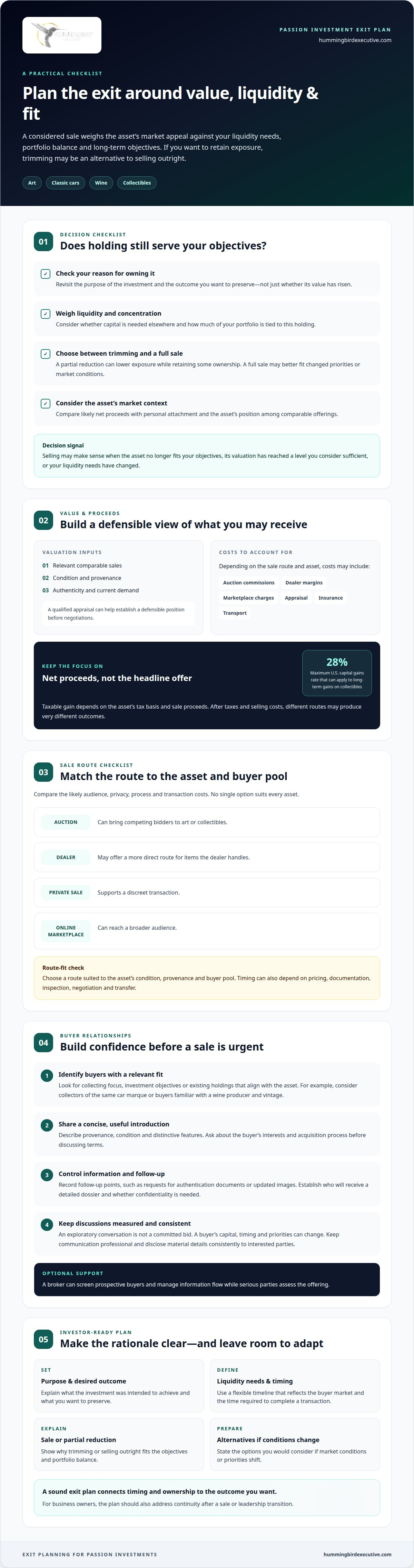
The sale route determines how an asset reaches buyers and how offers are handled. Auctions can bring competing bidders to art or collectibles; dealers may offer a more direct route for items they handle. Private sales support discreet transactions, while online marketplaces can reach a broader audience. For classic cars, wine, and art, choose a route suited to the asset’s condition, provenance, and buyer pool.
Compare the likely audience, privacy, process, and transaction costs before choosing a route. No single option suits every asset.
Valuation, Taxes, and Selling Costs
Fair market value is an estimate grounded in relevant comparable sales, adjusted for condition, provenance, authenticity, and current demand. A qualified appraisal can help establish a defensible position before negotiations. In the United States, long-term gains on collectibles can face a maximum capital gains rate of 28%; the taxable gain depends on the asset’s tax basis and sale proceeds. Selling costs may include auction commissions, dealer margins, marketplace charges, appraisal, insurance, and transport, depending on the route and asset.
Focus on net proceeds, not just the headline offer. After costs, an auction, dealer, private sale, or online marketplace may produce very different outcomes.
For business owners, transition options include a family transfer, third-party sale, management buyout, employee ownership plan, or leveraged recapitalization. Continuity depends on preserving essential expertise, customer relationships, and operational knowledge through the ownership change. A company less reliant on its owner may be easier to transfer smoothly.
Advisory support can help assess financial performance, market demand, buyer capacity, and sale readiness. Clean records, predictable processes, a capable management team, recurring revenue, and customer diversity can strengthen salable value. Investors can set a flexible timeline, define liquidity needs, and consider reducing a holding to diversify without exiting entirely.
Building relationships with potential acquirers
Potential acquirers are more than names on a future buyer list. A relationship built before an asset reaches the market gives both parties time to understand its provenance, condition, and strategic fit. For example, a collector interested in a particular artist may value documentation and ownership history as much as the work itself.
Identify buyers whose collecting focus, investment objectives, or existing holdings align with the asset. A classic-car owner might consider collectors of the same marque, while a wine seller could focus on buyers familiar with the producer and vintage. The aim is not to solicit an offer immediately. It is to learn what matters to a credible buyer and what information supports their decisions.
Keep early discussions measured and specific:
- Share a concise description of the asset, including provenance, condition, and distinctive features.
- Ask about the buyer’s interests and acquisition process before discussing terms.
- Record follow-up points, such as a request for authentication documents or updated images.
Control information carefully. Before sharing a detailed dossier, establish who will receive it and whether confidentiality is needed. A broker can screen prospective buyers and manage information flow, helping protect the seller’s position while serious parties assess the offering. Don’t present an exploratory conversation as a committed bid: a buyer’s capital, timing, and priorities can change.
Relationships can also clarify how a future transaction might work. A potential acquirer may prefer a private sale, need time to arrange capital, or require additional documentation before making a proposal. Understanding these preferences early can shape timing and reduce avoidable friction later. Keep communication professional, record substantive decisions, and disclose material details consistently to interested parties.
For a discreet view of rare-asset opportunities, explore private access to rare assets as you consider potential counterparties.
Business owners should assess whether their company is attractive to outside investors or strategic acquirers when choosing a transition path. Entrepreneurs should build a business that can operate independently of its owner to improve its salable value. Proactive steps to build salable value can potentially increase a business’s value by 300-500% within two to three years.
Reasons to sell or trim an investment
Selling can make sense when an asset no longer fits your objectives, its valuation has reached a level you consider sufficient, or your liquidity needs have changed. For example, a rare watch may have appreciated, but continued ownership still ties up capital and requires attention. Weigh likely net proceeds against personal attachment, portfolio concentration, and the asset’s position among comparable offerings. An exit strategy for passion investments connects these factors to a deliberate decision.
There’s no single selling period for art, classic cars, wine, or collectibles. Timing depends on buyer demand, the sale route, pricing, documentation, and the time needed for inspection, negotiation, and transfer. A well-documented asset with an interested buyer may move differently from a rare item requiring authentication or a specialist audience.
Prepare records that establish ownership and support the asset’s description. Depending on the item, these may include purchase documents, provenance, prior appraisals, authentication records, condition reports, service history, and title or registration documents. For a classic car, maintenance records and vehicle documents can answer buyer questions; for art, provenance and authentication materials can support an evaluation.
Market conditions are another reason to reassess a holding. If buyer interest shifts, comparable offerings increase, or an asset category evolves, consider whether the current valuation still supports your objectives. Selling may also make sense when an investment requires expertise or upkeep you no longer wish to provide. Compare expected proceeds with continued holding costs and the value of keeping the asset.
Trimming offers a middle course. Selling part of a collection or reducing exposure to one category can release capital while preserving an interest in future growth. For example, a collector might sell selected works while retaining pieces central to the collection. A disciplined exit strategy for passion investments can define the reduction in advance, then assess each candidate by condition, demand, personal significance, and likely sale costs. This keeps timing tied to purpose, not a single valuation or market signal.
Presenting an exit strategy to investors
An investor-facing exit plan should explain why you’re selling, the intended outcome, and how timing may evolve. For a passion asset, distinguish personal value from investment rationale. A collector may prize a painting’s place in a collection, while an investor may focus on liquidity, buyer demand, and portfolio concentration. Make the distinction explicit.
Set out a flexible timeline rather than a fixed sale date. Angels, venture capitalists, and other equity investors generally aim to achieve their target return within five to seven years. That horizon can inform discussions, but the plan should also explain what could change it, such as market demand, valuation, or a suitable buyer emerging earlier.
Show investors the choices behind the proposed exit. A clear presentation can include:
- Purpose: state whether the priority is liquidity, diversification, growth, or legacy.
- Route: explain whether a full sale, partial sale, or continued ownership best serves that purpose.
- Conditions: identify the market signals and buyer interest that would support a transaction.
- Alternatives: describe how the plan could adapt if demand or valuation changes.
For business owners, connect the exit to continuity. Investors will want to know who can lead after a transition, how key relationships will be maintained, and whether buyers can complete a transaction. For an art holding, the equivalent may be a documented provenance file and a credible route to interested collectors. These specifics make the plan assessable rather than aspirational.
Keep assumptions visible. Distinguish an indicative valuation from a confirmed offer, and explain how transaction costs affect expected proceeds. A credible presentation gives investors a reasoned framework for decisions, not a promise of a particular result. It also shows how the owner will navigate competing priorities, including capital needs and legacy objectives.
For a carefully managed route to rare-asset opportunities, explore private access to rare assets.
Hummingbird Executive: platinum Membership full access to rare assets ,investments, buy surch or sale plus 25/7 dedicated concierge services world wide at no extra charge,
Hummingbird Executive’s Platinum Membership is a natural next step when your plan involves acquiring or selling rare assets and investments. It provides full access to search, buy, or sell, with dedicated concierge services worldwide at no extra charge.
For a collector considering a partial sale or an investor seeking an acquisition, this access connects the next transaction to a wider view of rare-asset opportunities. The concierge service supports members as they navigate those decisions. Gold Membership offers white-glove services seven days a week during opening hours.
If your investment priorities are evolving and you would like to discuss membership, contact Hummingbird Executive.
Set Your Next Decision in Motion
Turn intention into a decision threshold. Define what would prompt action: a change in personal priorities, a target level of net proceeds, or a shift in how the asset fits your broader plans. Record your reasoning so a later decision reflects your objectives, not pressure in the moment.
Then decide what you want to retain, not only what you may release. That distinction can shape a more deliberate exit strategy for passion investments, particularly when an asset carries meaning beyond its financial value. A clear threshold also gives future conversations with investors and prospective acquirers a consistent point of reference.
When you’re ready to explore rare-asset opportunities in line with that plan, contact Hummingbird Executive. A considered next step can begin with a discreet conversation about your priorities.
Frequently Asked Questions
When Does It Make Sense to Sell Assets?
Selling makes sense when an asset no longer serves your financial or personal priorities, or when liquidity matters more than continued ownership. For example, if a collection is becoming difficult to manage or you need capital for another planned purpose, compare an outright sale with a partial reduction. A written threshold for acceptable net proceeds helps keep the decision aligned with your objectives.
What are the risks of holding a passion investment too long or selling in a weak market?
Holding too long can expose an asset to shifting demand, deterioration, storage needs, and concentration risk. Selling into a weak market can mean accepting less than your target. Distinguish a temporary lull from a lasting change in buyer interest. If a sale can’t be deferred, assess offers against net proceeds and your liquidity deadline rather than relying only on an earlier valuation.