The most expensive way to acquire a high-value aircraft is to buy one that is currently listed on the public market. In an environment where transparency is often sacrificed for visibility, private jet ownership costs are frequently obscured by layers of intermediary markups and unrecorded maintenance cycles. You’ve likely found that the traditional brokerage model fails to account for the “black holes” of depreciation that plague poorly sourced assets. It’s a frustrating reality for those who value precision over proximity.
This 2026 strategic guide provides a meticulous breakdown of the capital and operational requirements necessary to maintain a flight department at the highest level. We’ll examine the specific impact of new 25-hour cockpit voice recorder mandates and evolving environmental standards on your bottom line. You’ll gain a clear financial framework for budgeting that prioritizes off-market inventory and professional management, ensuring your transition into ownership is as seamless as the flights themselves. By shifting the focus toward curated, discreet acquisition, we move the conversation from simple expenditure to sophisticated asset facilitation.
Key Takeaways
- Master the three-pillar framework of private jet ownership costs, where the initial acquisition price represents less than half of a sophisticated five-year financial commitment.
- Distinguish between fixed preservation expenses and variable mission profiles to ensure your aircraft remains a high-performance asset rather than an unmanaged liability.
- Bypass the inefficiencies of public listings by leveraging off-market curation, effectively neutralizing the hidden markups and commissions found in the open market.
- Navigate the 2026 regulatory landscape with professional airworthiness management strategies that safeguard both your safety ratings and the asset’s long-term resale potential.
- Explore how a dedicated, 25/7 concierge serves as a silent partner, handling the intricate logistics of global aviation to protect your most finite resource: time.
Understanding the Real Cost of Private Jet Ownership in 2026
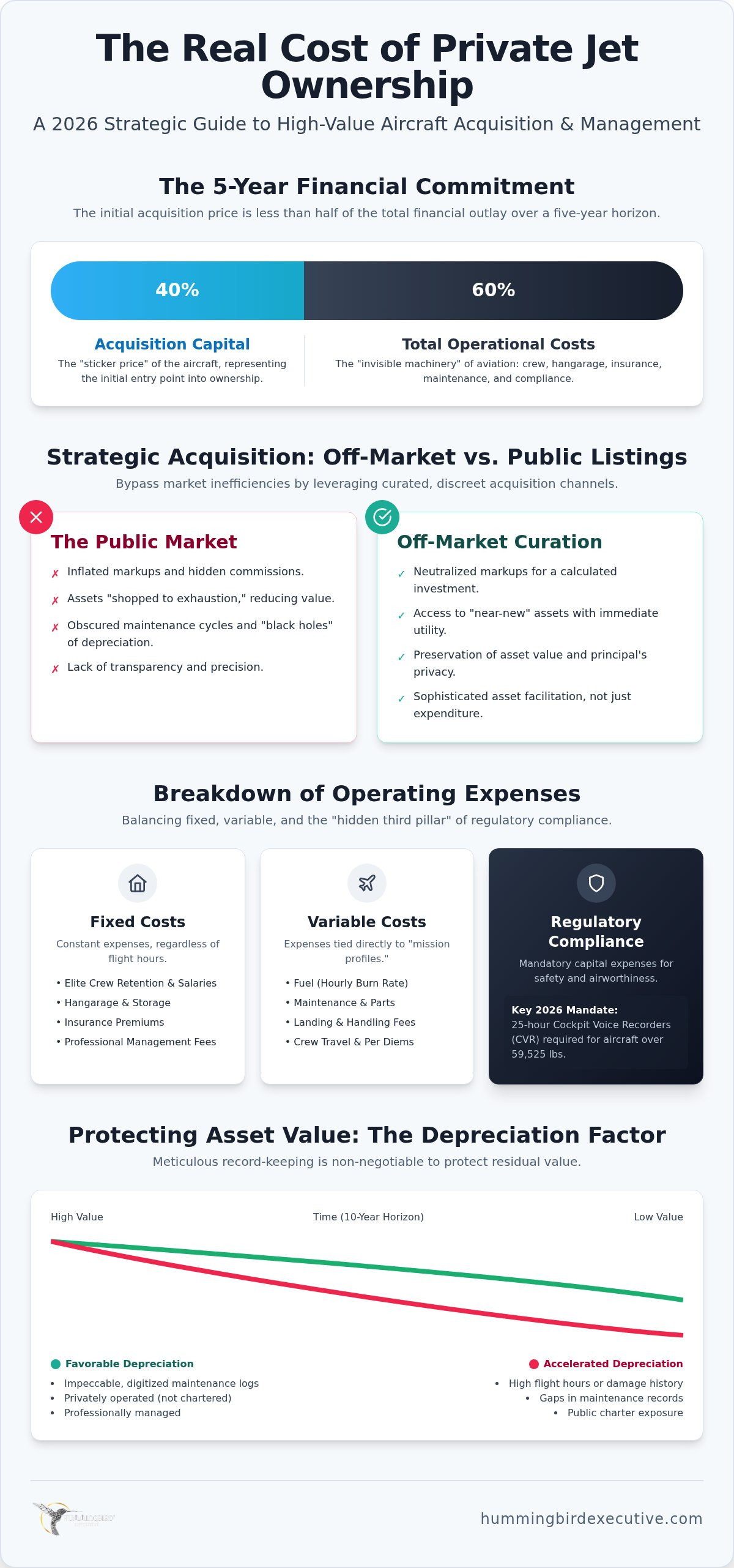
Strategic asset management begins with the realization that the initial purchase price is merely a down payment on a long-term operational commitment. In the current 2026 landscape, savvy principals recognize that private jet ownership costs are structured across three distinct pillars: acquisition capital, fixed operating expenses, and variable hourly burn. For most ultra-high-net-worth individuals, the “sticker price” of a Bombardier Global or a Gulfstream G700 represents only 40% of the total financial outlay over a five-year horizon. The remaining 60% is comprised of the invisible machinery of aviation: crew retention, hangarage, insurance, and the relentless demands of continuous airworthiness.
While mass-market brokers often highlight the entry price to close a sale, we prioritize the total cost of ownership. The 2026 market has seen a stabilization in global supply chains, which has paradoxically made pre-owned valuations more complex. As new-build delivery slots remain backlogged into the late 2020s, the premium on “near-new” off-market assets has intensified. Navigating this requires a silent facilitator who can bypass the public “luxury tax”—the inflated markups found on open listing sites where assets are often shopped to the point of exhaustion. By operating within a closed circle, we ensure the acquisition is a calculated investment rather than an emotional expenditure.
Acquisition Capital: The Entry Point
The choice between a new-build delivery and a pre-owned asset is a matter of timing and treasury strategy. New aircraft offer the latest in 2026 avionics and environmental compliance but require significant patience. Conversely, off-market opportunities provide immediate utility and often come with more favorable entry points. With July 2026 financing rates for new heavy jets hovering between 5.0% and 6.5% APR, the cost of capital remains a primary consideration for the 85% of owners who choose to finance. While some may consider the Fractional Ownership Model to mitigate these initial outlays, it lacks the absolute discretion and bespoke control afforded by full title. The most valuable assets never reach the public eye; they are moved quietly between private offices to preserve both the price and the principal’s privacy.
The Depreciation Factor: Protecting Your Investment
Depreciation is the single largest “hidden” cost of ownership. Heavy jets generally retain their value more robustly than light jets over a 10-year horizon, provided the maintenance pedigree is impeccable. In the 2026 market, the depreciation curve is defined as the predictable decline in an aircraft’s market value over time, accelerated by high flight hours or gaps in digitized maintenance logs. To protect the residual value of a high-value asset, meticulous record-keeping is non-negotiable. Discreet ownership structures also play a role; an aircraft that has not been “chartered out” to the public typically commands a significant premium upon resale, as the interior and airframe remain in pristine condition. Through our Platinum Membership, we provide the oversight necessary to ensure your asset remains on the favorable side of this curve.
Fixed vs. Variable: A Detailed Breakdown of Operating Expenses
Managing private jet ownership costs requires a bifurcated approach to the ledger. While the acquisition price is a singular event, the recurring expenses are what define the long-term viability of the asset. These costs are traditionally split into fixed and variable categories, but 2026 has introduced a “hidden third” pillar: regulatory compliance. New FAA mandates, such as the February 2026 requirement for 25-hour cockpit voice recorders on aircraft exceeding 59,525 lbs, have turned safety retrofits into a mandatory capital expense rather than a discretionary upgrade. Balancing these requirements requires a partner who understands that precision in the hangar is as vital as precision in the air.
Fixed Costs: Crew, Insurance, and Hangarage
Fixed expenses remain constant regardless of whether the aircraft flies ten hours or four hundred. In 2026, the premium for elite crew retention has reached a new threshold. For a Bombardier Global Express off-market acquisition, securing a captain rated for ultra-long-range missions typically requires a salary between £145,000 and £195,000. Insurance premiums have also shifted; off-market assets often necessitate bespoke underwriting to account for their unique provenance and limited public exposure. Hangarage in primary hubs like Teterboro or Farnborough continues to command a premium, reflecting the scarcity of secure, climate-controlled space in the world’s most frequented corridors.
Variable Costs: Fuel, Maintenance, and Landing Fees
Variable costs are dictated by your mission profile. A transcontinental flight in a Gulfstream G700 incurs a significantly different hourly burn than a short-haul regional hop. Fuel remains the most volatile variable, particularly with the 2026 structural price premium on Sustainable Aviation Fuel (SAF). In Northwest Europe, SAF prices are averaging $2,830 per metric ton, roughly double that of conventional jet fuel. These Strategic Considerations for Jet Ownership must be weighed against the efficiency of modern engines. Maintenance reserves must also be funded meticulously to prepare for “C-Checks” without disrupting your operational readiness. Landing and handling fees at exclusive executive terminals add a final layer of complexity to each journey. For those who prefer to delegate these intricacies, our Platinum Membership provides a seamless interface for managing every operational detail with absolute discretion.
Strategic Acquisition: How Off-Market Access Mitigates Costs
Public aviation listings are often the final destination for assets that failed to sell within private circles. By the time an aircraft appears on a global portal, its price has been inflated by “Broker Bloat,” a layering of commissions and marketing fees that typically adds 3% to 5% to the initial capital outlay. Controlling private jet ownership costs begins with the elimination of these unnecessary markups. By facilitating a “Quiet Sale,” we allow sellers of elite assets to exit their positions without the market volatility or public scrutiny that often accompanies high-value transactions. This creates a unique financial arbitrage opportunity for the buyer, where the purchase price reflects the true value of the asset rather than a broker’s inflated projection.
Accessing these opportunities requires more than just a network; it requires a silent infrastructure. Our platinum membership luxury concierge serves as the gateway to these restricted inventories, providing early access to fleet liquidations and private family office divestments before they reach the public domain. This proactive approach ensures that our members are not merely reacting to the market, but are positioned at the forefront of it. Due diligence is conducted with absolute discretion, auditing off-market aircraft through trusted technical partners without alerting the broader market or triggering a competitive bidding war.
The Anatomy of an Off-Market Deal
Identifying value in the off-market sector requires a deep understanding of private portfolio dynamics. We specialize in locating assets that may be considered “distressed” in terms of timing, such as a principal needing to move into a larger airframe before a new delivery slot, rather than the aircraft being in poor condition. For example, sourcing a low-hour Gulfstream GIVSP through a private family office divestment allows for a acquisition cost significantly lower than the public average. The “invisible hand” approach ensures that negotiations remain professional and detached, focusing purely on the technical and financial merits of the deal.
Tax and Legal Optimization
Strategic acquisition extends into the fiscal structure of the ownership. Registering an aircraft in the correct jurisdiction can offer substantial advantages in terms of VAT treatment and 2026 luxury tax mitigation. Our 24/7 dedicated concierge handles the cross-border legal complexities, ensuring that the transition of title is as seamless as the flight itself. To maintain the highest levels of security, we operate on a no-cookie platform, ensuring that high-net-worth transactions remain entirely private and free from digital tracking. This commitment to discretion is the primary currency of our inner circle.
Infrastructure and Management: Navigating the Invisible Overheads
Optimizing private jet ownership costs requires moving beyond the mindset of simple logistics toward a model of continuous asset protection. The debate between in-house flight departments and outsourced management often centers on control, yet the financial reality of 2026 favors the latter for all but the largest corporate fleets. A professional management partner doesn’t just coordinate flights; they act as a gatekeeper for the aircraft’s pedigree, leveraging global networks to secure preferential rates on fuel, insurance, and hangarage that an individual owner simply cannot access. This strategic oversight ensures that the “invisible” overheads don’t erode the capital advantages gained during the acquisition phase.
Central to this preservation is Continuous Airworthiness Management (CAMO). In 2026, safety ratings and resale values are increasingly dictated by the granularity of digitized maintenance logs and real-time telemetry. Standard business hours are insufficient in a world where an aircraft may be in London while its principal is in Singapore. While our gold membership luxury services provide white-glove support during standard hours for secondary assets, the complexities of a primary jet demand the 25/7 dedicated concierge oversight found at our Platinum level. This ensures that every regulatory update and operational hurdle is cleared before it can impact your schedule.
Crew Retention and Training
The high cost of pilot turnover is a variable that many owners fail to forecast. Beyond the £35,000 required for annual pilot training cycles, the loss of a trusted crew disrupts the seamless environment of the cabin. Mandatory 2026 training for updated avionics suites and new environmental monitoring systems adds another layer of necessary expenditure. We mitigate these risks by fostering a culture of professional distance and absolute support, ensuring the “Hummingbird Standard” of service is maintained without the friction of frequent personnel changes. Bespoke catering and cabin service are managed with the same level of curation, turning a variable cost into a signature experience.
Maintenance Planning and Downtime
The Aircraft on Ground (AOG) scenario is the most significant threat to the utility of your investment. An unscheduled repair in a remote location can result in six-figure recovery costs if not managed through a global concierge network capable of sourcing rare parts across borders. The return on investment for proactive maintenance is realized through the preservation of the aircraft’s hull value and the prevention of catastrophic depreciation during its next major inspection cycle. To ensure your flight department operates with this level of unflappable precision, we invite you to explore our bespoke management facilitation services.
Bespoke Aviation Facilitation: The Hummingbird Executive Advantage
Optimizing private jet ownership costs requires more than just technical oversight; it demands an elite facilitation partner who operates within the silent market. While standard management firms treat aviation as an isolated logistics problem, we view it as a critical pillar of a high-value asset portfolio. Our Platinum Membership provides a holistic approach that synchronizes your flight department with other rare investments, including off market properties. This integrated perspective ensures that capital is deployed with maximum efficiency across your entire estate, removing the friction often found when dealing with multiple, disconnected service providers.
Discretion is our primary currency. Unlike mass-market platforms that rely on high-trace, app-based booking systems, we operate a secure, no-cookie hub. This allows our members to transact high-value assets without leaving a digital footprint. For our Platinum members, managing private jet ownership costs is an integrated component of a broader wealth preservation strategy. Our 25/7 dedicated concierge acts as a silent extension of your family office, handling the complexities of global logistics and cross-border compliance with unflappable precision. It’s a level of service that exists beyond the reach of the public market.
Seamless Integration of Luxury Assets
True executive support is defined by the ability to manage the synergy between diverse assets. Whether you’re transitioning from your aircraft to a private luxury car collection investment or coordinating a season on your yacht, a single point of contact ensures total continuity. During the first 90 days of membership, we focus on a meticulous audit of your current operational structures to identify immediate cost-saving opportunities and security enhancements. This white-glove onboarding process is designed to align our “invisible hand” with your specific lifestyle requirements, providing a foundation of absolute reassurance.
Your Invitation to the Silent Market
Access to our members-only marketplace is reserved for those who value rarity and privacy above all else. The vetting process for our Platinum and Gold membership tiers is rigorous, ensuring the integrity of our inner circle remains uncompromised. We don’t advertise to the masses; we invite peers to join a protected environment where discretion is guaranteed. If you require a partner who operates with the same level of sophistication as your own team, we invite you to take the next step. Inquire about private aviation facilitation with Hummingbird Executive to begin the curation of your 2026 flight department.
Securing Long-Term Value in the Silent Market
Navigating the complexities of 2026 aviation requires a shift from reactive spending to proactive asset facilitation. We’ve explored how the true scope of private jet ownership costs extends far beyond the initial transaction, encompassing regulatory compliance, elite crew retention, and the nuances of the “hidden third” pillar. By prioritizing off-market acquisitions through a secure, no-cookie private marketplace, you bypass the inefficiencies of public listings and preserve the integrity of your capital. It’s the difference between being a participant in the market and being a leader of it.
Our expertise in off-market Gulfstream and Bombardier acquisitions ensures your portfolio remains resilient against market volatility. With a 25/7 dedicated worldwide concierge acting as your silent partner, every operational detail is managed with absolute professional distance. This isn’t just about logistics; it’s about the security of an inner circle that values your privacy as much as your time. We invite you to Explore Platinum Membership for Exclusive Asset Access and discover a more refined approach to high-value asset management. We look forward to facilitating your next acquisition with the discretion it deserves.
Strategic Aviation Intelligence: Frequently Asked Questions
How much does it cost to operate a private jet for 200 hours per year in 2026?
Operating a mid-to-heavy jet for 200 hours in 2026 generally incurs expenses between $700,000 and $1.5 million, though this varies significantly by airframe type. This figure includes fuel, crew salaries, and maintenance reserves. Since fixed costs are spread over fewer hours, the effective hourly rate appears higher than for high-utilization fleets. It’s a calculation that requires precise management to ensure the asset remains a viable tool rather than a liability.
What is the difference between fixed and variable costs in private aviation?
Fixed costs are the baseline expenses required to keep an aircraft airworthy regardless of flight frequency, such as crew retention, bespoke insurance, and hangarage. Variable costs are mission-dependent expenditures, including fuel burn, landing fees, and hourly maintenance wear. Balancing these two categories is essential for mastering private jet ownership costs and maintaining a transparent flight department budget throughout the year.
When does private jet ownership become more cost-effective than chartering?
Private jet ownership costs generally become more favorable than chartering when a principal exceeds 200 to 300 flight hours annually. Below this threshold, the fixed costs of management and elite crew often outweigh the convenience of title. However, for those who require absolute discretion, immediate availability, and the ability to curate their own cabin environment, ownership remains the preferred strategic choice regardless of the total hours flown.
How do off-market acquisitions reduce the total cost of private jet ownership?
Off-market acquisitions reduce the total cost of ownership by bypassing public broker commissions, which typically add 3% to 5% to the purchase price. By transacting through a “Quiet Sale,” buyers avoid competitive bidding wars that artificially inflate asset values. This curated approach allows for a lower initial capital outlay and provides access to high-quality aircraft that never reach the visibility of the public market.
What are the hidden costs of jet management that most owners overlook?
Owners often overlook the financial impact of new regulatory mandates, such as the February 2026 requirement for 25-hour cockpit voice recorders on heavy jets. Other “invisible” costs include the premium required for elite crew retention and the logistics of sourcing parts during unscheduled maintenance events. Professional management through a trusted partner mitigates these risks by providing a structured framework for continuous airworthiness and operational readiness.
How does Sustainable Aviation Fuel (SAF) impact operating budgets in 2026?
Sustainable Aviation Fuel significantly increases variable operating budgets, as it currently trades at approximately 2.5 times the price of conventional jet fuel. In 2026, principals operating in Europe and North America face higher fuel surcharges to meet evolving environmental standards. Strategic fuel planning and bulk purchasing through an established management network are essential to offset these structural price premiums and maintain budget predictability.
Can a luxury concierge membership help offset the costs of aircraft management?
A dedicated concierge doesn’t just manage logistics; it serves as a gatekeeper that prevents costly operational errors and administrative friction. Platinum members benefit from a 25/7 support system that handles cross-border legalities and technical facilitation at no extra charge. This “invisible hand” approach reduces the need for a large in-house administrative team, effectively lowering the overhead associated with managing complex, high-value asset portfolios.
Is it better to buy a new jet or a pre-owned aircraft from the silent market?
While new jets offer the latest 2026 avionics, they involve long lead times and immediate depreciation upon delivery. Pre-owned aircraft sourced from the silent market provide immediate utility and a more stable depreciation curve. For most sophisticated buyers, a low-hour, off-market Bombardier or Gulfstream offers the best balance of capital efficiency and operational performance, provided the maintenance pedigree is verified through discreet due diligence.