The most significant acquisitions in the automotive world never appear on a public auction block. You likely recognize that high-profile sales often come with a heavy price beyond the hammer; public visibility and excessive fees frequently compromise the integrity of a private luxury car collection investment. With the Hagerty Market Rating currently holding at 58.59, the 2026 market has entered a flat phase where precision and insider access are the only ways to ensure meaningful growth.
We understand that sourcing truly rare examples requires a level of discretion that the open market simply cannot provide. This article outlines a strategic framework for managing high-value assets within a protected inner circle. You’ll discover which marques remain resilient against the 28% capital gains tax on collectibles and why the shift toward 1990s analog supercars is defining the current investment landscape. We provide a clear path to a secure, private marketplace where provenance is rigorously vetted and your anonymity remains the highest priority.
Key Takeaways
- Identify the three definitive pillars of value—rarity, historical significance, and condition—that distinguish true investment-grade assets from standard luxury vehicles.
- Learn the strategic advantages of off-market acquisitions to protect your anonymity and bypass the visibility of public auction houses.
- Understand the financial mechanics that make a private luxury car collection investment a resilient hedge against global currency fluctuations and inflation.
- Explore the “Car Ladder” methodology for systematically diversifying a portfolio from entry-level exotics toward high-value, finite rarities.
- Access the framework for global asset management, including secure cross-border logistics and the necessity of dedicated concierge support.
The Anatomy of a Private Luxury Car Collection Investment
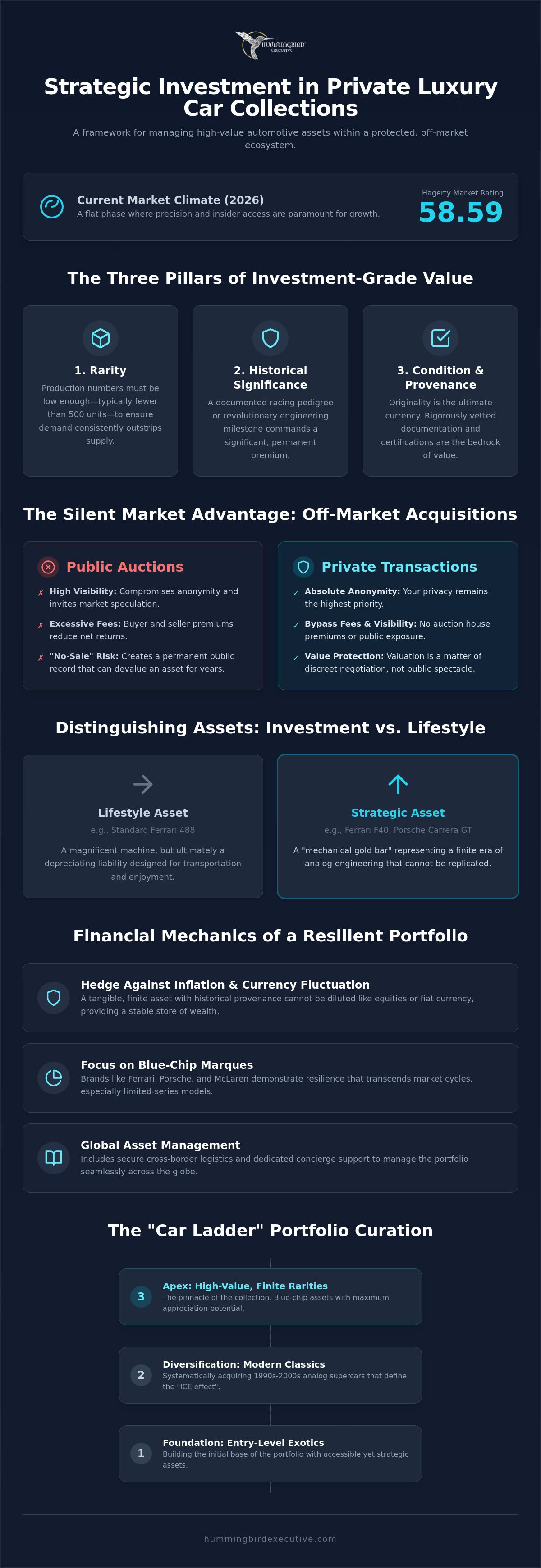
Most high-performance vehicles are depreciating liabilities. A true private luxury car collection investment operates on a different plane. It isn’t about transportation; it’s about preservation. In 2026, as digital markets face increased volatility and federal mandates begin requiring driver monitoring technology in new vehicles, tangible assets offer a silent, steady sanctuary. UHNWIs are increasingly pivoting toward these “mechanical gold bars” because they represent a finite era of engineering that cannot be replicated.
The transition from a mere enthusiast to a strategic collector requires a clinical eye for the three pillars of value. Rarity is the first pillar. Production numbers must be low enough to ensure demand always outstrips supply. Historical significance is the second. A vehicle with a documented racing pedigree or one that introduced a revolutionary engineering milestone will always command a premium. Condition is the final, non-negotiable pillar. In the current market, originality is the ultimate currency. A car that has been over-restored often loses the “soul” that serious collectors covet.
Facilitating these high-value transfers requires an invisible hand. The most significant deals happen behind closed doors, away from the noise of public bidding. This discreet approach ensures that the asset’s entry into a portfolio doesn’t trigger unnecessary market speculation or compromise the owner’s privacy.
Distinguishing Lifestyle Assets from Investment-Grade Vehicles
A standard Ferrari 488 is a magnificent machine, but it’s a lifestyle choice. An F40 is a strategic asset. The distinction lies in the “analog” supercar trend. Collectors in 2026 are focused on 1990s and 2000s models because they represent the peak of mechanical engagement. As electrification reshapes the industry, these naturally aspirated internal combustion engines (ICE) are becoming finite relics. This “ICE effect” is driving a two-tier market where modern classics are outperforming their contemporary counterparts. Identifying these shifts early is why a private luxury car collection investment requires a sophisticated long-term view.
The Role of Provenance and Documentation
Documentation is the bedrock of value. Without it, you have a car; with it, you have an asset. Successful investment requires expertise in vetting factory certifications, such as Ferrari Classiche or Lamborghini Polo Storico. These certifications act as a global gold standard for authenticity. We prioritize private, vetted maintenance logs over public service records. Private logs preserve the discreet nature of the asset’s history while proving it has been maintained to an exacting standard. The story of the car, its previous keepers, and its original configuration is often as valuable as the engine itself.
Financial Mechanics: Appreciation and the Economics of Rarity in 2026
While the broader Hagerty Market Rating of 58.59 suggests a flat period for common collectibles, the apex of the market operates under a different set of rules. For those treating a private luxury car collection investment as a serious financial vehicle, the focus remains on blue-chip marques. Brands like Ferrari, Porsche, and McLaren have historically demonstrated a resilience that transcends standard market cycles. This is particularly true for limited-series models where production is capped at fewer than 500 units, creating a permanent state of suppressed supply.
Global inflation continues to erode the purchasing power of traditional currency, driving a flight toward tangible, finite assets. Unlike equities or digital holdings, a physical asset with historical provenance cannot be diluted. When an asset is held off-market, its price floor is inherently protected. Public auctions often risk a “no-sale” scenario, which creates a permanent, searchable record that can devalue a car for years. Private transactions circumvent this visibility, ensuring that the asset’s valuation remains a matter of discreet negotiation rather than public spectacle.
Market Resilience of Blue-Chip Marques
The Porsche Carrera GT serves as a definitive case study in the 2026 market. Its value has remained robust even as younger collectors shift their focus toward “modern classics” from the late 1990s. This stability is mirrored in emerging markets, where a new generation of UHNWIs is seeking out European performance icons as a status-backed store of wealth. Balancing a portfolio between these vintage icons and modern hypercars requires a methodical approach to liquidity and risk. Identifying which models will transition from contemporary performance cars to investment-grade rarities is where discreet market intelligence becomes indispensable.
Calculating the Total Cost of Ownership (TCO)
Acquiring the asset is only the initial step. Maintaining its value requires a rigorous approach to climate-controlled storage and specialized logistics. In 2026, enclosed storage for high-value collections typically ranges from $175 to $272 per month, excluding the costs of specialized maintenance and discreet, high-limit insurance coverage. These operational expenses are necessary to preserve the vehicle’s condition pillar. The total cost of ownership is effectively offset by the asset’s appreciation within a suppressed-supply market where demand for off-market examples remains constant.
The Silent Market: Why the Best Acquisitions Never Reach the Auction Block
Public auctions are designed for spectacle. While they generate headlines, they often fail the requirements of a sophisticated private luxury car collection investment. The primary deterrents are visibility and cost. High commissions, combined with the public disclosure of final sale prices, strip the transaction of the discretion that UHNWIs require. When an asset is sold under the hammer, its provenance becomes a matter of public record, which can limit the strategic options for future portfolio rebalancing.
The rarest automotive assets circulate within members-only circles. These transactions occur in the “silent market,” where assets are traded between established collectors without ever appearing in a digital catalog. This environment protects the seller’s identity and ensures the buyer’s portfolio remains shielded from public scrutiny. Private consulting firms act as gatekeepers here. They vet every asset for mechanical integrity and historical accuracy before it is ever presented to a potential buyer.
The Risks of Public Exposure for UHNW Collectors
Public exposure carries inherent financial risks. A single “no-sale” at a high-profile event can artificially crash the market for a specific model, creating a permanent digital footprint that devalues similar examples. Privacy is the ultimate currency in high-stakes asset management. Keeping high-value assets off the digital grid prevents unwanted attention and preserves the long-term integrity of the collection. Understanding how to navigate this space is essential; for a deeper look at these mechanics, consider The Architect of Discretion: Understanding the Secure Private Asset Marketplace.
Navigating Private Treaty Sales
Private treaty sales offer a methodical, secure alternative to the frantic pace of an auction room. The process is governed by a clear sequence: a formal Letter of Intent (LOI), followed by rigorous due diligence and the use of secure escrow services. This structure ensures that both parties are protected throughout the exchange. Utilizing a secure, no-cookie platform allows collectors to browse rare assets without leaving a data trail for trackers or competitors. A white-glove facilitator manages every detail of the cross-border transaction, from title transfer to secure delivery, ensuring a seamless transition of ownership. This level of precision is the hallmark of a professional private luxury car collection investment strategy.
Strategic Portfolio Curation: Diversifying Beyond Traditional Equities
A private luxury car collection investment serves as a mechanical anchor within a sophisticated multi-asset strategy. In 2026, as traditional equities face headwinds from shifting federal mandates and digital market volatility, tangible assets provide a necessary layer of insulation. These vehicles often move independently of the stock market. Their value is dictated by global rarity and historical provenance rather than quarterly earnings reports or central bank interest rates. This low correlation makes them an ideal hedge for those seeking to preserve capital while maintaining a high-performance portfolio.
Strategic growth within this asset class often follows a “Car Ladder” approach. This methodology involves a disciplined progression from entry-level exotics, which provide immediate tactile enjoyment, to investment-grade rarities that anchor long-term wealth. By systematically upgrading assets as market trends shift, a collector can refine the quality of their holdings without increasing overall risk exposure. This process requires a long-term view of The Future of Rarity: A 2026 Analysis of Investing in Tangible Luxury Assets.
Historical Significance vs. Modern Performance
The “Le Mans” effect remains one of the most powerful drivers of long-term value in the automotive sector. Vehicles with a documented racing pedigree or those that share DNA with legendary endurance winners command a permanent premium. However, a specific sub-sector is currently outperforming broader trends: the “Last of the Manuals.” As manufacturers move toward seamless but detached dual-clutch systems and electric powertrains, the demand for a visceral, manual connection has intensified. Spotting these future classics before they reach peak market value involves identifying the final production years of naturally aspirated engines and traditional gearboxes.
While many investors focus on historical preservation, there is a parallel demand for high-end builds that offer modern performance within a classic frame. To discover how these two worlds are merged, visit Elite Restomods and explore their approach to high-performance classic car restoration.
The Intersection of Tangible Assets and Wealth Preservation
Owning a rare car provides a unique emotional dividend that traditional financial instruments cannot match. It’s an asset you can experience. Beyond the tactile pleasure, these vehicles act as a robust hedge against currency fluctuation, particularly when the collection is managed with a global perspective. Multi-generational planning is essential here. A well-curated collection isn’t just a personal holding; it’s a legacy that requires a structured approach to succession and preservation. Secure your position in the silent market by exploring our private asset acquisition services to ensure your portfolio remains as resilient as it is rare.
Securing the Portfolio: Discretion and Global Facilitation
The final phase of a successful private luxury car collection investment involves the meticulous management of the asset’s lifecycle. Acquisition is merely the starting point. For the global collector, the challenges of cross-border logistics and secure storage require a partner who operates with total discretion. Moving a high-value asset between continents isn’t a task for standard freight services. It demands specialized air freight solutions that prioritize security and climate control throughout the journey. Collectors must also account for shifting regulatory landscapes; for instance, the total duty for importing classic and race cars into the US stands at 12.5% as of February 2026. This level of oversight ensures that the condition pillar, discussed in the opening of this guide, remains uncompromised regardless of the asset’s location.
Strategic asset management often requires integrating automotive holdings with other elements of a high-net-worth portfolio, such as private aviation and maritime assets. Just as RateHighway provides essential rate automation and pricing strategy tools for the car rental industry, the luxury investment sector relies on sophisticated data to maintain a competitive edge. A car is rarely a standalone investment in this tier; it’s part of a broader ecosystem of rare acquisitions that must be managed with a singular, cohesive vision. A private investment membership serves as the modern gateway to this world, providing the infrastructure needed to facilitate these complex, multi-asset transfers behind a veil of absolute privacy. This approach allows for the silent movement of wealth across borders without the friction of public disclosure.
Integrating Concierge Support with Asset Management
A dedicated concierge is the silent engine behind a high-performing collection. They handle the white-glove details of acquisition, from initial vetting to the final delivery at a secure facility. This service extends beyond simple logistics; it involves leveraging a global network to source specific VINs or rare configurations that never reach the public eye. 24/7 support is essential for managing a global portfolio, particularly when coordinating inspections or maintenance across different time zones. For those seeking to understand the mechanics of this exclusive access, it’s beneficial to review The Architect of Rarity: Evaluating the Private Investment Membership Club for Off-Market Assets.
The Hummingbird Executive Advantage
The Platinum Membership offers a definitive path for those serious about building a discreet automotive portfolio. It provides full access to a secure, off-market marketplace where rare assets are traded with total anonymity. Our commitment to security is reflected in our no-cookie platform policy. It ensures that your browsing history and investment interests remain entirely private, removing the digital footprint that often plagues public transactions. Platinum members also benefit from 24/7 dedicated concierge services worldwide at no extra charge, ensuring that every private luxury car collection investment is managed with unflappable precision. Starting the journey requires only a methodical first step into a world where rarity is protected and discretion is the primary currency.
The Future of Automotive Curation
The landscape of high-value asset management in 2026 demands a departure from public spectacle. By prioritizing rarity and historical provenance over mass-market visibility, a private luxury car collection investment becomes a resilient pillar of a broader wealth strategy. You’ve seen how these transactions protect both the asset’s price floor and your personal anonymity. Success now relies on the precision of the invisible hand.
Our platform provides the necessary infrastructure for this level of curation. Through expert vetting of all off-market assets and a secure, no-cookie private marketplace, we ensure your interests remain entirely shielded from the digital grid. A 24/7 dedicated global concierge stands ready to facilitate every detail of your acquisition, from the initial sourcing of specific VINs to secure cross-border logistics.
Explore Exclusive Off-Market Automotive Opportunities with Platinum Membership
The transition from an enthusiast to a strategic collector is a journey defined by discretion. We invite you to secure your position within this protected inner circle where your legacy is treated with meticulous care.
Frequently Asked Questions
Is a private luxury car collection investment safer than the stock market?
Automotive assets offer a low correlation to traditional equities, acting as a tangible hedge against digital market volatility. While no investment is without risk, the 2026 market shows that blue-chip marques often retain value when broader markets fluctuate. It’s a physical store of wealth that isn’t subject to corporate earnings reports or central bank policy shifts. This independence makes it a resilient leg of a diversified multi-asset strategy.
What are the most sought-after off-market cars in 2026?
The current market is dominated by 1990s and 2000s “analog” supercars that offer a visceral driving experience. Models like the Porsche Carrera GT and Ferrari F40 remain at the apex of collector demand due to their mechanical purity. We’re also seeing a significant rise in the “Last of the Manuals” sub-sector. Collectors are prioritizing naturally aspirated engines produced before the federal mandate for driver monitoring technology became standard in new vehicles.
How do I verify the provenance of a car in a private treaty sale?
Verification relies on the clinical vetting of factory certifications and private, authenticated maintenance logs. A successful private luxury car collection investment requires cross-referencing VINs against global archives and racing registries to ensure an unbroken history. We facilitate physical inspections by specialized technicians who verify that the mechanical integrity matches the documented provenance. This rigorous process ensures that the asset’s story is as genuine as its engineering.
What is the minimum entry point for an investment-grade car collection?
Investment-grade status is defined by rarity and mechanical significance rather than a specific price bracket. You should look for models with production runs limited to fewer than 500 units or those that represent a definitive engineering milestone. High-volume luxury cars typically depreciate; true assets are found in the finite relics of the internal combustion era. Focus on vehicles that have already transitioned from contemporary performance cars to recognized modern classics.
Can I manage my car collection through a luxury concierge service?
Yes, a dedicated concierge handles the white-glove details of acquisition, maintenance, and global logistics. For Platinum members, this support is available 24/7 to manage assets across multiple time zones without requiring the owner’s direct involvement. They coordinate everything from specialized climate-controlled storage to routine mechanical preservation. This ensures your portfolio remains in peak condition while you maintain your focus on broader strategic interests.
Why should I avoid public auctions for high-value car acquisitions?
Public auctions involve high commissions and a loss of anonymity that can compromise your long-term strategy. A “no-sale” at a high-profile event creates a permanent digital record that can artificially devalue an asset for years. Off-market transactions protect the seller’s identity and ensure the buyer’s portfolio remains shielded from public scrutiny. This discreet environment allows for a private luxury car collection investment to grow without the noise of market speculation.
How does a no-cookie platform protect my investment privacy?
A no-cookie platform ensures your browsing history and specific asset interests aren’t tracked or sold to third parties. This prevents the creation of a digital footprint that competitors or data brokers could use to monitor your acquisition patterns. It’s a fundamental security measure for those who require absolute discretion. By removing tracking technology, we provide a secure environment where you can explore rare automotive opportunities without leaving a trail for the digital grid.
What are the logistics of moving a rare car collection internationally?
International transport requires specialized air freight solutions and a precise understanding of global customs regulations. For example, as of February 2026, the total duty for importing classic cars into the US is 12.5%. We manage the end-to-end process, including secure enclosed transport and climate-controlled freight handling. This methodical approach ensures that high-value assets are moved with the protection necessary to preserve their investment-grade condition across every border.