In the 2026 aviation market, a public listing is no longer a marketing tool; it’s a liability that invites market taint and erodes the residual value of your most significant mobile asset. To sell private jet discreetly is to move in silence, bypassing the digital noise that attracts unqualified “tyre-kickers” and public tracking of your tail number. You understand that the moment an aircraft hits the open market, its exclusivity begins to evaporate. It’s a sentiment shared by those who value the sanctity of their personal and financial privacy above all else.
This article details the strategic protocol for a silent, off-market exit, ensuring you retain maximum asset value while maintaining a zero-footprint transaction. We’ll explore the sophisticated architecture of the silent market, where vetting is the primary gatekeeper. You’ll learn how to navigate the 2026 regulatory shifts, including the substantial increases in UK Air Passenger Duty and EU fuel mandates, without alerting the broader market to your divestment plans. We’re moving beyond traditional brokerage into a world of curated, high-stakes facilitation where the invisible hand of a dedicated concierge ensures your privacy remains uncompromised.
Key Takeaways
- Understand how public listing data creates “market taint” and why private placement is the only way to preserve your asset’s true negotiation leverage.
- Access the 2026 strategic protocol to sell private jet discreetly through a gated ecosystem of vetted principals and global family offices.
- Evaluate the ROI of private sales, which consistently close closer to the asking price by eliminating the “time on market” stigma.
- Implement a rigorous five-step internal audit to prepare your aircraft’s records and maintenance history for a silent, high-value transfer.
- Learn how a Platinum Membership provides the “invisible hand” required to facilitate a secure, zero-footprint transaction on a global scale.
The Strategic Imperative of Discretion in Private Aviation
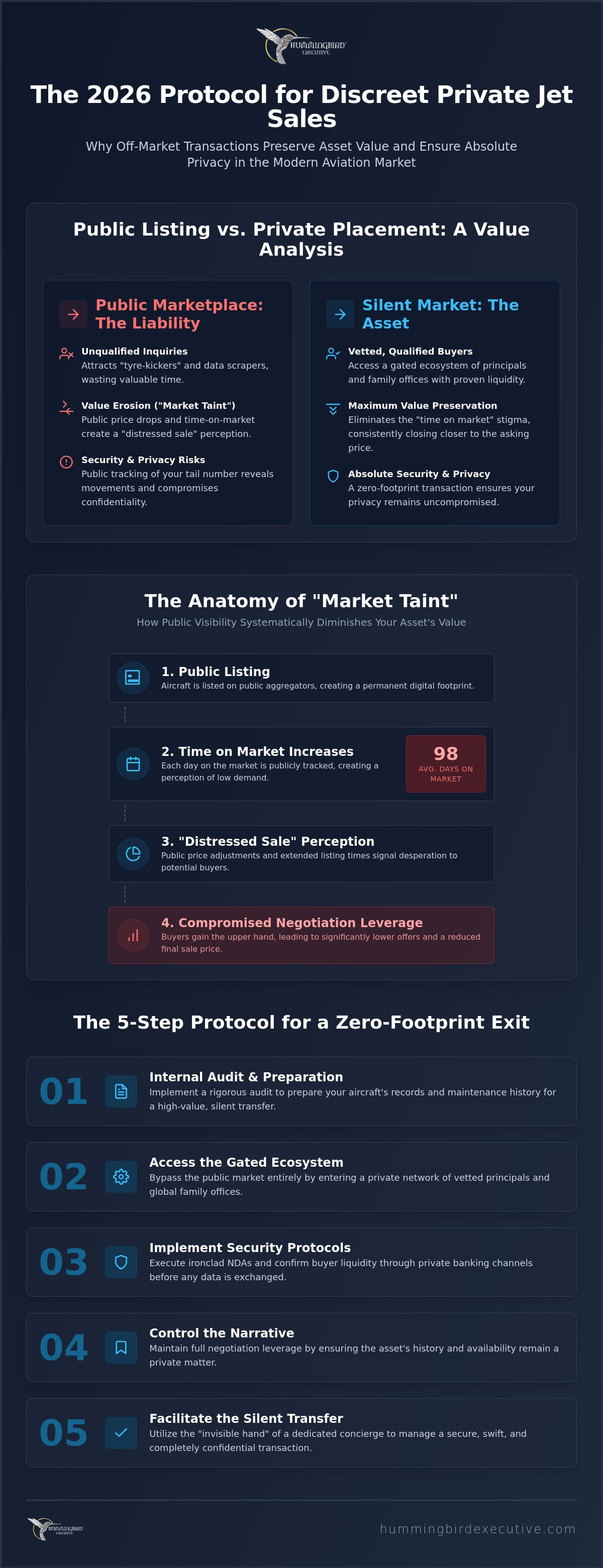
A public listing is often the first step toward eroding an asset’s value. In the sphere of private aviation, visibility is frequently mistaken for viability. However, for the discerning owner, the decision to sell private jet discreetly is a calculated defensive maneuver. Public records and aggregator sites create a permanent digital footprint that tracks every price adjustment and day spent on market. As of April 2026, the average time a pre-owned aircraft remains on the market has risen to 98 days. When this data is public, it signals a lack of demand, giving buyers undue leverage during negotiations. This “market taint” is difficult to scrub once it settles into the public consciousness. It creates a narrative of stagnation that is entirely avoidable through a silent exit.
Protecting your tail number is another critical pillar of this protocol. Digital tracking platforms allow anyone with an internet connection to monitor your movements. This is a significant security risk during a sensitive transaction. Selling off-market ensures your operational patterns remain private. It prevents competitors or the public from speculating on your corporate movements or personal transitions. Discretion is the primary currency of the elite; it’s a tool for maintaining absolute confidentiality through a controlled environment.
The Downside of the Public Marketplace
Aggregators scrape data with predatory efficiency. They archive speculative pricing and historical data, creating a permanent paper trail that compromises your security. High-level buyers often experience “spec-sheet fatigue” when they see the same airframe appearing across multiple public platforms. It strips the asset of its rarity. A public price drop can trigger a “distressed sale” perception, even if the divestment is purely strategic. By avoiding the open marketplace, you maintain the narrative of exclusivity and control. You ensure the asset’s history remains a private matter, accessible only to those who have been rigorously vetted.
Security Protocols for High-Value Divestment
True security in high-value divestment requires more than a simple handshake. It demands a rigorous gatekeeping process. Before a single digital logbook is shared, comprehensive non-disclosure agreements (NDAs) must be executed. We prioritize vetting prospective buyers through established private banking channels to confirm liquidity before granting access to sensitive data. This “invisible hand” approach filters out the noise. It ensures that only those with the actual capacity to close a transaction ever enter your inner circle. It’s about protecting both your time and your personal confidentiality through every stage of the process. This methodical pace ensures precision over speed.
Navigating the Silent Market: How Off-Market Transactions Function
The silent market isn’t merely a different sales channel; it’s a gated ecosystem designed for those who view an aircraft as a strategic asset rather than a commodity. Within this inner circle, vetted principals and family offices trade with absolute anonymity. This is the only environment where you can facilitate a discreet aircraft exit without the interference of speculative brokers or public scrutiny. It’s a world where reputation and relationships carry more weight than a digital advertisement.
Pocket listings represent the pinnacle of this architecture. In the 2026 landscape, where Honeywell forecasts 8,500 new business jet deliveries over the next decade, the pre-owned market has become increasingly saturated with noise. To sell private jet discreetly, you must bypass this saturation. High-demand assets, such as the Bombardier Global Express off-market, rarely reach public boards because the demand within private networks often exceeds available supply. These transactions happen behind closed doors, often closing before the general public is even aware the asset was available.
Digital security is paramount in these high-stakes exchanges. Most aviation listing platforms use tracking cookies that follow your browsing habits and alert data aggregators to your interests. A true off-market hub utilizes a no-cookie digital environment to prevent these data leaks. This ensures that your intent to sell remains within a closed loop, protected from the scraping tools used by competitors. If you require this level of technical shielding, engaging with a bespoke divestment partner is the first step toward a secure transaction.
The Architecture of a Private Marketplace
Secure hubs facilitate direct connections between sellers and pre-qualified capital. Unlike a public advertisement, a “blind” listing provides only the essential technical specifications without revealing the tail number or owner identity. This curation ensures that only the most relevant buyers gain access to the full dossier. Global concierge networks act as the connective tissue, identifying “quiet” buyers who aren’t actively searching on public boards but possess the liquidity to move for the right asset.
Vetting the Inner Circle
Entry into a private investment marketplace is strictly controlled. Prospective buyers must provide a verified “Proof of Funds” through established banking channels before any dialogue commences. This initial gatekeeping filters out non-principals and “tyre-kickers,” ensuring that your time is spent only with those capable of executing a high-value transaction. Intermediaries serve as a buffer, managing the friction of the sale while you remain at a professional distance, maintaining absolute composure throughout the process.
Public Listing vs. Private Placement: A Strategic ROI Analysis
The decision to sell private jet discreetly is often framed as a matter of personal preference, yet the financial logic is equally compelling. Public listings operate on a model of mass exposure, which often leads to price erosion. When an aircraft is visible on every major aggregator, buyers perceive it as a distressed asset if it doesn’t move within the first 30 days. In the 2026 market, where the average time a pre-owned aircraft remains on the market has risen to 98 days, a public listing can become a liability. It creates a digital anchor that drags down the asset’s value as days-on-market metrics climb for all to see.
Private placement creates an environment of scarcity. By targeting specific family offices or vetted principals, the seller maintains the upper hand. Net proceeds from off-market transactions typically align more closely with the initial valuation because the “stigma of time” is non-existent. You aren’t just selling an aircraft; you’re offering access to a curated asset that hasn’t been picked over by the general public. This exclusivity allows for a cleaner negotiation process where the focus remains on the asset’s merits rather than its public history.
The cost-benefit of bespoke concierge support versus traditional brokerage is clear when you consider the “time-value” of privacy. Traditional brokers often prioritize volume, pushing for public listings to attract quick enquiries. A bespoke facilitator acts as a silent partner, managing the entire lifecycle of the sale behind a secure firewall. This reduces the duration of the sales cycle by matching the aircraft with pre-qualified capital that is already seeking specific configurations. It’s a methodical approach that prioritizes precision over raw numbers.
Preserving the Asset’s Pedigree
Future residual value depends heavily on an aircraft’s pedigree. Sophisticated private Gulfstream jet acquisition strategies prioritize aircraft with “clean” digital histories. When an aircraft’s history is kept out of public databases, it retains a “Bluebook” premium that public assets lose. For instance, a strategic analysis of the Gulfstream GIVSP vs G550 in private circles shows that off-market assets command higher premiums because their maintenance and ownership records haven’t been scrutinized by speculative third parties. You’re protecting the asset’s future as much as its present.
Transaction Efficiency and Closing Rates
Off-market deals tend to have a lower “fall-through” rate because the parties involved are pre-vetted. When you sell private jet discreetly, you eliminate the psychological games that often plague public negotiations. Buyers in the silent market are typically looking for long-term holds and are less likely to pull out over minor market fluctuations. We utilize pre-vetted transaction templates that reduce legal friction, ensuring the closing process is as seamless as the initial introduction. This efficiency is the hallmark of a professional divestment strategy.
The 5-Step Protocol for a Discreet Aircraft Exit
Execution is everything. When you decide to sell private jet discreetly, the process must be as refined as the asset itself. We don’t rely on broad-spectrum marketing; instead, we follow a rigorous five-step protocol designed to maintain the “invisible hand” throughout the divestment lifecycle. This methodology ensures that your privacy is never a secondary consideration. It’s a structured journey from internal preparation to a silent closing.
- Step 1: The Internal Audit. We begin with a forensic review of all maintenance logs and digital records. This preparation occurs within a secure environment to ensure that the asset is presented with surgical precision without alerting public-facing maintenance staff.
- Step 2: Identifying the Target Demographic. We match the aircraft’s specific configuration and range to the profiles of global family offices. This isn’t a search; it’s a targeted alignment with pre-qualified capital.
- Step 3: Creating the ‘Blind Profile’. Marketing focuses on technical capabilities and performance metrics. We highlight the asset’s value without revealing the tail number or owner identity to the general market.
- Step 4: The Gated Release. Detailed dossiers are shared only after a rigorous vetting of the principal. This gatekeeping ensures that sensitive data remains within a closed loop of serious buyers.
- Step 5: The Concierge-Led Closing. We manage the entire transition, from private escrow arrangements to the final handover. Precision is the priority, ensuring the transaction concludes without a public footprint.
For those ready to initiate a silent exit, our bespoke divestment services provide the necessary gatekeeping to protect your interests.
Preparing for the Pre-Buy Inspection
The pre-buy inspection is the most vulnerable phase of a private sale. To mitigate risk, we select neutral, discreet facilities that are accustomed to high-profile transactions. Confidentiality agreements extend to the crew and ground staff involved in the transition. The Pre-Buy Protocol is a mandatory firewall against deal-breakers that ensures technical transparency without compromising the seller’s identity. This level of control prevents the sale from becoming public knowledge at the airfield level.
Managing the Digital Footprint
Digital trails are the primary enemy of a silent exit. We sanitise digital maintenance records before transfer to ensure the new owner’s registration doesn’t link back to your personal or corporate history. International registries play a vital role here, offering structures that maintain anonymity during the title transfer. It’s about ensuring that the sale doesn’t just feel private today, but remains untraceable in the future. We manage these complexities with an unflappable focus on your long-term security.
Hummingbird Executive: The Invisible Hand in Private Jet Sales
Hummingbird Executive operates at the intersection of high-level security and strategic asset facilitation. For those who seek to sell private jet discreetly, we provide a sanctuary from the volatility and exposure of the public marketplace. Our “Silent Architecture” isn’t a marketing concept; it’s a structural necessity for the 2026 divestment landscape. We act as an extension of your own team, assuming the burden of vetting and negotiation so you remain entirely insulated from the process. This ensures that your personal and corporate confidentiality remains the primary currency of the transaction.
The Platinum Membership luxury concierge manages the entire sale lifecycle with a level of precision that traditional brokers cannot replicate. We specialize in the off-market transfer of Gulfstream and Bombardier assets, leveraging a secure, no-cookie platform that prevents data leaks to aggregators. Our 25/7 support model provides real-time management of global time zones and logistics. This means that whether your asset is in London, Dubai, or New York, the transition is overseen by professionals who understand that speed is a given, but precision is the priority. We navigate the complexities of international registries and the shifting 2026 tax regulations with unflappable composure.
Beyond the Transaction: The Platinum Experience
Divesting an aircraft is rarely an isolated event. Our platform is designed for the multi-asset lifestyle, allowing for a seamless transition from your current airframe to your next strategic investment. Through Gold Membership luxury services, clients can manage the acquisition of new assets while our executive consultants finalize the exit of the old. This integrated approach covers yachts, real estate, and rare investments within a single, vetted ecosystem. You gain direct access to consultants who specialize in bespoke exit strategies, ensuring that your portfolio remains as agile as it is private.
Joining the Silent Market
The onboarding process for new sellers is methodical and rigorous. We maintain the integrity of our private marketplace by ensuring every participant meets our standards for liquidity and reputation. This gatekeeping is what makes our network valuable to the global elite. When you choose to sell private jet discreetly through us, you aren’t just listing an asset; you’re entering a protected inner circle of global investors. The process begins with a confidential consultation to align our protocol with your specific requirements. We invite you to contact Hummingbird Executive to discuss your off-market exit and experience the ultimate invisible hand in aviation divestment.
Strategic Divestment in the Silent Market
The 2026 aviation landscape has redefined the parameters of a successful exit. Relying on public exposure is no longer a viable strategy for those who prioritize asset value and personal security. As we’ve explored, the decision to sell private jet discreetly is a defensive necessity that prevents market taint and preserves your leverage. A silent exit ensures that your tail number remains private and your transaction history stays off public databases. It’s a transition managed with the quiet confidence of an inner circle rather than the noise of a public auction.
Hummingbird Executive serves as your invisible partner throughout this lifecycle. We provide exclusive access to off-market UHNW buyers through a secure, no-cookie marketplace that leaves no digital trail. Our 25/7 global concierge support handles the logistical friction, allowing you to maintain absolute focus on your next strategic move. Precision is our priority; your privacy is our currency. We invite you to elevate your divestment strategy with a partner who understands the weight of your discretion. Your next chapter deserves a transition that is as seamless as it is silent.
Secure your discreet aircraft exit with Hummingbird Platinum
Frequently Asked Questions
What is the primary benefit of selling a private jet off-market?
The primary benefit is the preservation of asset value by avoiding “market taint” and public price history tracking. When you sell private jet discreetly, you bypass the digital records that signal desperation to speculative buyers. This approach ensures your tail number remains private, protecting both your corporate security and your negotiation leverage from the moment the aircraft is positioned for divestment.
How do you vet buyers in a discreet aircraft sale?
We vet prospective buyers through a multi-layered process that begins with private banking verification and mandatory non-disclosure agreements. No technical data is shared until a principal’s liquidity and reputation are confirmed through established inner-circle channels. This gatekeeping ensures that only serious, pre-qualified capital enters your orbit, effectively eliminating the noise of unqualified enquiries and preserving your time for genuine transactions.
Will selling privately take longer than a public listing?
Private sales often conclude faster because the aircraft is matched directly with pre-qualified capital instead of waiting for a public lead. While the average time on the public market has risen to 98 days as of April 2026, targeted placement within a gated ecosystem bypasses the “shelf-life” stigma. Precision and direct access to family offices often lead to a more efficient closing cycle compared to traditional broadcast methods.
Can I still get market-leading prices without a public advertisement?
You can often secure higher net proceeds through private placement because the asset retains its aura of rarity and exclusivity. Public listings invite aggressive low-ball offers based on days-on-market data. In contrast, an off-market asset hasn’t been picked over by the general public, allowing you to maintain a premium price point. Sophisticated buyers value the “clean” history of an aircraft that has never been publicly advertised.
How does Hummingbird Executive protect my data during the sale?
Hummingbird Executive utilizes a secure, no-cookie platform designed to block data scraping and digital tail-number tracking. We operate within a closed-loop environment where information is only accessible to vetted members of our inner circle. This technical shielding prevents your intent to sell private jet discreetly from leaking into the broader market, ensuring that your transaction remains a private matter from initial enquiry to final escrow.
What documents are required to initiate a discreet jet sale?
Initiating a discreet sale requires a comprehensive internal audit of all maintenance logbooks, digital records, and current title documentation. We also require an executed non-disclosure agreement and a detailed specification sheet that focuses on performance metrics rather than identifying markers. This preparation allows us to build a “blind profile” that markets the aircraft’s capabilities without compromising the owner’s identity or the specific tail number.
Is an off-market sale suitable for all aircraft types?
Off-market transactions are most effective for rare, high-value assets where exclusivity is a primary selling point. While any aircraft can be sold privately, the silent market is optimized for ultra-long-range jets like Gulfstream and Bombardier models. These assets attract a specific demographic of buyers who prioritize privacy and are willing to pay a premium for a curated, off-market acquisition that hasn’t been exposed to the public eye.
How do I manage tail-number tracking during the sales process?
We manage tracking risks by utilizing neutral, discreet maintenance facilities and leveraging international registries that offer anonymous ownership structures. During the sales process, we rely on “blind” marketing that omits the tail number until the buyer has been fully vetted and an LOI is in place. This methodical approach ensures that your operational patterns remain untraceable, protecting your security even as the transaction progresses toward a close.