A disclosed conflict can still leave an important question unanswered: whose interests shape the recommendation? For private investors, avoiding broker conflicts of interest means looking beyond a disclosure document to the incentives attached to a specific transaction. Compensation, affiliated interests, and overlapping roles can all influence advice. Disclosure makes those interests visible, but it does not show by itself whether they have been managed or whether your privacy and negotiating position are protected.
Before authorizing a high-value transaction, establish who represents whom, how each participant is compensated, and what safeguards apply. This guide explains common sources of conflict, what disclosure can and cannot resolve, and practical questions to ask before proceeding. It also considers how Hummingbird Executive’s private sourcing approach, based on direct relationships with owners and decision-makers, fits into a discreet process. Vetted opportunities can support an informed assessment, but they do not replace independent diligence. Examine alignment at the transaction level, before you commit.
Key Takeaways
- A potential conflict is a risk to assess, not proof of misconduct. Focus on how competing interests could affect a specific transaction.
- Look beyond the recommendation to incentives, overlapping roles, related-party interests, and control over information.
- Disclosure helps you understand a conflict, but does not by itself remove the incentive or show that it has been managed.
- For avoiding broker conflicts of interest, define the professional’s role, map incentives, review disclosures and safeguards, and document your decision.
- Hummingbird Executive’s private asset-sourcing approach centers on direct relationships and vetted opportunities. Independent diligence remains essential.
What Is a Broker Conflict of Interest, and Why Should Investors Care?
A broker conflict of interest exists when a professional’s personal, financial, or business interests could affect their judgment or recommendations to a client. That possibility is a reason to examine the relationship, not proof of misconduct. The general idea behind understanding conflicts of interest is that competing loyalties can influence decisions, whether or not anyone intends to act improperly.
Start by clarifying each person’s role. A broker-dealer executes or recommends securities transactions in a particular capacity; an investment adviser provides advice under a different professional framework. A seller, asset owner, introducer, or other transaction participant may have separate interests and responsibilities. Applicable standards depend on the person’s role and the transaction. Do not assume that everyone involved is acting as your adviser, or that one participant’s obligations apply to every other party.
An actual conflict exists when competing interests are present; an appearance of conflict arises when circumstances reasonably create concern, even if no competing interest has been established. Both deserve careful review, but neither alone establishes misconduct.
How a Broker’s Interests Can Diverge From a Client’s
Consider a hypothetical recommendation involving two comparable investments. A professional might receive different compensation for each, hold an ownership interest in one, or have a business relationship with its sponsor. Those circumstances could affect which option receives attention or how its advantages are presented. The recommendation may still suit the client, but understanding the incentive helps you assess how it was reached.
Compare the recommendation with your own objectives, constraints, and alternatives. A professional’s incentives do not automatically invalidate their judgment. They do make it important to understand whose interests are involved, how the decision was made, and whether the proposed transaction fits your stated priorities.
Why High-Value Private Transactions Need Particular Clarity
Private transactions can involve owners, advisers, intermediaries, operating executives, and financing or legal participants, each with a distinct role. Someone who introduces an opportunity may not be responsible for evaluating it. A person facilitating negotiations may also have a separate relationship with the seller. Map these functions to see where interests overlap and who controls material information.
Discretion matters, but confidentiality should not make decision-making opaque. Before sharing sensitive information or authorizing terms, establish who represents each party, who can communicate or negotiate on your behalf, and what information may be shared. Clear boundaries help protect privacy and your negotiating position.
Hummingbird Executive’s private sourcing approach is built around direct relationships with owners and decision-makers, vetted opportunities, and one-to-one transactions. For ultra-high-net-worth individuals and family offices, this offers a discreet way to access rare assets while keeping roles and transaction terms central to the assessment. For further context on membership and private access to rare assets, see the private investment membership guide. A disciplined approach to avoiding broker conflicts of interest starts with identifying roles and incentives before they shape a transaction.
Where Broker Conflicts Arise: Incentives, Roles, and Relationships
Conflicts can be built into a transaction’s structure, not just an individual recommendation. A professional may have a financial incentive, a relationship with another party, or influence over which information reaches you. These circumstances do not establish that advice is improper. They do affect what you need to understand before deciding whether a recommendation fits your objectives. A transaction may suit you while still involving an incentive that deserves scrutiny.
Compensation terms, payment triggers, ownership ties, participant roles, and control of diligence materials can reveal where incentives may sit. Examine the arrangement as a whole rather than treating disclosure as the end of the inquiry.
Compensation and Transaction-Based Incentives
Compensation may include fees, commissions, or success-linked payments, and different structures can reward different outcomes. None is inherently improper. The relevant question is how the arrangement could shape the professional’s recommendations or conduct. Identify who pays each participant, what work the payment covers, and what event triggers it, such as closing or completion of a defined milestone.
- Incentives: A payment tied to a completed transaction may create a different motivation from compensation for work performed regardless of outcome.
- Role ambiguity: An introducer may also advise, negotiate, or coordinate diligence. Clarify which functions they perform and for whom.
- Related-party interests: A participant may have an ownership stake, affiliation, or other business relationship with the seller, asset, or counterparty.
- Information control: If one party selects records, restricts access, or filters answers, you may have less ability to assess value and competing interests independently.
Overlapping Roles, Relationships, and Information
In a private property transaction, an intermediary might introduce the owner, coordinate discussions, and have an affiliation with an entity connected to the asset. In an aircraft or yacht transaction, an operating or management relationship may overlap with the proposed sale. A collection may involve advisers with prior relationships to its owner. Establish what each connection is and how it relates to the transaction.
A disclosed relationship tells you that a connection exists. It does not show by itself whether the incentive’s effects have been limited, whether the professional can act independently, or whether you have enough information to decide. Review the safeguards and the evidence available for this transaction. Missing records or restricted access do not prove a conflict, but they can make its influence harder to assess.
For avoiding broker conflicts of interest, keep the review specific: map who is paid, by whom, for what, and when; identify every party’s role and relevant connections; then assess whether you can independently evaluate the material facts. These questions are especially useful when private sourcing involves several decision-makers. Hummingbird Executive’s approach emphasizes direct relationships, vetted opportunities, and private one-to-one transactions. Investors can review Hummingbird’s private asset access while retaining independent diligence over any opportunity.
Disclosure Is Not the Same as Managing a Broker Conflict
Disclosure makes a potential conflict visible. It does not, by itself, change who benefits from a transaction or remove an incentive to favor one outcome. Separate four possible responses: disclosure explains the interest; mitigation adds safeguards to reduce its influence; recusal removes a person from a particular decision or activity; removal eliminates the conflicting interest or arrangement. The appropriate response depends on the conflict, the professional’s role, and applicable requirements.
What Meaningful Disclosure Should Clarify
A useful explanation identifies the nature of the interest, the parties affected, and how the relationship could influence this transaction. It should describe relevant compensation and responsibilities in language you can evaluate, rather than relying on vague references to “potential conflicts.” The necessary detail varies with the relationship and applicable rules. Ask who pays whom, what the payment depends on, and whether the professional has another connection to a party or asset.
Then test the proposed safeguard against the specific incentive. If a participant’s compensation increases when a deal closes, written disclosure may tell you about that incentive but does not change it. A second reviewer could offer an independent perspective, but only if that reviewer has appropriate access and is not subject to the same influence. Ask not only whether a safeguard exists, but whether it addresses the source and possible effect of the conflict.
When a Conflict May Need Stronger Safeguards
When one person’s interests touch both the recommendation and the transaction’s execution, consider whether duties can be separated or an independent review can address the overlap. Recusal or declining a role may also be considered when other safeguards would not adequately address the concern. These are possible responses, not universal requirements. Legal and regulatory obligations vary by role and circumstance; this discussion is not legal advice.
For avoiding broker conflicts of interest, document what was disclosed, the safeguard proposed, and why it appears responsive to the particular risk. If the response leaves a material incentive untouched, seek clarification before proceeding. Disclosure informs your decision; a transaction-level assessment helps show whether the conflict has been addressed.
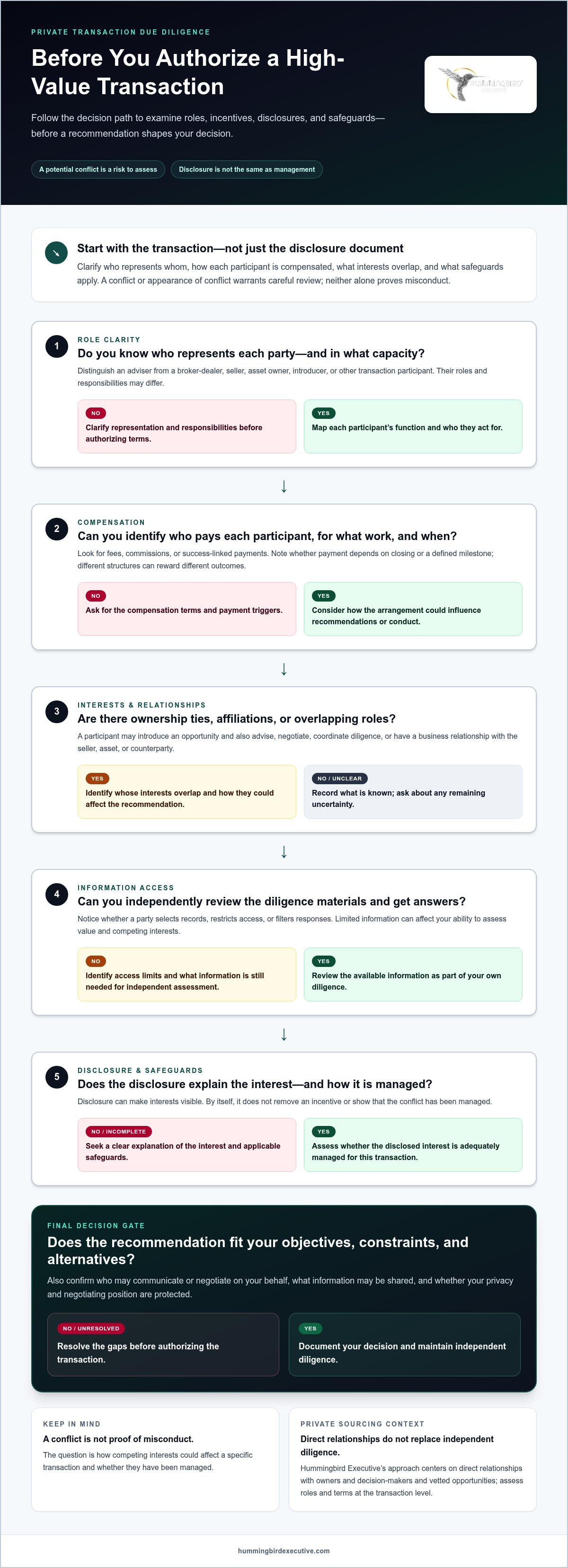
A Practical Due-Diligence Checklist for Evaluating Broker Conflicts
A focused review turns a general concern into questions you can resolve before authorizing a transaction. Tie the inquiry to the specific asset, recommendation, and responsibilities at hand. The aim is not to judge someone’s character. It is to understand how the transaction is structured and whether competing interests are addressed.
- Define the role. Record whom the professional represents, what they are responsible for, and where their authority begins and ends. Distinguish advice, introductions, negotiation, diligence, and execution.
- Map incentives. Identify who pays each participant, what work the compensation covers, and what triggers payment. Note ownership interests, affiliations, or other relationships connected to the asset or parties.
- Request transaction-specific disclosures. Ask for a plain-language explanation of relevant interests and how they could affect the recommendation or process. Keep the written response with the transaction materials.
- Assess safeguards. Compare each proposed measure with the conflict it is meant to address. Consider whether responsibilities are separated, a reviewer is independent, or a participant is removed from a particular decision.
- Document the decision. Save explanations, agreed responsibilities, safeguards, updates, and unresolved questions. Note why you chose to proceed, pause for clarification, or decline.
Questions to Ask Before Authorizing a Transaction
Direct questions help establish a clear record without turning the discussion into a broad judgment about a professional. Ask:
- Whom do you represent in this transaction, and what responsibilities do you have to each party?
- What interests, affiliations, or compensation arrangements could affect your recommendation or role?
- What safeguards apply to this specific situation, and who will carry them out?
- How will I receive material updates, including changes to roles, incentives, or access to relevant information?
How to Assess the Answers and Record Decisions
Specific, consistent answers are more useful than broad assurances. Compare the explanation with transaction documents and the proposed safeguard. If a review is described as independent, establish who conducts it and what information they can assess. Record what remains unanswered, who is responsible for resolving it, and whether that gap changes your decision.
This checklist supports disciplined questions; it does not replace independent legal or financial advice tailored to your circumstances. For avoiding broker conflicts of interest, keep a record that makes your decision understandable later, including the basis for proceeding despite any remaining uncertainty.
Hummingbird Executive provides private asset sourcing for qualified ultra-high-net-worth individuals and family offices, with opportunities vetted and presented through direct relationships. Independent diligence remains essential to assessing any opportunity.
Choosing a Discreet, Aligned Partner for Private Asset Sourcing
Private asset sourcing does not automatically place every participant under broker-dealer standards. The applicable framework depends on the participant’s role, the transaction, and the services provided. A sourcing relationship may involve introductions and coordination without being a securities recommendation or brokerage arrangement. Define the role before drawing conclusions about duties, and seek independent legal or financial advice where the transaction calls for it.
Assessing a Private Sourcing Relationship
Clarity begins with responsibilities. Establish who the sourcing partner represents, what they undertake to do, how decisions remain with you, and how material information is handled. Ask how an opportunity is identified, what validation precedes its presentation, and what diligence remains for you or your advisers. These transaction-specific questions are more useful than broad judgments about a firm.
Keep three issues distinct. Confidentiality governs how sensitive information is handled. Decision authority establishes who may approve terms or commitments. Transaction documentation records the parties, agreed responsibilities, and terms. Conflict analysis examines interests or relationships that could influence the process. Discretion is valuable, but it does not answer every question about incentives or alignment.
Hummingbird Executive’s Discreet, Direct Approach
Hummingbird Executive works through direct relationships with owners, GMs, and decision-makers, with private one-to-one transactions. Opportunities undergo due diligence and validation before they are presented. This gives qualified members a basis for assessment, but it does not promise a particular result or replace independent diligence on the asset, its terms, and relevant parties.
For avoiding broker conflicts of interest in a private sourcing context, assess the process on its own terms: understand who is involved, how the opportunity was validated, what decisions remain yours, and what records support the proposed transaction. A discreet process and a clear understanding of responsibilities should work together. Neither replaces the other.
Investors considering property opportunities can explore this guide to private off-market properties to understand how private sourcing differs from a conventional search. Hummingbird Executive membership is reserved exclusively for qualified ultra-high-net-worth individuals. The private membership access page explains how members access rare assets and tailored support.
Set Your Standards Before the Next Opportunity
The most useful safeguard is a clear standard established before a compelling opportunity arrives. Decide what transparency, decision authority, and independent review should look like for you, then apply that standard consistently. This gives you a steadier basis for judgment when timing, access, or competing priorities create pressure to move quickly.
A discreet process can support that discipline without replacing your own assessment. Hummingbird Executive’s approach centers on direct relationships with owners and decision-makers, with opportunities vetted and validated before presentation. Those features can inform your review, not determine its outcome. Independent diligence remains part of a considered decision.
For qualified ultra-high-net-worth individuals, explore Hummingbird Executive’s private membership access for discreet sourcing and tailored support.
Frequently Asked Questions
What is a broker conflict of interest?
A broker conflict of interest arises when a financial or personal interest could influence a broker’s judgment or recommendation. For example, a broker may have a relationship with the issuer of an investment being discussed. That connection warrants examination, but does not establish misconduct or prove the recommendation is unsuitable. Consider the professional’s role, the nature of the interest, and how it relates to the particular transaction before drawing conclusions.
Is disclosure enough to resolve a broker conflict of interest?
No. Disclosure can help you understand an interest, but it does not automatically remove the incentive or show that its effects have been addressed. Learning that a professional receives compensation tied to a transaction, for example, does not tell you whether another safeguard applies. Ask what practical steps accompany the disclosure, who is responsible for them, and whether those steps address the specific concern. The appropriate response depends on the facts and applicable requirements.
What are common examples of broker conflicts of interest?
Examples include compensation that varies by product or transaction, an ownership interest in an asset, an affiliation with a counterparty, or responsibilities to more than one party. A broker might also have an incentive connected to a particular timing or outcome. These arrangements are not automatically improper. Their relevance depends on the transaction and the professional’s role. Ask how each connection could affect the options presented, information shared, or decisions made.
How can I identify a conflict of interest before a transaction?
Before committing, ask the professional to explain their role, whom they represent, relevant relationships, and how they are compensated in connection with the transaction. Compare those answers with the documents and parties involved. For avoiding broker conflicts of interest, keep questions specific to the proposed deal and note anything unanswered. If a key explanation is unclear, pause before authorizing the transaction and consider independent legal or financial advice suited to your circumstances.
Can a broker represent both sides of a transaction?
Possibly, but whether dual representation is permitted and what disclosures or consent may be required depend on the transaction, the professional’s role, and applicable rules. Do not assume that a broker can act for both parties, or that agreement from both sides resolves every concern. Ask whose interests the broker represents at each stage, how confidential information is handled, and who makes decisions. Independent advice can help you assess the arrangement before proceeding.
What should I do if I discover an undisclosed broker conflict?
Preserve relevant communications, transaction documents, and a dated record of when and how you learned about the relationship. Avoid making accusations before establishing the facts. If a decision is pending, consider pausing authorization while you seek a clear explanation and advice from an independent legal or financial professional. Depending on the broker’s role and the circumstances, you may also consider the firm’s formal complaint process or an appropriate regulator.
Do conflict-of-interest rules apply to every private asset sourcing relationship?
No single set of broker-dealer rules automatically governs every sourcing relationship. The applicable framework can depend on the asset, activities performed, parties involved, and jurisdiction. A person introducing a buyer to an asset may have a different role from someone recommending or arranging a securities transaction. Clarify responsibilities and decision authority in writing, and seek advice on the rules relevant to your circumstances rather than assuming the relationship falls under a particular standard.