A private deal can be exposed before a document is shared: a name in a subject line, a message sent to the wrong recipient, or an early disclosure that signals intent. Secure communication for private deals depends on more than choosing a messaging platform. It requires deliberate control over what is shared, with whom, and through which channel.
That concern is well founded. Even a well-protected channel cannot prevent unnecessary details from reaching the wrong people or eliminate risks such as compromised devices and screenshots. Discretion is a transaction-wide practice, shaped by every participant and each exchange.
This framework explains how to keep deal conversations appropriately private while maintaining clear, coordinated progress. You’ll learn how to select channels for different stages, limit information to what each participant needs, and establish a practical communication protocol. Hummingbird Executive’s direct, one-to-one approach and dedicated app support requests, tracking, and confirmation, helping members manage sensitive discussions with care and precision.
Key Takeaways
- Secure communication for private deals begins with controlling who receives information, how much they receive, and when it is shared.
- Assess identity, recipient access, message content, metadata, and onward sharing. A secure channel cannot replace careful judgment.
- Choose email, messaging, calls, or a private hub according to the discussion’s sensitivity and the level of participant control required.
- Use a clear protocol to guide sensitive discussions from initial classification through follow-up and record handling.
- Hummingbird Executive facilitates direct, one-to-one communication with owners, GMs, and decision-makers, presenting opportunities only after they have been vetted and validated.
Secure communication for private deals starts with controlling information flow
Premature disclosure can do more than reveal a transaction. It may expose who is involved, signal a buyer’s or seller’s intentions, or reveal timing and negotiating context before participants are ready. Even a seemingly minor detail can become consequential when combined with information already known elsewhere.
Secure communication for private deals means sharing appropriate information with the intended participants, at the appropriate stage, through a channel suited to its sensitivity. Protecting message content is one part of that discipline. The broader idea of secure communication also highlights a channel’s limits: privacy depends on how information is created, transmitted, received, and handled afterward.
A protected conversation still requires disciplined disclosure: share only what the next decision requires, with only those who need to make it. A channel may help protect a message, but it cannot decide whether a detail should be shared or prevent every recipient from passing it along.
What makes a deal conversation sensitive?
Sensitivity may attach to identity, timing, or intent, even before commercial terms are discussed. Naming an owner or prospective buyer can reveal who is exploring a transaction. Mentioning a planned approach or decision date can signal timing, while describing the purpose of an inquiry may disclose negotiating posture. These details can matter independently of price, valuation, or other confidential terms.
Consider a hypothetical acquisition inquiry. An initial assessment may require a broad description of the asset and the buyer’s general criteria, while specific ownership details, internal rationale, or proposed terms may not yet be necessary. Separate what is needed to decide whether a conversation should proceed from details that belong in a later, appropriately scoped discussion. This is an illustrative example, not a client case study.
Why privacy is broader than message content
Metadata is contextual information surrounding an exchange, such as who communicated, when contact occurred, and the pattern or frequency of messages. Even without the message itself, that context may suggest that parties are in discussion or that a transaction is advancing. Consider the context an exchange creates, not only the words it contains.
Recipient access matters too. A message intended for one person may be visible to others through shared accounts or devices, while a forwarded document can travel beyond its original audience. Before sending, consider who can access the communication, whether attachments reveal more than necessary, and how recipients should handle what they receive.
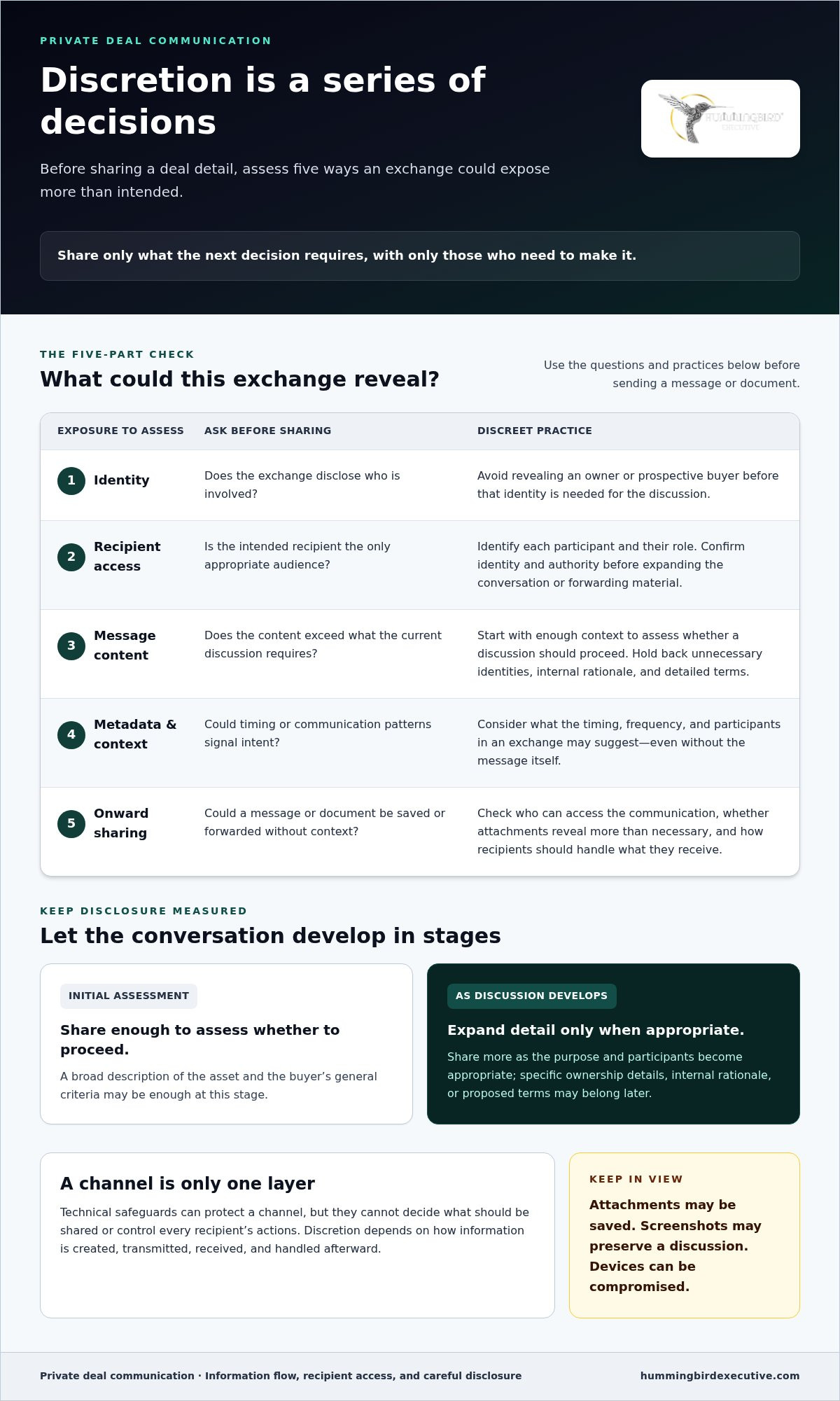
- Identity: Does the exchange disclose who is involved?
- Context: Could timing or communication patterns signal intent?
- Access: Is the intended recipient the only appropriate audience?
- Onward sharing: Could a document or message be forwarded without context?
These questions make discretion a transaction-wide practice rather than a feature of one platform. Each exchange should reveal no more than the next step requires.
The essential safeguards behind discreet private-deal communication
Discretion depends on a series of decisions, not a single setting. Before an exchange, consider five dimensions: identity, recipient access, content, metadata, and onward sharing. Ask whether the message identifies a participant, whether everyone included needs to receive it, and whether the content exceeds what the current discussion requires. Also consider whether the surrounding context could reveal a relationship or pattern, and what might happen if material is saved or forwarded.
Technical safeguards protect the channel; careful transaction conduct governs what enters it, who receives it, and when. Least-necessary sharing means limiting disclosure to what supports the immediate assessment or decision, then expanding access only as the discussion appropriately develops. This reduces avoidable exposure, but it cannot eliminate risk or control every recipient’s actions.
For a broader foundation in managing digital risks, NIST cybersecurity and privacy guidelines provide a useful reference. Apply that general awareness to the specifics of a private transaction: its participants, stage, and sensitivity. A rigorous approach is deliberate rather than indiscriminate.
Control who receives information and when
Before sharing a document or deal-specific detail, identify the intended participants and each person’s role. Familiarity with the transaction is not, on its own, a reason to include someone. Consider whether they need the information for the next step, and confirm their identity and authority before expanding a conversation or forwarding material.
Then disclose in stages. Begin with enough context to assess whether a discussion should proceed, without unnecessarily revealing identities, internal rationale, or detailed terms. Share more as the purpose and participants become appropriate. This keeps the flow measured and gives each disclosure a clear reason.
Treat devices, files, and metadata as part of the conversation
A communication doesn’t end when a message is sent. Attachments may be saved, screenshots may preserve a discussion, and backups or notifications may create additional copies or expose details on a device. Before sending a file, review its contents and consider whether every page, embedded detail, or name is necessary for the recipient’s immediate purpose.
Use access permissions thoughtfully and make expectations for handling shared material clear. Metadata deserves separate consideration: information about participants, timing, and communication patterns can provide context, but its presence doesn’t prove that message content is exposed. Assess both while keeping the distinction clear.
- Identity: Limit names and identifying details to what the stage requires.
- Access: Include only intended participants whose roles are relevant.
- Content: Share the minimum detail needed for the current decision.
- Handling: Consider saved copies, screenshots, notifications, and onward sharing.
Members seeking a discreet process around vetted opportunities can explore Hummingbird Executive’s private access to opportunities, supported by direct, tailored communication.
Email, messaging, calls, or a private platform: compare the trade-offs
No channel is right for every exchange. A brief scheduling note has different sensitivities from identity documents or detailed financial information. For secure communication for private deals, match the channel to the purpose, participants, and record the exchange may create. Capabilities vary by provider and configuration, so use the comparison below as a decision aid, not a ranking or guarantee of protection.
Match the channel to the sensitivity of the exchange
Use concise messages for coordination, and reserve sensitive details for a channel and audience suited to their importance. Calls can limit the written detail created during a discussion, but participants still need to exercise discretion, and follow-up notes can create a record. Consider who can access each exchange and how any resulting material will be handled.
| Channel | Useful context | Participant control | Record handling and suitability |
|---|---|---|---|
| Formal correspondence and material that needs a written exchange. | Recipients may be added, copied, or forwarded to. Check the audience before sending. | Messages and attachments can be retained or redistributed. Use care with identifying or detailed financial information. | |
| Messaging | Brief coordination and focused exchanges. | Group membership and recipient identity matter. Confirm who is included. | Messages may be saved or captured. Suitability depends on the provider, configuration, and sensitivity of the content. |
| Voice or video | Nuanced discussion where an immediate conversation is useful. | Confirm who is present and able to hear the discussion. | May create less written detail, but notes, recordings, or follow-up messages can extend the record. Use discretion throughout. |
| Dedicated private hub | Coordinating requests and transaction-related updates in a defined workflow. | A dedicated environment can provide a clear place for participants to coordinate, though access practices still matter. | Consider how records and shared materials are handled. Suitability depends on the hub’s capabilities and the information being exchanged. |
Encryption, where available, addresses particular risks in transmitting content. It doesn’t establish that recipients are appropriate, prevent onward sharing, or determine whether a detail should be disclosed. Treat channel choice as one part of the transaction’s communication discipline.
When a dedicated private hub can support coordination
A purpose-built hub may bring requests and transaction updates into a defined workflow, helping participants organize exchanges around the matter at hand. Hummingbird Executive’s dedicated app supports requests, tracking, and confirmation. These functions support coordination, not a guarantee about every aspect of confidentiality. Membership context is available through the private investment membership.
Choose the channel according to the exchange: what needs to be communicated, who needs to receive it, and what record should remain. The most suitable option is the one that fits those needs and supports careful handling at each stage.
A practical communication protocol for sensitive deal discussions
A concise protocol needn’t slow a transaction. It can prevent avoidable delays by clarifying who is involved, what a message needs to accomplish, and what should happen next. For secure communication for private deals, consistency matters: participants can move with purpose when expectations are understood before sensitive details are exchanged.
Before sharing: establish participants and purpose
Start by defining the exchange’s purpose and intended participants. Ask what decision or next step the communication supports, then distinguish initial opportunity information from sensitive supporting documents. For example, a hypothetical property inquiry might begin with a general description and acquisition criteria. Detailed financial records or identifying documents may be relevant only at a later stage. This is a neutral example, not a Hummingbird workflow.
- Classify the information. Identify whether the exchange includes participant identities, timing, intent, commercial terms, or supporting records. Consider the sensitivity of each element, not only the message as a whole.
- Define the immediate purpose. State what the recipient is being asked to assess, decide, or provide. A clear purpose keeps the discussion focused and limits unnecessary disclosure.
- Confirm the participants. Identify who needs to take part and why. Before expanding a conversation, confirm that each additional participant is appropriate for the information being shared.
- Stage the disclosure. Share enough context for the next assessment, then provide further detail as the discussion develops and there is a clear need. Avoid sending supporting documents simply because they are available.
- Verify before sending or forwarding. Check the intended recipient and the material included. Before forwarding a conversation, review earlier messages and attachments so unrelated or sensitive context isn’t carried into a new exchange.
- Close with clear follow-up. Record agreed actions, responsible participants, and relevant transaction context. Keep the summary proportionate to the discussion’s purpose.
During and after the exchange: keep the record deliberate
Follow-up should preserve clarity without creating an unnecessary dossier. Retain information in a considered, proportionate way, and handle messages and files according to their sensitivity and ongoing relevance. Avoid imposing an arbitrary retention period: the appropriate approach depends on the transaction’s needs and applicable obligations. For additional property-related context, consult the relevant 2026 guide to off-market properties.
A defined sequence creates fewer ambiguities, not more ceremony. Participants can see what has been shared, what remains outstanding, and who is responsible for the next step. Qualified individuals seeking private access to vetted opportunities can explore Hummingbird Executive membership and its tailored support for transaction discussions.
How Hummingbird Executive approaches communication around private deals
Discretion is most effective when it is part of a transaction’s structure, not an assertion about a single channel. Hummingbird Executive serves ultra-high-net-worth individuals and family offices through private access to vetted off-market opportunities, with communication shaped around direct relationships and carefully managed coordination.
A private, one-to-one approach to opportunity coordination
Hummingbird works directly with owners, general managers, and decision-makers. Transactions are private and one-to-one, without intermediaries. This gives discussions a clear line between relevant parties, while tailored assistance helps members coordinate requests and communication according to the opportunity and stage of consideration.
Opportunities are vetted and validated before presentation. This gives members relevant context to assess an opportunity before deciding whether to proceed; it is not a promise of investment performance or a particular transaction outcome. Sound judgment remains essential. Members determine what information they need for their assessment and how their own advisers or other appropriate participants are involved.
For secure communication for private deals, this distinction matters. Private access and direct coordination can support a discreet process, but confidentiality still depends on purposeful information sharing at each stage. The member, relevant decision-makers, and any additional participants each have a role in keeping communication proportionate to the discussion.
Hummingbird’s dedicated app supports requests, tracking, and confirmation. These functions help structure coordination without implying particular encryption capabilities or guarantees about every communication risk. The app is one part of a broader, transaction-wide approach to discretion, alongside direct relationships and opportunities vetted before presentation.
Privacy commitments and a measured next step
Hummingbird states that its platform does not use cookies and that personal information is never sold. These are specific privacy commitments, not claims that all risks are eliminated or that every aspect of a member’s communications is protected by a particular technical measure.
For members, the value lies in a considered process: relevant opportunities are presented after vetting, discussions proceed through direct relationships, and the dedicated app supports requests and confirmations. The approach is designed for a select audience, not general access. Membership is reserved exclusively for qualified ultra-high-net-worth individuals.
For those whose circumstances align, Explore Hummingbird Executive membership and its private access and tailored support for opportunity coordination.
Set the standard for your next deal discussion
Make discretion part of the transaction from the first exchange. As a deal progresses, revisit who needs to know what, and keep communication aligned with the next decision. A considered approach to secure communication for private deals helps protect the space to assess an opportunity without allowing unnecessary disclosure to shape the process.
For qualified ultra-high-net-worth individuals, Hummingbird Executive brings this approach to private opportunity coordination. Relationships are direct with owners, GMs, and decision-makers, and opportunities are vetted and validated before presentation. A dedicated app supports requests, tracking, and confirmation, giving members a defined way to follow key interactions as discussions develop.
Consider the level of access and tailored support that fits your priorities. Explore Hummingbird Executive membership, reserved for the qualified few. Thoughtful communication creates room for a more deliberate transaction, and every well-managed discussion is a sound place to begin.
Frequently Asked Questions
Is end-to-end encryption enough to secure communication for private deals?
No. End-to-end encryption may protect message content in transit, but it doesn’t determine whether the right people are included or what happens after they receive it. An encrypted exchange can still expose a deal if a participant forwards an attachment to a broader group. For secure communication for private deals, assess the full chain, from deciding what to disclose to handling copies afterward. No single feature guarantees confidentiality.
Can metadata reveal information about a confidential deal?
Yes. Depending on the service and its design, metadata may reveal context such as who communicated, when, or how often. That doesn’t automatically mean the message itself is visible. A pattern of repeated contact could still be sensitive if it signals that discussions are underway. Before opening a conversation, consider whether participant names or timing need to be disclosed at that point, and limit unnecessary identifying details.
How should a family office handle confidential deal updates across its team?
Give each update a defined audience and purpose. A family office might distinguish those responsible for assessing an opportunity from colleagues who need only a later decision or status. Keep routine scheduling separate from sensitive documents, and make the next action clear so recipients don’t circulate an update simply to establish context. Agree internally on how decisions and relevant correspondence will be recorded. The right process depends on the office’s governance and transaction needs; this isn’t legal or security advice.
What should I avoid sending in an initial private-deal conversation?
Avoid sending more identifying, financial, or strategic detail than the first discussion needs. An initial inquiry, for instance, may establish an opportunity’s general relevance without attaching account records, naming every participant, or disclosing internal negotiating limits. Review copied recipients and attachments before sending, since they can add context beyond the message itself. Share further details deliberately as the discussion advances and the intended audience is clear.
Does a private app automatically make a transaction confidential?
No. An app can support a communication process, but confidentiality also depends on participant choices and how information is handled. Hummingbird Executive’s dedicated app supports requests, tracking, and confirmation. Those functions don’t imply unspecified technical protections or mean every transaction detail is automatically confidential. Consider the app’s stated role alongside your own decisions about what to share, with whom, and how to handle material after receipt.
How can parties discuss a deal discreetly across different countries?
Agree on the intended participants, purpose, and channel before exchanging sensitive material, then keep early messages proportionate to the assessment at hand. For example, establish whether a discussion is relevant before circulating detailed documents across multiple offices or time zones. Cross-border transactions may raise different legal, governance, and data-handling considerations, so one process may not fit every jurisdiction. Seek appropriate professional guidance on obligations specific to the countries and parties involved.