A single agent represents one side of a transaction, not both. The benefits of a single-party asset agent start with that clear alignment: the agent can advocate for the buyer or seller they represent. Dual agency places one agent between both parties, while designated agency assigns separate agents within the same brokerage.
It’s reasonable to expect that a more focused relationship could also make an asset transaction more efficient. But representation alone doesn’t guarantee savings; any cost benefit depends on the arrangement, the work involved, and whether it avoids duplicated effort or services. The distinction matters especially when an asset is privately marketed, negotiations are sensitive, or the parties need clarity about whose interests the agent is representing.
This guide explains what a single agent does, how single, dual, and designated agency differ, and what those differences mean for loyalty, confidentiality, and client interests. It compares working with one agent to working with a team, outlines where potential efficiencies may come from, and explains why cost should be weighed against the quality and scope of representation.
Key Takeaways
- Clarify whether the agent represents the buyer or seller, and understand how that differs from dual or designated agency.
- Compare a single agent’s direct involvement with a team’s shared responsibilities, weighing continuity and capacity against your transaction’s needs.
- Look for potential savings in reduced duplication, coordinated accounts, and services that no longer need to be repeated.
- Assess representation by its duties to you, including loyalty, confidentiality, and accountability, rather than by title alone.
- Consider how a single-party arrangement applies to the specific asset and transaction, since the term can describe different roles in different contexts.
What are the Duties and Responsibilities of a Single Agent?
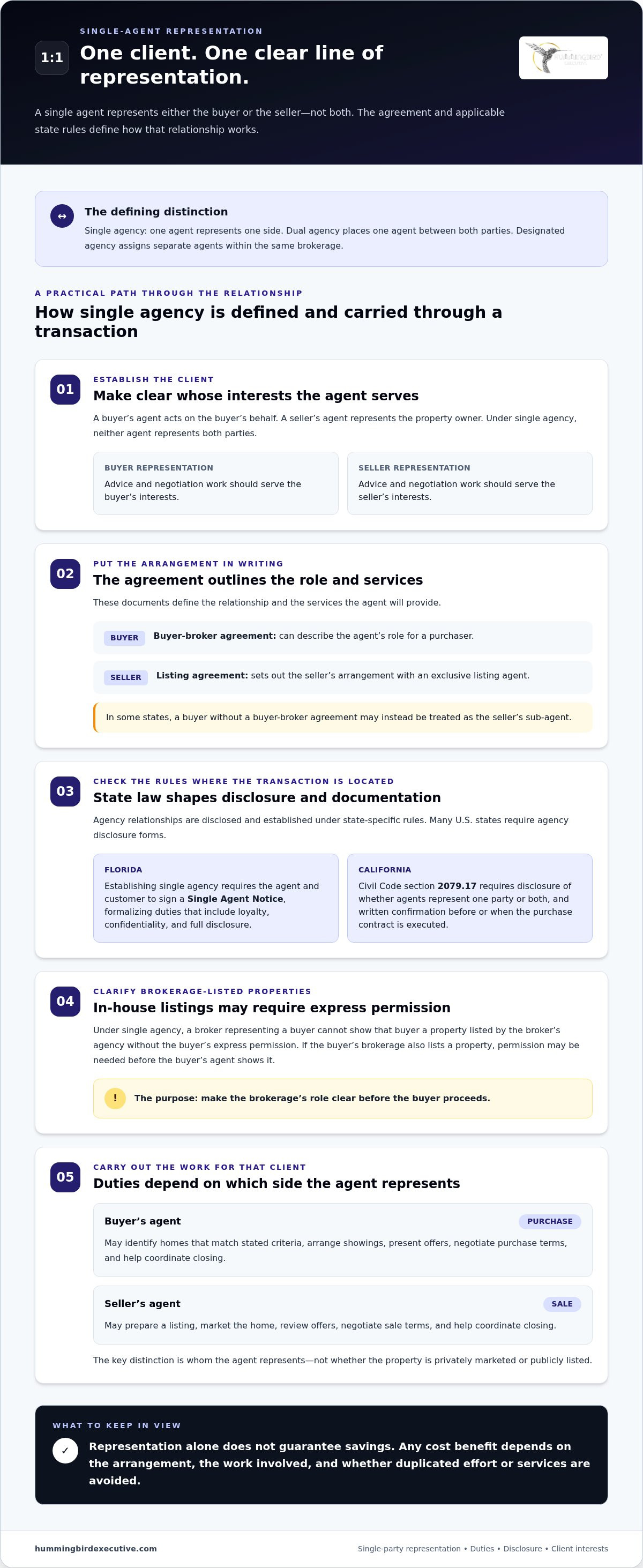
A single agent represents either the buyer or the seller in a real estate transaction, not both. State rules shape the duties and documents that establish this relationship.
Representing Buyers and Sellers
A buyer’s agent acts on the buyer’s behalf, while a seller’s agent represents the property owner. That distinction matters because each agent’s advice and negotiation work should serve their client’s interests. A buyer’s agent may identify homes that match stated criteria, arrange showings, negotiate price, and help coordinate closing. A seller’s agent may list and market a home, negotiate offers, and help coordinate closing.
Exclusive Agency and Client Agreements
An exclusive buyer’s agent works under an agreement to represent the buyer, while an exclusive listing agent represents the seller under a listing agreement. These documents define the relationship and the services the agent will provide. A buyer-broker agreement can describe the agent’s role for a purchaser; a listing agreement sets out the seller’s arrangement. In some states, a buyer without a buyer-broker agreement may instead be treated as the seller’s sub-agent.
State law governs how agency relationships are disclosed and established, so the applicable rules depend on the transaction’s location. In Florida, establishing single agency requires the agent and customer to sign a Single Agent Notice formalizing duties that include loyalty, confidentiality, and full disclosure. According to California Legislative Information, Civil Code section 2079.17 requires agents to disclose whether they represent one party or both, and to confirm that relationship in writing before or when the purchase contract is executed. Many U.S. states also require agency disclosure forms.
In-house listings require particular care. Under single agency, a broker representing a buyer cannot show that buyer a property listed by the broker’s agency without the buyer’s express permission. When the buyer’s brokerage also lists a property, permission may be needed before the buyer’s agent shows it. This makes the brokerage’s role clear before the buyer proceeds.
An agent’s practical duties depend on which side of the transaction they represent. For a buyer, that can mean matching homes to criteria, arranging access, presenting offers, and negotiating purchase terms. For a seller, the work can include preparing a listing, marketing the home, reviewing offers, and negotiating sale terms. Both roles may involve coordinating closing, but under single agency neither agent represents both parties.
Single agents typically handle real estate transactions for a home buyer or seller. A buyer’s agent supports a purchase; a listing agent supports a sale. The key distinction is whom the agent represents, not whether the property is privately marketed or publicly listed. The agreement and applicable state rules define how the relationship operates through negotiation and closing.
Choosing between a team and a single agent
A single agent offers one central point of responsibility; a team divides transaction work among its members. The right structure depends on the property, your buying or selling goals, and the attention the work requires. A seller preparing a distinctive listing, for example, may value direct coordination, while a complex transaction may benefit from several people managing separate tasks. What matters most is that each responsibility has a clear owner.
Capacity deserves close attention. A single real estate agent handling 15 to 20 deals has a higher deal volume than an average agent handling 5 to 10 deals. Those figures give context, not a measure of service quality. Ask how the agent will manage communication, showings, offers, and closing tasks alongside other commitments. With a team, identify who leads negotiations and who receives time-sensitive instructions; otherwise, a larger roster can create handoffs without clear accountability.
One risk of hiring a single agent is having limited backup if that person is unavailable, along with relying on one person’s judgment and workload. A team can distribute tasks, but several contacts may complicate instructions or blur responsibility. In either arrangement, clarify who handles each stage and who remains accountable to you.
Choose an agent by defining your transaction goals, then matching the proposed working structure to your needs. As a seller, consider whether a team’s marketing work promotes the property or mainly its own brand. As a buyer, find out who will oversee property review, negotiation, and closing coordination. Discuss the agent’s role, communication process, and responsibilities before signing a buyer-broker or listing agreement.
Experience can inform the comparison, but it should not replace a clear plan. An experienced real estate team may bring experience across many transactions, while one agent may offer a more direct working relationship. Neither structure automatically serves every client better. Before deciding, compare proposed roles, availability, transaction oversight, and fit with your goals for the property.
For those considering a broader range of private asset transactions, explore private asset opportunities as a separate consideration from choosing a real estate agent.
Potential cost savings
A single agent does not automatically reduce a transaction’s commission or other expenses. Any potential advantage lies in coordination: one point of contact may help identify duplicated work, overlapping services, or unnecessary complexity. For example, a buyer reviewing assets through several separate relationships may get a clearer view of holdings and costs by consolidating accounts.
Consolidated portfolios can make it easier to coordinate tax-loss harvesting across accounts. If similar investments sit in separate accounts, a unified view can also help reveal duplicate holdings. These are portfolio-management efficiencies, not automatic savings from appointing one agent. Their value depends on the assets, account structure, investment objectives, and decisions made across the portfolio.
Combining smaller accounts may help an investor qualify for lower fee tiers. Compare the total cost across existing accounts with the fees and services available after consolidation. A single statement or login may simplify oversight, but convenience alone does not establish that the arrangement costs less. Review which services remain necessary and which are duplicated.
Consolidation may also eliminate redundant financial services. For instance, an investor paying separately for overlapping reporting or account administration may find that one coordinated relationship covers the same work. Map each service to its purpose, provider, and account to identify duplication before changing arrangements. Do not remove a service that performs a distinct function simply because another account appears similar.
Real estate commission is a separate consideration. A single-agent relationship defines representation, but does not by itself determine commission terms. Compare the written agreement’s scope, duration, and services with your transaction needs. For a seller, consider the listing and marketing work; for a buyer, consider the support provided during property review and negotiation. Do not assume a commission amount from the agent’s title.
Asset consolidation can also support coordinated planning. A complete view may help an advisor align investments with risk tolerance and objectives, plan for a major expense, or coordinate account choices with an estate plan. The advantages depend on the investor’s situation and the assets involved. Consolidation is most useful when it improves visibility or reduces duplicated effort without obscuring distinct ownership or investment roles.
Before consolidating, compare the current and proposed arrangements side by side. Include account-level fees, investment overlap, duplicated services, tax considerations, and any changes to access or administration. This helps distinguish genuine efficiency from a simple transfer of assets. Clear savings come from specific changes, such as removing a duplicated service or combining qualifying accounts, not from the number of agents alone.
Single-agent loyalty and client interests
Single-agency representation aligns an agent’s work with one client’s interests. A buyer’s agent owes the buyer loyalty, confidentiality, and accountability, while a seller’s agent owes duties to the seller. For example, a buyer’s agent should advance the buyer’s negotiating position, not disclose the buyer’s maximum offer to the seller.
That distinction affects what an agent can do during negotiations. A single agent can advise their client on price and terms, then negotiate on that client’s behalf. A dual agent cannot advise either party about price or terms, negotiate for either side, or disclose one party’s private information to the other. This limits advocacy even when both parties want the same agent’s help.
The brokerage relationship also matters. Agents licensed under the same broker can create a dual-agency situation, even if they work in separate offices and do not know each other. Designated agency is different: two agents from one brokerage represent different parties. The brokerage’s duties and each agent’s assigned role shape whom they represent.
Florida illustrates why an agent’s title alone does not establish the level of advocacy. The default real estate brokerage relationship there is transaction brokerage, which provides limited assistance to both parties without fully advocating for either. A Florida customer outside a single-agency relationship may receive help with paperwork and transactions, rather than full representation and fiduciary duties. If the same brokerage represents the buyer and seller, an agent may return to transaction-broker status with the customer’s written consent.
California law sets a separate disclosure requirement. According to California Legislative Information, Civil Code section 2079.17 requires agents to disclose whether they represent one party or both, and to confirm that relationship in writing before or when the purchase contract is executed. That written clarification gives buyers and sellers a defined record of the agency relationship before contractual commitments.
Before sharing sensitive negotiating information, buyers and sellers should understand whom the agent represents. A buyer who shares a walk-away price with a single agent is giving that information to their representative; sharing it with a dual agent involves different confidentiality limits. The agent’s role determines how information can be used and what advice is available.
In some states, transaction brokers or facilitators provide services without traditional fiduciary duties of loyalty and obedience. The laws of 25 U.S. states allow brokers to work in those roles. This makes the relationship’s legal structure material: buyers should distinguish representation from neutral transaction assistance before relying on an agent to advocate for them.
What is a single-party asset agent?
A single-party asset agent is an intermediary engaged to represent one side of an asset transaction. In residential real estate, that means representing either the buyer or the seller, rather than both. The phrase describes the agent’s relationship to the parties, not a particular asset or ownership structure. A buyer purchasing a home and a seller listing one have different representation needs.
That distinction matters because “single-party” can be confused with “single-asset.” A single-asset entity is typically an LLC set up to own a specific real estate property. It is an ownership vehicle, not an agent or representative. For example, an LLC holding a commercial building owns the asset; an agent representing its buyer or seller acts on behalf of one transaction party.
In practice, the represented side determines the agent’s purpose. A buyer’s representative may help assess a property, arrange access, evaluate an offer, and negotiate terms. A seller’s representative may position a listing, communicate with prospective buyers, and negotiate offers. In a yacht purchase, the same basic distinction is whether the intermediary represents the purchaser or seller, although real estate agency rules do not automatically define other asset transactions.
The asset category also shapes the work. A residential property involves a listing, inspections, and closing coordination; a private jet or luxury car transaction may involve different information, counterparties, and transfer arrangements. The single-party principle remains useful: identify whose interests the agent is engaged to advance, then distinguish that role from neutral facilitation or representation of both sides.
Before proceeding, identify the represented party and the scope of the engagement. Read the agreement to understand which asset and transaction it covers, the agent’s responsibilities, and how the relationship is disclosed. A real estate buyer’s agreement, for example, concerns the agent’s role for that purchaser; it is different from an LLC’s documents for holding property. Clear terminology helps establish who receives advice and whom the agent represents.
The benefits of a single-party asset agent are clearest when a buyer or seller needs an advocate aligned with one side. That relationship is distinct from a transaction facilitator, who helps parties complete a deal without fully advocating for either. For private transactions involving rare assets, the appropriate structure depends on the asset, the parties, and the agreed role. Explore private rare-asset opportunities when considering a discreet route to buying or selling.
Hummingbird Executive: Platinum Membership Full Access to Rare Assets, Investments, Buy, Search, or Sale Plus 24/7 Dedicated Concierge Services Worldwide at No Extra Charge
Hummingbird Executive offers a platinum membership for those seeking access to rare assets and investments to buy or sell. It includes worldwide dedicated concierge services 24/7 at no extra charge, supporting members as they pursue opportunities that may not be publicly advertised.
This membership may suit buyers and sellers who value a discreet route to exploring rare assets, including yachts, private jets, premium properties, and luxury cars. Gold membership offers white-glove services seven days a week during opening hours. The distinction lies in the access and concierge arrangement that best fits your needs.
If you are considering a private asset transaction, visit Hummingbird Executive online to explore the membership options.
Make your next asset decision with clarity
Before entering a transaction, define what matters most: aligned representation, continuity, discretion, or access to a particular asset. The benefits of a single-party asset agent are most relevant when you want one clear point of advocacy, but the right arrangement still depends on the asset and work required. Use those priorities to shape your next conversation and distinguish essential support from unnecessary complexity.
For rare-asset searches and buying or selling opportunities, Hummingbird Executive offers a private next step through membership, reserved for the qualified few. Consider which level of access and concierge support fits your objectives. Begin a discreet conversation with Hummingbird Executive to bring your opportunity and priorities into focus.
Contact Hummingbird Executive to discuss your next asset opportunity. Your next move can begin with a clear brief and a considered conversation.
Frequently Asked Questions
Single, Dual, & Designated Agency: What’s the Difference?
Single agency means an agent represents one side of a transaction. Dual agency means one agent represents both buyer and seller, limiting the advice and negotiation they can provide. Designated agency assigns separate agents from the same brokerage to represent each party. For example, if two agents under one broker assist opposing parties, the arrangement may still raise agency questions even when the agents work separately.
Should I Be on the Lookout for Conflicts of Interest?
Yes. Pay attention to situations where the agent or brokerage may have relationships with both sides. A brokerage, for example, might represent a buyer while another of its agents lists the property. Ask who represents each party, whether the agent’s role has changed, and how confidential information will be handled. Written disclosure can clarify the relationship before you share negotiating limits or accept advice about an offer.
What are the benefits of using a single-party asset agent?
The benefits of a single-party asset agent include having an intermediary focused on one side’s objectives. For a buyer considering a property, that can mean guidance shaped around the buyer’s criteria and offer strategy. For a seller, it can mean advice centered on the sale. The practical value is clarity about whose interests the agent serves, not an automatic promise of lower costs or a better outcome.
How does a single-party asset agent compare with a multi-party or dual agent?
A single-party agent advocates for one represented party, while a dual agent serves both sides and is limited in the advice and negotiation they can provide. A team may cover separate tasks, but its size alone does not establish whom it represents. A buyer working with a team, for instance, should identify the lead representative and understand whether another agent from that brokerage is working with the seller.
How does single-party representation affect confidentiality and conflicts of interest?
In single agency, the represented party’s private information is protected within the agent-client relationship. A buyer might share a preferred ceiling for an offer, while a seller might disclose a minimum acceptable price. A dual agent cannot disclose one party’s private information to the other without permission. Clarifying the role before sharing sensitive details helps set information boundaries and identify potential conflicts early.
What duties and fiduciary obligations does a single-party asset agent have?
Duties depend on the state and the agency arrangement. In Florida, a single-agent relationship is formalized through a signed Single Agent Notice, including duties of loyalty, confidentiality, and full disclosure. Buyers and sellers should understand which duties apply before relying on an agent’s recommendations. The written notice and agreement help define the relationship, while local rules determine the obligations attached to it.