What if the most compelling off-market supercar is the wrong choice for the country where you intend to register it? Buying an off-market supercar takes more than agreeing on a price. Provenance, title, manufacturing details and destination-country requirements can all affect whether the acquisition makes sense.
That uncertainty is understandable. A vehicle’s history and paperwork may be less visible in a private sale, while import duties, taxes, inspections and conformity rules differ by jurisdiction and can change the total cost. Your circumstances and intended destination matter, too. Treat the purchase and registration as one coordinated decision, not separate errands.
This guide covers what to resolve before committing, from checking documentation and vehicle history to identifying customs, tax and registration questions that depend on the countries involved. It also explains how to plan for specialist advice where needed, so compliance and acquisition economics are considered together. Hummingbird Executive membership provides private marketplace access to luxury cars, alongside worldwide concierge support to help coordinate a complex acquisition journey.
Key Takeaways
- Map the seller’s location, the vehicle’s location, your residence and intended registration country before assessing the opportunity.
- When buying an off-market supercar, treat destination eligibility and registration requirements as part of the purchase decision, not a later administrative task.
- Compare registration routes by eligibility, documentation, inspection, tax questions and ongoing obligations. Requirements vary by jurisdiction.
- Review identity, title, provenance, condition and transaction terms before committing. Gaps in the records can complicate later preparation.
- Hummingbird Executive membership offers private access to rare assets, including luxury cars, with worldwide concierge support for a multi-stage acquisition journey.
Buying an off-market supercar abroad: separate acquisition from registration
Buying an off-market supercar often begins with a private introduction rather than a public advert. Details may be shared selectively, with discussion taking place directly with the seller. That quieter process can suit a discreet purchase, but it doesn’t remove the need for disciplined due diligence. A private opportunity still calls for a clear account of the vehicle, its ownership and the records supporting its history.
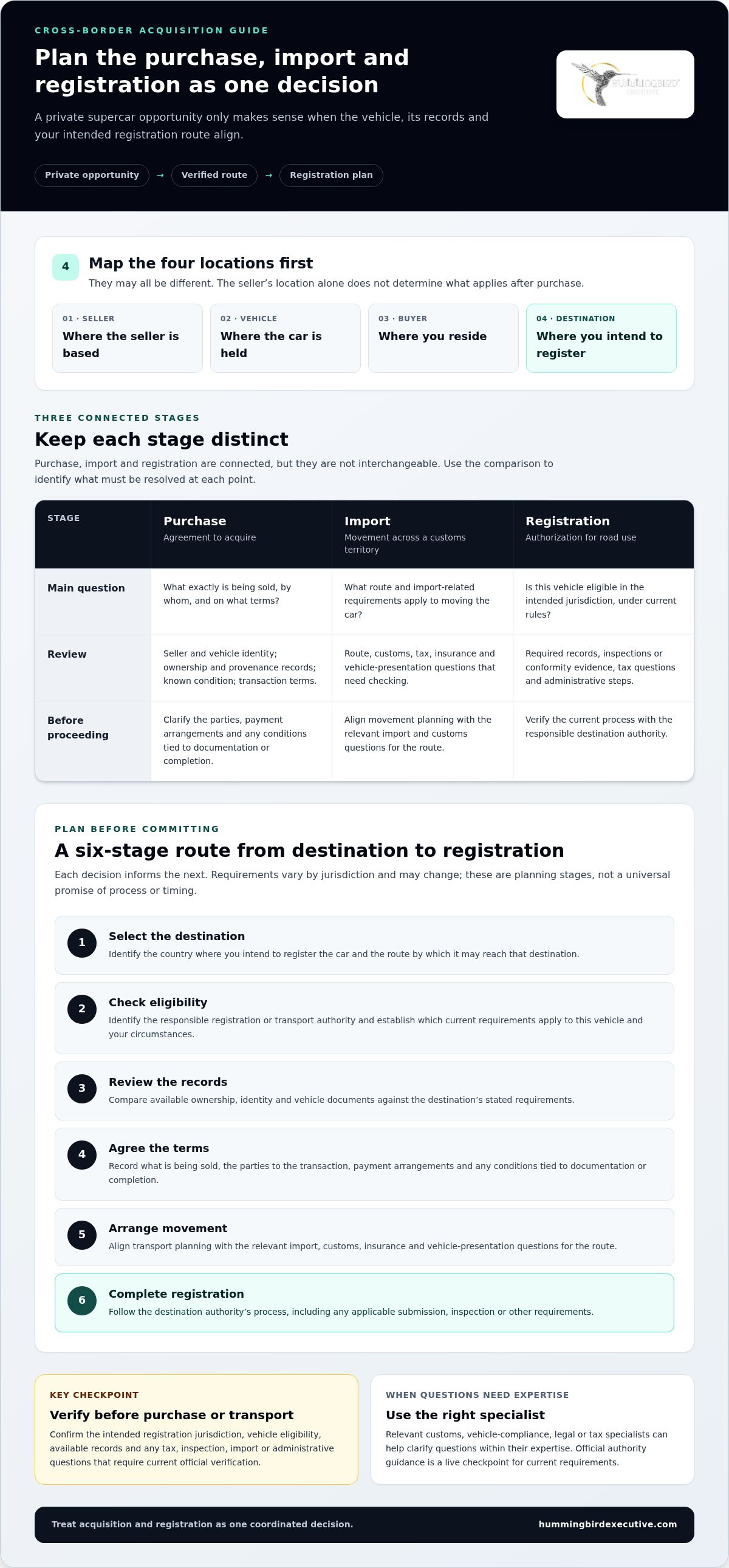
Keep four locations distinct from the outset: where the seller is based, where the car is held, where you reside and where you intend to register it. They may all differ. Each can shape a separate part of the transaction, so the seller’s location alone doesn’t determine the rules that apply after purchase.
What does buying a supercar off-market involve?
An off-market supercar is a privately sourced vehicle that isn’t publicly advertised through ordinary listings. Compared with a public listing, a private introduction may involve less broadly visible information and a more direct exchange with the seller. The information available varies by opportunity. Discretion should never be mistaken for verified provenance.
Review each car on its own record. Establish the identity of the vehicle and seller, examine available ownership and provenance documents, and understand what is known about condition before treating an offer as ready to proceed. Private access changes how an opportunity reaches you, not the standard of evidence it should withstand.
Why does the registration country matter before purchase?
The destination country can affect whether a particular vehicle is eligible for registration, what documentation is needed, whether inspections or conformity evidence may be relevant, and how taxes are assessed. Requirements are jurisdiction-specific and can change. Identify the intended registration country early and verify its current rules before making commitments or transport arrangements.
Your nationality or residence and the vehicle’s registration jurisdiction are separate considerations. A buyer who lives in one country may explore registration in another, but that possibility doesn’t establish eligibility. Both the relevant authorities’ requirements and your circumstances matter. Administrative arrangements may also vary within a country. For example, the Vehicle registration plates of the United States provide context for state-level variation in US registration.
Raise the registration question while the acquisition terms are still being considered. Before agreeing to buy or arranging transport, clarify:
- The intended registration jurisdiction and the vehicle’s eligibility there.
- Which records are available and whether they address that jurisdiction’s requirements.
- Which tax, inspection, import or administrative questions need current, official verification.
Purchase is the agreement to acquire the car; import is its movement into another customs territory; registration is its authorization for road use under a jurisdiction’s requirements. These stages are connected, but they are not interchangeable. Treating them separately makes it easier to assess the full acquisition before committing.
How to plan cross-border supercar registration before committing
Establish a registration plan while you are still assessing the acquisition. Confirm destination-country eligibility before finalizing an off-market purchase. Requirements vary by jurisdiction and may change, so use official guidance as a live research checkpoint rather than relying on assumptions drawn from another vehicle or transaction.
Work through the stages in order. Each decision informs the next, and a mismatch between the vehicle, paperwork and intended route can complicate completion.
- Select the destination. Identify the country where you intend to register the car and the route by which it may reach that destination.
- Check eligibility. Identify the responsible registration or transport authority and establish which current requirements apply to this vehicle and your circumstances.
- Review records. Compare the available ownership, identity and vehicle documents against the destination’s stated requirements.
- Agree terms. Record what is being sold, the parties to the transaction, payment arrangements and any conditions tied to documentation or completion.
- Arrange movement. Align transport planning with the relevant import, customs, insurance and presentation questions for the route.
- Complete registration. Follow the destination authority’s process, including any applicable submission, inspection or other requirements.
These are planning stages, not a universal promise of process or timing. For a US destination, U.S. Customs and Border Protection’s Importing a Motor Vehicle into the U.S. outlines considerations relevant to bringing a vehicle into the country. Consult the competent authorities for current requirements in the specific case. Relevant customs, vehicle-compliance, legal or tax specialists can help clarify questions within their expertise.
Which documents should a buyer organize?
Build a coherent file before finalizing terms. Depending on what exists and what the destination requires, organize:
- Identity and ownership records for the seller and vehicle.
- A written sale agreement identifying the parties and the vehicle.
- The vehicle identification number, matched consistently across available records.
- Available service history and supporting provenance documents.
Some destinations may require originals, translations or additional supporting evidence. Keep a consistent record of the seller, vehicle, payments and transport arrangements so details can be reconciled across transaction documents.
What should be checked before transport is arranged?
Confirm how the destination authority expects the vehicle to be presented and what eligibility evidence is relevant. Map any inspection, conformity, tax, customs and insurance questions that apply to the route, then place purchase, shipping and registration milestones in one written timeline. Resolve dependencies before booking movement. A transport date should follow the compliance plan, not substitute for one.
Hummingbird Executive membership provides private access to luxury cars, with worldwide concierge support to help coordinate a multi-stage acquisition journey. Explore private access to off-market luxury assets.
Compare registration routes, costs, and practical trade-offs
Assess a registration route against the vehicle’s intended use and your actual circumstances, not just the apparent simplicity of the paperwork. Registering in your country of residence may make ongoing administration more direct, while another jurisdiction may be an option only if you are eligible and the arrangement is lawful. Neither route should be presumed to reduce obligations.
How do residence and registration jurisdictions affect the decision?
Residence, ownership structure, vehicle location and intended use can each be relevant. Their significance depends on the jurisdictions involved. A foreign registration doesn’t automatically remove tax, insurance or regulatory responsibilities where you live or use the car. Before comparing outcomes, establish which rules apply to your circumstances using current official sources for each relevant jurisdiction.
| Consideration | Country of residence | Another eligible jurisdiction |
|---|---|---|
| Eligibility | Assess requirements for the buyer, vehicle and intended use. | Establish a lawful basis to register and use the vehicle there. |
| Documentation | Determine which ownership, identity and vehicle records are required. | Allow for destination-specific evidence, formats or translations. |
| Inspection | Check whether the process calls for inspection or conformity evidence. | Confirm the relevant process and where the vehicle must be presented. |
| Tax questions | Review applicable taxes and any obligations connected with use. | Assess tax exposure in both the registration jurisdiction and elsewhere. |
| Ongoing obligations | Consider renewal, insurance and other continuing responsibilities. | Account for administration across borders and obligations where the car is used. |
| Administrative complexity | May involve fewer cross-border steps, depending on the vehicle and rules. | Can require coordination among more authorities and parties. |
Which practical trade-offs deserve comparison?
Compare the full ownership pathway, not only the initial registration steps. Consider process complexity, document preparation, inspection arrangements, insurance availability and how the route may affect a future sale. A jurisdiction that appears administratively convenient may prove unsuitable once eligibility, vehicle use or resale plans are considered.
Build a cost schedule by category: transport, storage, duties, taxes, inspections, documentation and professional advice. Keep confirmed charges separate from estimates, and record the assumptions behind each estimate, such as route, timing, vehicle details and services required. Requirements and charges depend on the relevant jurisdictions. Verify legal and tax conclusions with current official sources and appropriately qualified advisers.
Make a like-for-like comparison: use the same vehicle, intended use and ownership assumptions, and record each route’s obligations separately. When buying an off-market supercar, a seemingly simpler registration path is not necessarily lawful, suitable or less costly overall. Resolve those distinctions before treating the acquisition figure as the full commitment.
Reduce risk with a disciplined off-market supercar due-diligence process
Discretion can make a private opportunity appealing, but it should never lower the standard of evidence. Discretion should protect privacy, not replace verifiable ownership and vehicle records. Before committing, assess the seller, car, supporting documents and proposed terms as separate parts of the transaction. If a material detail remains unclear, pause to understand its implications for the purchase and later registration preparation.
Use this pre-commitment checklist to keep the review focused:
- Identity: Establish who is selling the vehicle and whether that party’s role in the transaction is clear.
- Title and ownership: Review the available ownership evidence and look for inconsistencies in names, dates or vehicle details.
- Provenance: Assess records supporting the car’s history, including available service and ownership documentation.
- Condition: Distinguish documented facts from descriptions or representations that still require examination.
- Transaction terms: Put the agreed vehicle, condition, payment arrangements and delivery responsibilities in writing.
How can buyers assess provenance and vehicle condition?
Start with the vehicle identification number (VIN). Compare it across available records and against the physical vehicle. Note any discrepancy for resolution rather than assuming it is clerical. Review service history, ownership documents, and available repair or modification records as a connected file. Missing documentation limits what can be established about the car’s history. Arrange an appropriate independent technical inspection, and treat condition claims as claims, not findings, until then.
How should the purchase terms protect the process?
Ensure the written agreement identifies the vehicle and seller, records the agreed condition and included items, and sets out payment stages and delivery responsibilities. Define what must be in place for completion and how unresolved documentation issues will be handled. Keep communications secure and traceable, retain the agreement and supporting exchanges, and preserve transaction records for later administrative steps. These safeguards address different risks: technical review concerns the car, payment controls concern the transfer of funds, and written communications establish what the parties agreed.
Incomplete records or unclear ownership can weaken confidence in an opportunity and leave gaps in the file needed for later registration preparation. When buying an off-market supercar, treat unexplained inconsistencies as open questions, not details to resolve after payment or transport has been arranged.
For collectors seeking private access to rare assets, including luxury cars, Hummingbird Executive membership offers a discreet marketplace and worldwide concierge support. Explore private access to off-market luxury assets as part of a considered acquisition journey.
Move from private supercar opportunity to a coordinated next step
A considered acquisition follows a clear sequence: define the destination, evaluate the opportunity, organize the records, compare the relevant obligations, then coordinate completion. Keep the vehicle’s appeal and the practical route to ownership in view at the same time. That discipline helps distinguish an attractive introduction from a purchase that is ready to proceed.
Buying an off-market supercar can involve several parties and decisions, particularly when the car, seller, buyer and intended registration country are in different places. A concise brief helps keep those threads aligned. Note the vehicle characteristics you seek, your acquisition objectives, where you intend to use and register the car, what documentation is available, and which registration questions remain open.
When can membership support the acquisition journey?
Hummingbird Executive is a membership platform offering private access to rare assets, including luxury cars. Members can explore opportunities through a discreet marketplace, with concierge support to help coordinate a multi-stage acquisition journey worldwide. Registration eligibility, vehicle records and transaction decisions still require attention appropriate to the specific opportunity and jurisdiction.
Platinum membership provides access to search, buy or sell rare assets, with dedicated worldwide concierge support. Gold membership offers white-glove services seven days a week during standard opening hours. To consider how private access may fit your collecting objectives, explore private luxury car collection investment and the Platinum membership luxury concierge.
What should the buyer have ready for a focused conversation?
Preparation makes the next discussion more useful. Set out your preferred vehicle characteristics, intended use and acquisition objectives, including whether the purchase is for driving, collecting or another purpose. Identify your intended destination and registration jurisdiction, then summarize your timing, records already available and any unresolved questions about eligibility, import or registration.
Keep the brief factual. Separate what you know from what still needs assessment, and note the seller’s location and the vehicle’s current location if known. This gives the conversation a practical frame without treating early information as a substitute for due diligence or current official guidance.
With your destination and objectives defined, membership provides a discreet point of entry to rare-asset opportunities and concierge support for coordinating the journey. Explore Hummingbird Executive membership when you’re ready to consider private access.
Make the next move with clarity
The most valuable next step isn’t necessarily the fastest one. Turn open questions into decision gates: what evidence remains necessary, which jurisdiction-specific issues need resolution, and what must be settled before funds or transport are arranged. This keeps the acquisition aligned with your collecting priorities while leaving room to pause if the facts don’t support proceeding.
That measured approach matters when buying an off-market supercar. Access may be private, but the decision should remain evidence-led. A focused brief can make the next conversation more productive: define the vehicle profile and intended use, identify your destination, and distinguish established details from points still under review.
Hummingbird Executive offers members private access to rare assets, including luxury cars, with worldwide concierge support through membership services. If you’re ready to explore a discreet route into the private marketplace, explore Hummingbird Executive’s private membership.
Proceed with composure. The right opportunity is one you can pursue with confidence and clarity.
Frequently Asked Questions
Can I register a supercar in a country where I do not live?
Sometimes, but eligibility depends on the destination’s rules and your circumstances. A country may require evidence of a qualifying connection, ownership arrangement or local address, while another may apply different conditions. Before buying, describe your residence, ownership structure and intended use to the relevant registration authority or a qualified adviser. When buying an off-market supercar, don’t assume that access to a foreign registration route means you can lawfully use it as planned.
How long does cross-border supercar registration take?
There’s no reliable universal timeframe. The duration can depend on document completeness, authority processing, transport, inspection availability and whether the vehicle needs additional evidence or remedial work. A straightforward file may move differently from one with inconsistent records or questions about vehicle conformity. Ask the destination authority about its current process, then build a schedule with room for review and follow-up. Avoid committing to a fixed delivery or driving date before key milestones are understood.
What happens if a supercar does not pass a destination-country inspection?
A failed inspection may mean the vehicle cannot proceed through the expected registration path until the identified issue is addressed, but the consequences depend on local rules and the reason for failure. Obtain the written findings and distinguish a correctable fault from a broader eligibility or conformity concern. Then establish whether repairs, supporting evidence or another inspection are permitted. Before purchase, consider how unresolved findings could affect the vehicle’s usability, value and completion timeline.
Can I insure an off-market supercar before it is registered?
Possibly, but coverage terms depend on the insurer, vehicle status, location and intended use. An insurer may distinguish between cover during storage, transit or a registration process and cover for road use. Explain where the car will be kept, how it will move and whether it has valid plates or permissions. Obtain written confirmation of the applicable cover and exclusions before the vehicle is driven or transported. Don’t treat an insurance quote as authorization to use public roads.
How much tax or duty applies when importing a supercar?
There isn’t one cross-border rate that applies to every supercar. The amount, if any, depends on the destination’s current rules and factors such as the vehicle’s origin, value, age and import route. Ask the relevant customs and tax authorities or a qualified adviser to identify which charges apply to your case. Request a calculation that separates confirmed amounts from estimates, and note the assumptions used, including declared value and transport route.
Can I drive the supercar while its registration is being processed?
Don’t assume you can. Whether a vehicle may be driven before registration depends on the jurisdiction and its rules for temporary permissions, plates, insurance and road use. A car being physically present, insured for some purpose or awaiting inspection doesn’t itself establish that it can be driven legally. Confirm the exact status required before any journey, including movement to an inspection site. If no lawful road-use route applies, arrange transport rather than driving.
Does a supercar’s modification history affect registration abroad?
It can. Changes to the engine, exhaust, suspension, bodywork or other systems may affect how a destination authority assesses the vehicle, though the significance varies by jurisdiction and modification. Gather invoices, specifications and records showing who carried out the work, and compare them with the vehicle as it currently exists. Where documentation is absent, avoid relying on verbal descriptions alone. Establish how the relevant authority treats the specific changes before purchase, especially if originality or conformity is material.