A wider audience doesn’t always create a better sale. In the private sale of a classic car collection, controlled exposure can matter as much as the cars themselves. Each vehicle needs a clear presentation, while the collection’s provenance and your privacy deserve careful consideration.
If you’re weighing a private approach against an auction or dealer sale, the decision isn’t simply about reach. It’s about balancing qualified interest, presentation, timing, and control, especially when several cars need to be positioned as a coherent whole.
This guide explains how to prepare a collection for discreet consideration, organize ownership, condition, and provenance records, and compare sale routes. It also covers how a private marketplace and concierge support can help coordinate a multi-asset process without broad public exposure. The aim is to help you move from preparation to buyer review with clear decisions at each step.
Key Takeaways
- Set your priorities for privacy, timing, and collection flexibility before choosing how to sell.
- Use a clear sale brief and an orderly sequence of records, presentation materials, and buyer review to manage disclosure.
- Compare private sale, auction, and dealer routes by exposure and seller involvement, not by assumptions about price or speed.
- Prepare consistent condition summaries, photographs, provenance records, and ownership information for each vehicle.
- A private sale of a classic car collection can be supported through Hummingbird Executive’s private marketplace for members selling rare assets, including luxury cars.
Why choose a private sale of a classic car collection?
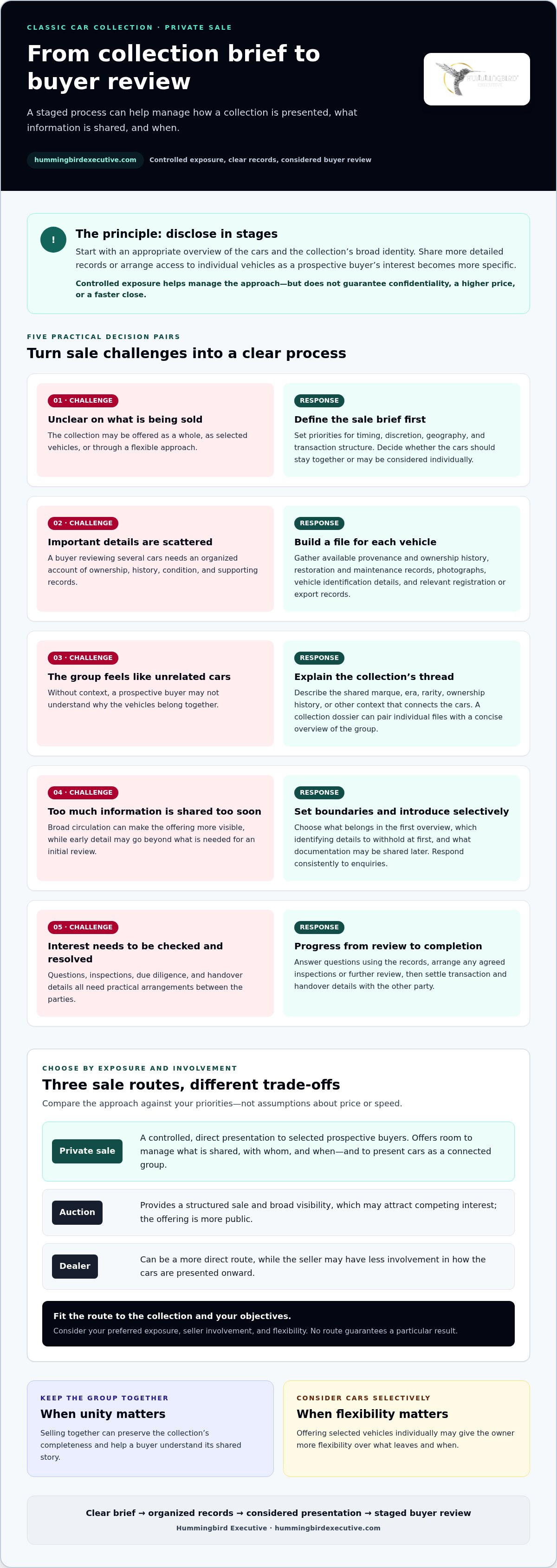
A private sale is a controlled, direct process for presenting one or more cars to selected prospective buyers instead of marketing them broadly through public listings. For owners considering the private sale of a classic car collection, that control can shape what is shared, with whom, and when. It may also make it easier to present the cars as a connected group rather than as unrelated lots competing for attention.
Controlled exposure is not guaranteed confidentiality. Information can travel beyond its intended audience, and a private route doesn’t guarantee a higher price or faster close. Its value lies in managing the approach. Controlled exposure means deciding how a collection enters the market; a public listing or auction puts it before a wider audience on a more visible timetable.
Start by identifying what holds the collection together. A shared marque, era, rarity, or ownership history may give the cars a narrative that helps a prospective buyer understand why they belong together. The term “classic car” is used in different ways; the definition of a classic car offers a general overview of classifications and the factors that shape how these vehicles are understood.
What makes a collection different from a single-car sale?
A single-car sale centres on one vehicle’s specification, condition, and history. A collection adds relationships between cars: perhaps a marque’s development across decades, a particular period of motorsport, or an owner’s consistent approach to preservation. That context can help a buyer understand the group as a whole.
Selling together preserves that unity, while offering selected cars individually gives the owner more flexibility over what leaves and when. If the collection’s significance rests on its completeness, keeping it together may be important. If the cars have distinct appeal, a staged or selective sale may fit better.
When does a private route suit a classic car owner?
A private approach may suit an owner who values discretion, wants to reach qualified interest, or needs a presentation tailored to a multi-car group. It also allows room to introduce the collection’s context before sharing detailed information. Careful records and buyer review still matter.
A public auction offers a structured sale and broad visibility, which may attract competing interest, but makes the offering more public. A dealer route can be more direct, while the seller may have less involvement in how the cars are presented onward. Compare the routes by your preferred level of exposure, involvement, and flexibility. No route guarantees a particular result; the right one is the one that best fits the collection and your objectives.
How a private classic car collection sale is structured
A well-structured private sale moves from the owner’s priorities to a controlled introduction, then to buyer review and transaction planning. This sequence helps limit premature circulation of sensitive information while giving a serious prospective buyer enough detail to decide whether to proceed. The owner sets the objectives and disclosure boundaries; the parties then agree practical arrangements, including due diligence and completion.
Staged disclosure means sharing relevant information progressively, as interest develops and the next decision requires it. An initial summary might describe the cars and the collection’s broad identity. More detailed records or access to individual vehicles can follow as discussions advance. This approach helps manage information, but does not guarantee confidentiality.
- Define the sale brief. Decide whether you’re offering the collection as a whole, considering individual vehicles, or open to both approaches. Set your priorities for timing, discretion, geography, and transaction structure.
- Organize the records. Assemble available provenance, ownership, restoration, maintenance, and vehicle identification information before approaching buyers.
- Prepare the presentation. Create consistent summaries and clear photographs so the collection can be understood without overstating condition or history.
- Introduce interest selectively. Share an appropriate overview first, then provide further detail as a prospective buyer’s interest becomes more specific.
- Manage diligence and completion. Answer questions using the records, arrange any agreed inspections or further review, and settle transaction and handover details with the other party.
Set the sale brief before approaching prospective buyers
Write down what a successful outcome means to you before discussions begin. An owner who values the integrity of a marque-focused group, for example, may prefer a single collection presentation. Someone seeking more flexibility may be willing to discuss selected cars separately. Note your preferred timing and geographic reach, and decide whether you want an outright sale or are open to another structure agreed with a buyer.
Set disclosure boundaries, too. Decide what can appear in an initial overview, which identifying details to withhold at first, and what documentation may be shared later. Clear boundaries make it easier to respond consistently to enquiries.
Build a credible collection dossier
Prepare a file for each car, along with a concise overview of the group. Include available ownership history, provenance material, restoration invoices or records, maintenance files, photographs, vehicle identification details, and relevant registration or export records where applicable. If a record is missing, state that plainly rather than filling the gap with an assumption.
Keep condition descriptions consistent. Separate documented facts, such as recorded restoration work, from your observations about presentation or operation. This distinction supports informed review and helps buyers assess each car on the same basis.
Once your brief and dossier are ready, a private marketplace can offer a considered route to buyer interest. Hummingbird Executive gives members private access to buy or sell rare assets, including luxury cars, with concierge support for complex, multi-asset matters. Explore private access to rare assets as one way to present a collection with care.
Private sale, auction, or dealer: which route fits your collection?
The right route depends on what you want the sale to accomplish. A collection with a strong shared identity may call for a different approach from a group of individually appealing cars. Consider potential reach, how much involvement you want, whether the cars should be offered together, and how much control you need over the presentation.
Public routes widen the audience; private routes allow greater control over who sees the offering and when. Neither approach guarantees a particular price, buyer, or timetable. The trade-offs are practical, and the best fit depends on your vehicles and circumstances.
| Route | Exposure | Seller involvement | Timing and collection flexibility |
|---|---|---|---|
| Private sale | Introductions and information can be shared selectively, though confidentiality isn’t assured. | The seller may coordinate presentation, enquiries, and buyer diligence, or involve a collection intermediary. | Discussion can be tailored, including whether the group or selected cars are considered. |
| Auction | A public sale format offers broad visibility to its audience. | The seller works within the auction’s process and sale structure. | The event timetable and lot format shape when and how vehicles are offered. |
| Dealer sale | Exposure is generally more direct than a public auction, depending on the arrangement. | A dealer-led transaction may reduce the seller’s role in the onward presentation. | A direct route may suit individual vehicles; handling a full collection depends on the dealer’s fit and the agreed terms. |
What a private sale can offer, and what it requires
A private sale lets you control the order of introductions and tailor what information is shared at each stage. That can be useful when the collection’s story is central or public visibility is not a priority. Control is not automatic; it depends on how the process is managed and what prospective buyers do with the information they receive.
Expect to coordinate materials, respond to questions, and support appropriate due diligence. A collection intermediary may help organize communication and buyer interest across several vehicles, but cannot promise a buyer or a particular result. Consider this route if discretion and flexibility matter enough to warrant active oversight.
When an auction or dealer route may be preferable
An auction may suit an owner who values an established public-sale format and is comfortable with wider exposure and a defined event structure. It can also offer a clear framework for presenting individual cars as lots, although the collection’s unity may be less central to that format.
A dealer sale may be preferable when directness and reduced seller involvement are priorities, particularly if the cars are being considered individually. A dealer’s approach to a multi-car group can vary. For the private sale of a classic car collection, weigh each route against the collection’s identity, your preferred visibility, and the level of involvement you’re prepared to retain. There is no universal best choice, only the route that aligns with your priorities.
Prepare a classic car collection for discreet buyer review
Prepare the collection so it is easy to assess without making the owner, location, or security arrangements unnecessarily visible. Build one dependable information set for the group, then a separate file for each vehicle. Consistent formats help a prospective buyer compare cars, while precise wording distinguishes evidence from opinion. For the private sale of a classic car collection, good preparation supports both credibility and careful disclosure.
Which records and facts should be assembled?
Gather available records before preparing summaries. Keep original documents distinct from later notes, and identify gaps plainly. A missing invoice is a gap, not proof that work was never done or that it occurred as described.
- Provenance and ownership: Assemble known ownership history and supporting records. If more than one person or an entity owns a vehicle, clarify who has authority to discuss or agree to its sale.
- Service and restoration: Sort maintenance files, restoration invoices, and related records by vehicle and date. Preserve original documents and label any summary as a summary.
- Identity and registration: Record each vehicle’s identification details and gather relevant registration documents. Keep export or transfer records where applicable.
- Condition notes: Describe each car using the same categories, such as known work, visible wear, and items requiring further review. Separate documented facts from the owner’s observations.
How to manage presentation, privacy, and practical details
Prepare a consistent set of photographs for each vehicle, covering the exterior, interior, engine bay, and notable features or visible imperfections. Use comparable angles and lighting across the group. Before sharing initial materials, remove or withhold details that reveal a home, storage facility, registration information, or other sensitive identifiers.
Keep the presentation candid. If a condition point is based on personal observation rather than an inspection or record, say so. Avoid broad claims such as “fully restored” unless the supporting documentation establishes what that description means. Clear limits on what the materials demonstrate help buyers assess the cars without mistaking an owner’s account for independently verified fact.
Plan for the period the cars remain available for review. Consider whether their current storage remains appropriate, how any viewing or transport would be arranged, and how insurance continuity will be maintained. Before agreeing terms or moving a vehicle across borders, discuss jurisdiction-specific tax, title, export, and transfer requirements with qualified advisers. The relevant details can depend on the parties and locations involved.
Owners considering the cars as part of a broader portfolio may also explore private luxury car collection investment. For members seeking private access to sell rare assets, including luxury cars, explore Hummingbird Executive’s private marketplace as an alternative to broad public exposure.
A discreet next step for selling a classic car collection
A considered sale begins with clear decisions, not a public announcement. Define whether you’re offering the cars together or individually, establish what matters most, organize supporting evidence, and choose a route that reflects your preferences for reach and involvement. Then decide what belongs in an initial presentation and what to share only as discussions progress.
This sequence gives you a framework for the private sale of a classic car collection while keeping key choices in your hands. It doesn’t determine a buyer, valuation, timetable, or outcome. Those depend on the vehicles, the parties, and the terms they agree.
What to expect from a member-oriented private marketplace
Hummingbird Executive provides members with private access to buy or sell rare assets, including luxury cars, through a secure marketplace. It offers an alternative to broad public exposure for owners who prefer a member-oriented setting. The platform does not use cookies, and personal information is never sold, details that may matter when considering how your information is handled.
Marketplace access is distinct from a guaranteed sale. It provides a route for presenting rare assets, not a promise of buyer interest or transaction results. Concierge support can help coordinate a complex, multi-asset process; it is support, not a commitment to a particular valuation, sale timing, or outcome. Platinum membership includes worldwide 24/7 dedicated concierge services. Review the Platinum membership luxury concierge details to understand how the membership is structured.
Choose a considered next step
Before proceeding, write down the scope of the collection you may sell, your preferred structure, and the boundaries for sharing information. Keep those priorities visible as you weigh marketplace access against auction or dealer routes. A concise brief can help you make deliberate decisions without treating discretion as an absolute guarantee.
For an owner managing several rare assets, Platinum membership’s worldwide 24/7 dedicated concierge services can support coordination across the wider process. Decisions about disclosure, terms, and whether to proceed remain yours.
If private access to rare assets and concierge support align with your priorities, explore Hummingbird Executive membership. You can also read the private luxury car collection investment guide for a broader perspective on the asset itself.
Shape the next chapter for your collection
A collection sale can mark a change in stewardship as much as a change in ownership. Before taking the next step, consider what you want the transition to preserve: the group’s identity, your preferred level of visibility, or the freedom to place vehicles separately. Let those priorities guide the pace and form of the process.
A private sale of a classic car collection is most considered when the route reflects the owner’s intentions rather than simply following the most visible path. Hummingbird Executive gives members private access to opportunities to buy or sell rare assets, including luxury cars. Platinum membership also includes worldwide 24/7 dedicated concierge services for members seeking additional coordination.
If a member-oriented route fits your priorities, explore Hummingbird Executive’s private access to rare assets. Take the next step with clarity about what you wish to share and how you want the collection to move forward.
Frequently Asked Questions
Is a private sale better than auction for a classic car collection?
Neither route is universally better; the right choice depends on your priorities and the character of the cars. An auction suits owners who welcome a public event and its established format. A private sale may appeal if you prefer to control introductions and discussions. Before choosing, consider whether your collection benefits from being seen together, how much visibility you accept, and how involved you want to be. No route guarantees a particular price or sale.
Can I sell a classic car collection without advertising it publicly?
Yes. A private sale of a classic car collection can be pursued through direct introductions or a member-oriented marketplace rather than a public listing. You can begin with a brief, non-identifying overview and reserve detailed material for later discussions. Private circulation is not a guarantee of complete confidentiality. Be deliberate about who receives information, what it contains, and whether recipients may share it onward.
How is a classic car collection valued for a private sale?
Value is assessed vehicle by vehicle, then considered in the context of the group. Relevant factors can include condition, originality, provenance, restoration quality, documented history, and demand for each model. A collection’s coherence or completeness may matter to some prospective buyers, but it shouldn’t be assumed to create an automatic premium. For a defensible asking position, compare relevant sales and consider an independent specialist appraisal, especially where records or condition are complex.
Should I sell a classic car collection as one lot or individually?
Offer the cars together if their shared history, completeness, or presentation as a group is central to what makes the collection distinctive. Individual sales may make more sense if the vehicles appeal to different buyers or you want flexibility over what to release. You can also state that you prefer a complete sale while remaining open to selected-vehicle discussions. Decide in advance which outcome matters most, so early interest doesn’t dictate the strategy.
What documents should I prepare before a private classic car sale?
For each car, assemble available ownership and registration documents, identification details, provenance material, service records, restoration invoices, and photographs. Keep original documents separate from summaries, and label copies clearly. A simple index linking each record to the relevant vehicle helps prevent confusion when several cars share a marque or period. Record missing items accurately, and make sure the person discussing or approving a sale has the appropriate authority.
Should I keep classic cars insured while they are being sold?
Generally, maintain appropriate insurance while the cars remain in your possession, including during storage and any agreed movement or viewing. A vehicle’s use and location may change during a sale process, so review the policy conditions rather than assuming existing cover applies to every circumstance. Keep a clear record of when possession and responsibility transfer. Avoid cancelling cover until the handover arrangements and transfer of ownership have been settled.
How can I protect my privacy when selling a classic car collection?
Limit identifying details in initial materials. Avoid showing addresses, storage facilities, registration numbers, or distinctive location clues in photographs, and review image metadata before sharing files. Use a concise, anonymized overview for early interest; provide identifying records only when relevant to a serious discussion. Keep a note of what you’ve shared and with whom. These steps can reduce unnecessary exposure, but no private process can guarantee that information won’t be passed on.