What if a classic car rises in value but still leaves you with a loss? Asking “is a classic car a good investment” means looking beyond headline auction prices to the costs and uncertainty between purchase and sale. A car can appreciate on paper while storage, insurance, maintenance, restoration and the timing of a sale determine the actual result.
The appeal is clear. A rare or historically significant car offers a distinctive pleasure of ownership, and some models have gained value over time. But past appreciation doesn’t establish what a specific car will be worth or how readily it can be sold when you choose. The financial case depends on the car itself, its provenance and condition, collector demand, and your total cost of ownership.
This 2026 guide explains how to assess those factors, compare potential resale proceeds with ongoing expenses, and interpret market trends without treating them as a forecast. It also helps distinguish the enjoyment of collecting from the investment case, and consider where a classic car may fit within a broader collection or portfolio. Private access to rare cars can support the search, while careful due diligence remains essential.
Key Takeaways
- Whether is a classic car a good investment depends on net resale proceeds, not appreciation alone. Include ownership and transaction expenses in your calculations.
- Assess rarity alongside sustained collector demand, and examine provenance, originality, restoration records and condition as separate evidence.
- Compare classic cars with liquid financial assets and other collectibles by potential appreciation, carrying costs, liquidity, expertise and personal utility.
- Use a consistent evaluation process: define your investment thesis, review the vehicle and its history, research comparable sales, then document costs and exit assumptions.
- Decide whether a car suits your collection by weighing enjoyment against expertise, liquidity needs and concentration across your assets.
Classic Cars: Good Investment or Just for Enjoyment?
Some classic cars appreciate, but no classic car guarantees a return. The financial result is what remains after accounting for the purchase price, ownership expenses, maintenance, restoration and transaction costs. An increase in estimated market value is not, by itself, evidence that an owner has made a profit.
Imagine buying a car for its rarity and selling it later for more than the purchase price. If years of storage, insurance, upkeep and specialist work absorb the difference, you may have owned an appreciating asset without earning a positive net return. The holding period matters because it determines how long those costs accumulate and when you need to find a buyer.
Appreciation is a change in price. Investment quality is the net result after costs, risk and the practical challenge of selling.
What counts as an investment when the asset is a car?
Start with four elements: purchase price, holding period, sale proceeds and expenses. Record the acquisition cost, then account for recurring and one-off expenses before estimating what a sale could realistically return. This gives you a financial measure, separate from how much the car means to you.
Market value estimates what a buyer may pay under particular conditions. Personal value is different: it may come from driving pleasure, family history, design, heritage or the community around a marque. Those benefits can justify ownership on their own terms, but they shouldn’t be counted as cash proceeds when calculating return. A car’s collectible status alone doesn’t predict future appreciation.
The phrase Classic car describes vehicles collectors value for their age, significance or character, although the boundaries can vary. The label describes the object; it doesn’t establish an investment case. Ask whether the specific car has a plausible resale market and whether likely proceeds could compensate for the capital committed and costs incurred.
Why classic-car returns are uncertain
Demand shifts as collector interests and buyer tastes change. Rarity matters only when buyers continue to value what is scarce; a limited production run alone doesn’t create sustained demand. Condition affects desirability, while an incomplete history or extensive changes may narrow the pool of interested buyers. These factors interact, so a model’s reputation cannot settle the prospects of an individual example.
Hagerty’s guidance is conditional: selection and maintenance affect a car’s potential value, not a guaranteed outcome. Even careful upkeep can’t control future demand or the timing of a sale. Historical performance may show how particular cars or market segments behaved during a past period, but it can’t establish what a specific vehicle will return in the future.
So, is a classic car a good investment? It may be if a particular car has a credible financial case after expenses and uncertainty are considered. It may also be worthwhile primarily for the experience of ownership. Keep those aims distinct: assess the numbers as an investor, then decide whether the non-financial rewards justify the rest.
What Drives Classic-Car Values: Rarity, Provenance, Condition, and Demand
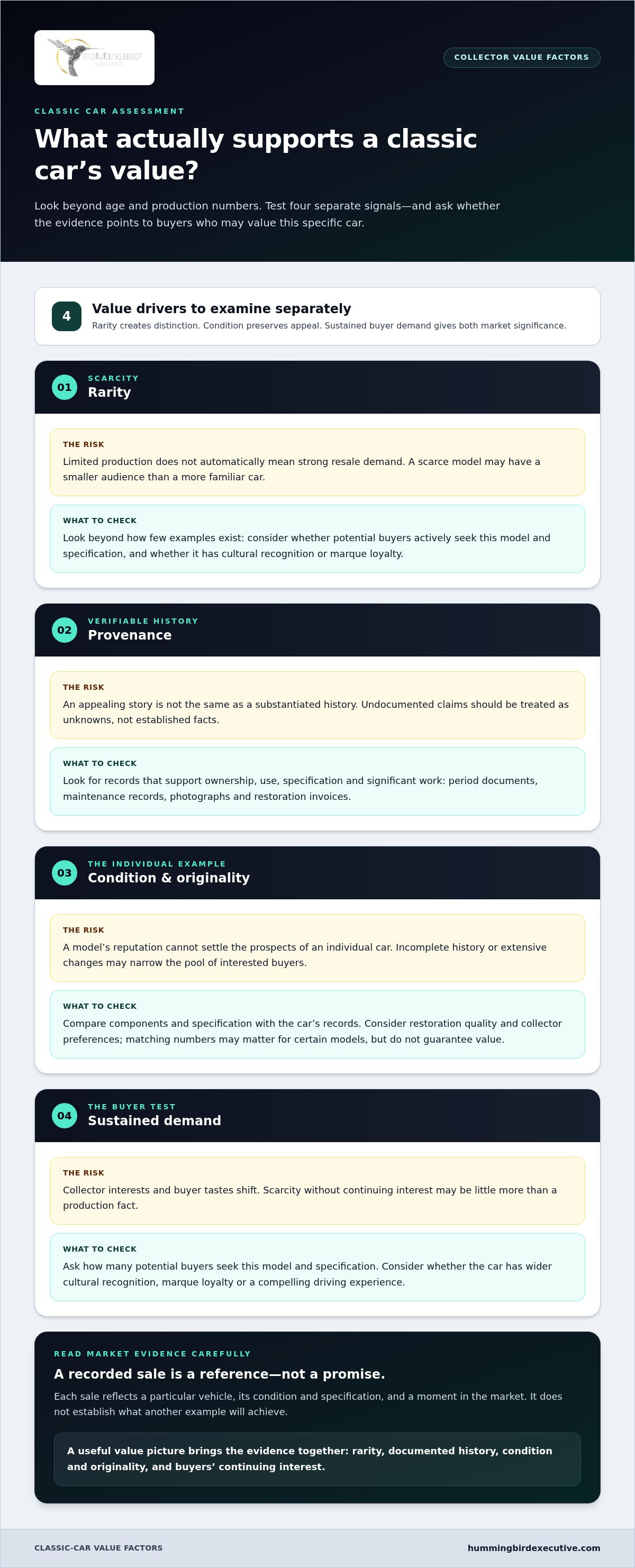
A car’s value reflects more than its age or production numbers. Collectors consider what makes a specific example desirable, how convincingly its history can be established, and whether buyers are likely to want it when it comes to market. A sought-after model and a sought-after example are not necessarily the same thing.
Rarity creates distinction, condition preserves appeal, and sustained buyer demand gives both their market significance. Without demand, scarcity may be little more than a fact about production.
How provenance and originality affect collector interest
Provenance is a vehicle’s verifiable history, including its ownership, use, specification and significant work. Period documents, maintenance records, photographs and restoration invoices can help support that history. A coherent record is more useful to a buyer than an appealing story that cannot be substantiated.
Originality and restoration quality also need context. A car that retains its factory specification may appeal to one group of collectors, while a carefully restored example may attract another. Matching numbers can matter for certain models, but they aren’t a universal guarantee of value. Compare the car’s components and specification with its records, and treat undocumented claims as unknowns rather than established facts.
Why rarity is not enough to support a valuation
Limited production doesn’t automatically mean strong resale demand. A scarce model may have a smaller audience than a familiar car with wider cultural recognition, stronger marque loyalty or a more compelling driving experience. Consider not only how few examples exist, but also how many potential buyers actively seek this model and specification.
Market records help establish context, but they need careful interpretation. A recorded sale reflects a particular vehicle, condition, specification and moment in the market. It isn’t a promise that another example will achieve the same result. Broader research, including SEMA automotive research, can offer perspective on changing aftermarket interests, but it can’t replace evidence about an individual car.
Compare examples as a buyer would. Separate the model’s general reputation from the subject car’s documented history, note differences in condition and specification, and compare like with like rather than relying on a single headline sale. A popular model with incomplete records or substantial unverified work may present a very different proposition from a well-preserved, documented example. The details matter.
These characteristics also shape a car’s role in a collection. Unlike a conventional financial asset, a car may provide personal utility through driving, display and participation in a community. Those benefits don’t establish market value or ensure a ready sale. Collectors weighing both objectives can explore rare luxury cars through Hummingbird Executive’s private marketplace, while keeping independent research and valuation judgment central to the decision.
Classic Car Investment vs. Other Assets: Weigh Return, Costs, and Liquidity
A fair comparison goes beyond possible appreciation. A classic car is a specialist asset with practical costs and personal appeal; a liquid financial asset generally serves a different role. Other collectibles share some market uncertainty, but each category has its own storage, expertise and resale considerations. The useful question isn’t simply which asset might rise in value, but what it costs to hold and how readily it can be sold.
| Factor | Classic cars | Liquid financial assets | Other collectible assets |
|---|---|---|---|
| Potential appreciation | Depends on the individual vehicle, condition, demand and sale circumstances. | Varies by asset and market; value can rise or fall. | Depends on category, rarity, condition and collector interest. |
| Carrying costs | Storage, insurance, maintenance and possible restoration. | Typically fewer physical care needs, though account or transaction charges may apply. | May require secure storage, insurance, conservation or specialist handling. |
| Liquidity | Finding a suitable buyer can take time; sale price may depend on timing. | Often easier to trade, subject to the asset and market conditions. | Can be limited by the size of the buyer pool and the sale channel. |
| Expertise required | Vehicle history, specification, mechanical condition and market knowledge matter. | Requires understanding of the asset, its risks and how it is held. | Specialist knowledge helps assess authenticity, condition and demand. |
| Personal utility | May offer driving, display and heritage value alongside financial exposure. | Usually held primarily for financial purposes. | May provide aesthetic, historical or personal enjoyment. |
Which costs change the investment calculation?
Build a cost picture that separates predictable expenses from uncertain ones. Include purchase and sale transaction expenses, insurance, storage and routine maintenance. Then consider whether restoration or other condition-related work may be needed. A car requiring substantial work can demand more capital and a longer holding period before sale, while unexpected repairs can reduce net proceeds.
Keep estimates distinct from known costs. A planned storage arrangement can be budgeted; future repairs and market movement remain uncertain. This distinction helps prevent a projected sale price from being mistaken for a dependable return. Personal enjoyment can make the expenditure worthwhile, but it doesn’t erase the financial outlay.
Why liquidity and portfolio concentration matter
A classic car doesn’t sell as instantly as an asset traded in a deep public market. Reaching a qualified buyer may take time, and a seller facing a fixed deadline may need to accept a less favourable price. Account for that possibility in your exit assumptions before purchase, not only when a sale becomes necessary.
Concentration matters, too. If a substantial share of your wealth is tied to one vehicle, its market, condition and sale timing can have an outsized effect on your collection. So, is a classic car a good investment? It may suit a collector who understands its specialist risks and can hold it without relying on a prompt sale. Consider it one collectible within broader financial planning, not a substitute for diversification.
How to Evaluate a Classic Car Before Treating It as an Investment
A disciplined assessment separates what the car is, what its records establish, what buyers have paid for comparable examples, and what ownership may cost. Work through each stage in order, recording assumptions instead of relying on an asking price or a compelling story.
- Define the investment thesis. State why this particular car might appeal to future buyers, whether because of its specification, provenance, condition or place in the market. Set an intended holding period and separate that financial rationale from the enjoyment you expect to receive.
- Inspect the vehicle itself. Assess its condition, identity details, and the quality of any restoration or modifications. Record inspection findings and what they may mean for valuation and necessary work. A visual impression alone isn’t a substitute for a careful assessment.
- Review provenance and documentation. Compare ownership records, service history, restoration invoices and specification details with the car presented for sale. Check chassis and engine numbers against available records. Missing paperwork is an uncertainty to investigate and account for, not proof of a defect.
- Research the market. Gather dated sales of comparable cars, noting differences in specification, originality, condition and documentation. An auction result is evidence from one transaction, not a guaranteed price for another example. Keep asking prices distinct from completed sales, and record why each comparison is relevant.
- Build the cost analysis. Estimate purchase and selling expenses, storage, insurance, maintenance and potential restoration separately. Identify known costs and uncertain ones, such as future repairs. Test how additional work or a longer holding period would change the net proceeds.
- Document the exit assumptions. Identify the likely buyer profile, possible resale routes and the conditions under which you might sell. Stress-test the plan against slower demand, a delayed sale, unexpected work and the possibility of accepting a lower price to meet a deadline.
This process gives the question is a classic car a good investment a more useful answer than a broad market forecast. The case rests on the individual vehicle and the evidence behind its expected costs and resale prospects. A private marketplace can help collectors explore rare-car opportunities, alongside vehicle research, valuation and independent investment judgment.
For a wider view of how a vehicle may sit within a collection, consult The Silent Asset: A 2026 Guide to Private Luxury Car Collection Investment. Then apply a final decision test: proceed only if the financial assumptions remain credible under less favourable conditions and the personal value of ownership still makes sense. If either case depends on optimistic resale assumptions, pause.
Collectors can explore rare assets, including luxury cars, through Hummingbird Executive’s private marketplace.
Where a Classic Car Fits in a Private Luxury Asset Collection
A classic car can occupy a distinctive place in a private collection. It may be driven, displayed and appreciated for its design or heritage, while also carrying uncertain financial exposure. That combination is its appeal and its complication. Treat it as a specialist collectible, not a dependable investment or a substitute for assets held to meet defined liquidity needs.
Suitability depends on your purpose and circumstances. A vehicle may complement a collection when its significance is understood, its ownership demands are manageable and its purchase doesn’t create undue concentration in one asset or market. The right fit is personal: a car that excites one collector may be an illiquid, expensive holding to another.
When a classic car may suit a collector-investor
A stronger fit exists when you value the car independently of appreciation. Driving enjoyment, design, heritage or a meaningful connection to a marque can remain rewarding even if resale value is flat or uncertain. That personal utility is real, but keep it separate from a financial return calculation.
Consider practical capacity as well as enthusiasm. Ownership can involve storage, insurance, maintenance and restoration, while a future sale may take time or require flexibility on price. A collector should be able to absorb uncertain expenses and hold the vehicle without depending on a prompt sale. Ultimately, the decision depends on individual objectives, expertise, available liquidity and the wider financial picture.
Explore rare-car opportunities through a private asset marketplace
For collectors who have established that a car fits their objectives, Hummingbird Executive provides members with access to rare assets, including luxury cars, through a private marketplace. Platinum membership includes access to search, buy or sell rare assets, alongside dedicated concierge services worldwide, at no extra charge. The marketplace offers a route to explore opportunities, while due diligence, valuation and investment judgment remain essential for each vehicle.
Membership is one part of the decision, not the investment thesis. Collectors assessing the service in more detail can review the Platinum Membership Luxury Concierge guide for membership context, then evaluate each vehicle on its evidence and terms. No marketplace can establish that a car will appreciate, find a buyer at a desired time or deliver a particular result.
The broader question, is a classic car a good investment, has no universal answer. A car may have a place in a collection when you understand the risks, have room for uncertain costs and value ownership beyond a projected resale price. If the case depends on guaranteed appreciation or immediate liquidity, it is unlikely to be a comfortable fit.
Collectors considering rare assets can explore Hummingbird Executive for private marketplace access.
Set Your Collection Priorities Before the Next Search
Before pursuing a particular car, decide what role you want it to play. Is your priority driving enjoyment, a connection to a marque, or a considered place within a broader collection? Set boundaries for capital, ongoing commitment and time to sell before a compelling example makes those decisions feel urgent.
The question “is a classic car a good investment” is personal as well as financial. A considered choice leaves room for uncertain outcomes while preserving the reasons you wanted the car in the first place. That clarity can help you recognise when an opportunity fits your objectives and when its appeal rests mainly on an optimistic resale assumption.
For collectors exploring rare assets, including luxury cars, Hummingbird Executive offers private marketplace access. Platinum membership includes access to search, buy or sell rare assets, alongside worldwide concierge services. The marketplace can be a discreet avenue for exploration, while your own research and judgment remain central.
Explore Hummingbird Executive to explore rare assets and consider how they may fit your collection.
Frequently Asked Questions
Is a classic car a good investment?
It can be, but the outcome depends on the individual car and the terms of ownership. To assess whether a classic car is a good investment, model a realistic sale scenario rather than relying on an optimistic asking price. Compare expected net proceeds with the full amount committed, including any work needed before sale. If the result looks attractive only under the most favourable assumptions, treat the purchase primarily as a collecting decision.
Can classic cars lose value?
Yes. A car can lose market value, and deterioration or newly discovered work can reduce its sale proceeds further. For example, if a buyer’s inspection uncovers corrosion or an undocumented modification, the buyer may revise an offer or withdraw. Consider how you would respond to that possibility before purchasing. A sound decision shouldn’t depend on the car retaining its condition or appeal without ongoing attention.
How do you know if a classic car is worth investing in?
Look for consistency between the car, its records and the value you assign to it. If a seller describes a vehicle as original but service documents show a major component replacement, understand how that affects your intended use and potential resale. Review several completed sales, not just advertisements, and note what differs between those cars and this one. The evidence should support a purchase rationale you can explain without relying on a single standout result.
Are classic cars a good hedge against inflation?
Not reliably. A classic car’s resale price can move independently of general inflation, and ownership costs may rise even when the vehicle’s market value does not. If protecting purchasing power is a priority, define the period and outcome you’re trying to protect, then compare the car’s uncertain and potentially delayed sale proceeds with that objective. Don’t treat a collectible’s past price increases as proof that it will keep pace with future living costs.
What makes a classic car increase in value?
No single feature ensures an increase. A desirable specification may attract attention, but its appeal is stronger when supported by credible records, sound condition and a continuing pool of interested buyers. For example, a documented restoration can help explain the work performed, yet buyers may still differ on whether that restoration suits their preferences. Weigh these factors together rather than treating them as a checklist that predicts a particular future price.
Are classic cars easy to sell when you need to?
Not always. A sale can take longer if the vehicle’s history is difficult to establish, its price exceeds comparable evidence or its likely buyer group is narrow. Before committing, decide how flexible you can be on timing and price. A collector who may need funds by a fixed date should be especially cautious about relying on a quick sale. An identified route to market is useful, but it can’t guarantee a buyer or a particular outcome.
Should I buy a classic car for investment or enjoyment?
Separate the two motives before deciding. Ask whether you’d still want the car if its value stayed unchanged, then consider whether the purchase remains financially comfortable after expected ownership costs. If enjoyment is the central reason, that can be a legitimate basis for collecting, provided you understand the financial exposure. If investment performance is essential, require a defensible financial case rather than letting anticipated driving pleasure stand in for a return calculation.