A wire can be technically correct and still reach the wrong party. For a high-value acquisition, secure payment for multi-million dollar assets depends on more than choosing a transfer method: the counterparties, payment instructions, release conditions, and records all need careful attention. Discretion matters, but it cannot replace verification.
It’s reasonable to want funds protected, sensitive information kept private, and the transaction completed without unnecessary exposure. The challenge is knowing who controls the funds, what must happen before they’re released, and how to confirm that instructions are genuine before authorizing a transfer.
This guide explains how to assess escrow and direct settlement structures, verify counterparties and payment details, organize transaction documents, and coordinate each milestone before funds move or an asset is released. For acquisitions sourced through Hummingbird Executive’s private platform, concierge coordination can help organize communications and stakeholders. Payment controls remain a separate part of the transaction. Precision first, then commitment.
Key Takeaways
- Assess direct transfer, escrow, and staged settlement by who controls the funds, what documentation is required, and when release conditions are met.
- A secure payment for multi-million dollar assets begins with verifying the parties, their authority, and payment instructions through independently established channels.
- Agree on diligence and verification steps early to reduce last-minute uncertainty while keeping sensitive information appropriately contained.
- Use a clear sequence for reviewing terms, authorizing funds, confirming release, and retaining settlement records.
- Discreet concierge coordination can help organize communications and milestones around private-market opportunities, while payment controls remain separate.
What Secure Payment for Multi-Million-Dollar Assets Actually Requires
Secure payment for multi-million dollar assets is a controlled process in which the parties, their authority, payment instructions, and conditions for releasing funds and the asset are independently verified and documented. Confidentiality and payment security are distinct: privacy limits unnecessary disclosure; security establishes who may act, where funds should go, and what must happen before they move.
That distinction matters whether the purchase involves a yacht, aircraft, property, or another private-market asset. High value increases the consequences of an error. Cross-border parties, corporate ownership structures, tight deadlines, and a preference for discretion can also make it harder to confirm who is speaking and which documents govern the transaction. No payment method removes the need for independent checks.
Why privacy and payment security are not the same
Restricting deal information to relevant participants is prudent, but it doesn’t establish a buyer’s identity, a seller’s ownership, or an agent’s authority to receive funds. An impersonator may exploit private communications, and altered payment instructions can appear in an otherwise legitimate exchange. Discretion should mean controlled sharing with authorized parties, not skipped verification or reliance on a familiar email thread.
Where payment risk enters a high-value transaction
Risk can arise at each transition: an initial offer may misstate the seller’s authority; deposit instructions may be substituted; final settlement details may change shortly before transfer; or delivery may be arranged before the agreed funds-release conditions are met. An overview of escrow explains the basic role of a neutral arrangement, but the transaction documents must still specify the actual parties, responsibilities, and release conditions.
Keep the roles distinct. The buyer verifies the purchase terms and authorizes payment. The seller establishes its authority to transfer the asset and confirms delivery requirements. Advisers may review documents within their remit, while a custodian or settlement agent performs only the functions assigned in the agreement. Don’t assume that a title holder, broker, or coordinator has authority over funds or ownership simply because they’re involved.
Separate financial steps should not be treated as one event. Financing approval indicates that a funding source has approved lending or access to capital; it is not the buyer’s payment authorization. Authorization directs the transfer. The funds transfer is the movement of money, while settlement is the completion of obligations under the agreed terms. Asset delivery or handover is another milestone, governed by the contract and relevant records.
Before proceeding, define these milestones in writing: who gives each instruction, how instructions are authenticated, which documents establish authority, and what evidence is required before funds or the asset are released. If parties, entities, accounts, or the asset span jurisdictions, have qualified professionals review the applicable documents and local requirements. A familiar transfer route may be convenient, but it cannot verify the recipient or the conditions attached to the sale.
Compare Payment Structures Before Choosing a Settlement Route
The right settlement structure depends on what is being transferred, who holds the funds, and which contractual events must occur before payment or delivery. A direct transfer may be straightforward when the parties, account ownership, and handover terms are clear. Escrow or staged settlement can add controls, but each also requires precise instructions and coordination. None is a universal safeguard.
Direct transfer, escrow, and staged settlement compared
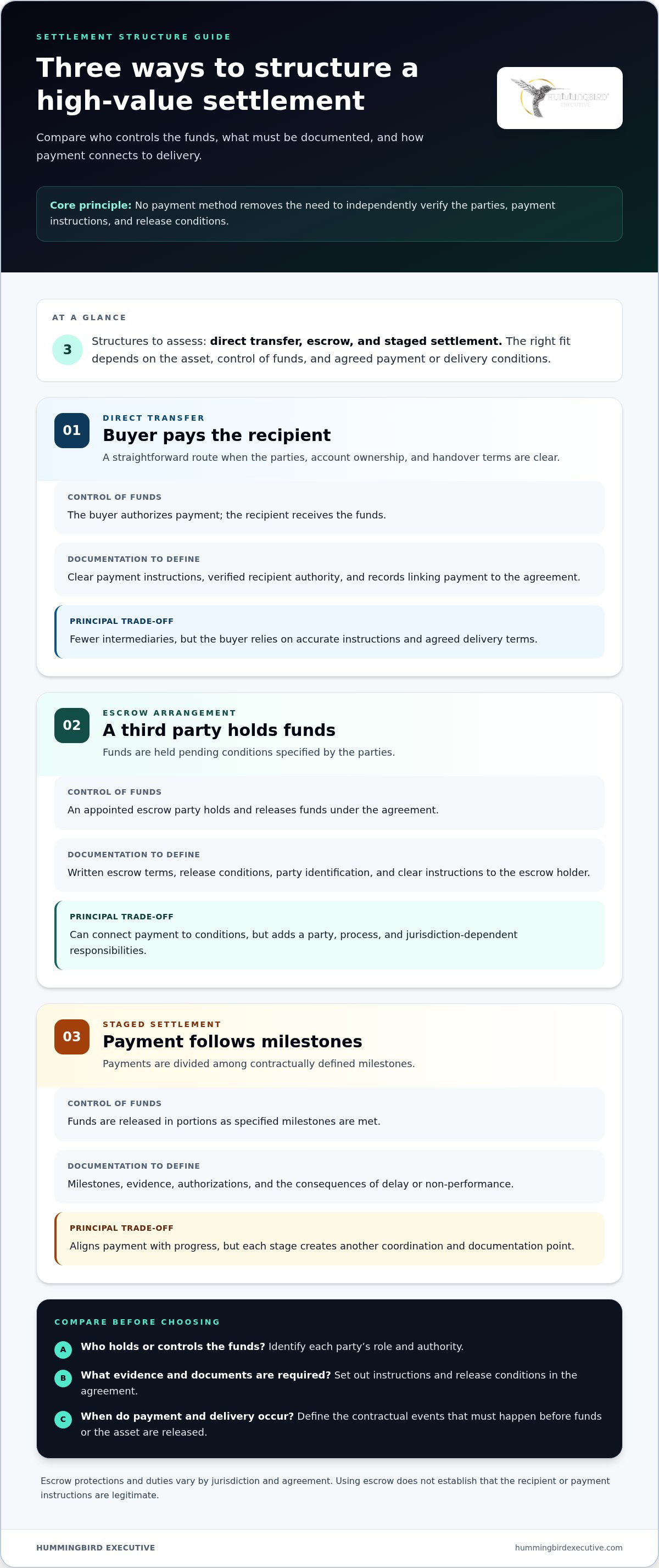
In a direct transfer, the buyer instructs their bank to send funds to the seller or an authorized recipient. With escrow, the parties appoint a third party to hold funds pending specified conditions. In staged settlement, payments are divided among contractually defined milestones, which may be handled directly or through escrow. The table outlines typical distinctions; actual responsibilities depend on the agreement.
| Structure | Control of funds | Coordination and documentation | Principal trade-off |
|---|---|---|---|
| Direct transfer | Buyer authorizes payment; recipient receives funds. | Clear payment instructions, verified recipient authority, and records linking payment to the agreement. | Fewer intermediaries, but the buyer relies on accurate instructions and agreed delivery terms. |
| Escrow arrangement | An appointed escrow party holds and releases funds under the agreement. | Written escrow terms, defined release conditions, party identification, and clear instructions to the escrow holder. | Can connect payment to conditions, but adds a party, process, and jurisdiction-dependent responsibilities. |
| Staged settlement | Funds are released in portions as specified milestones are met. | Milestones, evidence, authorizations, and the consequences of delay or non-performance must be defined. | Aligns payment with progress, but each stage creates another coordination and documentation point. |
Escrow protections and duties vary by jurisdiction and agreement. Using escrow doesn’t establish that the recipient or instructions are legitimate. The buyer and seller should understand who can direct, hold, and release funds, and what evidence the responsible party must rely on. Keep to the agreed procedures and document any formal changes.
Match the structure to the asset and transaction
Asset type shapes the paperwork and handover. A property transaction may involve title and closing records; a yacht or aircraft may require its own ownership and transfer documentation; a collectible may depend on a written bill of sale and agreed delivery evidence. These examples are not a complete legal checklist. The relevant documents depend on the asset and governing terms.
Then map the parties. A buyer or seller may act through an entity, representative, adviser, or custodian, while funds and assets may cross borders or involve different currencies. Each additional party or jurisdiction can affect instructions, documentation, timing, and responsibilities. Qualified legal and financial professionals can assess the particular contract and applicable jurisdiction; no single settlement route fits every acquisition.
For a secure payment for multi-million dollar assets, compare the structures against the written deal: who controls funds, what triggers each release, and how completion is recorded. Buyers exploring rare, off-market opportunities can also consider Hummingbird Executive’s private asset access as one part of a discreet acquisition process, separate from payment arrangements.
The Due-Diligence Checks That Address the Biggest Payment Objection
Careful checks can feel like a drag on a transaction, especially when the parties value speed and discretion. The key is to plan verification in advance rather than improvise at the point of transfer. Agreeing who will check what, and how, can reduce last-minute uncertainty without eliminating fraud risk or exposing details beyond the people who need them.
For secure payment for multi-million dollar assets, assess identity, authority, ownership, payment instructions, and release conditions as separate questions. A convincing answer to one doesn’t settle the others. Keep the process proportionate to the asset and transaction, and record the basis for each decision.
Verify the counterparty, authority, and asset documentation
Begin by reconciling the names and roles in the agreement. If a company is buying or selling, establish which legal entity is party to the contract, who can sign for it, and whether any representative is authorized to negotiate, receive notices, or direct payment. Names, entity details, signatures, and account ownership should make sense together. Don’t rely on a title or introduction alone.
Then review records relevant to the asset and proposed transfer. Depending on the transaction, these may include ownership, registration, title, or custody documents. Treat such records as diligence inputs, not universal proof: their meaning and reliability depend on the asset, issuing source, and jurisdiction. KYC and AML requirements also vary with the parties, transaction, and applicable rules, so qualified professionals should determine what applies.
- Identity: Does each party’s legal name align with the agreement and supporting records?
- Authority: Is the person giving instructions empowered to act in that specific capacity?
- Ownership: Do relevant asset records support the seller’s ability to transfer it?
Protect payment instructions from impersonation
Payment details need their own verification, even when the counterparty and asset have been reviewed. A new beneficiary account or a change to existing instructions should pause authorization until it has been confirmed through a channel established independently of the message containing the change. Don’t reply to that message or rely solely on contact details supplied within it. Use a previously verified phone number or another separately sourced contact route, and confirm the details with an authorized person.
Verify payment instructions through a separately established channel, not through the message that introduced them. This rule helps distinguish a legitimate update from an unverified request; it doesn’t guarantee that a transfer is safe.
Keep a restricted record of who checked the instructions, when the check occurred, whom they reached, and which account details were approved. If anything changes after approval, treat it as a new instruction and repeat the verification. Pre-agreed steps help preserve both pace and privacy: authorized participants know what to confirm, while sensitive information stays within the defined transaction group.
A Practical Secure-Payment Checklist for Buyers and Sellers
A written sequence turns agreed safeguards into clear actions. Assign an owner to each milestone, define what evidence completes it, and keep a concise record of the outcome. For secure payment for multi-million dollar assets, this discipline helps buyer and seller coordinate without circulating sensitive information more widely than necessary.
Before authorizing a deposit or final transfer
- Review the executed agreement. Confirm the parties, asset description, purchase price, payment schedule, due dates, deposit terms, and conditions for refund or forfeiture. The buyer and seller should work from the same final version, with amendments documented rather than handled through informal messages.
- Confirm parties and authority. Reconcile the legal names of the buyer, seller, and any contracting entities. Identify who is authorized to sign, issue payment directions, confirm receipt, and approve delivery. Record the basis for each role, particularly when representatives or multiple entities are involved.
- Match the payment details to the contract. Before each payment, compare the amount, currency, recipient’s legal name, account details, and contractual due date with the approved instructions. Confirm that the stated payee is entitled to receive that payment under the agreement.
- Recheck deposits and changes. Ensure deposit and refund conditions match the executed terms. Treat any discrepancy, replacement account, or last-minute change as unresolved until it has been reviewed through the transaction’s independent verification procedure. The person responsible for payment authorization should document the check and approved instruction version.
- Authorize only after the required checks. The buyer or designated authorized signatory should confirm that applicable approvals are complete and that the transfer matches the agreed terms. Keep authorization evidence with the transaction record, limiting access to those with a defined role.
Before funds are released and the asset changes hands
- Confirm the asset-specific milestone. Identify what must occur before funds are released or possession changes. Depending on the asset and contract, this may involve delivery, title transfer, registration, custody, or another agreed handover step. For a yacht sale, seller-side preparation should align asset and transfer records with the executed terms; a property transaction likewise calls for diligence suited to that property and its ownership documentation.
- Record completion by the responsible party. The person assigned to confirm receipt, release, or handover should document when the milestone was met and which supporting record was reviewed. Don’t treat a transfer instruction, delivery arrangement, or verbal assurance as proof that every contractual condition is satisfied.
- Retain a controlled settlement file. Preserve the signed agreement and amendments, approved payment details, authorization records, settlement confirmation, and relevant delivery or transfer documents. Use appropriate access controls, and avoid duplicating sensitive financial or identity information in broad email threads.
Declare the transaction complete only when the applicable contractual conditions have been met and recorded. Buyers exploring rare, off-market assets can explore private asset access and concierge support as part of a discreet, well-coordinated acquisition process.
How Hummingbird Executive Supports Discreet Asset Transactions
Private-market acquisitions call for more than access to an opportunity. They also require a measured process for coordinating the people, communications, and milestones around it. Hummingbird Executive provides private access to rare asset opportunities and concierge support to help members keep a transaction organized, while their legal, financial, and other professional advisers address their respective responsibilities.
Private access with a more considered transaction process
Members have private access to off-market opportunities involving yachts, private jets, premium properties, and luxury cars. When a transaction involves several representatives or distinct handover milestones, concierge support can help keep communications aligned, clarify who is responsible for the next coordination step, and maintain a clear view of agreed progress. This is facilitation, not a substitute for independent diligence.
Concierge coordination does not replace payment verification or guarantee an outcome. Buyers and sellers remain responsible for following the transaction’s agreed payment controls, confirming authority, and satisfying contractual conditions. A privacy-conscious platform supports discretion, but it cannot establish a counterparty’s identity or make a transfer safe on its own.
The platform is cookie-free, and personal information is never sold. These privacy practices help limit unnecessary data exposure within the platform experience. They are one part of a broader process, not a replacement for verifying counterparties, documents, and instructions through appropriate channels.
For members considering the Platinum tier, Platinum Membership offers full access to rare assets and investments, along with dedicated concierge support. A concierge can help organize communications among the buyer, seller, advisers, and other transaction participants, track agreed milestones, and keep coordination orderly as the parties follow their own verification and settlement procedures.
Choose a membership aligned with the level of support you need
Platinum Membership includes worldwide, dedicated concierge services available 24/7. Gold Membership includes white-glove service seven days a week during standard opening hours. Complimentary worldwide white-glove access is also available during business opening hours. Each offers a distinct level of support for coordinating needs around private asset opportunities.
This support can be useful when the process involves multiple parties, time zones, or carefully sequenced steps. A coordinator can help keep agreed communications and milestones visible, while the parties and their professional advisers retain responsibility for payment authorization, legal review, funds, and asset release. Clear roles, discreet coordination.
For buyers seeking private access to rare assets with concierge support suited to their needs, Explore private asset access with Hummingbird Executive.
Make the Next Acquisition a Deliberate One
Establish your transaction’s decision points before an opportunity demands a quick answer. Set out who must approve the purchase, which records will inform that decision, and how each party will coordinate as the process advances. A considered framework for secure payment for multi-million dollar assets leaves room for discretion without allowing urgency to replace judgment.
For those exploring off-market yachts, private jets, premium properties, or luxury cars, Hummingbird Executive offers private access and concierge support. Its cookie-free platform does not sell personal information, and Platinum Membership includes worldwide 24/7 dedicated concierge services. These features support private access and coordination; payment diligence remains a separate responsibility in every transaction.
Let the next move be measured, with the right opportunity and support aligned to your priorities. Explore private access to rare assets with Hummingbird Executive, and approach your next acquisition with greater clarity.
Frequently Asked Questions
Is a bank wire transfer secure for a multi-million-dollar asset purchase?
A bank wire can be an appropriate way to move substantial funds, but the method alone doesn’t establish that the recipient or instructions are legitimate. Before initiating one, compare the beneficiary details with the signed agreement and follow your bank’s procedures for authorizing a high-value transfer. A correctly executed wire to an incorrectly verified account can still create serious exposure. Treat payment-rail security and transaction diligence as separate matters.
Can an escrow arrangement protect both the buyer and seller?
An escrow arrangement can give both parties a defined process for holding and releasing funds, provided its written terms match the sale agreement. For example, the parties might specify what documents or delivery evidence must be received before a release instruction is valid. The arrangement isn’t a guarantee: responsibilities, dispute procedures, and protections depend on the agreement and applicable jurisdiction. Read the escrow terms alongside the purchase contract before relying on them.
What should I verify before sending payment for a private asset?
Confirm that the recipient account belongs to the party entitled to receive funds under the contract, and that the amount and currency match the payment schedule. For an entity seller, check that the signatory or representative has authority to provide instructions. Compare asset identifiers in the agreement with relevant records, such as a vessel’s identifying details or a property’s legal description. Keep a record of which documents informed your approval.
What happens if payment instructions change just before settlement?
Pause the transfer and treat the change as unverified, even if it arrives in a familiar email chain. Confirm the new details using contact information established before the change, not a phone number or link in the message. If funds have already been sent, promptly notify your bank and the authorized transaction participants through known channels. Record the timing and content of the changed instruction for the transaction file.
Do multi-million-dollar asset payments require KYC and AML checks?
Requirements depend on the parties, transaction structure, and jurisdictions involved, so the purchase price alone doesn’t provide a universal answer. Banks and other regulated participants may request identity, entity, or source-of-funds information under their applicable procedures. Prepare for relevant questions through the professionals responsible for the transaction, and share sensitive records only through approved channels. Don’t assume that one party’s checks satisfy every other participant’s obligations.
Can a private marketplace guarantee a secure asset payment?
No marketplace should be treated as a guarantee of payment security. A private platform can provide access to opportunities and support discreet communication, but it doesn’t replace verification of the seller, asset, authority, beneficiary details, or settlement terms. Hummingbird Executive provides members with private access to off-market assets; payment authorization and transaction controls remain distinct diligence steps. Platform privacy can limit exposure, but it doesn’t authenticate a payment instruction.
Should I split a large asset payment into several transfers?
Use multiple transfers only when the signed agreement specifies a staged schedule or the parties formally amend the terms. Dividing one payment without a contractual reason can complicate reconciliation, create uncertainty about whether a milestone is complete, and produce mismatched records. Before any installment, confirm its amount, due date, recipient, and release condition against the approved schedule. Don’t split transfers to avoid a bank’s review or applicable reporting processes.