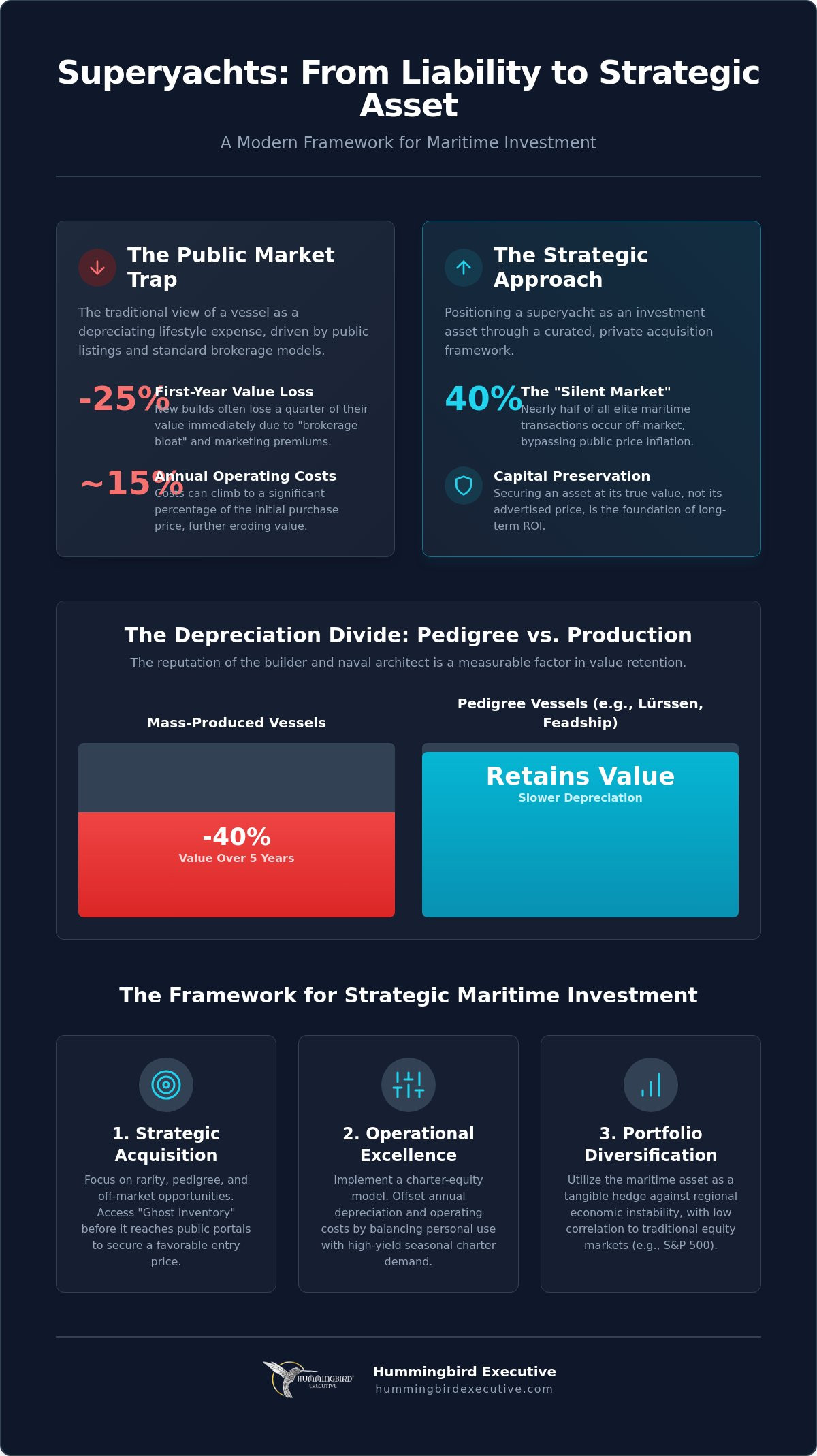
The traditional view that a vessel is merely a depreciating lifestyle expense is a failure of acquisition strategy rather than a fault of the asset itself. Positioning a superyacht as an investment asset requires moving beyond the transparency issues of the public market and into a curated, private environment. You’ve likely seen new builds lose 25% of their value in the first year while operating costs climb to 15% of the purchase price. It’s a frustrating reality for those who rely on public listings and standard brokerage models that prioritize volume over value retention.
This article demonstrates how off-market maritime acquisitions transform these traditional liabilities into strategic tools for luxury asset portfolio diversification. By leveraging the 2026 regulatory landscape, including the US Section 179 deductions and the latest EU maritime emissions standards, a vessel can serve as a sophisticated hedge. We’ll examine the specific shipyards that command lasting value, the mechanics of the off-market advantage, and the process of integrating maritime holdings into a broader, secure wealth strategy.
Key Takeaways
- Learn why 40% of elite maritime transactions occur in a silent market, allowing you to bypass the inflated premiums found in public listings.
- Understand the mechanics of positioning a superyacht as an investment asset by transitioning from a lifestyle expense to a disciplined business unit.
- Discover how to offset annual depreciation through a charter-equity model that balances personal use with high-yield seasonal demand.
- Identify the specific shipyards and naval architects whose work ensures long-term value retention and rarity in the secondary market.
- Gain exclusive entry to “Ghost Inventory” through a private framework designed for the discreet acquisition of high-value maritime holdings.
Beyond the “Hole in the Water”: Reimagining the Superyacht as an Investment Asset
The cliché of the “hole in the water” is a tired narrative often perpetuated by those operating in the over-leveraged, public brokerage market. While it’s true that mass-produced vessels suffer from aggressive depreciation, the reality changes when you view a superyacht as an investment asset within a sophisticated private framework. In 2026, the transition from purely experiential ownership to strategic wealth preservation has become a hallmark of the ultra-high-net-worth portfolio. This shift requires a departure from the “lifestyle expense” mindset, opting instead for the acquisition of passion assets that possess inherent rarity and enduring market appeal.
Public market data often paints a grim picture because it includes high-volume production models that lack the craftsmanship required for value retention. These vessels are liabilities from the moment they leave the yard. Conversely, bespoke maritime holdings acquired through off-market channels operate on entirely different financial principles. By securing an asset before it reaches public portals, you eliminate the “brokerage bloat” and marketing premiums that typically erode entry-point value. It’s a method of gatekeeping that ensures the asset’s financial integrity remains intact from day one.
The Role of Rarity in Maritime Value Preservation
The scarcity of shipyard slots at premier builders like Lürssen or Feadship creates a natural floor for valuation. These yards often have waitlists extending years into the future, making the immediate delivery of a well-maintained, pedigree vessel a high-demand event. Historical data indicates that while production boats may lose 40% of their value over five years, a pedigree yacht often retains its nominal value or experiences significantly slower depreciation. The Pedigree Premium is the measurable value added to a vessel by the reputation of its builder, the excellence of its naval architecture, and the exclusivity of its provenance.
Maritime Assets in the Context of Global Diversification
Strategic maritime holdings offer a unique layer of protection against regional economic instability and currency fluctuations. Because these assets are mobile and globally traded in major currencies, they provide a tangible hedge that traditional equity markets cannot match. There is often a low correlation between the value of a top-tier maritime asset and the volatility of the S&P 500, offering a “quiet” diversification layer. Accessing this inventory through private channels ensures that your asset movement remains shielded from public scrutiny, maintaining the discretion that is foundational to Hummingbird Executive’s philosophy. This approach reinforces the role of the superyacht as an investment asset that provides both utility and capital security.
The Off-Market Advantage: Why Entry Price Dictates Maritime ROI
Entry price is the single most significant determinant of long-term yield. In the public market, the sticker price often includes a “marketing tax” designed to cover global advertising campaigns and multi-layered brokerage commissions. This is where the 15-25% first-year depreciation curve typically begins. To position a superyacht as an investment asset, one must bypass these public portals entirely. The “Silent Market” is where approximately 40% of elite maritime transactions occur, shielded from the eyes of casual observers and the price-eroding effects of public exposure. Understanding the mechanics behind discreet luxury asset transactions is essential for any investor seeking to operate within this exclusive tier.
Avoiding brokerage bloat is essential for capital preservation. Private transactions allow for a direct, vetted exchange that eliminates the premiums associated with mass-market visibility. This approach identifies “quiet” assets or motivated sellers before they’re forced into a public price drop. Utilizing an off-market yacht acquisition service ensures you’re viewing inventory that the general public won’t see for months, if ever. It’s about securing the asset at its true value, not its advertised price.
Entry Strategies: Buying the Build Slot vs. the Vessel
Acquiring a shipyard build slot at a premier yard is often a more agile investment than buying a finished vessel. These slots act as transferable options, allowing an investor to “flip” the position as delivery dates approach and scarcity increases. Speculative maritime construction carries risks, but the rewards are substantial for those who understand yard pedigree. Private networks are the only reliable way to identify owners who wish to exit a build contract early without alerting the wider market and devaluing the contract.
The Mechanics of a Private Maritime Transaction
Discretion is the primary currency in high-value transfers. Protecting a vessel’s “market virginity” ensures that its history isn’t documented across public databases, which can negatively impact future resale. A private yacht acquisition membership facilitates this by vetting both parties under strict non-disclosure agreements. This methodology allows off-market assets to bypass the steep first-year depreciation hit, as the purchase price remains grounded in private equity rather than public sentiment. If you’re looking to refine your holdings, consider how a platinum membership might streamline your next acquisition through 24/7 dedicated support.
Strategic Chartering: Offsetting Depreciation Through Operational Excellence
Treating a vessel as a business unit is the only way to validate a superyacht as an investment asset. The Charter-Equity Model moves beyond the hope of “breaking even” and instead focuses on strategic offsetting through high-yield seasonal bookings. For a 40-60 meter vessel, base Mediterranean charter rates in 2026 range from €80,000 to €250,000 per week. To master the quantitative analysis required for these complex holdings, investment professionals can discover Financial Modelling University and its advanced curriculum. When managed with precision, these yields significantly mitigate the 12-15% annual operating costs that often surprise less prepared owners. It’s about data-driven scheduling, not just filling weeks on a calendar.
Specialized management is required to navigate the complexities of the 2026 regulatory environment, including the expanded EU Emissions Trading System (ETS) for vessels over 5,000 gross tonnes. Managing operational leakage means more than just watching fuel costs; it involves protecting the asset from the “VAT trap” and ensuring all maritime activities align with commercial tax exemptions. For those operating in the 100m+ ultra-charter niche, the ROI logic shifts toward extreme scarcity, where the daily rate is dictated by the rarity of the build rather than market averages.
Operational Efficiency as a Value Driver
Precision in crew management is a direct investment in the asset’s longevity. Since crew salaries account for 30-40% of the annual budget, retaining a high-tier team ensures that maintenance remains predictive rather than reactive. This meticulous care protects the hull’s resale value and ensures compliance with the Malta Commercial Yacht Code (CYC) 2025, which sees its first full year of implementation in 2026. In the US, owners can leverage the Section 179 deduction of up to $1,250,000 alongside a 40% bonus depreciation, provided the vessel is utilized for legitimate business purposes more than 50% of the time.
Maximizing Charter Appeal for Resale
While the public market focuses on the aesthetic allure of a beach club, the private investor understands that technical pedigree and eco-propulsion systems are what drive the highest charter rates in 2026. Amenities like helipads and advanced waste treatment systems are no longer optional for those targeting expedition-style itineraries. A strong charter history acts as a proof of performance for future buyers, demonstrating the vessel’s operational reliability and market desirability. This historical data transforms a subjective “passion asset” into an objective financial holding with a documented track record of performance.
Building a Maritime Portfolio: Vetting Rarity and Pedigree
Success in positioning a superyacht as an investment asset depends on a disciplined adherence to the “Golden Rule”: Pedigree, Provenance, and Condition. In the private market, these aren’t just buzzwords; they’re the pillars of capital preservation. While a shipyard like Feadship provides the structural foundation, the naval architecture defines the asset’s market authority. Designs from firms like Espen Øino or Winch Design carry a weight that transcends aesthetic trends, ensuring the vessel remains a liquid asset within elite circles. These names act as a seal of quality that sophisticated buyers recognize instantly, much like a blue-chip artist’s signature on a canvas.
Investors must avoid the “Customization Trap.” While bespoke interiors are often marketed as value enhancers, extreme personalization is frequently a liability in the secondary market. Rarity should be engineered into the hull and the technical specifications rather than the cabin finishes. If an interior is too eccentric, it necessitates a costly refit for the next owner, which is inevitably reflected in a lower offer. In 2026, we’re seeing a strategic shift toward eco-refits for older hulls. Upgrading a pedigree vessel with hybrid propulsion or advanced emissions scrubbing systems can effectively reset its depreciation clock and align it with the stringent EU maritime regulations discussed earlier.
Due Diligence: The Private Equity Approach to Yachts
Maritime vetting requires the same rigor as a private equity acquisition. It’s the unglamorous side of investment: analyzing hull thickness, engine hours, and the granular details of technical surveys. Beyond the physical asset, you must vet the shipyard’s financial stability, especially before committing to a multi-year new build. A documented discreet luxury asset transaction history is vital; it ensures the vessel’s reputation hasn’t been tarnished by public legal disputes or poor management. This level of scrutiny ensures that when it’s time to exit, the asset’s provenance is beyond reproach.
The “Ghost Inventory”: Finding Assets That Aren’t for Sale
The most lucrative maritime holdings are rarely found on public listing sites. This “Ghost Inventory” consists of vessels that are currently being enjoyed but whose owners would consider a surgical offer under the right conditions. Accessing this inventory requires an “if you know, you know” network that operates behind the scenes. It’s a psychological game as much as a financial one. By approaching an owner through a trusted intermediary, you bypass the competitive frenzy of the open market and secure an entry price that reflects the asset’s true value. To begin building your maritime portfolio with this level of precision, consider how a platinum membership can provide the necessary gatekeeping and access.
The Hummingbird Framework: Discreet Acquisition and Asset Management
Positioning a superyacht as an investment asset requires a silent architecture of support that extends far beyond the initial transaction. While the public market struggles with transparency and fluctuating valuations, the Hummingbird framework operates within a private ecosystem designed for capital preservation. We facilitate access to the world’s most exclusive maritime “Ghost Inventory,” identifying vessels that possess the pedigree and provenance required for long-term value retention. This isn’t a volume-based brokerage model; it’s a curated facilitation process that prioritizes the security of your portfolio over market visibility.
Managing the lifecycle of a maritime holding involves solving complex logistical challenges that can otherwise erode ROI. Our framework integrates these assets into a secure, no-cookie digital hub, ensuring that your data remains as private as your acquisitions. By treating the vessel as a disciplined business unit, we help members navigate the “crew and berth” problem through a global network of vetted professionals. This end-to-end management ensures that the asset remains in peak condition, ready for seasonal chartering or a discreet exit when the market conditions are most favorable.
Platinum Membership: The Silent Partner in Maritime Success
The Platinum Membership serves as the ultimate gatekeeper for those seeking rare maritime opportunities. It provides full access to off-market deals that never reach public brokers, allowing you to secure assets at their true private equity value. Beyond acquisition, the membership includes 25/7 dedicated concierge services worldwide at no extra charge. Whether you require immediate assistance with global mooring logistics or the rapid vetting of a specialized expedition crew, our team operates as an extension of your own, ensuring that the operational side of your investment remains unflappable and efficient.
Your Next Strategic Move in the Maritime Sector
Transitioning from inquiry to acquisition within the Hummingbird ecosystem is a methodical and secure process. For those focused on specific maritime goals, the choice between Gold and Platinum tiers depends on the desired depth of engagement and the need for around-the-clock facilitation. While Gold offers white glove services during opening hours, the Platinum tier is designed for the global investor who requires a silent, powerful partner operating behind the scenes at all times. If you’re ready to transform a traditional lifestyle expense into a strategic tool for diversification, explore the Hummingbird Platinum Membership to begin your maritime portfolio expansion.
Refined Maritime Governance: Your Path to Strategic Portfolio Expansion
Navigating the maritime sector in 2026 requires more than just capital; it demands a fundamental shift from ownership to governance. By prioritizing pedigree builds and securing entry through the silent market, you bypass the aggressive depreciation that typically plagues public listings. Treating your vessel as a business unit through strategic chartering and professional management ensures that rarity translates into measurable value retention. Integrating a superyacht as an investment asset into a broader wealth strategy is a calculated move for those who value privacy and precision.
Hummingbird Executive provides the silent architecture needed to facilitate these complex transitions. Our members benefit from exclusive access to maritime “Ghost Inventory” and a secure, no-cookie platform that guarantees absolute discretion. With 25/7 global concierge support included, the logistical burdens of crew and mooring are managed by experts who prioritize your interests above all else. Secure your access to off-market maritime assets with Hummingbird Platinum and redefine the boundaries of your luxury holdings. We invite you to step into a protected inner circle where rarity is preserved and wealth is strategically extended.
Frequently Asked Questions
Is a superyacht really a viable investment asset in 2026?
A superyacht as an investment asset is viable when the focus shifts from lifestyle indulgence to disciplined maritime governance. In 2026, this requires acquiring pedigree builds through private channels to bypass the initial 25% depreciation hit seen in the public market. When paired with high-yield chartering and US Section 179 tax deductions, these vessels function as strategic hedges within a diversified luxury portfolio. Success depends on the asset’s rarity and technical excellence.
How much does it cost to maintain a superyacht annually?
Annual operating costs for a modern superyacht typically range between 12% and 15% of the original purchase price. For a 45-meter vessel, this equates to a budget of $3M to $4.5M per year. Crew salaries and benefits represent the largest single expense, often accounting for 30% to 40% of the total annual budget. These figures emphasize the necessity of professional management to prevent operational leakage and protect the asset’s long-term resale value.
What is the “off-market” advantage in yacht acquisition?
The off-market advantage centers on securing a vessel before it’s exposed to the price-eroding effects of public listings. By transacting within a private ecosystem, you avoid the “marketing tax” and brokerage commissions that inflate public prices. This method preserves the vessel’s “market virginity,” ensuring its history isn’t documented across public databases. It allows for a more favorable entry price, which is the primary driver of eventual return on investment.
Can charter revenue actually cover the operational costs of a yacht?
While charter revenue rarely covers every expense, it can significantly offset the 12-15% annual running costs when managed as a business unit. High-yield seasonal bookings in the Mediterranean, where rates for 40-60m vessels reach €250,000 per week, provide substantial liquidity. To maximize this, owners must ensure the vessel is used for legitimate business purposes over 50% of the time, allowing for significant tax deductions under US and EU maritime regulations.
Which yacht builders hold their value the best for resale?
Shipyards with a proven history of quality, such as Feadship and Lürssen, consistently demonstrate the highest value retention in the secondary market. These builders create artificial scarcity through limited shipyard slots, which supports price stability. Resale value is further bolstered by naval architecture from esteemed firms like Espen Øino or Winch Design. Choosing a pedigree builder ensures the asset remains liquid and desirable within the world’s most exclusive private maritime circles.
What is the role of a luxury concierge in maritime asset management?
A luxury concierge acts as a silent, powerful partner that manages the intricate logistics of maritime ownership. This includes everything from securing prime berthing in high-demand ports to vetting specialized crew members who protect the asset’s condition. At Hummingbird Executive, this support is available 25/7, ensuring that the operational complexities of a global maritime portfolio never interfere with the owner’s primary objectives. It’s a service defined by precision and unflappable efficiency.
How does Hummingbird Executive protect my privacy during a yacht transaction?
Privacy is protected through a secure, no-cookie digital platform and a strict adherence to off-market transaction protocols. By facilitating deals within a private network, we ensure that your financial movements and asset holdings remain shielded from public scrutiny and data harvesting. Every acquisition or sale is conducted under rigorous non-disclosure agreements, maintaining the discretion that is foundational to our inner circle. Your data is never sold or shared for marketing purposes.
What are the risks of buying a superyacht as a diversification tool?
The primary risks include aggressive depreciation of mass-produced hulls and the impact of evolving environmental regulations like the EU Emissions Trading System. Non-pedigree vessels lack the scarcity required to hold value, making them liabilities rather than assets. Additionally, the lack of transparency in public yacht listings can lead to hidden operational costs. Mitigating these risks requires a private equity approach to due diligence and a focus on rare, technically superior maritime holdings.