The presence of a rare asset doesn’t, by itself, diversify a portfolio. Luxury asset portfolio diversification depends on whether an asset’s market drivers differ from your existing holdings, and whether its liquidity and ownership demands fit your broader strategy. Appeal alone doesn’t show how an asset contributes to a portfolio.
It’s reasonable to be cautious. Yachts, private aircraft, premium property, and collectible cars each bring distinct valuation questions, ongoing responsibilities, and practical limits on resale. Those differences make comparisons difficult, particularly when pricing is opaque and a sale may take time.
This guide offers a framework for assessing the potential role of luxury assets within a wider portfolio. You’ll learn to compare categories using consistent criteria, including value drivers, valuation, liquidity, ownership costs, and management requirements. It also outlines practical questions to consider before pursuing a private-market opportunity, so decisions can start with fit and due diligence rather than rarity alone.
Key Takeaways
- Assess luxury asset portfolio diversification by examining distinct markets and value drivers, not simply counting asset categories.
- Compare how each asset is valued and sold, alongside the responsibilities involved in owning and managing it.
- Review your goals, existing exposures, the asset’s intended role, ownership demands, and review cadence before pursuing an opportunity.
- Ask whether a prospective asset adds a genuinely different exposure or deepens an existing concentration.
- Private marketplace access can broaden discovery of rare assets to buy or sell, but it does not establish suitability or investment merit.
What Luxury Asset Portfolio Diversification Can, and Cannot, Do
Luxury asset portfolio diversification means holding assets with meaningfully different markets, value drivers, and economic exposures, rather than relying on a single source of value. A collection can be varied in appearance yet remain concentrated in the same market or dependent on similar buyers.
Diversification is the deliberate combination of assets with distinct exposures; it is not the accumulation of valuable possessions. A carefully selected asset may contribute a different source of exposure to a broader portfolio. It does not, on its own, ensure lower risk, preserve purchasing power, or produce a particular return. Correlations can change, and rarity is no substitute for evidence about demand, valuation, or resale prospects.
Which assets count as luxury investments?
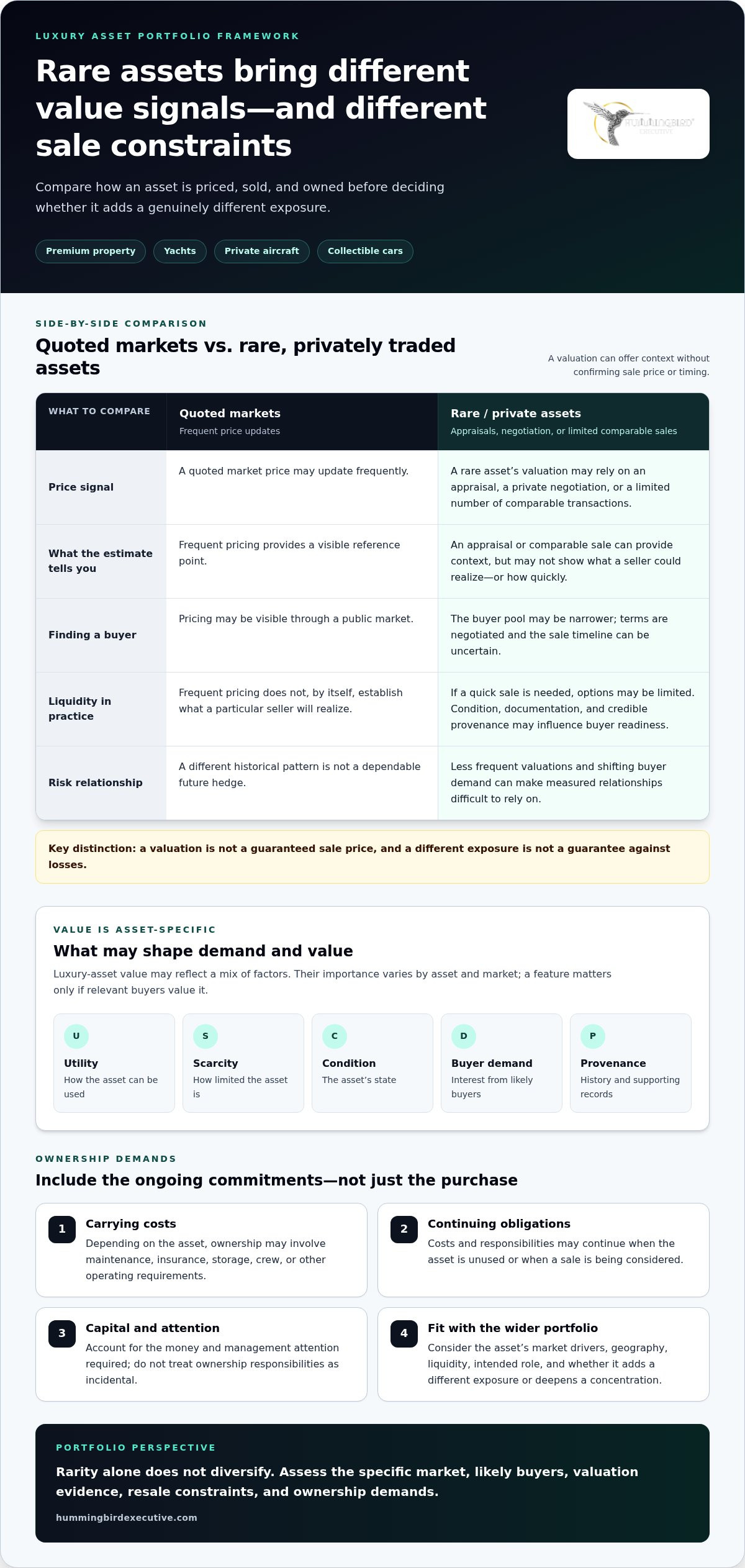
Premium property, yachts, private jets, and collectible cars are among the categories that may be considered in a luxury-asset portfolio. Their value can reflect a mix of utility, scarcity, condition, buyer demand, and provenance. The importance of each factor varies by asset and market. A notable history or distinctive specification matters only if relevant buyers value it. The broader economic characteristics of luxury goods are outlined in Understanding Luxury Goods.
These assets also bring responsibilities beyond acquisition. They may require ongoing management and may not be readily converted to cash. Assess each category on its own terms rather than treating luxury assets as a single investment type.
Why conventional diversification principles still matter
Concentration risk is straightforward. If much of a collection consists of premium properties in one city, its fortunes may be closely tied to that location’s property market. Adding another property in the same market could increase the collection’s value without adding much difference in exposure. A yacht or collectible car may introduce other value drivers, but it won’t automatically offset weakness in the property market.
It helps to distinguish three dimensions:
- Asset category: Property, marine assets, aircraft, or collectible vehicles.
- Geography: Where the asset is located and which local markets may influence demand.
- Economic exposure: The conditions, buyer base, and uses that may affect its value.
Different categories can still share an underlying exposure, while assets in the same category may respond to different regional conditions. An asset label also doesn’t prove low correlation with financial markets. That relationship can vary across periods and market conditions, so assess the specific asset and its likely buyer pool rather than assuming it behaves independently.
Property illustrates why location matters alongside category. A review of off-market property investment offers additional context on how a property opportunity enters the market. The same discipline applies across rare assets: distinguish the appeal of ownership from the role an asset can reasonably play in a portfolio.
How Luxury Assets Affect Portfolio Risk, Liquidity, and Resilience
Luxury assets can add exposures that differ from listed securities, but the distinction should be tested, not assumed. A quoted market price may update frequently; a rare asset’s valuation may rely on an appraisal, a private negotiation, or a limited number of comparable transactions. These figures can provide context, but they may not show what a seller could realize or how quickly a sale could happen under current conditions.
Diversification cannot eliminate asset-specific or market risk. For luxury asset portfolio diversification, resilience is better understood as the ability to hold a considered mix of exposures without relying on one market or one timely sale. It isn’t a guarantee against losses, downturns, or unexpected ownership demands.
Why low correlation is not a guarantee
An asset may have moved differently from public markets during a particular period, but that historical relationship isn’t a dependable future hedge. Reported valuations may be less frequent than market quotations, while buyer demand and sale timing can shift independently of the data used to estimate correlation. A low measured relationship is a reason to ask more questions, not a basis for confidence.
Nor should a yacht, collectible car, or premium property be treated as reliable protection against inflation or a downturn. Scarcity may matter to buyers, but it doesn’t ensure demand at a particular moment. Consider what could influence value, who the likely buyers are, and how those factors could change in different conditions.
The less visible costs and constraints of ownership
Ownership involves more than purchase and eventual sale. Depending on the asset, carrying costs and obligations may include maintenance, insurance, storage, crew, or other operating requirements. These commitments can continue even when the asset isn’t in use or a sale is under consideration. Include them in your estimate of the capital and attention the asset requires, rather than treating them as incidental costs.
Liquidity also depends on the asset. A public market may show frequent pricing; a privately traded asset may have a narrower buyer pool, negotiated terms, and an uncertain sale timeline. If you need to sell quickly, your options may be limited. Condition, complete documentation, and credible provenance may also influence whether a prospective buyer is prepared to proceed.
- Valuation: Separate an indicative estimate from an offer that could be accepted.
- Liquidity: Consider the potential buyer pool and how flexible your timing is.
- Ownership: Account for upkeep, insurance, and operating responsibilities.
These checks won’t make an asset liquid or remove uncertainty. They help make trade-offs visible before you commit capital. Hummingbird Executive gives members private access to opportunities to buy or sell rare assets, with dedicated worldwide concierge support through Platinum membership. The company’s private access to rare assets is a sourcing route; suitability and investment merit remain separate questions.
Compare Luxury Asset Classes Before Calling a Portfolio Diversified
A category label is only a starting point. For a useful comparison, consider what may influence an asset’s value, how a sale might take place, and what ownership requires in practice. The following framework supports luxury asset portfolio diversification by making those differences visible without implying that any category has a universal return profile.
Property and collectible cars: distinct value drivers
For premium property, location can tie value closely to local conditions, while use and condition shape its appeal to a prospective buyer. For a collectible car, provenance, rarity, and condition may matter alongside collector preferences. Neither category is inherently stable, liquid, or appreciating. This guide to private luxury car collection investment offers a focused example of the car category.
Yachts and private jets: use alongside ownership obligations
Buyers may consider yachts and private jets for utility, access, and the experience of ownership, not solely for their place in a portfolio. Those uses come with ongoing operating and upkeep responsibilities, which should be weighed against intended use and your capacity to oversee the asset. Resale also merits separate consideration: practical value to an owner doesn’t establish market demand or mean a buyer is readily available.
Owning multiple assets in one category may also leave exposure concentrated. Two properties in the same local market, or two collectible cars appealing to a similar collector segment, could respond to overlapping demand conditions. Compare actual value drivers and obligations, not just the number of categories represented.
A Practical Framework for Assessing Luxury Asset Diversification
A measured review can help distinguish an asset that serves a clear purpose from one that simply adds another holding. For luxury asset portfolio diversification, ask whether the opportunity fits your circumstances, including your objectives, existing exposures, capacity to own it, and ability to wait for a sale. No category guarantees a particular outcome.
Map goals and existing exposures first
Begin by naming the asset’s intended role. You may acquire it for enjoyment or utility, as a possible store of value, or for potential investment exposure. These purposes can overlap, but separating them clarifies what would make ownership worthwhile to you and which trade-offs you’re prepared to accept.
Next, map current holdings by category, geography, market dependence, and liquidity. A second property in a familiar market, for example, may add less distinct exposure than its category label suggests. Allocation decisions are individual; a universal percentage prescription can’t account for differences in goals, resources, or tolerance for illiquidity.
Set review criteria before pursuing an opportunity
Write down the assumptions and constraints that matter before a transaction gathers momentum. A concise review helps keep attention on portfolio fit as well as the asset’s appeal.
- Clarify your goals. Record the intended role and distinguish personal use from financial objectives.
- Map current exposures. Note where holdings overlap by category, geography, likely buyers, or economic drivers.
- Define the asset’s role. Ask what distinct exposure it may add. Would it complement the portfolio or reinforce an existing concentration?
- Assess ownership burden and liquidity. Account for ongoing responsibilities, the holding period you can tolerate, and whether you could retain the asset if a sale takes longer than expected or market conditions become uncertain.
- Set review criteria and cadence. Document value assumptions, material ownership obligations, exit considerations, and the information that could change your decision. Revisit the assessment if your goals, liquidity needs, or the asset’s circumstances materially change.
Be explicit about what remains uncertain. An estimated value and an achievable sale price, for example, aren’t necessarily the same. A planned exit also depends on timing and buyer interest. Identify which assumptions are essential to your decision and what new information would lead you to pause, revise, or decline the opportunity.
This framework supports disciplined evaluation, not investment advice or an assurance of suitability. An asset’s category cannot guarantee allocation fit, liquidity, appreciation, or protection from loss. Hummingbird Executive gives members access to rare assets for buying or selling, with concierge support through its membership. The company’s private access to rare assets provides a sourcing route, while the portfolio decision remains grounded in your own review.
Accessing Luxury Asset Opportunities with Greater Discretion
A considered portfolio review comes before the search. Once you’ve clarified what an asset should contribute, private access can broaden the opportunities you discover. It doesn’t establish that a particular asset is suitable, fairly valued, or sound on investment grounds. Those judgments are separate from the sourcing process.
What a private marketplace can contribute
Hummingbird Executive gives members private access to rare assets to buy or sell, including yachts, private jets, premium properties, and luxury cars. A marketplace can bring opportunities into view that align with a member’s interests. Access is a starting point, not a conclusion: each opportunity still calls for its own assessment of value assumptions, market exposure, ownership demands, and possible exit conditions.
Concierge support can assist members as they navigate rare-asset transactions. Platinum membership includes dedicated worldwide concierge services, while Gold membership offers white-glove support during standard opening hours. This support can help with the transaction process, but it doesn’t constitute investment advice, verify portfolio suitability, or assure a particular outcome. Details of Platinum membership and rare-asset access provide context on the membership pathway.
Keep the distinction clear. Private sourcing concerns how an opportunity comes to your attention; due diligence concerns whether its characteristics and risks fit your circumstances. Before progressing, consider whether you understand the basis for the proposed valuation, what information supports the asset’s history and condition, and what obligations ownership would bring. An appealing opportunity can still deepen a concentration or create a holding burden that doesn’t fit your plans.
- Before exploring: Clarify your objectives, existing exposures, liquidity needs, and intended ownership role.
- When reviewing an opportunity: Consider its value drivers, documentation, ongoing responsibilities, and plausible exit conditions.
- Before proceeding: Decide what additional information could change your view, and allow time for an independent assessment of fit and risk.
Choose a next step that fits your portfolio review
If your goals and exposures are still taking shape, refine your review before focusing on individual assets. If you’re ready to explore opportunities, membership information can help you assess whether private access and concierge support fit your approach. Neither step commits you to a transaction. The aim is to keep discovery aligned with considered portfolio decisions.
Hummingbird Executive’s private asset marketplace provides members with a route to explore rare assets to buy or sell. Let the portfolio review set the direction and assess each opportunity on its own merits.
Make Your Next Move Deliberate
The next step in luxury asset portfolio diversification isn’t necessarily acquiring another asset. It may be refining the questions you’ll use to assess the next opportunity: what purpose it serves, what would change your view, and how much flexibility you need to retain. Clear criteria make it easier to explore selectively, without letting rarity or urgency set the agenda.
When private access would help broaden your search, Hummingbird Executive offers rare assets to buy or sell, with dedicated worldwide concierge support through Platinum membership. The marketplace is a route to opportunities, not a substitute for your own assessment of fit and risk.
Explore Hummingbird Executive’s private asset marketplace as a considered next step. Proceed at a pace that preserves perspective, and let each opportunity earn its place in your plans.
Frequently Asked Questions
What is luxury asset portfolio diversification?
Luxury asset portfolio diversification is the deliberate assessment of whether high-value assets add different exposures alongside other holdings. For example, an investor might compare a property’s dependence on local conditions with a collectible car’s appeal to a particular buyer segment. The aim is to understand how those drivers fit together, not simply to collect assets with different labels. A broader mix doesn’t guarantee returns or prevent losses.
Can luxury assets reduce portfolio risk?
They may contribute different exposures, but they can also introduce risks of their own. Imagine a downturn in which both an asset’s estimated value and the number of interested buyers weaken. A sale might then be difficult even if other holdings remain accessible. Assess how the specific asset could behave under different conditions, and consider whether you could retain it without disrupting other financial commitments.
Are luxury assets a good hedge against inflation?
Not reliably as a broad category. Some assets may respond to changing prices or buyer demand differently from conventional investments, but a rise in stated value doesn’t necessarily translate into a favorable sale or offset ownership expenses. Consider the potential holding period, upkeep, and conditions needed to realize value. Don’t rely on an inflation-hedge label unless the reasoning applies to the specific asset and your circumstances.
Which luxury assets can be considered for portfolio diversification?
Premium property, yachts, private jets, and collectible cars are among the categories investors may assess. Their functions differ: property may serve a residential or commercial purpose, while aircraft or yachts may be acquired for use and access. A collectible car’s appeal may depend on its particular history and prospective buyers. Compare the actual opportunity with your aims and capacity to oversee it, rather than treating the category as evidence of diversification.
How do I assess whether a luxury asset diversifies my portfolio?
Compare the proposed asset with a written inventory of current holdings. Record which markets influence each holding, where demand may come from, and how readily you can access its value. Then state what distinct role the new asset could serve and what overlap it may create. Ask what would change your decision, such as a different valuation basis, ownership requirement, or expected sale timeline.
Are luxury assets easy to sell when I need liquidity?
No. The ability to sell depends on the individual asset and the circumstances at the time. A potential buyer may require information about condition, ownership history, or supporting records before proceeding, and a private sale may not align with a seller’s preferred timing. Before acquiring an asset, consider how you would manage expenses if it remained unsold longer than planned. Don’t treat an estimate as cash available on demand.
Does access to off-market luxury assets mean an investment is suitable?
No. Access describes how an opportunity may be found, not whether its valuation, risks, or role suit your portfolio. Hummingbird Executive gives members private access to rare assets to buy or sell, and Platinum membership includes dedicated worldwide concierge support. That support can assist with navigating transactions, but it doesn’t guarantee an outcome or replace an assessment of the opportunity against your objectives.