A dedicated concierge turns your preferences into considered arrangements, from dining recommendations and reservations to transport, experiences and travel details. Knowing what to expect from a dedicated concierge means understanding that the role goes beyond responding to requests: it involves anticipating practical needs and tailoring recommendations to you, the occasion and the destination.
Personal attention matters most when time is limited, plans are changing or a familiar standard is difficult to find in an unfamiliar place. A concierge can draw on local knowledge to suggest where to dine or what to visit, then coordinate suitable arrangements around your preferences. The scope depends on the service, but the principle is consistent: fewer loose ends, and choices made with context. This guide explains how a dedicated concierge learns what matters to you, handles requests, applies local insight and makes recommendations that are more useful than a generic list of popular places.
Key Takeaways
- Share the preferences and constraints that shape your plans so a concierge can anticipate useful details, not simply respond to requests.
- Use local insight to narrow dining and sightseeing options to choices that suit your interests and schedule.
- Understand how request coordination can bring transport, reservations, and other arrangements together around your plans.
- Compare concierge membership options by the level of access and service that best fits the support you need.
Anticipatory service and complaint resolution
A concierge provides personal assistance, from travel coordination to practical arrangements. The value lies in anticipating needs and handling requests with care.
A dedicated concierge typically provides a consistent point of contact, while standard concierge support may come from a shared team. Day to day, you can expect help with requests such as transport, local recommendations, reservations, and resolving a disrupted arrangement. A concierge may work in person or through digital tools; digital hotel services can provide support 24/7.
Anticipating Guest Needs
Anticipatory service means using your known preferences and the situation at hand to address likely needs before they become urgent. Small arrangements can shape the whole travel experience. For example, if you have an early departure, a concierge can help arrange transport or a takeaway breakfast. If baggage is lost or a flight is missed, the concierge can help coordinate practical next steps. Complaint resolution follows the same principle: understand the issue, identify what needs attention and manage the response through its next stage.
Dedicated Concierge Duties
Concierge duties are personalized services that help you manage plans, activities and unexpected requests. A dedicated relationship can carry your preferences and context from one request to the next, so you do not have to explain them afresh each time. Hotel reception staff may also provide concierge-level care, but their work generally focuses on arrival and departure administration, while concierge support centres on activities and the guest experience. In-person assistance and digital messaging are different ways to manage those needs.
To choose a dedicated personal concierge, first define the support you need, such as travel coordination, reservations or help adapting to changing plans. Then discuss how to submit requests, what decisions the concierge may make and how urgent matters are handled.
Useful qualities include relevant hospitality or personal-assistance experience, clear communication, sound judgment and strong coordination skills. For example, arranging transport alongside a reservation calls for careful timing and follow-through.
Privacy and security considerations can include sharing travel plans, personal preferences, payment details or access to property. Clarify how information is handled, what authority the concierge has and who is responsible for decisions or resulting costs. Before beginning, discuss the service scope, communication channels, complaint escalation, confidentiality and liability arrangements.
Local knowledge and guest preference capture
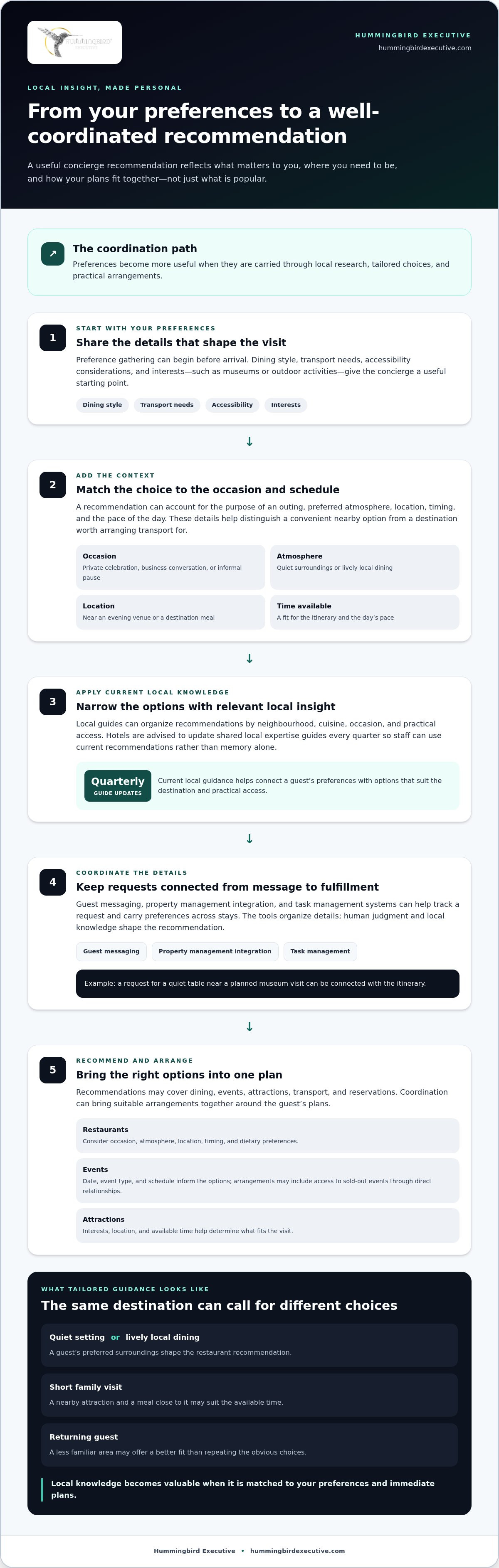
Local knowledge is most useful when matched to your preferences and immediate plans. A dinner recommendation, for example, should take account of location, timing, atmosphere and stated dietary preferences. A concierge can distinguish a convenient nearby option from a destination worth arranging transport for. That context makes tailored guidance more useful than a generic list of restaurants or attractions.
Preference gathering often begins before arrival. Details such as dining style, transport needs, accessibility considerations and interests in museums or outdoor activities can help shape a visit. Specific information makes recommendations more relevant: someone who values quiet surroundings may prefer a different restaurant setting from someone seeking lively local dining. Clear preferences give the concierge a useful starting point.
Local expertise also needs maintenance. Hotels are advised to update shared local expertise guides every quarter, so staff can use current recommendations rather than memory alone. A guide can organize choices by neighbourhood, cuisine, occasion, and practical access. For instance, a family planning a short visit may value a nearby attraction and a meal close to it, while a returning guest may prefer exploring a less familiar area.
To carry preferences into action, a hotel concierge can use guest messaging, property management integration, and task management systems. These tools help track a request from its first message through fulfillment and carry preferences across stays. If a guest asks for a quiet table near a planned museum visit, the record can connect that preference with the itinerary. Human judgment remains central: systems organize details, while local knowledge shapes the recommendation.
For personalized coordination shaped around individual priorities, explore tailored concierge support as a way to bring preferences into the planning process.
Restaurant, event, and attraction recommendations
Recommendations are most useful when they reflect the purpose of an outing, not simply its popularity. A concierge can shape a proposal around the occasion, preferred atmosphere, location and pace of the day. Knowing what to expect from a dedicated concierge means looking for that judgment: a suggestion should fit your plans, rather than simply add a name to a list.
For a restaurant recommendation, explain whether the meal is for a private celebration, a business conversation or an informal pause between activities. Those details help distinguish a quiet dining room from a lively setting. Location matters too. A restaurant near an evening venue may simplify your schedule, while a destination meal can make sense when the journey is part of the experience.
Event recommendations also benefit from context. A concierge may help arrange tickets, including access to sold-out events through direct relationships. Your preferred date, event type and schedule shape the options. A useful recommendation explains how the event fits the broader itinerary while leaving the final choice to you.
Attractions can be assessed by your interests, location and available time. Someone drawn to architecture may prefer a focused visit, while a guest travelling with children might prioritize an accessible attraction and a relaxed schedule. When considering what to expect from a dedicated concierge, look for how your preferences shape the proposed plan, rather than receiving the same itinerary as everyone else.
Before confirming arrangements, consider whether the proposed sequence suits your priorities and allows time for the experience you want. A simple brief, such as a quiet dinner before a performance or a museum visit followed by an unhurried afternoon, gives the concierge clear direction. You can then assess the recommendation as part of a considered day, not in isolation.
Concierge duties and guest requests
Concierge support extends beyond reservations to practical arrangements, travel coordination and sourcing special items. It works best when each request has a clear purpose and enough detail to guide action.
Handling Guest Requests
Handling guest requests means translating a person’s needs into coordinated arrangements or useful next steps. This matters because requests often connect several details. A request for a gift delivery, for example, may involve sourcing an appropriate item, arranging delivery, and aligning it with an occasion. Concierge services can also arrange transport, event tickets, hotel reservations, pet care, senior care, errands, and special-item sourcing. A clear request helps establish priorities and avoid unnecessary back-and-forth.
Responding to Requests
There is no universal response time for every request. Urgency, complexity, timing and service hours shape the appropriate pace. A transport issue affecting an imminent departure needs attention sooner than a request to source an item for a future occasion. A useful response acknowledges the request, clarifies essential details and explains the next step.
Availability and response speed are related, but they are not identical. A service may operate during stated hours without promising an instant resolution, especially when a request depends on external arrangements. Platinum Membership includes 25/7 dedicated concierge services worldwide; Gold Membership offers white-glove services 7 days a week during opening hours. These schedules describe service availability, not a guaranteed completion time for every task.
For a complex request, concise details help the concierge assess priorities: deadline, location, preferences and constraints. If plans change, communicate the update promptly. For example, a revised departure time may affect transport and other arrangements. Clear direction helps keep connected tasks aligned.
For support coordinating personal requests and arrangements, explore dedicated concierge support.
Hummingbird Executive: platinum Membership full access to rare assets ,investments, buy surch or sale plus 25/7 dedicated concierge services world wide at no extra charge,
Hummingbird Executive brings dedicated concierge support together with access to rare assets and investment opportunities. Platinum Membership provides full access to search, buy, or sell rare assets and investments, alongside 25/7 dedicated concierge services worldwide at no extra charge. It may suit readers seeking both personal assistance and access to off-market opportunities.
Gold Membership offers white-glove services 7 days a week during opening hours. Free access to white-glove service is also available worldwide during opening hours. These options provide different ways to access support, depending on the membership and service arrangement relevant to your needs.
To explore the available membership options and concierge support, visit Hummingbird Executive.
Make the next arrangement intentional
Before delegating, decide which parts of your schedule would benefit most from discreet coordination. Consider which decisions you want handled, which details you prefer to manage personally and how you want changes communicated. These boundaries give a concierge a clear framework for acting in line with your priorities.
A practical starting point is a concise personal brief outlining your preferences, recurring commitments and expectations around discretion. You can refine the working relationship over time. What to expect from a dedicated concierge becomes clearer when responsibilities and communication reflect your routines, rather than assumptions.
If you’re ready to discuss the next step, contact Hummingbird Executive. A considered beginning can make future arrangements feel more deliberate, leaving you better placed to focus on what matters.
Frequently Asked Questions
What Is a Concierge?
A concierge is a person or organization that provides personal assistance with practical arrangements and requests. The role varies by setting: a hotel concierge focuses on a guest’s stay, while a personal concierge may assist with broader lifestyle needs. Someone unfamiliar with a destination, for example, might seek help coordinating a visit, while a household may need support organizing an ongoing task.
What services does a dedicated concierge typically provide?
A dedicated concierge provides tailored assistance shaped by your priorities and the service scope. Beyond individual bookings, the value lies in keeping related arrangements aligned as plans evolve. If a meeting location changes, for example, you can ask for connected arrangements to be revised around the new plan. Clear preferences and timely updates help make the support more precise.
What tasks can a dedicated concierge handle, and what requests are off-limits?
A concierge can handle requests within the agreed service and delegated authority. Tasks requiring your personal judgment, approval or financial commitment should remain yours unless you explicitly authorize a specific action. Before work begins, clarify spending limits, decision-making authority and how sensitive information is handled. This sets a practical boundary: the concierge can coordinate while you retain control over consequential decisions.