


A standing membership may not suit occasional needs. When comparing luxury concierge programs, start with the service model: ongoing membership, per-request support, and retained arrangements serve different patterns of use. The structure matters because it shapes both how you pay and how support is organised around your requests.
Price is only one measure. You’ll also want to understand the scope of access, the quality and continuity of service, and whether VIP access meaningfully supports your priorities. A corporate or private-bank program may be designed around a broader relationship than an individual travel membership, so the right comparison starts with who the program serves and what it is built to coordinate. This guide sets out how the principal models differ, what to weigh when assessing service and access, and how to decide which structure best aligns with your needs.
Key Takeaways
- Match the payment structure to how often you’ll use the service and the kind of support you need.
- Assess service quality through continuity, responsiveness, discretion, and the scope of coordination.
- Separate meaningful VIP access from amenities that add little value to your priorities.
- For corporate or private-bank needs, consider how concierge support fits into the wider client or employee relationship.
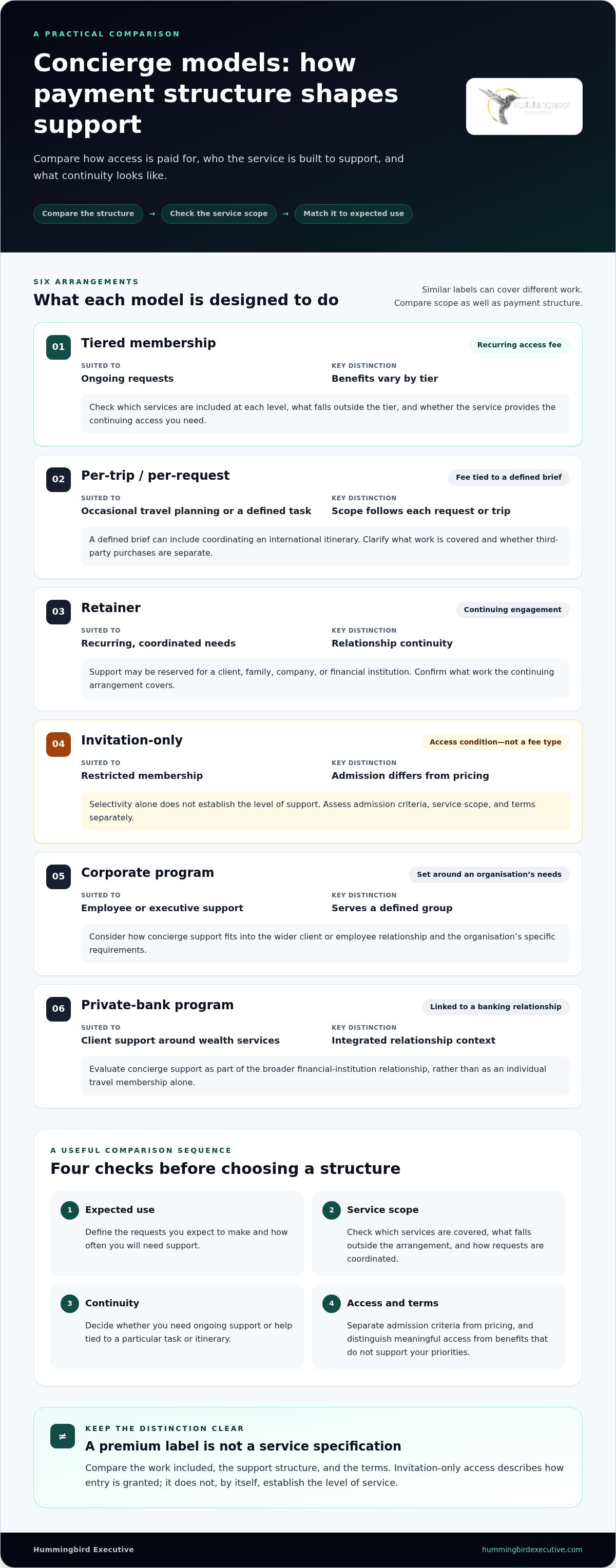
Membership, per-trip, and retained pricing models
The service model determines whether ongoing access or individual requests shape the relationship. Membership provides continuing access, while a per-request arrangement ties support to a defined task or itinerary. A retainer reserves ongoing support for a client, family, company, or financial institution. Compare the scope of service as well as the structure, since similar labels can cover different work.
When comparing membership tiers, identify what distinguishes each level. One tier may focus on lifestyle requests, while another includes broader coordination or access. The practical question is which services members can use and what falls outside the tier. A premium label alone does not explain the day-to-day relationship.
A per-request arrangement can suit a defined brief, such as coordinating an international itinerary, while a retainer may suit recurring needs that call for continuity. Consider how support is structured, what work it covers, and whether third-party purchases are separate. These details clarify what the arrangement covers without relying on a headline figure.
Invitation-only membership describes how access is granted, not the complete service model. It may accompany ongoing membership or another arrangement. Consider admission criteria, service scope, and terms separately. A private invitation signals selectivity, but does not by itself establish the level of support.
| Option | Payment structure | Best suited to | Key distinction |
|---|---|---|---|
| Tiered membership | Recurring access fee | Ongoing requests | Benefits vary by tier |
| Per-trip | Fee tied to a defined brief | Occasional travel planning | Scope follows each trip |
| Retainer | Continuing engagement | Recurring, coordinated needs | Relationship continuity |
| Invitation-only | Access condition, not a fee type | Restricted membership | Admission differs from pricing |
| Corporate program | Set around an organisation’s needs | Employee or executive support | Serves a defined group |
| Private-bank program | Linked to a banking relationship | Client support around wealth services | Integrated relationship context |
When comparing luxury concierge programs, define your expected needs first, then compare coverage, service scope, and structure. Choose an arrangement whose terms align with the requests you expect to make.
Provider selection and service-quality checks
In the United States, leading options span private memberships, travel-focused concierge services, and corporate or private-bank programs. No single category suits every need; compare language access, coverage, service scope, and continuity.
Multilingual Round-the-Clock Service
Multilingual support matters when a request crosses language or cultural boundaries. Compare which languages the service can handle directly and how it manages handoffs between locations. Elite concierge memberships are described as offering a dedicated team available 24/7, but round-the-clock access alone doesn’t establish response quality. Consider whether the same relationship can carry a request from initial brief through resolution.
Global Reach and Service Coverage
Global reach means coordinating requests across destinations; coverage describes where and when support operates. They are separate criteria. A travel-focused program, for example, may coordinate an itinerary abroad, while a lifestyle service may concentrate on requests in a defined location. Compare the categories handled, geographic scope, operating hours, and continuity when a request spans destinations.
Customer Reviews and Satisfaction Ratings
Reviews and satisfaction ratings for luxury concierge programs vary by provider and service category. Look for specific examples, such as communication during a travel change or follow-through on a complex request, rather than relying on an overall score. Compare several reviews for recurring strengths or concerns, and treat an account of a single interaction as one data point, not a complete measure of service.
Use a consistent selection process: define the requests you expect, identify the locations and languages involved, then compare coverage and service categories. Next, assess whether support is ongoing or request-based, and look for review examples relevant to your priorities. This gives you a more useful comparison than a brand ranking alone.
For a US-based executive who travels internationally, language support and global coverage may matter more than lifestyle amenities. A household seeking local assistance may prioritise different services. Match the program’s operating model to your actual needs, then weigh relevant service evidence against ease of access.
VIP access, amenities, and loyalty optimization
Luxury concierge programs differ in the requests they coordinate and the access or amenities they provide. Compare their benefits with your actual priorities, such as travel planning, reservations, or loyalty coordination.
Concierge Services
Services describe the work a program coordinates; VIP access describes the privileges or introductions associated with it. For travel, one program might focus on itinerary planning, while another coordinates a broader set of arrangements. Compare how each handles a specific example, such as changing a reservation, and note which tasks require separate arrangements or third-party payment.
For a practical comparison, list the requests you made in a typical month and mark which require specialist coordination. Someone who mainly needs travel assistance may value itinerary support more than dining privileges. A person managing several types of requests may place greater importance on one point of contact and continuity across tasks.
Program Benefits
Benefits may include preferential access, tailored amenities, or help aligning loyalty opportunities with planned travel. Their value depends on how well they fit your habits. A hotel benefit matters less if you rarely stay in hotels; reservation privileges may matter more if sought-after tables are a regular priority. Compare the access itself with the effort it saves.
When assessing loyalty coordination, consider how a program handles existing memberships and travel preferences. Compare one planned trip from the initial request through completion, noting whether an amenity or loyalty benefit improves the experience. Weigh any time saved against how relevant the benefit is, even when the task itself is brief.
- Separate service scope from VIP access.
- Compare amenities against your regular travel patterns.
- Trace one request to see where loyalty benefits apply.
Rank each benefit by how often you would use it and how useful it would be. This keeps occasional privileges from outweighing services that support recurring needs.
Corporate and private-bank concierge programs
Credit-card concierge services are attached to cardholder benefits; standalone memberships create a separate service relationship. Compare eligibility, request scope, and whether support suits individual or organisational needs.
Corporate Concierge Programs
A corporate program is structured around an organisation, for example, to coordinate executive travel or employee assistance. Unlike an individual membership, the company defines eligible users, request types, and how support fits existing operations. An executive team may value coordinated travel requests, while a broader employee program may prioritise practical lifestyle assistance.
Assess the service from both the employee’s and organisation’s perspectives. Identify who can make requests, which categories are covered, and how discretion is maintained when personal tasks intersect with work. A corporate program should complement internal processes and clarify who handles each request.
Private-Bank Concierge Programs
A private-bank program connects concierge support with a banking relationship. Assistance may sit alongside the client’s broader financial relationship rather than operate as a standalone lifestyle membership. Consider whether the support is intended for travel, personal arrangements, or coordination connected to wider priorities.
To compare the service, trace a representative request from initial contact to completion. Note how the bank and concierge team coordinate, what information is shared between them, and how discretion is preserved. The quality of that handoff matters as much as the range of amenities.
Choose a card-linked benefit for assistance tied to cardholder access and its stated scope. Consider a standalone membership for a distinct service relationship, or a corporate or private-bank program when support needs to align with an organisation or banking relationship. Compare access rules, request categories, and each partner’s role before deciding.
For a corporate or private-bank setting, define the intended users and the requests that need discreet coordination. Explore concierge support for private requirements as a next step.
Hummingbird Executive: platinum Membership full access to rare assets ,investments, buy surch or sale plus 25/7 dedicated concierge services world wide at no extra charge,
Hummingbird Executive is relevant when your requirements extend beyond conventional lifestyle assistance to rare assets and investments. Its platinum Membership provides full access to rare assets and investments to search, buy, or sell, alongside 25/7 dedicated concierge services worldwide at no extra charge.
For a different service arrangement, gold membership offers white glove services 7days a week during opening hours. Free access to white glove service is available worldwide during opening hours. These options distinguish the level and structure of support, while the platinum Membership combines asset access with dedicated concierge services.
Consider Hummingbird Executive if you seek concierge support alongside access to rare assets and investment opportunities, including off-market options. Compare how each program aligns access and assistance with your priorities.
For a discreet discussion of your requirements, contact Hummingbird Executive.
Choose the Relationship You Want to Build
Start by deciding what you want a concierge relationship to make easier. A careful comparison should look beyond a preferred label or access tier. Consider which responsibilities you want to delegate, how closely support should align with your personal or professional life, and the role discretion should play in each interaction.
Before deciding, write down the requests you expect to make and the outcomes that matter most. This brief can make a conversation more precise, helping you distinguish essential support from appealing but less relevant extras. It also gives you a clear basis for discussing how a program’s structure fits your priorities.
If rare assets, investments, or dedicated concierge support are relevant to those priorities, begin a conversation with Hummingbird Executive. A considered next step can bring greater clarity to the relationship you want to establish.
Frequently Asked Questions
What are the membership fees and initiation costs for luxury concierge services?
Fees depend on whether a program charges for ongoing membership, individual requests, or a retained relationship. Initiation costs may also form part of some arrangements. Compare what the fee covers, how access is structured, and whether third-party purchases are separate. For Hummingbird Executive, membership pricing isn’t stated here, so assess the published service distinctions rather than assuming a particular fee.
Which luxury concierge programs require an invitation or minimum spend?
Invitation requirements and minimum-spend conditions vary by program. Invitation-only describes an access process; a spending threshold is a separate eligibility condition, and one does not automatically imply the other. Distinguish membership admission from ongoing service terms. A program, for example, may restrict entry without tying access to a stated spending commitment.
How do response times and service availability compare across concierge programs?
Availability ranges from support during stated opening hours to services described as available around the clock. Elite luxury concierge memberships are commonly described as offering 24/7 access, but that label alone doesn’t explain response speed or how urgent requests are handled. Compare the operating hours, contact channels, and coverage for a request such as a late travel change.
Which programs offer travel, dining, event, and lifestyle bookings?
Travel-focused programs centre on itinerary planning, while broader lifestyle services may coordinate dining, events, and other personal requests. Categories vary, so compare the specific tasks each program handles. Hummingbird Executive’s Platinum Membership provides access to rare assets and investments, with dedicated concierge services worldwide. It may suit members whose priorities extend beyond bookings.
What are the top luxury concierge programs in the United States?
Leading options include private memberships, travel-focused concierge services, and corporate or private-bank programs. No single category suits every need, so compare service scope, coverage, continuity, and who the program serves.


