Access is only the beginning. Insider access to luxury investments may mean acquiring rare assets directly or entering private-company transactions. The right route depends on whether you want to own an asset or gain exposure through an investment interest.
The appeal is clear: a luxury asset can offer personal enjoyment as well as potential financial value. But rarity alone does not establish worth. History, condition, market demand, and supporting documentation all affect how confidently you can assess an opportunity.
This article outlines common routes into luxury assets and the factors that shape their risks and potential returns. It explains how provenance documents an asset’s history, why authenticity affects valuation, and what to review before proceeding. The aim is to help you judge whether a particular asset and investment structure fit your objectives.
Key Takeaways
- Compare direct ownership with investment interests in private companies to understand how the structure shapes your entry point and exposure.
- Assess potential returns alongside market shifts, asset-specific risks, and the patience these investments may require.
- Use provenance and authenticity evidence to evaluate an asset’s history and support a more informed view of its value.
- Plan for each stage, from acquisition and secure storage to insurance and eventual sale, with the asset’s needs in mind.
3. What are the minimum investment amounts for luxury assets?
There is no universal minimum for luxury assets. The required commitment depends on the asset, ownership structure, and transaction terms. Buying a yacht outright differs from acquiring a share in a pooled investment or an interest in a private company. Focus on the amount required for the specific route, not a single threshold for the market.
Direct ownership usually means funding the acquisition and planning for the asset’s ongoing needs. For a vintage car, such as a 1962 Ferrari 250 GTO, the purchase price is only one part of the financial picture. Storage, maintenance, insurance, and eventual resale all shape the capital required to own and hold it. A buyer should assess those obligations alongside the asset’s provenance and condition.
Shared ownership and pooled structures can divide exposure among participants, changing each investor’s commitment. Review the terms to understand the minimum subscription, how ownership is recorded, and how a future sale is handled. Compare these mechanics before focusing on the headline amount. A lower entry point does not establish the quality of the asset or how easily you can exit.
Private-company transactions work differently. An investor’s commitment depends on the offer structure and allocation, not the company’s overall valuation. Private startups such as OpenAI and Anthropic can reach valuations in the tens or hundreds of billions of dollars before an IPO. Those valuations describe the companies, not the minimum an individual investor must commit.
For rare collectibles, scarcity and history can affect valuation, but evidence of authenticity matters too. A limited-edition watch with documented ownership presents a different assessment from a similar-looking piece without supporting records. Review provenance, condition, and the valuation method before deciding how much capital to allocate. Consider personal enjoyment separately from potential financial returns.
To establish the practical minimum, first choose an asset class, such as property, a yacht, a private jet, or a collectible. Next, determine whether you are considering direct ownership, shared ownership, or an investment interest. Review the acquisition commitment and the costs of holding, maintaining, storing, and selling the asset. Finally, assess whether the documentation supports its identity and history. This gives you a fuller picture of the capital required beyond the headline figure.
3. What are the risks and typical returns of luxury investments?
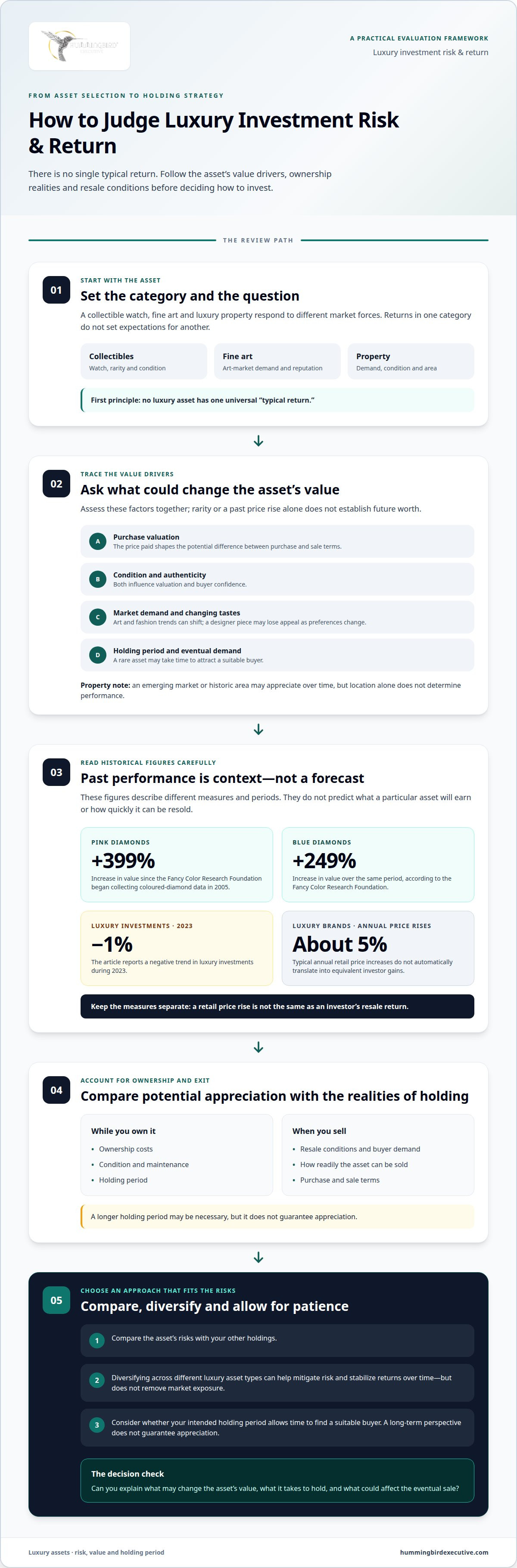
Luxury investments have no single typical return. Outcomes depend on the asset, purchase valuation, holding period, condition, and eventual demand. A collectible watch, fine art, and luxury property respond to different market forces, so returns in one category do not set expectations for another. Consider potential appreciation alongside ownership costs, resale conditions, and how readily the asset can be sold.
Past performance offers context, not a forecast. Pink diamonds increased in value by 399% since the Fancy Color Research Foundation began collecting coloured-diamond data in 2005. Blue diamonds increased by 249% over the same period, according to the Fancy Color Research Foundation. Those historical figures describe specific categories across a defined timeframe; they don’t indicate what a particular stone will earn or how quickly it can be resold.
Market conditions can also move in the opposite direction. Luxury investments recorded a negative 1% trend in 2023. Luxury brands’ typical annual price increases are about 5%, but retail price rises don’t translate automatically into equivalent gains for an investor. An asset’s resale value also reflects demand, condition, authenticity, and the difference between its purchase and sale terms.
Changes in fashion and art trends can add volatility. A designer piece may lose appeal as tastes shift, while demand for a work of fine art may change as an artist’s reputation develops. Luxury properties in emerging markets or historical areas may appreciate over time, but location alone does not determine performance. Demand, condition, and the character of the area also influence property valuation.
Before investing, examine the asset’s history, market demand, and valuation process. Then compare its risks with other holdings. Diversifying across different luxury asset types can help mitigate risk and stabilize returns over time, though it doesn’t remove market exposure. A long-term perspective may be necessary, since a rare asset can take time to attract a suitable buyer.
Use a disciplined review: identify the factors that could change value, assess how those factors affect the asset, and consider your intended holding period. For investors exploring privately sourced opportunities, luxury investment access can be a starting point for reviewing potential transactions with that framework in mind.
Shifts in art and fashion can affect the value of designer goods and fine art, making these categories sensitive to changing buyer preferences. If you are considering either, account for the possibility that an asset’s appeal may change during ownership. Even a well-documented, carefully maintained item can be difficult to value as tastes evolve.
Luxury investments may require patience and a long-term perspective. A longer holding period does not guarantee appreciation; it recognizes that finding the right time to sell can take time. Continue to monitor changes in art and fashion, as these trends may affect value while you hold the asset.
4. How can investors buy, store, insure, and sell luxury investment assets
Start with the transaction record. Before acquiring a painting, yacht, private jet, or property, gather the sale terms, ownership details, condition records, and provenance documents. An art advisor or high-end real estate broker can provide specialist guidance within their field. Keep the purchase agreement and supporting records together so ownership and the asset’s history remain traceable.
For a private sale, clarify what transfers with the asset. A painting may come with authentication and exhibition records; a yacht transaction may include maintenance and condition documentation. Match each record to the specific item rather than relying on a general description. Note gaps or discrepancies during due diligence, and ensure the final transaction documents accurately identify the asset and parties.
Choose storage based on the asset’s physical needs and intended use. Fine art requires handling and environmental conditions suited to its materials, while a yacht or private jet needs appropriate facilities and ongoing care. Document the asset’s condition before storage, preserve relevant service or conservation records, and maintain an inventory of associated items. These records help track its condition over time.
For insurance, start with a clear description of the asset and your exposure. Provide the insurer with accurate asset details, valuation information, provenance or ownership records, and information about storage and use. For a work of art, condition reports and other documentation can help distinguish the insured object from a similar piece. Review the policy’s covered risks, exclusions, valuation basis, and transport or storage requirements. Keep the policy and supporting records together.
Plan the sale before it becomes urgent. Decide how the asset will be presented, which records support its authenticity and condition, and which sale process suits its market. A fine-art seller may work with an art advisor; a property owner may engage a high-end real estate broker. Prepare an accurate description and organized documentation, then plan for inspection, negotiations, transfer of ownership, and delivery or handover.
Maintain a consistent file for each asset, including acquisition and sale documents, provenance, condition assessments, insurance records, and maintenance or conservation history. If assets are held in multiple locations, record where each item and document is kept. A clear documentation trail supports decisions throughout ownership, from purchase to resale.
For assistance accessing rare assets and coordinating a purchase or sale, explore private asset opportunities.
Hummingbird Executive: platinum Membership full access to rare assets ,investments, buy surch or sale plus 25/7 dedicated concierge services world wide at no extra charge,
Hummingbird Executive’s platinum Membership provides full access to rare assets and investments, with the ability to search, buy, or sell and dedicated worldwide concierge services at no extra charge. It offers a discreet next step when you’re considering an off-market opportunity and want support in accessing assets or arranging a transaction.
Gold membership offers white-glove services seven days a week during opening hours. The appropriate membership depends on the level of access and service you seek. For a considered conversation about buying or selling rare assets, contact Hummingbird Executive or visit its website.
Set your investment mandate before the next opportunity
Before pursuing insider access to luxury investments, define the role an asset should play in your wider portfolio. Decide whether your priority is personal enjoyment, potential appreciation, or a balance of both. Then clarify your intended holding period, tolerance for limited liquidity, and the documentation you expect before proceeding.
A written mandate gives each opportunity a consistent frame. It can help distinguish a suitable asset from one that simply attracts attention and keep acquisition decisions aligned with your wider objectives. Revisit the mandate as circumstances change, rather than letting a single rare offering determine your strategy.
When you’re ready to explore private opportunities for buying or selling rare assets, contact Hummingbird Executive to discuss access. A considered next step can begin with a clear brief and a discreet conversation.
Frequently Asked Questions
What does insider access to luxury investments mean?
Insider access to luxury investments means gaining entry to private opportunities that are not broadly marketed. An investment may involve a tangible asset, such as a yacht or rare car, or an interest in a private company. Access describes how an opportunity is sourced; it does not establish authenticity, valuation, or suitability. Each requires a separate assessment tailored to the asset and transaction.
How can individual investors access luxury investment opportunities?
First decide whether you want direct ownership or an investment interest, then identify a suitable asset class and transaction route. Specialist guidance, such as an art advisor’s input on a work of art, can help interpret asset-specific details. Before committing, understand the ownership structure, decision rights, transfer terms, and exit process. These determine what your investment entitles you to do.
What platforms and firms offer access to luxury investments, and what are their requirements?
Hummingbird Executive gives members private access to off-market opportunities involving rare assets and investments, including yachts, private jets, premium properties, and luxury cars. Membership is reserved exclusively for ultra-high-net-worth individuals and family offices, and access is for qualified members. Membership options provide different levels of access and service; eligibility is the first consideration for prospective members.