Access alone does not create trust. Confidentiality in UHNW circles depends on clear expectations about what may be shared, careful selection of participants, and respect for personal and professional boundaries. In single-family-office peer networks, that trust can make candid discussion possible while keeping peer insight distinct from formal advice.
That distinction matters. Wealth decisions often touch family, business, and personal interests at once, so useful peer conversations need room for candor without turning private details into currency. Discretion is not simply silence; it is a shared understanding of purpose, limits, and accountability.
This article explains how confidentiality shapes peer discussions among ultra-high-net-worth individuals, why trust depends on both group design and conduct, and how these conversations can complement a family’s advisers. It also considers ways to protect personal and financial privacy in a network, while keeping peer insight in its proper role: valuable perspective, not a substitute for tailored legal, tax, or financial guidance.
Key Takeaways
- Set clear expectations for what participants may share, how discussions are used, and where confidentiality boundaries sit.
- Use peer networks for perspective and shared experience, while keeping tailored legal, tax, and financial decisions with professional advisers.
- Protect sensitive information by considering how it is disclosed, stored, and accessed across personal and financial matters.
- Understand the U.S. privacy framework that may apply to financial information, then consider how Hummingbird Executive’s rare-asset access and concierge offering fits your needs.
Confidentiality and trust in single-family office peer networks
A single-family office serves one family, aligning wealth management with its priorities, governance, and global interests. A multi-family office serves several families, while a hybrid model combines internal family-office functions with selected external resources. These structures differ in control, shared infrastructure, and how information moves between family members, staff, and advisers.
Privacy practices also differ across family offices, private banks, and private security firms. Family offices coordinate household and business information; banks focus on financial relationships, while security firms address personal and physical risk. Appropriate boundaries depend on each organization’s role and the information needed for its work.
There is no single typical cost for cybersecurity and privacy services. Scope, technical systems, staffing, locations, and information sensitivity all shape the expense. A tailored assessment can distinguish essential protections from optional measures.
Trust relies on defined access, not simply professional discretion. Families can map which advisers need investment, tax, estate, or administrative information, then limit each person’s access to relevant records. Family offices, banks, lawyers, and wealth managers handle confidential data under their own procedures and agreements, so families benefit from clarifying responsibilities and permitted uses before sharing information.
That clarity is especially useful when firms collaborate on behalf of UHNW families. An estate lawyer and wealth manager, for example, may need coordinated instructions, while neither needs unrestricted access to every family record. A written purpose, designated contact, and secure transfer method can keep discussion focused and reduce unnecessary circulation.
Before granting staff or vendors access, define their roles, review relevant references and credentials, document confidentiality expectations, and limit access to what their duties require. Revisit permissions when responsibilities change. These steps make vetting an ongoing process rather than a one-time introduction.
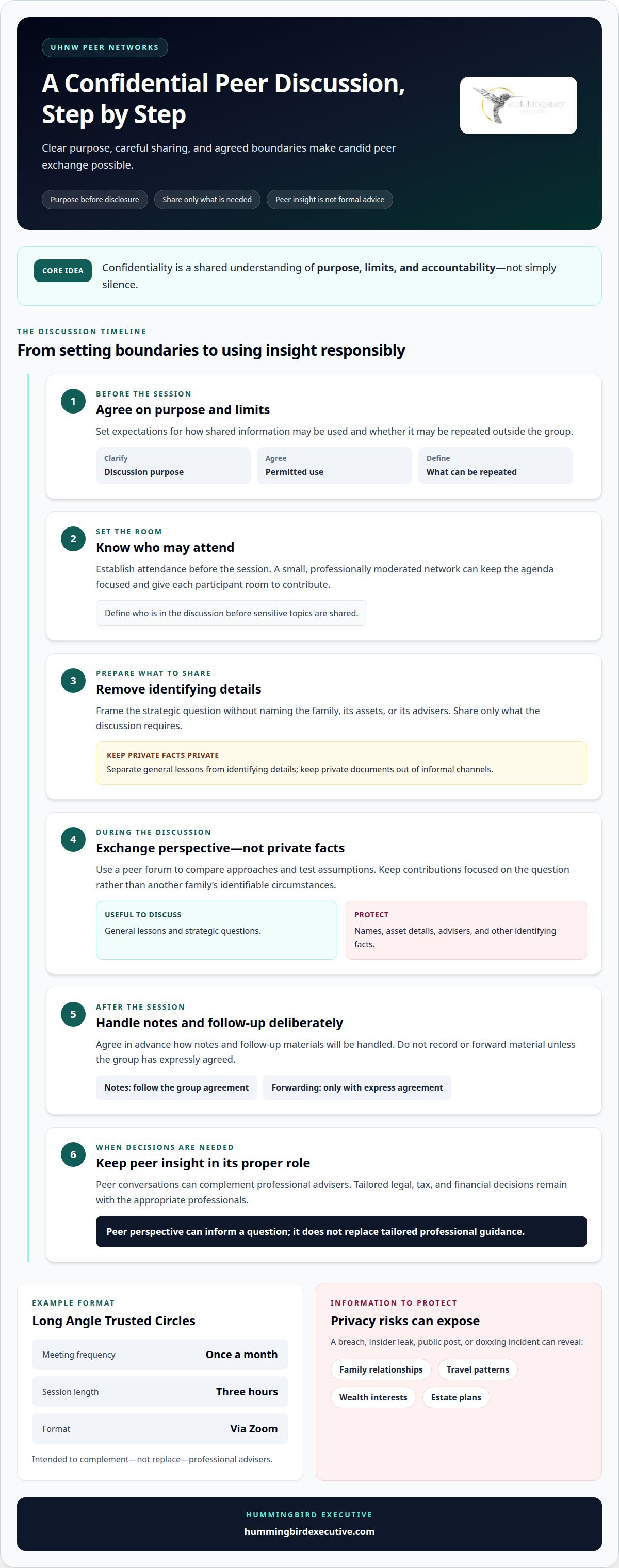
Governance extends the same discipline across generations. A family can hold a scheduled discussion to explain decision rights, confidentiality expectations, and how sensitive topics reach advisers. Long Angle Trusted Circles meet once a month for three hours via Zoom and are intended to complement, not replace, professional advisers. Structured peer exchange can offer perspective while tailored family decisions remain with the appropriate professionals.
Confidential peer discussions for ultra-high-net-worth individuals
Peer forums give family-office professionals a private setting to compare approaches to complex wealth questions. Their value depends on clear boundaries, purposeful discussion, and candid feedback.
Confidentiality Requirements in Peer Discussions
Confidentiality in a peer discussion means agreeing how shared information may be used and whether it may be repeated outside the group. That agreement lets members discuss strategic choices without turning another family’s experience into identifiable details. Before a session, establish who may attend, what records can be shared, and how notes or follow-up materials will be handled.
For example, a family-office executive can describe an estate-planning challenge without naming the family, its assets, or its advisers. Members should separate general lessons from private facts and avoid recording or forwarding material unless the group has expressly agreed. A small, professionally moderated network can keep the agenda focused and give each participant room to contribute.
UHNW Privacy Risks and Protections
UHNW privacy protection means limiting personal and financial exposure across digital, professional, and social settings. A breach, insider leak, public post, or doxxing incident can reveal family relationships, travel patterns, wealth interests, or estate plans. Privacy rules, data-transfer conditions, and contractual duties can differ across the United States and other jurisdictions; global families should map where records are held and who receives them.
Participants can reduce exposure by sharing only what a discussion requires, removing identifying details, and keeping private documents out of informal channels. A U.S. family with business interests abroad, for instance, can separate general investment questions from account records and personal identifiers. The applicable rules and risks depend on the jurisdictions and information involved.
Peer networks also support shared education across generations. A family-office professional can bring a strategic question about wealth transfer, then gather perspectives without presenting the family’s full net worth or naming beneficiaries. UHNW individuals may hold substantial investable assets, so careful handling of portfolio details is important.
In a Portfolio Defense discussion, members can test assumptions about concentration, liquidity, or a proposed asset allocation. Long Angle Trusted Circles offer a named example of structured peer exchange. When a discussion prompts a separate rare-asset search, private access to rare assets and investments may serve as a distinct next step.
How do UHNW individuals protect their personal and financial privacy?
Strong confidentiality in UHNW circles starts with identifying sensitive information and those who genuinely need it. Map financial records, identity documents, travel details, family relationships, and property information. Assign an owner to each category, then document its approved recipients and purpose. A consolidated inventory helps reveal where personal and financial details overlap.
Next, restrict access rather than relying on discretion alone. Give each employee or adviser only the records required for their role, and remove permissions when responsibilities change. For example, a household employee may need itinerary details but not investment statements. Review shared folders, devices, and account access when staff roles change and vendors are offboarded.
Digital safeguards should match the exposure. Use separate channels for sensitive discussions, secure devices, and strong authentication for financial accounts. Avoid sending account numbers or identity documents through informal messaging. Wealth managers may be expected to provide additional risk management and cybersecurity protections; families can discuss how those protections address their particular information and access needs.
Public exposure also calls for deliberate management. Before sharing a photograph or announcement, remove location clues, travel dates, family names, and visible documents. A real-time post from a private residence, for instance, may disclose both the household’s location and an absence elsewhere. Ask household members and representatives to follow consistent rules for social media and public references.
For physical and professional privacy, manage visitors, deliveries, and document handling carefully. Keep sensitive papers out of view during meetings, use designated receiving procedures, and dispose of records securely. A family coordinating a property transaction can limit draft circulation to the parties who need the documents. Review incidents promptly, record what information was exposed, and adjust access or procedures to address the cause.
What are the U.S. rules for protecting UHNW clients’ financial and personal information?
In the United States, privacy obligations depend on the organization, information, and relationship involved. A family office, bank, lawyer, and security firm may handle overlapping details under different legal and contractual frameworks. Families should identify the entity holding each record and the purpose for which it is used.
Start with a record map. Separate account information, tax materials, identity documents, health details, household schedules, and investment records. For each category, note who receives it, where it is stored, and whether it moves between advisers. A tax preparer, for example, may need income records but not a household travel calendar.
Written terms help define permitted use. Engagement documents and confidentiality provisions can specify what information is shared, who may access it, and how it may be handled. A family coordinating an estate matter can ask counsel to clarify which advisers need particular documents and how drafts should be circulated. Those terms should reflect the actual relationship and information involved.
Technology and access controls provide another layer of protection. A family office can assign role-based permissions, use secure transfer methods, and remove access when a staff member or adviser’s duties end. Keep an access record for sensitive folders and review it after a personnel change or a change in project scope. These controls make unnecessary access easier to identify.
Cross-border activity adds complexity. A U.S. family with property or advisers abroad should track where records travel, which entities receive them, and what contractual terms govern sharing. Maintain an up-to-date list of recipients and jurisdictions, especially for estate, investment, and identity records. That map gives advisers a concrete starting point for assessing applicable obligations.
Privacy rules do not replace sound governance. Assign one person to coordinate requests, document approvals, and report suspected exposure through established channels. A written incident process can identify affected records, recipients, and corrective actions without circulating sensitive details more widely. For UHNW families, a disciplined record of decisions supports accountability while preserving discretion.
Hummingbird Executive: platinum Membership full access to rare assets ,investments, buy surch or sale plus 25/7 dedicated concierge services world wide at no extra charge,
Hummingbird Executive offers a practical next step when a private asset search or transaction requires dedicated support. Hummingbird Executive provides full access to search, buy, or sell rare assets and investments, with 24/7 dedicated concierge services worldwide.
Hummingbird Executive serves ultra-high-net-worth individuals seeking private access to opportunities such as yachts, private jets, premium properties, and luxury cars. Gold Membership provides white-glove services seven days a week during opening hours. Membership options address distinct needs, from rare-asset access and transactions to concierge assistance.
For discreet support with an asset search or transaction, visit hummingbirdexecutive.com.
Make discretion part of the family’s practice
Treat confidentiality in UHNW circles as an operating discipline, not an assumption. The next step is to turn shared expectations into a protocol that remains useful as family roles, advisers, and priorities change. A brief review can identify who approves access, how sensitive information moves, and what happens when a relationship or responsibility ends.
Keep the protocol practical. Assign an owner, record key decisions, and revisit the approach when a new adviser, investment, or generation enters the conversation. Consistency in ordinary exchanges matters as much as care during high-stakes decisions. It gives everyone a clearer basis for speaking candidly while respecting boundaries.
If you’re considering support for rare-asset access or related concierge needs, contact Hummingbird Executive to discuss your needs. Thoughtful preparation can help make private conversations more constructive and trust more durable.
Frequently Asked Questions
What does confidentiality mean in ultra-high-net-worth (UHNW) circles?
In practice, confidentiality in UHNW circles means protecting sensitive information from use or disclosure beyond an agreed purpose. For example, a family discussing a proposed property acquisition with advisers may share enough detail to assess the opportunity without circulating beneficiary identities or unrelated portfolio records. Clear boundaries help participants distinguish useful context from information that should remain restricted, even after a meeting ends.
What confidentiality clauses are common in UHNW NDAs and what can they legally cover?
Common NDA terms define confidential information, limit its use to a stated purpose, restrict disclosure to permitted recipients, and address safeguards, duration, and the return or deletion of materials. A clause might cover transaction details, family identities, or non-public financial records shared during due diligence. Its enforceable scope depends on the wording, circumstances, and applicable law; an NDA should be tailored to the relationship and reviewed by counsel.
How do confidentiality practices differ for UHNW individuals in the U.S. and other jurisdictions?
Privacy rules, data-transfer conditions, and contractual duties can differ across jurisdictions. Global families should map where records are held and who receives them.