What if the most compelling private asset is also the least fully documented? In a private purchase, presentation can create confidence before the evidence is in place. Due diligence for private asset purchase brings the focus back to what matters: condition, ownership, existing obligations, and the seller’s authority to transfer the asset.
A seller’s records and assurances may not tell the full story. A yacht, aircraft, property, or luxury vehicle each calls for different inspections and documentation. A cross-border transaction can add unfamiliar legal, tax, and logistics considerations. Careful review helps identify material risks before you sign or transfer funds.
This guide explains how to shape a diligence process around the asset, verify title and provenance, examine contracts and liabilities, and arrange appropriate independent technical, legal, valuation, or tax review. It also covers how to preserve confidentiality while assessing privately sourced opportunities. The goal is a considered decision supported by evidence, not confidence based on appearance alone.
Key Takeaways
- Use due diligence for private asset purchase to verify the asset’s identity, ownership, condition, history, obligations, and transferability before committing.
- Match records and inspections to the asset type and jurisdiction; one checklist won’t suit every acquisition.
- Assess findings by their significance: a document gap may be resolvable, while concerns about condition, title, or transfer rights may change the decision.
- Coordinate financial, technical, legal, tax, and logistical reviews while keeping each workstream distinct and documenting the final decision.
- Private-market access and concierge coordination can support an acquisition, but they don’t replace independent review or guarantee an asset’s quality or outcome.
What due diligence for a private asset purchase actually verifies
Private-asset due diligence is the evidence-based process of verifying what an asset is, who can transfer it, what condition it is in, and which obligations or restrictions may accompany the purchase. It compares the seller’s description with records, inspections, and other relevant evidence before the buyer commits.
The goal is informed risk assessment, not certainty. A careful review can surface discrepancies, unanswered questions, and issues that may affect value or intended use. It cannot promise perfect condition, future performance, or investment returns. Keep the scope clear: examining the asset is distinct from confirming ownership, identifying related obligations, and establishing whether the proposed transfer can be completed.
For a broader overview of the term and its applications, see What is due diligence? In a purchase, the practical question is more specific: what evidence would support proceeding, changing terms, seeking further review, or stepping away?
Which questions should diligence answer before commitment?
Ask questions that can be answered with evidence, not reassurance alone. The review should establish whether the asset on offer is the one the buyer expects to acquire and whether the transaction can convey the relevant rights.
- Authority: Can the seller demonstrate authority to transfer the asset and any associated rights? Identify the owner of record and the person or entity authorized to sign.
- Identity and condition: Do independent records and appropriate inspections support the asset’s identifying details, current state, and stated history?
- Obligations and restrictions: Are there contracts, claims, use limitations, or unresolved matters that could affect ownership, transfer, or intended use?
These lines of inquiry are related, but not interchangeable. An inspection can inform condition while leaving title unresolved. Ownership evidence may be strong while a restriction affects how the asset can be used.
Why does private sourcing change the buyer’s review?
Private transactions may offer limited public information. Primary records, a clear account of provenance, and carefully managed access to supporting documents are therefore especially useful. A buyer can preserve discretion while requesting evidence through an orderly, controlled process.
Confidentiality and verification serve different purposes. Discretion protects sensitive information; it doesn’t validate a claim or resolve a missing record. For private real-estate transactions, the guide to off-market properties explains how privately sourced opportunities differ from publicly marketed listings. In either setting, limited disclosure calls for focused review, not an assumption that scrutiny is unwelcome.
For due diligence for private asset purchase, tailor the evidence to the asset and transaction. A property, yacht, aircraft, or vehicle calls for different records and specialist assessments. The standard remains consistent: understand what is being transferred, what supports the seller’s account, and what remains uncertain before deciding how to proceed.
How to examine a private asset’s condition, ownership, and history
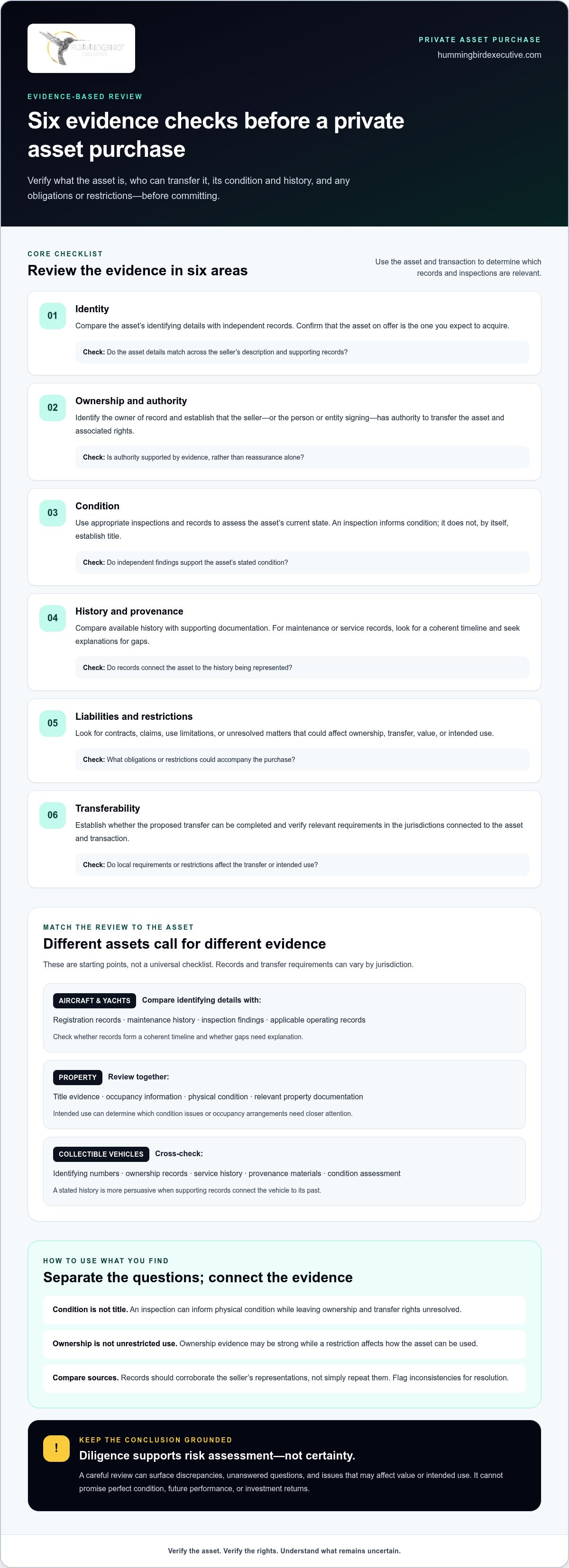
A useful review follows the asset from identification through transfer. Organize the evidence across six areas: identity, ownership, condition, history, liabilities, and transferability. The exact records and inspection methods depend on the asset and jurisdictions involved, so use examples as starting points rather than a universal checklist.
Asset-specific records should corroborate the seller’s representations, not simply repeat them. Compare documents from different sources where possible, and flag inconsistencies for resolution. Cornell Law School’s Legal definition of due diligence offers a concise legal framing. For a physical asset, the practical review must also account for condition, identity, and the records associated with it.
What evidence matters for aircraft, yachts, property, and vehicles?
Start with the asset’s identifying details, then select records and inspections suited to its category. Evidence that matters for a property may say little about an aircraft or collectible car.
- Aircraft and yachts: Compare identifying details with registration records, maintenance history, inspection findings, and applicable operating records. Check whether the records form a coherent timeline and whether any gaps need explanation.
- Property: Review title evidence alongside occupancy information, physical condition, and relevant property documentation. Intended use can determine which condition issues or occupancy arrangements deserve closer attention.
- Collectible vehicles: Compare the vehicle’s identifying numbers with ownership records, service history, provenance materials, and a condition assessment. A compelling history is more persuasive when supported by records that connect the vehicle to its past.
Documentation, registry practices, and transfer requirements can differ by jurisdiction. Verify local requirements in the place relevant to the asset and transaction rather than assuming one country’s paperwork or process applies everywhere.
How should buyers assess title, provenance, and physical condition?
Cross-check details across the asset itself, documentary records, inspection findings, and proposed transaction documents. A mismatch in a serial number, registration detail, ownership name, or described feature is a reason to pause and establish which record is reliable.
Provenance describes an asset’s history. Look for a coherent documentary trail, such as records connecting previous owners or documented events, and distinguish supported facts from the seller’s account. An unexplained gap doesn’t establish wrongdoing, but it may limit what can reasonably be concluded.
Physical and documentary reviews answer different questions. An independent technical inspection can assess observable condition, but it doesn’t establish title or resolve legal rights. Paperwork cannot replace a suitable inspection either. Keep the assessments complementary, then reconcile their findings before deciding.
For buyers considering privately sourced opportunities, Hummingbird Executive’s private asset marketplace provides access to rare assets alongside concierge support. That coordination can support the acquisition journey while independent technical and legal reviews remain distinct.
How diligence findings affect private-asset purchase decisions
Evidence is useful when it informs a decision. A discrepancy doesn’t automatically mean a purchase should end, just as a reassuring presentation doesn’t resolve a material uncertainty. For due diligence for private asset purchase, record each finding, the evidence behind it, what remains unknown, and what response would support proceeding with appropriate confidence.
The table offers a starting framework. The significance of a finding depends on the asset, intended use, transaction documents, and applicable law.
| Finding type | Evidence to review | Potential significance | Possible next decision |
|---|---|---|---|
| Inconsistent identity or records | Asset identifiers, registry or ownership records, and transaction documents | May be a clerical discrepancy, or may leave the asset being transferred uncertain | Request supporting evidence; pause commitment until material inconsistencies are addressed |
| Condition concern | Inspection findings, maintenance or service records, and seller disclosures | May affect use, value, or the scope of work needed after purchase | Seek clarification or further inspection; consider whether revised terms or protections are appropriate |
| Ownership or transfer uncertainty | Title or ownership evidence, authority to sign, and documents governing associated rights | Could affect whether the seller can convey the asset or the rights the buyer expects | Obtain appropriate legal analysis before proceeding |
| Incomplete supporting history | Available provenance, service, or property records, compared with the seller’s account | May limit confidence in the asset’s history without necessarily disproving it | Seek corroboration and assess whether the uncertainty changes the purchase decision |
Which findings may require clarification, revised terms, or a pause?
Separate a correctable gap from a substantive concern. A missing copy of a record may be resolved by obtaining an authoritative replacement or corroborating evidence. If records conflict, seek a documented explanation before relying on either version.
Condition findings can lead to different responses: a buyer might request another inspection, discuss revised terms, or consider contractual protections. None is automatic. Any appropriate remedy depends on the agreement and applicable law. Unresolved questions about ownership or transfer rights warrant a pause for legal analysis, since the consequences can turn on the documents and jurisdiction involved.
How do asset purchases differ from buying a company’s shares?
An asset transaction concerns the specified assets and rights set out in the agreement. Buying shares involves acquiring an entity, so review may extend to the wider business and its liabilities. The legal effect of either structure depends on the transaction documents and applicable jurisdiction; the label alone doesn’t determine which obligations follow.
For an aircraft, asset-specific questions may include the records and rights associated with that particular aircraft. The private jet acquisition guide provides context for that category. In every transaction, use findings to shape the next decision, not as a substitute for reviewing the governing agreement.
A discreet, practical sequence for private-asset due diligence
A review is easier to manage when its scope, responsibilities, and decision points are established before documents begin to circulate. For due diligence for private asset purchase, keep a record of what is known, what remains open, and what evidence is needed before the next commitment.
What should buyers establish before reviewing documents?
Define the exact asset and boundaries of the proposed transaction. Specify included equipment or associated rights, intended use, and exclusions. Then tailor an evidence request to the asset and relevant jurisdictions rather than relying on a generic checklist alone. Assign review responsibilities, agree on decision points, and set secure document-sharing practices before exchanging sensitive material.
A practical sequence keeps the work orderly without treating every acquisition as identical:
- Define scope: Identify the asset, included rights or equipment, intended use, seller, and proposed transaction boundaries.
- Request evidence: Build an asset-specific list of records, disclosures, and inspection materials. Note which items are essential to assess identity, ownership, condition, history, obligations, and transfer.
- Assign workstreams: Keep technical inspection, legal review, financial assessment, tax analysis, and logistics distinct. Give each reviewer a clear remit and a way to flag issues affecting another workstream.
- Set decision gates: Identify what must be resolved before signing, transferring funds, or taking possession. Let new findings prompt a focused request or further review.
- Consolidate findings: Compare reviewers’ conclusions, record outstanding issues, and document the decision and its conditions.
How can buyers document findings and outstanding questions?
Maintain a findings log with the item reviewed, its source, the reviewer, any gap or inconsistency, its potential significance, and the next action. Label seller statements, verified facts, assumptions, and open questions separately. This prevents an assertion from being treated as established simply because it appears in a document pack.
Keep sensitive information on a need-to-know basis. Use controlled document sharing, limit access to people involved in the relevant workstream, and avoid forwarding confidential files more widely than necessary. Keep versions identifiable so reviewers can see which records informed a comment or decision. Confidentiality should protect the process, not narrow the evidence needed to assess the purchase.
Connect each open question to a decision point in the transaction timeline. Record the document or answer required, who is responsible for reviewing it, and whether it affects the buyer’s ability to proceed. If new information changes an earlier conclusion, update the log rather than leaving conflicting notes unresolved. Clear records help preserve discretion and accountability.
For discreet access to private opportunities alongside concierge support, review Hummingbird Executive’s private asset access and concierge support as part of your acquisition journey.
From verified opportunity to considered acquisition with Hummingbird Executive
Opportunity sourcing and due diligence serve different purposes. A private marketplace can bring a rare asset within view; the buyer’s review determines whether the evidence supports proceeding. Neither access nor concierge coordination establishes an asset’s condition, value, ownership, or investment potential. Those conclusions depend on the buyer’s assessment and the relevant independent reviews.
Where can discreet access and diligence sit in the same acquisition journey?
Hummingbird Executive’s private marketplace gives members access to rare assets and investments, including yachts, private jets, properties, and luxury cars. Access begins the acquisition journey; it does not replace verification. Each asset still calls for documentation, inspection, and transaction review suited to its characteristics and jurisdiction.
Concierge support can help coordinate the practical aspects of a globally minded purchase, while technical, legal, tax, and valuation assessments remain distinct. A buyer considering an aircraft, for example, may coordinate document review and an inspection while separately addressing ownership and transaction questions. The roles are complementary, not interchangeable. The Platinum membership guide provides further context on membership and private asset access.
What is the considered next step after reviewing an opportunity?
Turn the review into a decision framework before committing. Set out the buyer’s intended use, the evidence already assessed, unresolved questions, and the findings that would change the decision. This keeps attention on material issues rather than the opportunity’s momentum or presentation.
Align the remaining work with the asset and transaction. An inspection may address physical condition, while legal analysis may focus on title or transfer rights. Tax and logistics questions can require their own review, particularly where jurisdictions differ. Coordinate the workstreams while preserving clear responsibility for each conclusion. Transaction documents and protections should reflect the actual findings and be assessed in light of applicable law.
A considered decision need not mean proceeding. It may mean continuing once specified evidence is supplied, revising proposed terms where appropriate, pausing for further review, or declining to acquire. Record why the decision follows from the evidence, and make any conditions for proceeding clear before the next commitment.
For buyers ready to explore rare private opportunities with discretion, explore Hummingbird Executive’s private asset access and membership. Let the opportunity begin the conversation; let evidence guide the decision.
Make the next decision with clarity
Before moving forward, decide what level of uncertainty you’re prepared to accept and which unanswered questions would change your position. You don’t need every unknown eliminated, but you do need to understand its significance, who can resolve it, and whether the remaining exposure fits the purpose of the purchase.
That discipline gives the decision room to be deliberate. If evidence supports proceeding, document the basis for that choice and any remaining conditions. If it doesn’t, pausing or declining can be as considered an outcome as completing the transaction. The value of due diligence for private asset purchase lies not in removing every risk, but in making the next step intentional.
For discreet access to private opportunities, explore Hummingbird Executive’s private asset access. Approach each opportunity with clear criteria and let the evidence guide the pace.
Frequently Asked Questions
How long does due diligence for a private asset purchase take?
There’s no fixed timetable; the review depends on the asset, available records, inspection access, and issues that need follow-up. A straightforward file may move faster than a purchase involving incomplete records or several jurisdictions. Before setting a target date, identify the evidence to review and who needs to assess it. Allow time for clarification, specialist input, and considered decision-making.
Can a buyer rely on the seller’s inspection or valuation?
A seller’s report can inform the review, but it shouldn’t be treated as the buyer’s independent assessment. Consider who commissioned it, what it examined, when it was prepared, and whether its scope matches your intended use. A valuation, for example, may address market value without answering questions about mechanical condition. If the report leaves a material question open, obtain appropriate independent input before relying on it.
What happens if ownership documents are incomplete or inconsistent?
Identify exactly what is missing or inconsistent and whether another reliable record can clarify it. A misspelled name may call for a different response than conflicting ownership records or an unclear right to sell. Don’t treat either as resolved based on verbal assurance alone. If the uncertainty concerns authority to transfer or the rights conveyed, pause the relevant commitment and obtain legal analysis before proceeding.
Is due diligence different for an asset purchase than a share purchase?
Yes. An asset purchase focuses on the specific assets and rights described in the transaction documents, while a share purchase involves acquiring an entity and may call for review of its broader operations, contracts, and liabilities. The distinction affects the questions to investigate, but labels alone don’t settle the legal outcome. The agreement and governing jurisdiction matter, so align the review with the proposed structure.
Do private asset purchases require cross-border legal and tax review?
Cross-border purchases can raise questions that a domestic transaction may not, particularly if the asset, seller, buyer, or intended use connects to different jurisdictions. Whether specialist legal or tax review is appropriate depends on those facts and the transaction structure. For instance, clarify which jurisdiction’s records establish ownership and whether the proposed transfer has local implications. Don’t assume familiar home-country procedures apply unchanged elsewhere.
Does a thorough due diligence process guarantee an asset is risk-free?
No. Diligence can reveal evidence, highlight uncertainty, and help a buyer make a better-informed decision, but it can’t eliminate every known or unknown risk. An inspection reflects its scope and timing; records may be incomplete, and circumstances can change. The practical objective is to understand material exposures, decide which are acceptable, and document any conditions for proceeding. A careful process is not a promise of perfect condition or future returns.
How can buyers preserve confidentiality during private-asset diligence?
Limit sensitive materials to people who need them for a defined review, and use controlled document sharing with access restricted to that group. Keep a record of what was shared and avoid circulating identity, financial, or asset details in unnecessary correspondence. Agree on how questions and document versions will be handled. Discretion should shape the information flow, not prevent appropriate reviewers from receiving the evidence needed for a sound decision.