Privacy changes how a deal is sourced and negotiated; it doesn’t place the transaction beyond the law. The legal framework for off-market transactions depends on more than where buyer and seller meet. Jurisdiction, asset type, ownership and transaction structure can all shape the diligence and documentation required.
Discretion is often central to a private deal, but it shouldn’t come at the expense of clarity. Buyers and sellers still need to establish who owns the asset, understand its condition and record the terms carefully. The practical task is to distinguish legal obligations from commercial preferences while recognising that requirements can vary across borders and asset classes.
This guide outlines common legal workstreams in an off-market transaction, including jurisdiction, ownership and title checks, asset-specific diligence, and choices such as an asset purchase or a share purchase. It also explains how privacy and sound recordkeeping can coexist. Hummingbird Executive provides private access to rare-asset opportunities and concierge coordination. This is general information, not legal advice; the appropriate analysis depends on the facts and applicable law.
Key Takeaways
- The legal framework for off-market transactions still applies when marketing is private. Discretion doesn’t remove ownership, contract, tax or reporting obligations.
- Map the asset’s location, the parties’ residence or incorporation, the contract’s governing law and the place of closing to identify jurisdictions that may matter.
- Match diligence to the asset. Property, aircraft, yachts and vehicles can involve different title, registration and transfer processes.
- Choose a transaction structure carefully. Direct negotiations, intermediary introductions and ownership through an entity can change the documentation and authority checks involved.
- Plan a clear sequence from identity and ownership checks through asset diligence, written terms and closing, with independent legal review alongside discreet coordination.
What the Legal Framework for Off-Market Transactions Actually Covers
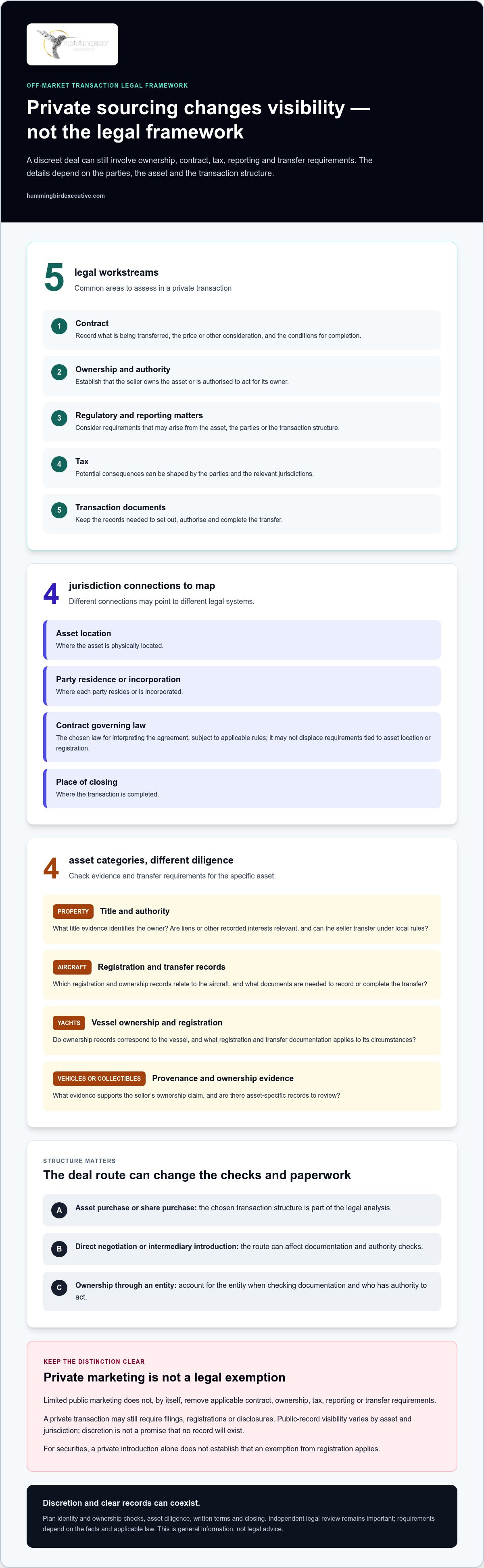
An off-market transaction is negotiated without broad public marketing. The term describes how an opportunity is distributed, not whether the deal is lawful or exempt from ordinary obligations. A private approach may limit who sees an opportunity, but it doesn’t, by itself, remove applicable requirements concerning contracts, ownership, tax, reporting or transfer.
The legal framework for off-market transactions is not one special set of rules. It combines requirements that may apply to the parties, the asset and the chosen transaction structure. Commercial terms, confidentiality preferences and customary practices also shape negotiations, but they shouldn’t be mistaken for legal duties.
Does off-market mean outside the law or outside public records?
No. Limited public marketing doesn’t determine whether a transaction is lawful, and it doesn’t mean that the parties are hidden from authorities or exempt from required disclosures. Deal sourcing and legal reporting are separate matters: a transaction can be arranged privately while still requiring filings, registrations or disclosures under applicable rules.
Public-record visibility also varies. A property transfer may leave different records from a private sale of a yacht, aircraft or vehicle, and requirements can differ between jurisdictions. A discreet process can limit unnecessary exposure, but it shouldn’t be treated as a promise that no record will exist.
Which legal layers can apply to a private transaction?
Several workstreams may need attention. Their relevance and scope depend on the deal:
- Contract: the parties’ written terms, including what is being transferred, the price or other consideration, and the conditions for completion.
- Ownership: evidence that the seller owns the asset or has authority to act for its owner.
- Regulatory and reporting matters: requirements that may arise from the asset, the parties or the transaction structure.
- Tax: potential consequences shaped by the parties and relevant jurisdictions.
- Transaction documents: records needed to set out, authorise and complete the transfer.
For example, a privately negotiated securities transaction may involve different considerations from the sale of a property or a registered asset. A Block Trade is one securities-market example of a large volume negotiated privately, but the label alone doesn’t determine which requirements apply to a particular deal.
The analysis depends on the facts, including the parties, asset location and structure. Rules and guidance can also change, so legal examples should be checked against the relevant jurisdiction and date before being relied upon. A private marketplace can facilitate introductions and coordination; transaction-specific legal review remains a separate workstream.
How Jurisdiction, Asset Type and Ownership Shape Off-Market Deal Rules
No single jurisdictional test governs every cross-border transaction. Relevant legal connections may include where an asset is located, where each party resides or is incorporated, which law governs the contract, and where closing takes place. These connections can point to different legal systems, each with a distinct role.
A contract’s governing-law clause identifies the law chosen for interpreting the agreement, subject to applicable rules. It doesn’t necessarily displace requirements tied to an asset’s location or registration. For example, parties based in the United States and the UAE might negotiate under a contract governed by one jurisdiction’s law while dealing with an asset located or registered elsewhere. Which rules apply depends on the facts and requires jurisdiction-specific review.
Securities transactions illustrate why asset and structure matter. In the United States, some offerings may rely on an exemption from registration, but the relevant route depends on the offering and its circumstances. The SEC’s SEC Exempt Offerings resource outlines exemptions; a private introduction alone doesn’t establish that an exemption applies.
Ownership checks depend on the asset
The key diligence question is not simply whether a seller presents paperwork. It is whether the evidence establishes ownership or authority to transfer the specific asset. Records and transfer formalities vary. Use these categories to frame the inquiry, not as universal legal rules:
These distinctions make jurisdiction mapping an early diligence step, not a formality to leave until closing. Hummingbird Executive facilitates private access to rare-asset opportunities, including premium properties, yachts, private aircraft and luxury cars, with concierge coordination. Members exploring private access to rare assets should treat that facilitation as complementary to transaction-specific legal review.
Comparing Off-Market Transaction Structures and Their Legal Implications
The route from introduction to closing shapes the records a deal needs. A direct negotiation may keep communication between buyer and seller. An intermediary can coordinate an introduction or pass information between the parties. An entity-level transaction may involve a company or other vehicle that owns the asset. None is inherently preferable; the appropriate structure depends on the asset, parties, commercial objectives and applicable law.
Direct sale, intermediary or entity-level transaction?
- Direct buyer-seller negotiation: The parties communicate and negotiate with each other. The documents should identify the parties, define the asset and record the agreed terms. If someone signs or negotiates on another person’s behalf, document that person’s authority.
- Intermediary-facilitated introduction: A third party connects the parties or helps coordinate communications. Clearly document the scope of that role, any authority to make representations or negotiate, and any compensation arrangement. The legal treatment of intermediary activity can depend on the asset, jurisdiction and nature of the work.
- Transaction involving an owning entity: The buyer may acquire an interest in the entity that owns the asset, rather than buying the asset directly. This can raise separate questions about signing authority, governance, ownership and disclosure, as well as the obligations or liabilities that remain with the entity.
In a securities transaction, private negotiation doesn’t by itself establish that a registration exemption applies. The relevant analysis depends on the facts and jurisdiction. For U.S. transactions, U.S. Code § 77d Exempted Transactions sets out statutory exemptions under the Securities Act; it is a starting reference, not a conclusion about a particular offering.
How do confidentiality terms and closing arrangements fit?
A confidentiality agreement can set expectations for how information shared during negotiations may be used or disclosed. Controlled access to sensitive records can also support a more measured diligence process. These arrangements have limits: they don’t override applicable disclosure or reporting duties, or obligations arising from a court order. Their scope and enforceability can depend on jurisdiction and wording.
Closing mechanics should reflect the deal. Parties may use escrow, where documents or funds are held pending agreed conditions, or arrange a staged closing in which steps occur in sequence. Neither is mandatory in every transaction, and neither guarantees completion or removes the need to document release conditions, responsibilities and transfer requirements.
Specialist legal analysis is particularly important when an entity owns the asset, an intermediary’s role or compensation is material, or the transaction spans jurisdictions. The structure should clarify who is acting, what is transferring, which documents establish authority, and how information and closing steps will be handled. Discreet coordination can support the process; it doesn’t replace independent legal review.
A Practical Legal-Diligence Sequence for an Off-Market Transaction
A disciplined sequence helps preserve discretion without leaving essential questions unresolved. The legal framework for off-market transactions varies by deal, but a useful process moves from identifying the parties and relevant jurisdictions to verifying the asset, documenting terms and completing the transfer.
Diligence scope should follow the asset, transaction structure and applicable jurisdiction. Use the steps below as a planning framework, not as a substitute for transaction-specific legal advice.
- Map the transaction. Identify the asset, its location and any registration location, the parties’ residence or place of incorporation, the proposed governing law and where closing may occur. Record these details early so the relevant legal systems can be identified before documents are prepared.
- Establish identity and authority. Be clear about the legal person on the other side of the deal. A seller should be able to evidence ownership or authority to act for the owner; a buyer should clarify whether they are acting personally or through an entity. For representatives, record who may negotiate, sign and bind the relevant party.
- Set information-handling expectations. Before sharing sensitive records, agree on a controlled method of exchange and document confidentiality expectations where appropriate. Handle personal and commercial information in accordance with applicable privacy requirements. Confidentiality arrangements don’t displace disclosure or reporting obligations.
- Conduct asset-specific diligence. The buyer’s review may include ownership, title, registration, encumbrances and condition, tailored to the asset. For property, that may mean examining title evidence and potential liens; for an aircraft, yacht or vehicle, the relevant ownership and registration records will differ. The seller should provide accurate supporting records and disclose material information as required by the agreement and applicable law.
- Resolve findings in the documents. Compare diligence results with the proposed representations, conditions and transfer documents. If an issue affects value, timing or the seller’s ability to transfer the asset, address it expressly in the agreed terms rather than leaving assumptions undocumented.
- Prepare for signing and closing. Confirm required approvals, authorised signatories, execution formalities, funds-transfer steps and the documents needed to complete the transfer. Where applicable, account for post-closing registrations or filings, and retain a clear record of what was agreed and completed.
Responsibilities may differ: sellers generally need to substantiate ownership and authority and provide relevant information, while buyers organise their review and assess findings against the proposed terms. The precise allocation depends on the agreement and applicable law. For independent legal guidance, have qualified counsel review the transaction documents and jurisdiction-specific requirements.
For discreet access and coordination around rare-asset opportunities, explore private access to rare assets through Hummingbird Executive.
How to Pursue Off-Market Access with Discretion and Legal Clarity
Before pursuing an opportunity, establish four points: identify the asset, map the jurisdictions that may be relevant, select a transaction structure and plan diligence around the asset and parties. This sequence keeps access decisions distinct from legal conclusions. The legal framework for off-market transactions still requires transaction-specific assessment, even when an introduction and negotiation take place privately.
Where a private marketplace fits in the transaction
Hummingbird Executive gives members private access to rare-asset opportunities, including premium properties, yachts, private aircraft and luxury cars. Its platform and concierge support can facilitate access and help coordinate the process. They don’t constitute legal representation, certify compliance or replace independent review of ownership, documentation and transaction terms.
For real-estate-specific context, read the guide to off-market properties. Keep the practical questions grounded in the asset: what is being acquired, who owns it, which jurisdictions may apply and what checks belong in the transaction plan? A private channel can shape how parties connect, but legal diligence remains a distinct workstream.
Continue with asset-specific transaction guidance
Some assets call for a more focused review of their own records and transfer process. For maritime context, explore the guide to private superyacht sales. For aircraft-specific considerations, consult the Bombardier Global Express acquisition guide. These resources can help frame the questions to address, while the legal analysis for a particular transaction depends on its facts and applicable law.
Members can use Hummingbird Executive’s private marketplace and concierge support for access and coordination, while retaining independent legal counsel for transaction-specific advice. Consider membership when a curated route to rare-asset opportunities aligns with your search.
Move Forward with Clarity and Discretion
A considered off-market deal begins with clear fundamentals: identify the asset, map the jurisdictions that may apply, choose a suitable transaction structure and shape diligence around the ownership and transfer questions involved. The legal framework for off-market transactions depends on these particulars. Private access changes how parties connect, not the need for careful documentation and independent legal review.
Hummingbird Executive provides members with private access to rare assets and investments, alongside concierge coordination. Platinum Membership includes worldwide 24/7 dedicated concierge services. This support can sit alongside transaction-specific legal counsel, helping members coordinate an opportunity without confusing access with legal advice or a guarantee of compliance.
Explore Hummingbird Executive membership access and concierge support for a discreet route to rare-asset opportunities.
Frequently Asked Questions
Is an off-market transaction legal?
An off-market transaction can be lawful, but private marketing alone doesn’t establish compliance. The legal framework for off-market transactions depends on the asset, the parties, the transaction structure and the jurisdictions involved. A deal may still involve contract requirements, ownership checks, disclosures, reporting, tax considerations or registration steps. Treat general guidance as a starting point, not a legal conclusion about a particular transaction. Obtain transaction-specific legal analysis before signing.
Does an off-market sale avoid public disclosure?
No. Limiting public marketing doesn’t automatically remove required filings, registrations, reporting or disclosures. Some transaction or ownership details may become visible through an asset registry, closing process or applicable law. The extent of public visibility varies by asset and jurisdiction. Plan separately for controlled information sharing and obligations that parties cannot contract away. A confidentiality arrangement cannot guarantee that a transaction or its records will remain private in every respect.
What legal documents are needed for an off-market transaction?
There is no universal document checklist; requirements depend on the asset, parties, jurisdiction and deal structure. Documents may include a purchase agreement, evidence of ownership and authority, confidentiality terms, diligence materials, transfer documents and closing records. If an entity owns the asset, corporate approvals or authority documents may also be relevant. Prepare or review documents for the specific transaction, and verify applicable requirements in each relevant jurisdiction before signing.
How do I know which jurisdiction’s law applies?
More than one jurisdiction may be relevant. A contract may specify governing law, while the asset’s location or registration, a party’s incorporation and the place of closing can raise separate legal questions. A choice-of-law clause doesn’t necessarily displace mandatory local rules. Map these connections before agreeing terms, then have the proposed structure assessed against current law in the relevant jurisdictions. The answer depends on the transaction’s particular facts.
Can an off-market transaction be completed through a company or other entity?
It may be possible, depending on the asset, ownership structure, parties and applicable law. An entity-level transaction can differ from a direct asset transfer in its approvals, authority records, diligence scope, tax treatment and disclosure considerations. Using a company doesn’t automatically create privacy or legal advantages. Before deciding how ownership should change hands, review the entity’s documents, confirm who can authorize and sign the transaction, and assess the structure with transaction-specific legal advice.
Is an NDA enough to protect confidentiality in an off-market deal?
No. An NDA can set contractual expectations for handling specified information, but it isn’t a complete privacy or transaction-risk solution. Its scope, permitted disclosures, duration and enforceability depend on its wording and governing law. It also can’t override applicable reporting or disclosure duties. Use confidentiality terms as one part of a broader process: limit information access appropriately, record what the parties have agreed, and plan how sensitive material will be shared.
What due diligence should buyers conduct before an off-market purchase?
Start by confirming the seller’s identity and authority, then examine ownership evidence and asset-specific title, registration, condition and encumbrance issues. Review relevant agreements, disclosures and transfer requirements, while accounting for the transaction’s structure and jurisdictions. The scope differs for property, aircraft, yachts, vehicles and other assets. Organise diligence before signing, and address material findings in the final documents. Discretion doesn’t replace verification; the appropriate review depends on the deal.