What makes an off-market opportunity attractive, its discretion, can also make it harder to assess. Vetting off-market investment deals takes more than a persuasive introduction or privileged access. With limited public information, ownership, valuation, counterparties, and execution plans may be difficult to verify independently. A compelling narrative is a reason to investigate, not evidence.
Private opportunities need not be dismissed, but they do call for a disciplined review before you commit. This guide explains how to assess the evidence, identify gaps and conflicts, and decide whether a deal’s risks and structure fit your investment objectives.
The process is repeatable: establish what is being offered, verify the material facts, examine the people and entities involved, and bring in specialists suited to the asset and its risks. Hummingbird Executive’s private marketplace provides access to rare assets and investment opportunities. It is a sourcing channel, not a substitute for independent diligence. The aim is a considered decision supported by evidence.
Key Takeaways
- Separate deal sourcing from verification, valuation, and suitability. Private access alone says nothing about an opportunity’s quality.
- Use a repeatable process for vetting off-market investment deals. Start with your mandate and test material claims against primary evidence.
- Classify information as verified, independently estimated, seller-provided, or unresolved so evidence gaps are visible before commitment.
- Compare valuation, liquidity, holding costs, counterparty risk, and exit assumptions with your investment requirements.
- Pause when ownership cannot be verified, asset details conflict, urgency is unexplained, or reasonable review is refused.
What Vetting Off-Market Investment Deals Really Requires
An off-market opportunity is a transaction that isn’t broadly advertised. Private circulation may make access more selective, but it signals neither quality nor risk. Vetting off-market investment deals means assessing the opportunity against evidence, rather than treating discretion, scarcity, or the person presenting it as proof of value.
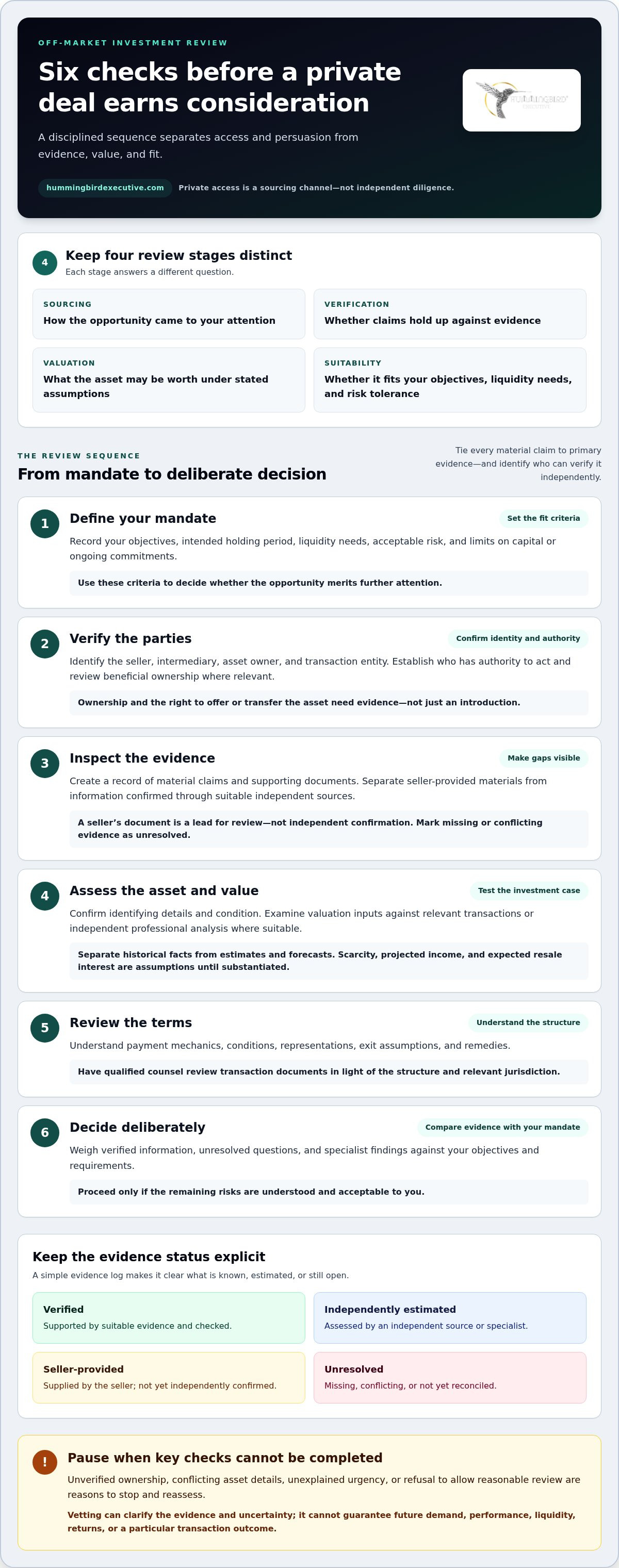
Keep four stages distinct. Sourcing brings an opportunity to your attention. Verification tests claims against underlying evidence and independent sources. Valuation considers what the asset may reasonably be worth under stated assumptions. Suitability asks whether the opportunity fits your objectives, liquidity needs, and tolerance for risk. A private marketplace can help with sourcing, but it doesn’t replace independent assessment. The broader due diligence process provides a useful foundation for this review.
What deal vetting establishes: How well the available evidence supports material claims, what remains uncertain, and whether the opportunity merits further consideration.
What it cannot guarantee: Future demand, asset performance, liquidity, investment returns, or a particular transaction outcome.
What makes an off-market opportunity different to assess?
Private circulation can mean fewer comparable listings and less information in public records. That makes provenance, the documented history and origin of an asset, and the parties’ authority to offer or transfer it especially important. Access to information matters too. Establish what records, inspections, and other evidence are available for a meaningful review.
Confidentiality can be legitimate, but it doesn’t remove the need for documentation. A property may require review of title, income, condition, and permitted use. An aircraft calls for records specific to its ownership, maintenance, and operating status. For a yacht, relevant evidence may include title, condition, and service history. A collectible vehicle calls for its own examination of identity, provenance, condition, and ownership records. The evidence depends on the asset. If material information is withheld, distinguish what can still be verified from what remains unresolved.
Why exclusivity is not an investment thesis
Rarity and restricted access don’t establish fair value or future demand. A seller’s account may combine documented facts with estimates and expectations. Separate each claim and identify the evidence behind it. Treat projected income, anticipated resale interest, and claims of scarcity as assumptions until they are independently substantiated.
Fit is personal. An asset with a compelling story may still be unsuitable if its holding costs, resale prospects, or access to capital conflict with your objectives. Start with evidence, then decide whether the remaining risks are ones you’re prepared to carry.
How to Vet an Off-Market Investment Deal Step by Step
A disciplined review follows a sequence. Each stage answers a different question, and every material claim should be tied to primary evidence: what supports it, and who can verify it independently? A document supplied by a seller is a lead for review, not independent confirmation.
- Define your mandate. Record your objectives, intended holding period, liquidity needs, acceptable risk, and limits on capital or ongoing commitments. Use these criteria to decide whether the opportunity merits further attention.
- Verify the parties. Identify the seller, any intermediary, the asset owner, and the entity that would enter the transaction. Establish who has authority to act and review beneficial ownership where relevant.
- Inspect the evidence. Create a record of claims and supporting documents. Distinguish seller-provided materials from information confirmed through suitable independent sources. Mark gaps rather than treating them as established facts.
- Assess the asset and value. Confirm identifying details and condition. Examine valuation inputs against relevant transactions or independent professional analysis where suitable. Separate historical facts from estimates and forecasts.
- Review the terms. Understand payment mechanics, conditions, representations, exit assumptions, and remedies. Have qualified counsel review transaction documents in light of the structure and relevant jurisdiction.
- Decide deliberately. Weigh verified information, unresolved questions, and specialist findings against your mandate. Proceed only if the remaining risks are understood and acceptable to you.
Verify the asset, ownership, and right to transact
Match the proposal’s description to identifying records and independent documentation where available. Depending on the asset, review may involve property title records, aircraft or vessel registry information, surveys, inspections, or maintenance and condition records. Assess liens and other encumbrances with appropriate specialists. The relevant records and review methods vary by asset and jurisdiction.
Keep an evidence log that records each material claim, the source provided, the independent source or specialist who can test it, and the status of that check. If a record cannot be obtained or reconciled, keep it listed as an open issue rather than filling the gap with an assumption.
Test the investment case and transaction terms
Separate operating history and other verifiable information from projections, assumptions, and seller-provided forecasts. Examine what drives the proposed valuation, including comparable transactions where relevant, and note where an independent estimate relies on limited information. Tailor legal, tax, technical, and financial reviews to the asset, transaction structure, and jurisdiction.
Terms matter as much as headline value. Review how funds move, what must happen before completion, which statements are being relied on, and what remedies apply if obligations aren’t met. Hummingbird Executive’s private marketplace for rare assets can help source opportunities, while concierge support can help coordinate a considered process around your requirements. Independent verification remains central to the decision.
Compare Value, Risk, and Fit Before Committing
Judge a deal against your mandate, not a single projected return. Create a comparison record that makes the quality and origin of each input clear. Use four labels consistently: verified, independently estimated, seller-provided, and unresolved. A forecast doesn’t become a fact simply because it appears in a detailed presentation.
| Factor | What to assess | Input status |
|---|---|---|
| Evidence quality | Are core claims supported by records that can be independently checked? | Label each source |
| Valuation basis | What comparables, condition assumptions, or income estimates inform the value? | Label each input |
| Liquidity | Who might buy the asset, and what sale process or holding period is assumed? | Label each assumption |
| Holding costs | What recurring operating, maintenance, storage, or other costs may apply? | Separate records from estimates |
| Counterparty risk | What is known about the parties, their authority, and their capacity to perform? | Identify gaps |
| Exit assumptions | What conditions must hold for the proposed resale or other exit? | Mark forecasts and unresolved items |
Assess valuation and liquidity together
When private assets have limited transaction histories, valuation may depend more heavily on assumptions about condition, provenance, demand, or future use. Treat comparable transactions as context, not automatic proof: assets in the same broad category may differ in ways that materially affect value. Consider the likely buyer pool, sale process, expected holding period, and costs alongside any proposed valuation. A high estimate has limited practical meaning if a sale depends on a narrow pool of buyers.
Test the case under less favorable conditions. Consider what changes if resale takes longer, costs rise, or demand is weaker than assumed. Sensitivity analysis can show which assumptions drive the case, but it doesn’t predict an outcome.
Test strategic fit and concentration
Assess whether the asset’s time horizon and operating demands match your objectives. Then consider concentration across asset, sector, geography, counterparty, and source of expected value. Several investments may appear different yet depend on the same market or buyer base. The private luxury car collection investment guide offers a category-specific illustration of why asset-level considerations matter.
Vetting off-market investment deals is a comparison of evidence, exposure, and fit. Record what would need to be true for the opportunity to meet your objectives, and which unresolved assumptions could change your judgment. This supports a considered decision, not a promised return.
Red Flags, Common Misconceptions, and Reasons to Pause
Privacy is not proof of merit. An opportunity isn’t automatically safer, better priced, or more valuable because it is privately circulated. Scarcity may be relevant to demand, but it doesn’t establish fair value or guarantee an eventual buyer. When vetting off-market investment deals, treat warning signs as prompts for focused review, not proof of misconduct.
Pause and seek clarification when material details don’t align or the review process is restricted without a clear reason. Pay particular attention to:
- Inconsistent asset details: Descriptions, identifying records, condition reports, or proposed terms differ without a satisfactory explanation.
- Unverifiable ownership or authority: The person presenting the opportunity cannot provide evidence connecting the owner, seller, and party authorized to transact.
- Unexplained urgency: Pressure to commit quickly replaces a clear account of timing or transaction conditions.
- Restricted review: Reasonable access to essential documents, inspections, or independent advice is refused.
- Unclear incentives: Compensation, intermediary roles, or potential conflicts aren’t disclosed, or you’re urged to bypass independent advice.
When missing information becomes a decision risk
Confidentiality can govern how sensitive information is shared, but it shouldn’t make essential ownership or transaction evidence impossible to assess. Record each material claim, who supplied it, the supporting document, and any independent check. If a record conflicts with the seller’s account, preserve both versions and request a specific explanation rather than choosing the more convenient one.
Pause if a critical fact, such as authority to sell or the identity of the asset, cannot be independently checked or credibly explained. A gap may have an innocent cause, but until it is resolved, it remains a decision risk.
How to preserve independent judgment
Use qualified legal, tax, financial, and technical professionals for questions within their respective areas. Their reviews should suit the asset, transaction structure, and jurisdiction. Also understand each intermediary’s role and compensation, including whether an interest in completing the transaction could affect the information being presented.
Keep a written decision record that distinguishes verified evidence from estimates, assumptions, and open questions. Note why you proceed, pause, or decline, and which facts could change your conclusion. This gives you a clear basis for judgment without mistaking a polished narrative for substantiation.
For members seeking discreet access to rare-asset opportunities, Hummingbird Executive’s private marketplace provides a sourcing channel. Keep independent review central to your decision.
From Private Access to a Considered Next Step
Private access can broaden the field of opportunities worth examining, but it cannot decide whether an opportunity belongs in your portfolio. Keep sourcing and investment judgment distinct: define your mandate, identify relevant opportunities, verify material evidence, commission asset-appropriate reviews, then decide whether to proceed, pause, or decline.
What a disciplined deal review should leave you with
Bring the review together in one decision file. It should show what is established, what remains an assumption, and where further work is needed. Include:
- Verified facts and the records or sources that support them.
- Key assumptions behind the valuation, operating case, and exit plan.
- Unresolved items, with the person or party responsible for each claim.
- Relevant specialist opinions, noting their scope and any limits.
- Downside scenarios and the conditions that would materially change your view.
Make the decision against your mandate. Proceed when the evidence and remaining risks are acceptable; pause when a material question still needs resolution; decline when the opportunity no longer fits. Scarcity alone is not a reason to move forward. The discipline in vetting off-market investment deals lies in knowing what would change your mind, not simply in accumulating documents.
How discreet access and concierge support fit the process
Hummingbird Executive’s private marketplace provides members access to opportunities involving rare assets, including yachts, private jets, premium properties, and luxury cars. It is a sourcing channel, not a substitute for independent verification or advice. Concierge support can help coordinate a considered process around your requirements. Platinum membership includes worldwide 24/7 dedicated concierge service, while Gold membership includes white-glove service seven days a week during standard opening hours.
For a real-estate-specific perspective, see the off-market property guide. Its asset focus differs, but the same principle applies: access introduces an opportunity; evidence and fit inform the decision.
If private access to rare-asset opportunities fits your requirements, explore Hummingbird Executive membership and its private marketplace. The final judgment remains yours, supported by the records, reviews, and advice appropriate to the opportunity.
Make the Next Decision on Evidence
Vetting off-market investment deals is a sequence of judgments, not a reaction to exclusivity. Define your mandate, verify the parties and asset, and separate documented facts from projections and unresolved questions. Then weigh valuation, liquidity, holding costs, and exit assumptions against your objectives, using specialist review where the opportunity calls for it.
A disciplined decision may be to proceed, pause, or decline. Each choice should rest on evidence and fit, not scarcity or a persuasive narrative alone. Private access can introduce opportunities; independent diligence remains central to deciding whether one merits a place in your portfolio.
Hummingbird Executive’s private marketplace provides members access to rare-asset opportunities, including property, yachts, private jets, and luxury cars. Platinum membership includes worldwide 24/7 dedicated concierge services to support a considered process. Explore Hummingbird Executive’s private access to rare assets and take your next step with clarity and care.
Frequently Asked Questions
What does vetting an off-market investment deal involve?
Vetting off-market investment deals involves confirming the asset’s identity and ownership, establishing the seller’s authority, and examining records, valuation assumptions, counterparties, and transaction terms. Assess whether the opportunity fits your objectives and liquidity needs. Independent legal, financial, tax, or technical specialists may be relevant, depending on the asset and jurisdiction. A review clarifies what evidence supports the case and what remains unresolved; it can’t guarantee performance or remove investment risk.
How do you verify an off-market deal is legitimate?
Start by matching the asset and seller details to reliable records, then independently establish who owns the asset and who has authority to transact. Review the source and date of financial and technical documents, and identify each intermediary’s role. Involve specialists suited to the asset and transaction. A private introduction, polished presentation, or urgent timeline isn’t proof. Pause if essential information remains inconsistent or cannot be verified.
Is an off-market investment deal safer than a public listing?
No. “Off-market” describes how an opportunity is circulated, not the quality of its documentation, valuation, ownership, or risk. Private transactions may offer discretion, but they can also have fewer public comparables or less readily available information. Assess the asset, counterparties, terms, and supporting evidence on their merits. Independent advice suited to the transaction can help test assumptions, but no review can eliminate investment risk.
What documents should I review before investing in a private deal?
The relevant documents depend on the asset and transaction. They may include ownership or registry evidence, financial statements, valuation support, inspection or survey reports, contracts, liability records, and evidence of the seller’s authority. Qualified legal, tax, financial, and technical professionals can help determine which records matter for the specific deal. Track who provided each document, its date, and whether its material claims have been independently verified.
Can I assess an off-market investment without an independent adviser?
You can review the information provided, but complex or high-value transactions may raise legal, tax, technical, valuation, and financial questions beyond your expertise. An independent adviser with relevant experience can help test assumptions and identify issues within their area. Ensure the advice suits the asset and jurisdiction, understand any conflicts or compensation, and retain responsibility for the final investment decision. Access alone isn’t a substitute for independent judgment.
What are the warning signs in an off-market investment opportunity?
Warning signs include inconsistent asset details, unclear ownership, missing essential records, unexplained pressure to decide, opaque terms, or undisclosed intermediary incentives. A warning sign doesn’t by itself establish misconduct; it calls for a clear explanation and proportionate independent review. If a material claim can’t be verified, or reasonable diligence is discouraged, pause. Don’t let exclusivity or urgency take the place of evidence before making a commitment.