What if a tangible asset that seems to steady a portfolio introduces risks that are harder to see? For investors considering diversifying wealth with hard assets, physical ownership can offer a different kind of exposure, but it doesn’t automatically mean greater security or simpler decisions. Property, yachts, aircraft, and luxury cars each bring distinct questions about valuation, liquidity, maintenance, and resale.
It’s reasonable to value assets that exist beyond conventional market holdings. The discipline lies in assessing what they may contribute alongside the obligations and constraints they carry. A compelling acquisition can still be difficult to price, costly to maintain, or slow to sell.
This guide explains how hard assets may complement a broader portfolio and how to compare categories using consistent, practical criteria. It also covers the due diligence to undertake before committing, from ownership costs and exit options to specialist valuation and appropriate professional advice. The aim is to provide a clearer basis for evaluating opportunities without mistaking access or appeal for an investment recommendation.
Key Takeaways
- Assess how diversifying wealth with hard assets may complement existing holdings without assuming it will reduce risk or ensure gains.
- Compare property, aircraft, yachts, and collectibles by ownership structure, valuation, liquidity, ongoing obligations, and resale considerations.
- Weigh potential portfolio benefits against the practical complexity of maintenance, pricing, and limited exit options.
- Use a disciplined evaluation framework to document portfolio fit, key assumptions, unanswered questions, and independent sources.
- Consider private asset access and concierge support as tools for exploring opportunities, not as validation of an investment.
What Diversifying Wealth With Hard Assets Can and Cannot Do
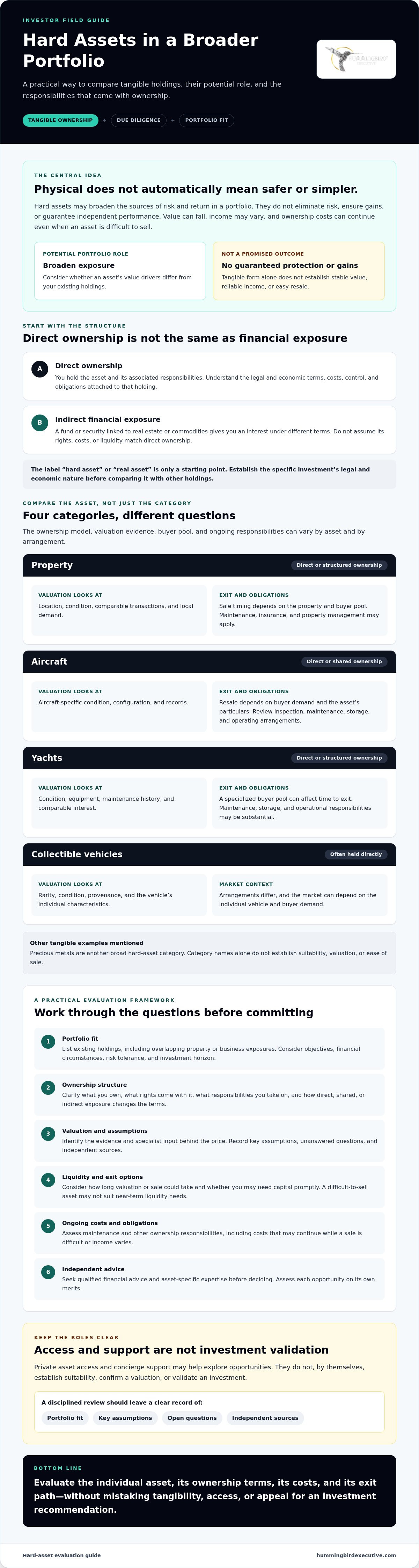
Hard assets are tangible holdings such as property, aircraft, yachts, collectible vehicles, and, as a broad category, precious metals. Their physical presence distinguishes direct ownership from exposure through a financial product, such as a fund or security linked to real estate or commodities. The distinction matters. Direct owners hold an asset and its associated responsibilities; investors using financial products hold an interest structured under different terms. Structures vary, so establish an investment’s legal and economic nature before comparing it with direct ownership.
The terminology can overlap. Real assets offers a useful overview of how real assets are distinguished from financial assets and grouped across areas such as property and natural resources. In practice, the label alone tells you little about an asset’s suitability, valuation, or ease of sale.
Portfolio role describes how an asset may contribute to a mix of exposures; investment outcome describes what it actually earns or loses. Diversifying wealth with hard assets may broaden the sources of risk and return in a portfolio. It doesn’t eliminate risk, ensure gains, or guarantee that different holdings will move independently. Physical presence also doesn’t promise stable value, reliable income, or protection from inflation. An asset’s price can fall, its income may vary, and ownership can carry costs even when it’s difficult to sell.
Which assets are generally considered hard assets?
Property, aircraft, yachts, collectible vehicles, and precious metals are common examples of tangible categories. Each category includes materially different assets. A property’s location and condition matter; an aircraft or yacht may involve operational obligations; and the market for a collectible vehicle can depend on its individual characteristics and buyer demand. Direct ownership is only one route. Financial products may offer indirect exposure, with different rights, costs, and liquidity. Examine the specific structure rather than relying on the category name.
How can tangible assets fit into a broader portfolio?
Some investors consider tangible holdings for exposure to assets whose value drivers differ from those of their existing investments. That potential role should be assessed, not assumed. Start by listing what you already own, including overlapping property or business exposures. Then consider your investment horizon and how much capital you may need to access promptly. An asset that takes time to value or sell may not suit near-term liquidity needs.
Fit is personal. It depends on your objectives, financial circumstances, risk tolerance, and the full costs and terms of ownership. Seek qualified financial advice before making a decision, and assess each opportunity on its own merits.
How Property, Aircraft, Yachts, and Collectibles Differ as Hard Assets
A hard-asset label is too broad to guide a purchase. A property, private aircraft, yacht, and collectible vehicle may all be tangible, yet their ownership structures, valuation methods, carrying obligations, and likely buyers differ. Asset-specific due diligence matters more than the hard-asset label because value and risk are shaped by the individual holding, its condition, and the market for it.
The comparison below is a starting point, not a rulebook. Direct ownership, shared arrangements, and indirect financial exposure can each change what an owner controls and is responsible for.
| Asset | Ownership model | Valuation | Liquidity and resale | Ongoing obligations |
|---|---|---|---|---|
| Property | Direct or structured ownership | Location, condition, comparable transactions, and local demand | Sale timing depends on the property and buyer pool | Maintenance, insurance, and property management may apply |
| Aircraft | Direct or shared ownership; structures vary | Aircraft-specific condition, configuration, and records | Resale depends on buyer demand and the asset’s particulars | Inspection, maintenance, storage, and operating arrangements require review |
| Yachts | Direct or structured ownership | Condition, equipment, maintenance history, and comparable interest | A specialized buyer pool can affect time to exit | Maintenance, storage, and operational responsibilities may be substantial |
| Collectible vehicles | Often held directly, though arrangements differ | Rarity, condition, provenance, and comparable sales | Buyer interest may be narrow and market-dependent | Storage, preservation, insurance, and documentation merit attention |
Property requires local, asset-level diligence
For property, examine location, physical condition, title documentation, maintenance history, and the local market rather than relying on broad claims about real estate. The guide “The Silent Market: A 2026 Guide to Off Market Properties” offers a related perspective on property opportunities. Have qualified professionals familiar with the relevant jurisdiction review transaction-specific legal or tax questions.
Aircraft, yachts, and collectible vehicles call for specialist review
For aircraft and yachts, request specialist inspections and examine maintenance records, operating obligations, and arrangements for ongoing care. For collectible vehicles, assess condition and provenance with appropriate expertise. The guide “The Silent Asset: A 2026 Guide to Private Luxury Car Collection Investment” explores that category further. Rarity may attract buyer interest, but it doesn’t establish fair value or future demand.
When diversifying wealth with hard assets, distinguish personal appeal from financial merit. An access platform may help members explore opportunities, but it doesn’t validate an investment. For information about access to rare-asset opportunities, see Hummingbird Executive membership.
The Hard Asset Diversification Objection: Liquidity, Valuation, and Costs
The central objection is straightforward: tangible ownership can add complexity rather than simplify a portfolio. An asset may offer direct control or personal utility, yet also require specialist oversight, ongoing expenditure, and a carefully planned exit. These features aren’t universal, but they should be assessed alongside any potential portfolio role. Diversifying wealth with hard assets means weighing both sides, not treating physical ownership as a safeguard in itself.
| Potential advantage | Corresponding limitation |
|---|---|
| Direct ownership may provide control over a specific asset. | That control can bring maintenance, management, and operating responsibilities. |
| An asset may have uses or qualities beyond its financial role. | Personal appeal or utility doesn’t establish its market value or resale prospects. |
| Its value drivers may differ from those of other portfolio holdings. | Different drivers don’t ensure independent performance or offset losses elsewhere. |
| A tangible holding can be assessed through its physical condition and records. | Inspection and documentation don’t guarantee a ready buyer or a predictable sale price. |
Why liquidity and valuation can be difficult
Some assets trade infrequently, leaving no continuously observable market price. An asking price is a seller’s stated expectation; an independent valuation is an expert’s opinion under specified assumptions; a completed transaction records what a buyer actually paid. These figures can differ. Resale timing and price may also depend on condition, documentation, location, and the depth of buyer demand. A delay in finding a buyer can turn an uncertain valuation into a practical liquidity problem.
Transaction friction can add to that uncertainty. Preparing an asset for sale, documenting its condition, and identifying appropriate buyers may take time and expertise. If you need capital on a fixed schedule, a sale that takes longer than anticipated can constrain other financial decisions. Consider a range of plausible exit timelines rather than assuming a prompt sale at an estimated value.
What ownership can require beyond acquisition
Before committing, identify who is responsible for maintenance, insurance, storage, and management, and account for transaction obligations at both purchase and sale. Details vary substantially by asset and ownership structure. A holding that appears manageable at acquisition may require continuing attention and resources. Document these commitments, then seek qualified legal, tax, and financial review of the specific arrangement.
Careful review makes the trade-off clearer: tangible assets may contribute distinctive exposure, but they can also demand patient capital and active oversight. If an asset’s value, carrying responsibilities, or exit route remains unclear, treat that uncertainty as central to the decision, not as a detail to resolve after purchase.
A Practical Framework for Evaluating Hard Asset Opportunities
A disciplined review begins before a particular property, aircraft, yacht, or collectible captures your attention. For anyone diversifying wealth with hard assets, a clear sequence helps separate portfolio fit from an asset’s appeal and gives advisers specific questions to examine.
- 1. Define the portfolio role. Identify what purpose the asset might serve without assuming appreciation or income. Consider how it may affect concentration across your existing holdings, including related business or property exposures.
- 2. Test the fit against your time horizon and liquidity needs. Consider when you might need access to the capital and whether the asset’s potential resale timeline is compatible. Set aside any opportunity that depends on an exit schedule you can’t accommodate.
- 3. Clarify the ownership structure. Establish what you would own, what rights and responsibilities attach to it, and who else may have an interest. Have a qualified legal professional review relevant documents and the proposed transaction.
- 4. Verify the asset itself. Request relevant ownership and provenance records, condition reports, and maintenance or service history. Arrange appropriate independent technical or specialist review rather than relying solely on information supplied by a seller or intermediary.
- 5. Scrutinize the valuation and transaction assumptions. Record the basis for the stated value, the evidence supporting it, and any assumptions about market demand. Distinguish an estimate from a completed comparable sale, and ask an independent specialist to assess material uncertainties.
- 6. Map obligations and plan the exit. Identify expected responsibilities for maintenance, insurance, storage, or management, as applicable. Document possible resale routes, likely buyer profiles, and what could delay a sale. Seek qualified tax and financial advice on the implications for your circumstances.
Keep a written record of assumptions, unresolved questions, and independent sources for every material claim. A concise file makes gaps visible before they become commitments.
Screening asks: Does this fit my portfolio, time horizon, and liquidity needs? Do I understand the ownership, obligations, and plausible exit routes?
Professional verification asks: Have qualified legal, tax, financial, and technical specialists reviewed the relevant documents, valuation assumptions, condition, and transaction structure?
Screen for fit yourself; commission independent verification where expertise is required. If you’re exploring private opportunities involving rare assets, Hummingbird Executive membership information describes a means of discovery and facilitation, not an investment assessment.
Using Private Asset Access and Concierge Support Thoughtfully
Private access can widen the field of opportunities considered, including property, yachts, private jets, and luxury cars. It is a means of discovery and facilitation, not an investment endorsement. An opportunity being off-market does not establish its quality, fair value, or suitability for your circumstances. The discipline remains with the prospective buyer.
What private access can and cannot provide
Before relying on an access platform, ask how opportunities are presented, what information is available about counterparties, and which transaction details require separate confirmation. Clarify what is known about ownership, condition, provenance, and the basis for any valuation, then arrange independent review where appropriate. An introduction may help you identify a possible asset; it cannot replace verification of the documentation, transaction terms, or your own investment objectives.
For a related discussion of the role of access, see Platinum Membership Luxury Concierge: The Silent Architecture of Rare Asset Access. Whether an opportunity comes through a private channel or a public market, apply the same standard of scrutiny. Privacy or exclusivity should not be mistaken for due diligence.
When a membership conversation may be useful
Hummingbird Executive provides members with private access to opportunities involving rare assets, including premium property, yachts, private jets, and luxury cars. Platinum membership includes access to search, buy, or sell assets, alongside worldwide dedicated concierge support. Gold membership includes white-glove services during standard opening hours. These are distinct offerings. Confirm current membership terms and service availability directly before deciding whether either arrangement suits your needs.
Concierge support may assist with navigating a complex search or transaction, but it does not determine whether an asset is fairly priced, whether a counterparty is suitable, or whether an investment fits your portfolio. Maintain independent review of documentation, counterparties, suitability, and transaction terms. When diversifying wealth with hard assets, facilitation can make the process more manageable without removing the need for your own judgment and professional advice.
If private access and concierge support align with the way you prefer to explore opportunities, Hummingbird Executive membership details explain the available access and support. Confirm the current terms before proceeding.
Make the Next Decision With Clarity
Diversifying wealth with hard assets is a considered portfolio decision, not a shortcut to security. The right assessment starts with fit: how a holding relates to your existing exposures, time horizon, and liquidity needs. It continues with asset-specific due diligence, including ownership, condition, valuation, ongoing obligations, and a credible exit plan.
Tangible ownership may add distinct opportunities, but it can also bring responsibilities and uncertainty that require independent review. Access can help you discover possibilities; it doesn’t establish value or suitability. Keep that distinction clear as you assess each opportunity with your financial, legal, tax, and technical advisers.
Hummingbird Executive members can access opportunities involving property, yachts, private jets, and luxury cars. Platinum membership includes worldwide dedicated concierge support to assist with searches and transactions. If this kind of access and support aligns with your needs, Hummingbird Executive membership information explains the offering. Confirm the current terms before proceeding.
Frequently Asked Questions
What are hard assets in wealth diversification?
Hard assets are tangible holdings such as real estate, aircraft, yachts, collectible vehicles, and precious metals. An investor may own an asset directly or gain indirect exposure through a financial product; these arrangements can involve different rights, responsibilities, and liquidity. The distinction matters: owning a property brings responsibilities tied to that property, while owning an interest in a financial product follows the product’s structure and terms.
Can hard assets help diversify a portfolio?
Hard assets can broaden a portfolio’s exposure, but they don’t necessarily move independently from other holdings or reduce risk in every market. Their potential role depends on your existing assets, concentration, time horizon, and need for accessible capital. Consider the asset’s full ownership structure and obligations, not only its category. Qualified financial advice can help assess whether a specific holding is suitable for your circumstances and broader objectives.
Are hard assets a reliable hedge against inflation?
No hard asset is a reliable inflation hedge in every circumstance. Its value may respond to market demand, condition, location, operating costs, and other asset-specific factors, and its price can decline even during periods of rising costs. Income, if any, may also be variable. Treat inflation protection as a possibility to evaluate, not a promised outcome, and examine independent evidence for the particular asset rather than relying on its tangible nature.
What are the main risks of investing in hard assets?
Key risks include uncertain valuation, limited liquidity, transaction friction, and ongoing ownership responsibilities. A property may require maintenance and management; aircraft, yachts, or collectible vehicles may call for specialist inspection and care. Documentation, condition, and the size of the potential buyer pool can affect resale prospects. Assess these factors before purchase, and ask qualified financial, legal, tax, and technical professionals to review the issues relevant to the asset.
How do I evaluate an off-market hard-asset opportunity?
Start by confirming the ownership structure, the asset’s condition, and the documentation supporting its provenance and history. Request the basis for any valuation, distinguish estimates from completed transactions, and independently review material claims. Assess ongoing responsibilities, transaction terms, the identity and role of counterparties, and plausible exit routes. Record unanswered questions and assumptions. Off-market status describes how an opportunity is presented; it doesn’t establish fair value or suitability.
Does a private marketplace guarantee that an asset is a good investment?
No. A private marketplace may introduce opportunities that are not publicly advertised, but access alone doesn’t verify an asset’s condition, fair value, documentation, counterparty, or fit with your objectives. Conduct independent due diligence and have qualified advisers review relevant transaction terms. Treat the marketplace as a possible discovery channel, not a substitute for investment judgment, technical inspection, or professional legal, tax, and financial advice.
How can Hummingbird Executive support a hard-asset search?
Hummingbird Executive members can access opportunities involving property, yachts, private jets, and luxury cars. Platinum membership includes access to search, buy, or sell rare assets and investments, along with worldwide dedicated concierge support. Gold membership offers white-glove services during standard opening hours. Concierge support may help members navigate a search or transaction, but it doesn’t validate an investment. Explore Hummingbird Executive membership and confirm the current terms and service availability before proceeding.