What if the asset you’re seeking never appears on a public marketplace? For buyers and sellers considering uncommon yachts, private aircraft, premium property, or other valuable holdings, access may begin through discreet networks. A luxury asset sourcing concierge can help identify private opportunities, but an introduction alone is not the measure of the service.
The harder questions come next. How are provenance and counterparties assessed? Who coordinates inspections, independent advisers, and international details? Discretion can protect a process, but it shouldn’t replace clear documentation or appropriate professional review. A credible process makes responsibilities and next steps understandable before sensitive information is shared.
This guide explains what a luxury asset sourcing concierge may do, from mandate to transaction, and how to assess the process before engaging. You’ll learn how opportunities are identified, what to clarify about evaluation and fees, and how advisers and logistics can be coordinated with fewer fragmented conversations. Hummingbird Executive connects members with private opportunities across asset categories, with different levels of concierge support available through its membership tiers. Access matters. So does knowing how it’s handled.
Key Takeaways
- A luxury asset sourcing concierge should work from a clear mandate, not simply forward listings or make an unqualified introduction.
- A concise brief can define asset criteria, timing, and communication preferences without requiring every sensitive detail at the outset.
- Compare marketplaces, brokers, specialist advisers, and sourcing concierges by their roles, representation, coordination, and diligence responsibilities.
- Before proceeding, clarify service scope, terms, counterparties, privacy practices, and which independent professionals should review the opportunity.
- Hummingbird Executive connects members with private opportunities across several asset categories, with concierge support varying between membership tiers.
What a Luxury Asset Sourcing Concierge Does Beyond Finding Listings
A luxury asset sourcing concierge works from a client’s mandate to identify relevant opportunities and facilitate access to them. The role is broader than forwarding a listing. It begins with understanding what the client is seeking, then helps bring relevant opportunities and parties into view. Access is not guaranteed, and an introduction is only a starting point.
This distinction matters across categories such as yachts, private jets, premium properties, and luxury cars. A family office may coordinate investments and personal assets for a family; the Family office overview provides useful background on this broader role. A sourcing concierge can complement a client’s existing advisers, but shouldn’t be treated as a substitute for independent legal, tax, technical, or investment advice.
What does an asset sourcing concierge handle?
A clear brief gives the search direction. It can state the asset category, preferred location, timing, and acquisition preference, such as whether the client is seeking a purchase or considering a sale. The more precise the priorities, the easier it is to distinguish a relevant lead from an attractive but unsuitable one.
The concierge may identify potential opportunities and facilitate introductions or next-step conversations. Confirm the scope in advance: coordination does not, by itself, establish the asset’s condition, title, provenance, or suitability. Those questions may require review by appropriately qualified independent professionals. Sourcing is not an investment recommendation.
How private sourcing differs from a public marketplace
A luxury asset sourcing concierge uses a client’s brief to seek relevant opportunities, including those that may not be publicly listed, and helps facilitate access and coordination.
A public marketplace typically presents inventory visitors can search and compare using the information shown on the platform. Private sourcing may involve opportunities shared through relationships or direct introductions, so details may be limited at first. An initial conversation can help clarify the opportunity, but it doesn’t confirm that the asset or counterparty has been independently verified.
Ask what is known, what remains to be established, and who is responsible for each review before progressing. A disciplined process keeps the distinction clear: sourcing opens a door; independent assessment helps determine whether to walk through it.
How Luxury Asset Sourcing Moves from a Private Brief to an Opportunity
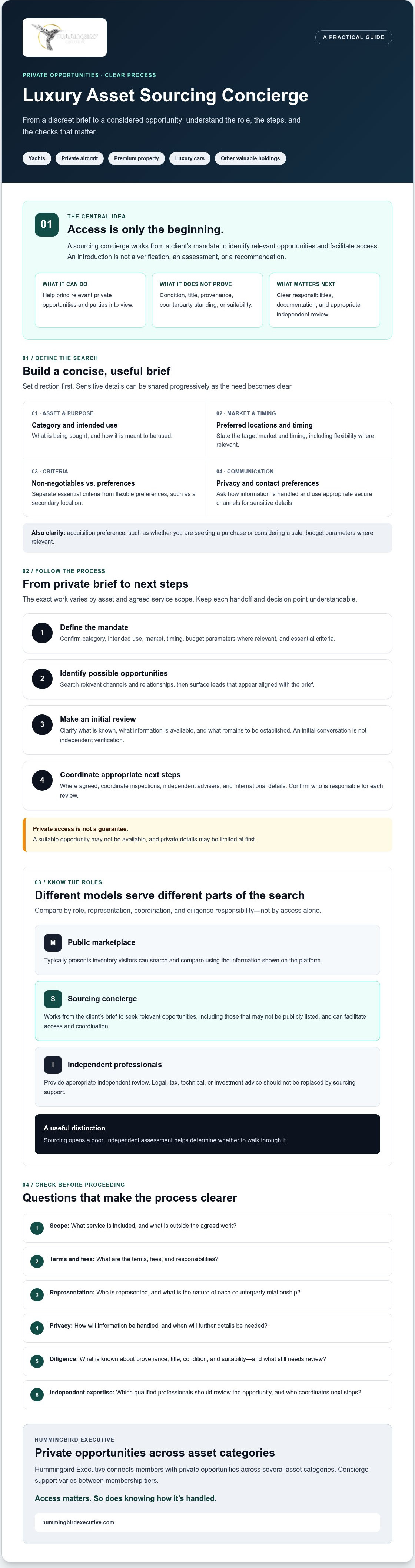
A considered search begins with a precise mandate, then advances through opportunity discovery, preliminary review, and coordinated next steps. The process should make clear what the client is seeking, what information is available, and where independent expertise is required. An introduction should never be mistaken for a completed assessment.
What belongs in a discreet sourcing brief?
Keep the initial brief concise. State the asset category, intended use, preferred markets, timing, and non-negotiable criteria. Separate these from flexible preferences, such as a secondary location or a flexible delivery window. For property searches, this guide to off-market properties offers further context on private real estate opportunities.
You can usually describe your objectives before sharing identifying or highly sensitive details. Ask how information will be handled, and use appropriate secure channels when providing it. Share further particulars progressively, as the process and need for them become clear.
What happens when a potential asset is identified?
A luxury asset sourcing concierge can structure the process around a series of decision points. The precise work varies by asset and agreed service scope, but a typical sequence may look like this:
- Define the mandate. Confirm the category, intended use, market, timing, budget parameters where relevant, and essential criteria.
- Identify possible opportunities. Search relevant channels and relationships, then present leads that appear aligned with the brief. Private access doesn’t mean every suitable opportunity will be available.
- Review initial fit. Consider the information provided, including how it appears to align with the mandate, available provenance details, counterparty information, and supporting documentation.
- Request further information. If the client wishes to proceed, clarify what records or access are needed to assess the opportunity. Decide whether to continue or decline if key details remain unavailable.
- Coordinate next steps. Where appropriate and within the agreed scope, help organize discussions and involve independent specialists in evaluation and transaction planning.
Private access is not proof of asset quality, provenance, or counterparty reliability. Available documents may need to be checked, and the asset may require an independent inspection or technical assessment. Depending on the opportunity, legal, tax, and investment questions should go to the client’s own qualified advisers. Sourcing and coordination do not replace those professional judgments.
Before sharing a detailed mandate, clarify the responsibilities involved and how each opportunity will be presented. To understand how Hummingbird Executive connects members with private asset opportunities, review Hummingbird Executive’s asset sourcing.
Sourcing Concierge, Broker, or Marketplace: Which Model Fits the Mandate?
These models can overlap, but they aren’t interchangeable. A marketplace helps surface inventory; a broker typically facilitates a transaction within an agreed role; a specialist adviser brings focused expertise; and a luxury asset sourcing concierge may coordinate a broader search around a client’s mandate. Actual responsibilities depend on the asset, transaction, and written agreement.
| Model | Inventory access | Mandate and representation | Coordination and likely diligence role |
|---|---|---|---|
| Marketplace | Inventory displayed or otherwise made available on its platform | Usually supports browsing or connections; representation should not be assumed | May provide listing information or platform functions; confirm what checks, if any, are performed |
| Broker | Often focused on a particular market or asset class, with access shaped by the broker’s relationships and inventory | May represent a buyer, seller, or another party, depending on the agreement | Can support transaction discussions within scope; confirm whether diligence is included or referred elsewhere |
| Specialist adviser | Access may come through specialist knowledge or professional networks | Engagement is generally focused on a defined area of expertise | May assess technical or professional questions within their expertise; confirm boundaries and independence |
| Sourcing concierge | May search across public and private channels in response to a brief | Scope is mandate-led; clarify whom the service represents and how it is compensated | May facilitate introductions and coordinate next steps; independent reviews should be assigned explicitly |
Off-market access is not evidence of rarity, value, authenticity, or suitability. A privately introduced yacht, property, or vehicle still requires assessment appropriate to that asset and the intended transaction. The right structure depends on what is being acquired, the transaction’s complexity, and the professional agreements in place.
When a broker or specialist adviser may be the better fit
A focused broker or specialist may be preferable when the mandate depends on detailed knowledge of one asset class, a particular market, or a defined transaction. For example, an acquisition requiring technical evaluation may call for an appropriately qualified independent expert alongside any broker or sourcing support. No model is universally superior. Establish representation, potential conflicts, compensation, and responsibilities in writing before relying on an introduction or assessment.
How to assess discretion, diligence, and alignment
Ask how counterparties and available documentation are assessed, which asset-specific risks are considered, and what falls outside the provider’s scope. Confirm whether the provider represents you, the seller, or neither party, and how any conflicts are handled. Discuss discretion as a process, rather than treating it as a promise of absolute confidentiality.
Before making a binding commitment, arrange independent professional review suited to the opportunity. Keep each role distinct: sourcing may identify and coordinate; brokers may facilitate a transaction; and independent advisers can address legal, technical, tax, or investment questions within their expertise.
How to Prepare and Evaluate a Luxury Asset Sourcing Mandate
A well-prepared mandate makes it easier to judge whether a search is properly aligned and whether the service suits the decision ahead. Before sharing personal or commercially sensitive details, establish what you want to acquire or sell, who has authority to decide, and how information should be handled.
Questions to ask before sharing a mandate
Ask how opportunities are sourced, what information is needed to begin, and how the provider will communicate if a potential match emerges. A luxury asset sourcing concierge should be able to explain the proposed scope and distinguish coordination from independent professional advice. Confirm the applicable membership terms, service availability, and whether any charges would be agreed separately. Don’t assume an introduction includes inspections, negotiation, or transaction support.
- Mandate: Are the asset category, intended use, preferred markets, timing, and non-negotiable criteria clear?
- Decision authority: Who can approve a next step, request additional information, or decline an opportunity?
- Communication: Which contact method, recipients, and level of detail are appropriate?
- Scope and terms: What work is included, what is excluded, and what membership terms or separate charges apply?
- Information handling: How will personal information be used, who may access it, and what are the limits of confidentiality?
- Responsibilities: Who assesses counterparties and documents, and which independent specialists should review the asset?
Share information progressively. You may be able to establish fit with a concise brief before disclosing identifying details. Ask which information is essential at each stage and use appropriate secure channels. Discretion is a process to clarify, not an assumption of absolute confidentiality.
A practical framework for reviewing an opportunity
Judge each lead against the mandate, not the language used to present it. Exclusivity alone doesn’t establish quality, value, or suitability. Separate documented facts from promotional descriptions and preliminary indications, then record what still needs to be established.
- Fit: Does the opportunity meet the firm criteria, or would you need to change an essential requirement?
- Evidence: What supporting documents are available, and what would an independent review need to confirm?
- Open questions: What is unknown about the asset, counterparty, or proposed transaction?
- Dependencies: Are inspections, specialist advice, approvals, or other steps needed before a decision?
- Timing: What decision dates have been stated, and is there sufficient time for appropriate review?
If you’re considering a private mandate, you can contact Hummingbird Executive to begin a discreet conversation about your objectives and the applicable membership terms.
How Hummingbird Executive Supports Discreet Luxury Asset Sourcing
Once you’ve defined the mandate and established how an opportunity will be evaluated, the next consideration is fit: which asset categories and level of concierge support align with your needs? Hummingbird Executive connects members with private opportunities through a platform for buying and selling. A luxury asset sourcing concierge can help bring a search into focus, but any specific opportunity depends on the brief and current availability.
Which asset categories can members explore?
Member opportunities span yachts, private jets, premium properties, luxury cars, and other investment assets. This cross-category scope may suit a mandate that isn’t limited to a single type of holding. It doesn’t mean every asset is available at a given time, or that an introduction confirms an asset’s condition, provenance, suitability, or value.
Review each opportunity on its own evidence. Confirm what information is available, what remains to be verified, and whether an independent inspection or specialist assessment is appropriate. For investment-related decisions, use qualified independent advisers. Sourcing support isn’t investment advice and can’t assure performance or returns.
What to expect when considering membership
Hummingbird Executive offers different concierge arrangements by membership tier. Platinum membership includes access to rare assets and investments to buy or sell, with dedicated worldwide concierge support described as available 24/7 at no extra charge. Gold membership offers white-glove service seven days a week during opening hours. Free Access includes complimentary white-glove service worldwide during business opening hours. Confirm current membership conditions, availability, scope, and applicable terms before joining. The Platinum membership guide provides a deeper overview.
The platform and concierge can help connect members with potential opportunities and support a more coordinated process. They don’t replace the independent reviews, professional advice, or clear agreements needed for a particular transaction. Ask who handles each step, which services apply to the asset category, how information is treated, and what remains your advisers’ responsibility. Hummingbird Executive states that its platform does not use cookies and that personal information is never sold. Review the privacy practices separately, and don’t treat them as a guarantee of transaction confidentiality.
If the approach fits your objectives, prepare a concise mandate and discuss the relevant membership terms and service scope directly. For a discreet next step, contact Hummingbird Executive to discuss your requirements. Access begins with a clear brief, and each opportunity calls for its own review.
Set the Mandate, Then Take the Next Step
Private sourcing is most useful when the brief is clear and the process is accountable. Define what matters, establish who can make decisions, and confirm the provider’s scope before sharing sensitive information. An introduction can create access, but it doesn’t establish an asset’s quality or suitability. Independent review remains essential before a commitment.
A luxury asset sourcing concierge may help connect a mandate with private opportunities and coordinate conversations around a potential transaction. Hummingbird Executive connects members with opportunities across yachts, private jets, premium properties, and luxury cars. Membership tiers provide different concierge arrangements, so confirm current terms, service availability, and what applies to your intended asset category before proceeding.
The most considered next step is a discreet discussion grounded in your requirements, not an assumption of availability or outcome. Share only what’s needed to clarify the mandate, then determine whether the service scope and evaluation process suit your objectives. Discuss a private asset sourcing mandate with Hummingbird Executive. A clear brief is a measured beginning, and it puts the next decision on firmer ground.
Frequently Asked Questions
What does a luxury asset sourcing concierge do?
A luxury asset sourcing concierge works from a client’s mandate to identify relevant opportunities and facilitate access or next-step coordination. Depending on the agreed scope, this may involve a search across asset categories such as yachts, private jets, premium properties, and luxury cars. The service is not automatically a full transaction or independent assessment. Clarify who checks documentation, evaluates condition, and provides legal, tax, or investment advice.
How does a luxury asset sourcing concierge find off-market assets?
A concierge may use a client brief to look for opportunities through relevant private channels, relationships, and available marketplaces. The precise method depends on the provider and asset category, and no search can promise access to every privately offered asset. Ask how potential leads are selected, what information supports an introduction, and whether the provider has a relationship with the seller or another party.
Is an off-market luxury asset automatically a better investment?
No. An asset’s private or off-market status doesn’t establish its value, condition, rarity, or investment suitability. Evaluate the opportunity against comparable information where available, supporting documentation, and your intended use and risk tolerance. A yacht, jet, or property may require asset-specific inspection and professional review. For investment decisions, seek advice from an independent qualified adviser rather than relying on exclusivity or an introduction.
What is the difference between an asset sourcing concierge and a broker?
A broker typically has a defined role in facilitating a transaction, while a sourcing concierge may work from a broader mandate to identify opportunities and coordinate introductions or next steps. These roles can overlap, so titles alone don’t establish responsibilities. Before engaging, confirm in writing whom the provider represents, how compensation works, whether conflicts may arise, and which transaction or diligence tasks fall outside the agreed scope.
How do I protect my privacy when using a luxury asset sourcing service?
Share information progressively, beginning with the details needed to define the search rather than personal identifiers that aren’t yet necessary. Ask how information is handled, who may access it, which communication channels are appropriate, and what confidentiality limits apply. Hummingbird Executive states that its platform doesn’t use cookies and that personal information isn’t sold. Review current privacy statements, and don’t treat platform policies as a guarantee of transaction confidentiality.
Can a sourcing concierge arrange due diligence for a yacht, jet, or property?
That depends on the asset, provider, and agreed service scope. A concierge may help coordinate discussions or next steps, but don’t assume inspections, document checks, or specialist assessments are included. Confirm who is responsible for each review and whether independent technical, legal, tax, or other professional advice is needed. The appropriate checks for a yacht, jet, or property depend on the specific opportunity.
What should I prepare before contacting an asset sourcing concierge?
Prepare a concise brief covering the asset category, intended use, preferred markets, timing, and non-negotiable criteria. Separate firm requirements from flexible preferences, and identify who can make decisions or authorize further steps. You can also state communication preferences. Before sharing sensitive details, ask what information is necessary to begin, how it will be handled, and what membership terms, service availability, and scope apply.