What gives buyers an advantage in finding deals before they hit the market isn’t simply being first. It’s being prepared to recognise a credible opportunity and assess it carefully. Public listings can attract broad competition at once, while private introductions often depend on trusted relationships and a clear understanding of what a buyer is seeking. Early access matters when it’s matched by sound judgement.
This guide explains where private deal flow originates, how relationships shape access, and how to evaluate an opportunity when information is limited. You’ll learn to define an acquisition brief, respond with purpose, and preserve due diligence instead of letting urgency set the terms. It also explores how a private marketplace can provide a route to opportunities beyond public listings, including yachts, private jets, premium properties, and luxury cars. Hummingbird Executive’s marketplace supports private transactions, with concierge assistance included according to membership. The goal isn’t to pursue every early lead, but to be ready to assess a relevant opportunity when it emerges.
Key Takeaways
- Finding deals before they hit the market starts with building trusted relationships and sharing a clear acquisition brief.
- Private opportunities may come through specialist networks, direct seller approaches, or curated marketplaces, each with different levels of visibility.
- Assess an early introduction on its merits: private access alone doesn’t establish fair value, asset quality, or a better outcome.
- Separate non-negotiables from preferences, then use a consistent process to assess the opportunity before proceeding to due diligence.
- Hummingbird Executive’s private marketplace gives members a route to explore rare assets and investment opportunities across several asset categories.
Finding Deals Before They Hit the Market: What Private Deal Flow Means
A pre-market deal is an opportunity shared privately before it’s publicly advertised, or one that proceeds without public advertising. The introduction may come through a relationship, a specialist network, a direct approach, or a structured private marketplace. In each case, the route is private; the opportunity still needs to be assessed on its own merits.
Private access describes how an opportunity reaches a buyer, not its quality, fair value, exclusivity, or investment merit. That distinction matters. Finding deals before they hit the market can create a more targeted conversation, but early access doesn’t prove that an asset is scarce, suitable, or attractively priced.
How a private opportunity differs from a public listing
A public listing makes information broadly visible. A quiet introduction may reach a narrower group because a seller prefers discretion or targeted outreach. That initial conversation can happen before a formal information package or defined transaction process is ready. A pocket listing is one real-estate example of property marketed privately rather than through public listing channels.
Private doesn’t necessarily mean secret. Nor does it mean scarce, undervalued, or right for a particular buyer. Public listings, personal introductions, and structured marketplaces each offer different ways to discover and assess opportunities; none is universally superior.
Which asset categories can involve pre-market opportunities?
Private deal flow extends beyond property. Premium homes, private aircraft, yachts, and collectible luxury cars may all be introduced through targeted or private channels. The assessment process varies by asset: relevant records, condition considerations, transaction structure, and practical requirements depend on what’s being bought. An approach suited to property shouldn’t be assumed to apply unchanged to an aircraft or collectible car.
For a closer look at property-specific considerations, see The Silent Market: A 2026 Guide to Off Market Properties. Across categories, start by establishing what’s being offered, why it’s being presented privately, and what information you need to assess its fit. A private marketplace can provide a structured route to explore opportunities across asset types, but access alone doesn’t replace careful review.
How to Find Deals Before They Hit the Market: Four Sources of Access
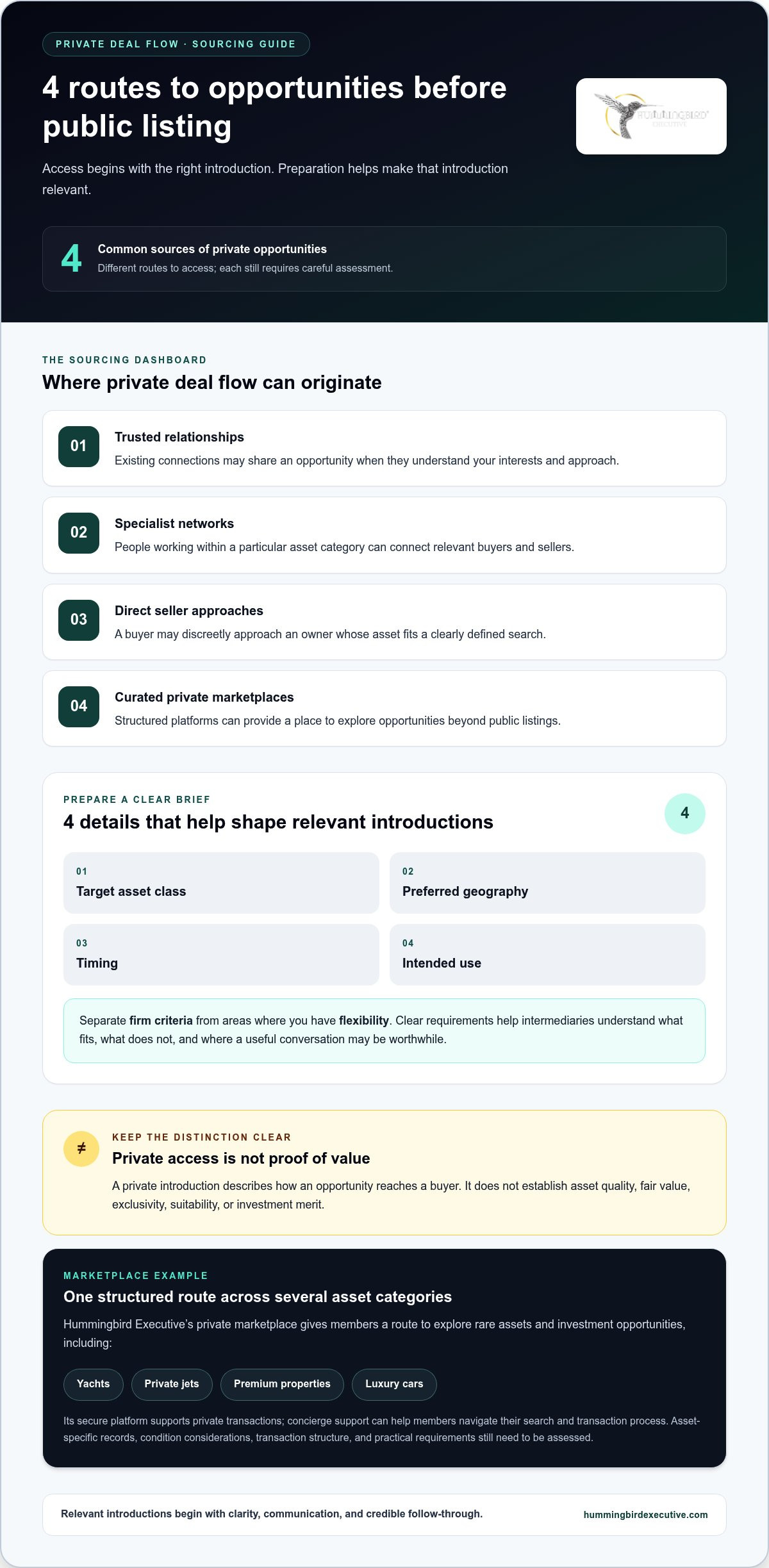
Finding deals before they hit the market is less about casting the widest net and more about making the right introduction possible. Private opportunities commonly surface through four routes:
- Trusted relationships: Existing connections may share an opportunity when they understand your interests and approach.
- Specialist networks: People working within a particular asset category can connect relevant buyers and sellers.
- Direct seller approaches: A buyer may discreetly approach an owner whose asset fits a clearly defined search.
- Curated private marketplaces: Structured platforms can provide a place to explore opportunities beyond public listings.
Access develops over time. A concise acquisition brief, reliable communication, and credible follow-through help intermediaries understand which introductions may be relevant. Indiscriminate outreach, scraped listings, or unsupported claims that an opportunity is “exclusive” don’t establish a trusted channel. The quality of the information and the basis for the introduction still matter.
Build relationships before a specific opportunity appears
Prepare a brief that states your target asset class, preferred geography, timing, and intended use. Separate firm criteria from areas where you have flexibility. Clear acquisition criteria make introductions more relevant because they show intermediaries what fits, what doesn’t, and where a useful conversation may be worthwhile. Respond consistently, communicate changes to your requirements, and follow through on commitments. Professional conduct builds a relationship more reliably than a single introduction.
Use structured networks and private marketplaces thoughtfully
Informal introductions can provide personal context, while specialist networks and membership-based marketplaces offer more structured ways to encounter opportunities. Each has a different role; neither removes the need to assess the asset and transaction. For property-specific sourcing ideas, Redfin’s off-market properties guide offers a real-estate-focused perspective. Broader private searches may span several asset classes.
Hummingbird Executive’s private marketplace gives members a route to explore rare assets and investment opportunities, including yachts, private jets, premium properties, and luxury cars. Its secure platform supports private transactions, and concierge support can help members navigate their search and transaction process. For related reading, see How to Access Exclusive Investment Opportunities Privately and the Platinum membership guide. To explore the private marketplace, visit Hummingbird Executive.
Is Finding a Deal Before Market Always an Advantage?
No. Earlier access can create room for a discreet, focused conversation, but it doesn’t establish fair value, asset quality, or a better outcome. A seller may prefer a narrower process to limit exposure or speak with a specific group of buyers. That can suit both parties, but it may also mean less information is immediately available and more pressure to respond before the opportunity is widely known.
Access is how an opportunity reaches you; verification tests its claims; valuation considers what it may be worth; suitability depends on your objectives and circumstances. These are separate judgements. Treating them as one can turn a promising introduction into an assumption that hasn’t been examined.
What private access may offer, and what it cannot promise
A private process can support discretion and targeted discussions. It may also begin informally, before a complete information package is assembled. But private circulation doesn’t validate ownership, condition, pricing, provenance, or claims made about an asset. It doesn’t prove that an opportunity is rare, exclusive, undervalued, or likely to appreciate. A narrower buyer pool is a feature of the process, not proof of merit.
Pay particular attention to time pressure. A request for a swift response may reflect the seller’s preferred timetable, but it shouldn’t replace a considered review. If key details are missing, distinguish what’s known from what remains to be established before deciding whether to proceed.
Initial checks before progressing a high-value opportunity
Start by establishing who is presenting the opportunity, whether the counterparty has authority to transact, and what documentation supports ownership. Then shape the review around the asset rather than applying one universal checklist. Depending on the category, relevant material may include condition records, provenance, operating information, legal documentation, and financial details. The available evidence and its significance will differ between a property, yacht, aircraft, or collectible car.
- Identity and authority: Clarify the parties involved and the basis on which the opportunity is being presented.
- Asset information: Review relevant records and supporting documents, noting omissions or points that need clarification.
- Independent assessment: Where complexity or jurisdiction warrants it, qualified independent expertise can help examine the asset, documentation, or transaction structure.
These checks don’t predetermine the outcome. They give you a more reliable basis for deciding whether to proceed, request further information, or step away. The discipline matters as much as the access.
Practical Process for Preparing for a Pre-Market Deal
Private opportunities can move through an informal early stage before all the details are assembled. A prepared buyer can respond promptly without confusing speed with certainty. Use a repeatable sequence: define your objectives, prepare your decision process, assess the introduction, then move into asset-specific diligence.
Prepare an acquisition brief and decision process
Write down the criteria that will guide your search. Separate non-negotiables from preferences so an introduction can be matched accurately without making the brief so rigid that a suitable opportunity is overlooked.
- Set the parameters: Record preferred asset categories, geography, intended use, timing, and material exclusions.
- Clarify authority: Identify who can approve the acquisition, who must be consulted, and how a decision will be reached.
- Prepare for execution: Consider transaction structures to explore and the advisers whose expertise may be needed for diligence.
- Protect sensitive details: Share information in proportion to the stage of the discussion and the recipient. A concise brief can establish fit without disclosing unnecessary personal or financial detail.
Internal alignment matters. If decision-makers have different objectives or authority is unclear, a time-sensitive introduction can create delay rather than readiness. Agree in advance on the questions that must be answered, the information required to progress, and the person coordinating the response.
Move from introduction to informed decision
When an opportunity arrives, organize what’s available. Record the source, stated terms, supporting materials, open questions, and proposed timetable. Then compare the opportunity with your objectives, relevant alternatives, and an independently informed view of value. This helps distinguish an attractive presentation from a fit that withstands scrutiny.
Finding deals before they hit the market is useful only when the response process is as disciplined as the search. Don’t draw conclusions from incomplete information or treat urgency as a substitute for verification. Progress when the relevant facts, counterparty authority, diligence requirements, and decision approvals have been appropriately addressed. If material questions remain, identify them before committing to a course of action.
For a regional perspective, Finding Off-Market Investment Opportunities in Europe offers a related resource. The same process applies more broadly across private opportunities and asset types. To explore opportunities through Hummingbird Executive’s private marketplace, explore private asset opportunities.
Finding Private Opportunities Through Hummingbird Executive
For buyers and sellers considering rare assets, Hummingbird Executive provides a private hub to explore opportunities and support private transactions. The marketplace spans yachts, private jets, premium properties, and luxury cars, bringing several asset categories into one discreet setting. It gives members another route to discover opportunities beyond public listings. Each opportunity still needs to be assessed for fit and merit.
A private marketplace for rare assets and investments
Members can use the marketplace to search for, buy, or sell rare assets and investments. A private setting can support more measured exchanges of information, while each asset and transaction calls for its own assessment. For a closer look at one category, The Silent Asset: A 2026 Guide to Private Luxury Car Collection Investment explores considerations relevant to luxury car collections.
Finding deals before they hit the market is most useful when access is paired with a clear brief and careful review. The platform supports private transactions; it doesn’t replace independent diligence or establish the value or suitability of an individual opportunity.
Choose the level of concierge support suited to your search
Membership options provide different levels of support. Platinum includes full access to search, buy, or sell rare assets and investments, together with dedicated worldwide concierge service 24/7 at no extra charge. Gold membership offers white-glove services seven days a week during opening hours. Free Access White-Glove Service provides complimentary worldwide support during business opening hours. Choose the level that best fits the support you want as you explore and progress a search.
Concierge assistance can help facilitate a member’s search and transaction process. The right level of support depends on your needs and the stage of your search.
Take the next step with discretion
Privacy is part of the platform’s approach: it doesn’t use cookies, and personal information is never sold. Members can consider the marketplace and membership options in light of their acquisition objectives, preferred asset categories, and desired level of concierge support.
Explore Hummingbird Executive membership and private marketplace access to see how it fits your search.
Prepare to Recognise the Right Opportunity
Finding deals before they hit the market depends on more than early access. Trusted relationships and a clear acquisition brief can make introductions more relevant, while preparation helps you respond without letting urgency replace sound judgement. Private circulation is a route to an opportunity, not proof of its value or suitability. Careful, asset-specific diligence remains essential.
Hummingbird Executive offers members a private marketplace for exploring opportunities involving yachts, private jets, premium properties, and luxury cars. Platinum membership includes full access to search, buy, or sell rare assets and investments, as well as dedicated worldwide concierge service 24/7 at no extra charge. A disciplined decision process remains essential when assessing any opportunity.
If your acquisition brief is taking shape, explore Hummingbird Executive’s private marketplace and membership options.
Frequently Asked Questions
What does finding deals before they hit the market mean?
It means learning about an opportunity privately before it’s publicly advertised, or when it won’t be publicly advertised. The introduction might come through a trusted relationship, a specialist network, a direct approach, or a private marketplace. “Pre-market” describes how an opportunity is shared, not whether it’s exclusive, fairly priced, verified, suitable, or likely to perform. Buyers still need to assess the asset and transaction on their own merits.
How can I find off-market investment opportunities?
Build relevant relationships, communicate a focused acquisition brief, and consider specialist networks or curated private marketplaces. State your preferred asset type, geography, timing, and intended use so introductions can be more targeted. Follow through reliably and avoid indiscriminate outreach or unsupported claims of exclusivity. Hummingbird Executive offers members a private marketplace for exploring opportunities across rare assets and investments, including yachts, private jets, premium properties, and luxury cars.
Are off-market deals always better than public listings?
No. A private process may offer discretion and a more targeted discussion, but it can also mean less public information and pressure to respond quickly. A public listing may provide broader visibility, while neither route establishes an asset’s fair value or suitability. Compare the opportunity with your objectives and alternatives, and assess the available evidence. Early access is a sourcing advantage only if the opportunity withstands careful review.
How do buyers verify an off-market opportunity?
Start by establishing the counterparty’s identity and authority to transact, then review documentation supporting ownership. Request and organize the information available about the asset, such as relevant condition records, provenance, operating details, and legal or financial materials. The appropriate review depends on the asset and transaction. Where complexity or jurisdiction warrants it, qualified independent expertise can help assess documentation and unresolved questions before you proceed.
Can luxury assets be bought before they are publicly listed?
Yes. Yachts, private aircraft, premium properties, and luxury cars may be introduced privately before public advertising, or offered through a private transaction process. That doesn’t mean every asset in these categories is available off-market, exclusive, or appropriate for a particular buyer. Hummingbird Executive provides members access to opportunities involving these rare assets through its private marketplace. Each introduction remains subject to its own assessment and diligence.
How do I prepare to act on a private deal?
Prepare an acquisition brief that records your target asset category, geography, intended use, timing, and non-negotiable requirements. Clarify who has decision authority, who needs to be consulted, and what information is needed to progress. When an introduction arrives, organize the available facts, identify gaps, and compare the opportunity with your objectives and an informed view of value. A clear process supports a considered response without treating urgency as proof.
Is a private marketplace the same as an investment adviser?
No. A private marketplace provides a route to explore opportunities and may support private transactions; it doesn’t, by itself, provide personalized investment advice or establish that an opportunity is suitable. Hummingbird Executive’s marketplace supports members seeking to buy or sell rare assets and investments, with concierge support to facilitate the search and transaction process. Explore Hummingbird Executive’s private marketplace and membership options to learn more.