Access begins with a clear, credible application. Prospective buyers, sellers and authorised representatives seeking rare, off-market assets can apply for consideration; understanding how to get on exclusive asset viewing lists means knowing what to provide so the request can be assessed with confidence. Identity, representative authority and the nature of the interest are central to presenting a complete profile.
Discretion matters, but so does clarity. A concise application should explain who is applying, whom they represent and what information supports their request. This guide explains how qualified buyers can approach exclusive asset viewing lists with a clear brief and understand the next steps.
Key Takeaways
- Understand who may apply for access and what makes an application easier to assess.
- Learn which identifying, representative and supporting details help present a clear request.
- See how a professional can help buyers navigate curated access to private asset opportunities.
- Consider how invitation-only viewings differ from public listings and auctions before choosing an approach.
What are exclusive asset viewing lists, and who manages them?
- An exclusive viewing list is a private way to present selected assets, not a public directory. Owners and decision-makers share opportunities directly with people whose interests fit. Access may include a confidential brief, viewing arrangements or further information, depending on the asset and the process.
- Start by identifying who controls access to the asset. The owner or an authorised decision-maker may arrange introductions and share details with prospective buyers whose requirements align with the opportunity. A representative might, for example, provide a property brief and viewing invitation to a qualified buyer.
- Clarify who manages the introduction and who has authority over the asset. The contact arranging access can explain the viewing process, while the owner or authorised representative controls the sale mandate. A direct, confidential enquiry helps establish the right route and whether the opportunity fits your requirements.
- Match your request to the asset and your purpose. A buyer seeking a private jet needs a different brief from someone considering a yacht or premium property. State the asset type, intended use and whether you are exploring a purchase or investment. Specificity helps focus the introduction on relevant opportunities.
- Clarify whether you are seeking a particular opportunity or a continuing relationship for relevant introductions. A viewing invitation should identify the asset or opportunity, the responsible contact and the next step. Access to one opportunity does not automatically mean access to every private offering.
- Use the application process to establish a professional relationship. Provide accurate identifying details and, if applying for someone else, explain your authority to represent them. Then describe the opportunity you seek and the supporting information requested. These steps give the list manager a coherent basis for routing your enquiry to the relevant broker, seller or marketplace.
How can a professional help buyers qualify for exclusive real estate or luxury asset viewing lists?
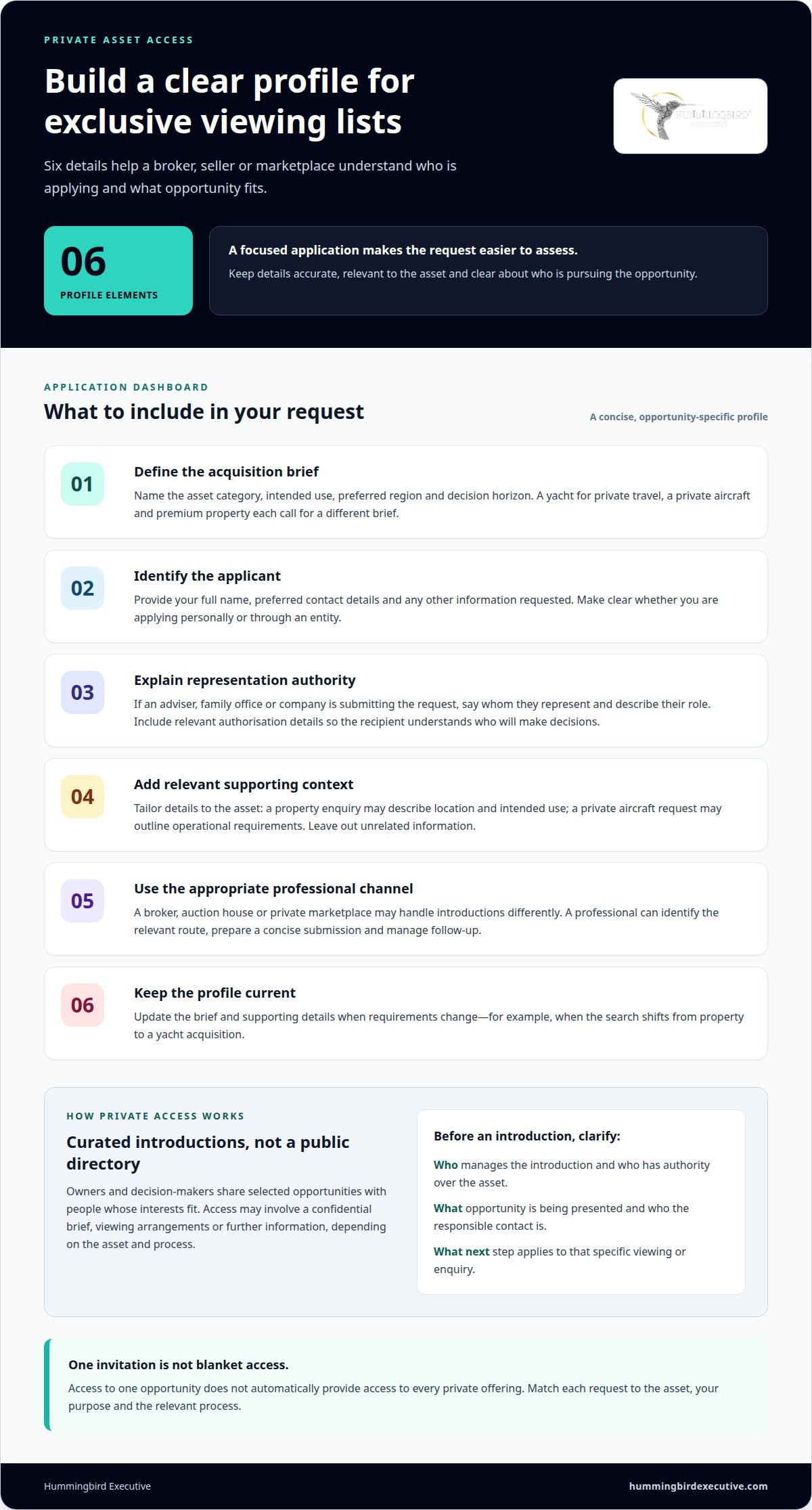
- Define your acquisition brief before requesting an introduction. Set out the asset category, intended use, preferred region and decision horizon. A buyer seeking a yacht for private travel, for example, has different priorities from an investor considering premium property. A precise brief helps identify relevant opportunities.
- Prepare a clear identifying profile with your full name, preferred contact details and any other information requested for the process. Consistent details make follow-up straightforward. Explain whether you are acting personally or through an entity, so the recipient understands who is pursuing the opportunity.
- If an adviser, family office or company submits the request, clarify whom they represent and their role in the proposed acquisition. An adviser acting for a principal can identify that relationship and provide relevant authorisation details, helping the recipient understand who will make decisions.
- Tailor supporting context to the asset category. A property enquiry may describe location and intended use; a private aircraft request may outline operational requirements. Include relevant details without crowding the application with unrelated information. A focused brief makes your purpose easier to understand.
- Present the request through the appropriate professional channel. A broker, auction house or private marketplace may each handle introductions differently. The professional identifies the relevant route, prepares a concise submission and manages follow-up in a consistent manner. This is how to get on exclusive asset viewing lists with an application shaped around the opportunity.
- Keep the profile current as requirements evolve. If the buyer changes from a property search to a yacht acquisition, the professional updates the brief and supporting details before making another introduction. For buyers seeking coordinated access to rare assets, professional asset access support can help structure the search and application.
How can a professional help buyers find reputable brokers, auction houses, and private marketplaces with exclusive listings?
- Define the asset and market before identifying intermediaries. A search for a sailing yacht differs from a search for a private jet or premium property. The professional maps the buyer’s brief to brokers, auction houses or marketplaces whose stated focus aligns with that category and the intended transaction.
- Review each intermediary’s role and authority. The professional establishes whether a broker represents a seller, an auction house is coordinating a sale, or a marketplace is presenting opportunities. This distinction clarifies who can provide asset details, arrange a viewing and explain the process for submitting interest.
- Look for relevant experience and a clear understanding of the asset category. For a property search, focus on experience with comparable opportunities; for a yacht enquiry, consider familiarity with yachts. Specific relevance is more useful than broad claims about luxury assets.
- Review how the opportunity is documented. Consider the available description, ownership or representation details, viewing arrangements and next steps. If you receive a catalogue or asset brief, check whether it clearly explains the opportunity and how to proceed.
- Clarify communication and commercial terms before proceeding. Establish who will communicate with you, what information may be shared and how any costs or obligations are set out. Written clarity helps ensure responsibilities are understood before an engagement begins.
- Coordinate introductions selectively. After reviewing the buyer’s brief and the intermediary’s relevance, the professional prepares a focused introduction, identifies the buyer’s representative and states the specific opportunity sought. A targeted approach gives a broker or private marketplace useful context without circulating unnecessary personal or acquisition details.
How do invitation-only asset viewings compare with public listings and auctions
- Compare access first. A public listing lets prospective buyers discover an advertised asset, such as a premium home shown on an open property portal. An invitation-only viewing is arranged through a controlled introduction, so information or access may be shared selectively. Neither format alone establishes whether an asset suits your requirements.
- Consider the information available at each stage. Public property listings may provide photographs, descriptions and advertised details. A private introduction may begin with a concise brief, followed by further material when interest is established. For a yacht, clarify what technical and ownership information accompanies the viewing before making a decision.
- Distinguish a viewing from an auction. An invitation may allow a prospective buyer to inspect a specific asset without requiring an immediate bid. An auction follows its stated bidding and sale process. Before attending a Christie’s auction, for example, understand how that sale communicates participation requirements and lot information.
- Assess how each route fits your acquisition strategy. Public listings can help buyers scan a visible market, while private introductions can focus attention on selected opportunities. Auctions suit buyers prepared to participate under defined sale terms. A buyer seeking a discreet property search may prefer curated introductions over broad public browsing.
- Keep due diligence separate from access. An invitation to view a private jet, a listing online or an auction catalogue does not replace examining the asset and transaction documents. Treat each channel as a route to information, then assess condition, ownership details and terms through appropriate professional advice.
- Choose the channel that matches your brief, then prepare for its process. A buyer can use public listings to define priorities, pursue introductions for selected off-market assets, or review auction terms before bidding. For tailored access to rare opportunities, explore private asset access.
Due diligence can also include sanctions screening, particularly when ownership or counterparties are unclear. The SDN_XML.ZIP file is compressed by about 92% compared with SDN.XML. Assets belonging to people and companies designated as Specially Designated Nationals are blocked, and U.S. persons are generally prohibited from dealing with them. Treat screening as separate from the viewing route, and seek suitable professional guidance.
Hummingbird Executive: platinum Membership full access to rare assets ,investments, buy surch or sale plus 25/7 dedicated concierge services world wide at no extra charge,
Hummingbird Executive provides private access to rare assets and investment opportunities for qualified members. Platinum Membership offers full access to search, buy or sell, with dedicated concierge services worldwide at no extra charge. It suits requirements spanning multiple asset categories or involving both acquisitions and sales.
For buyers seeking white-glove assistance, Gold Membership offers that service seven days a week during opening hours. The appropriate route depends on the level of access and support sought. Membership gives buyers a structured way to pursue opportunities beyond public listings, while concierge assistance supports the process.
To discuss your requirements, contact Hummingbird Executive.
Set Your Next Acquisition in Motion
Before requesting an introduction, define your objective. Decide which asset category matters, what makes an opportunity relevant and who should represent your interests. A focused brief gives Hummingbird Executive a clear basis for shaping the next conversation and directing your enquiry.
Knowing how to get on exclusive asset viewing lists means presenting a credible, coherent request through a private introduction. Define your intentions, preferred asset type and representative arrangements. To pursue a tailored search, contact Hummingbird Executive about membership and its Asset Sourcing service.
If you’re ready to discuss your requirements, contact Hummingbird Executive. A considered first conversation can help give your search direction.
Frequently Asked Questions
What documents and proof of funds are required to join a private viewing list?
Requirements depend on the asset and the process; no single document set applies to every private viewing. Prepare identity details, entity information if buying through a company, and written authority if an adviser represents you. Keep a concise acquisition brief ready. Share sensitive financial information only when requested for the specific opportunity and through the specified process.
What are the typical membership, brokerage, or access fees for exclusive viewing lists?
There’s no single fee structure for every viewing list. Distinguish a membership charge for access from a broker’s transaction commission or an auction-related charge stated in sale terms. These charges serve different purposes and depend on the relevant agreement and transaction structure. Review the written terms before authorising an engagement, and don’t assume that joining a viewing list itself carries a particular fee.
What scams and risks should buyers watch for when seeking exclusive asset listings?
Clarify the contact’s role and authority, the opportunity’s ownership or representation details, and the viewing arrangements. Understand communication, costs, obligations and next steps before proceeding; clear terms help keep responsibilities understood.