The headline price is only one part of a private asset sale. The assets and liabilities that transfer, along with purchase-price adjustments, help determine what the seller ultimately retains. To understand how to structure a private asset sale, define what is included, compare an asset sale with a share sale, and agree on the terms before closing.
Costs also deserve close attention. Broker, legal and accounting fees, real-estate costs, due-diligence expenses and taxes can reduce net proceeds. Working-capital adjustments or escrow arrangements may also affect when funds are received. The allocation of costs and the closing mechanics make a material difference.
This article explains how asset and share sales differ, when to put buyer confidentiality agreements in place, and how price adjustments can help protect proceeds. It also covers costs and transaction terms that affect the final amount retained, giving you a clearer basis for weighing the trade-offs.
Key Takeaways
- Distinguish a share sale, which transfers ownership of the company, from an asset sale, which transfers selected assets and liabilities. According to the Internal Revenue Service, a buyer acquiring 80% or more of a target corporation may use a Section 338(h)(10) election to treat the stock transaction as an acquisition of the target’s assets for tax purposes.
- Put confidentiality terms in place before sharing sensitive business or asset information with prospective buyers.
- Assess how fees, taxes, working-capital adjustments and escrow terms may affect the proceeds you retain and when you receive them.
- Define precisely which assets transfer and which liabilities the buyer assumes, since that scope shapes consents, documentation and the transaction’s practical value.
Choosing between an asset sale and a share sale
The key question is what changes hands: selected assets or ownership of the legal entity. In the United States, state entity law and governing documents determine approval requirements. Tax reporting and transfer filings depend on the transaction structure and the assets involved.
Asset Sale and Share Sale Features
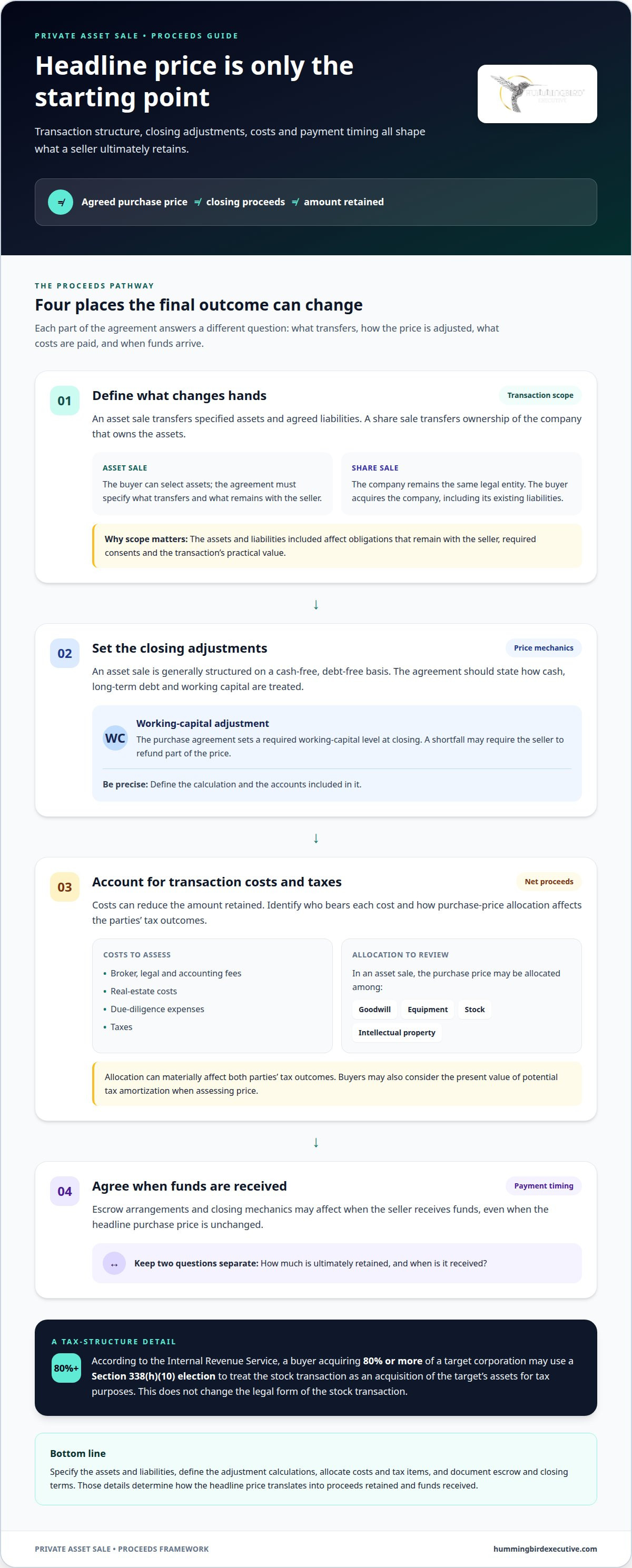
An asset sale transfers specified assets and agreed liabilities. A share sale transfers shares in the company that owns them. The distinction matters: in an asset sale, the buyer can select which assets to acquire; in a share sale, the seller transfers ownership of the entity. The structure determines which obligations remain with the seller and which stay within the acquired company.
A share sale can preserve continuity because the company remains the same legal entity. Most contracts continue, although change-of-control clauses may require consent or allow termination. The buyer also acquires the company’s existing liabilities, including risks associated with its employment history. In an asset sale, by contrast, the parties must specify what transfers and what remains.
A buyer acquiring 80% or more of a target corporation may use a Section 338(h)(10) election to treat the stock transaction as an acquisition of the target’s assets for tax purposes, according to the Internal Revenue Service. This can affect the tax analysis, but does not change the legal form of the stock transaction. Tax consequences also depend on the entity and transaction terms.
Board and Shareholder Approval
Approval requirements come from the governing state’s entity law and the company’s charter, bylaws or operating agreement. These documents determine how directors, shareholders or members authorize a transaction. No single approval threshold applies to every private asset or share sale. Distinguish an asset transfer from a merger, since the required approval process may differ.
In a US statutory merger, the buyer typically needs consent from a majority of the target company’s equity holders to obtain all its equity. A sale structured as an asset transfer follows a different path, with approvals shaped by the entity’s governing rules and the assets involved. A corporation must have at least one shareholder, and an LLC must have at least one member. An LLC can have one member. Ownership concentration therefore affects whose interests and votes are central to the decision, while the governing documents set the process. This distinction is central to how to structure a private asset sale.
Confidentiality agreements for potential buyers
Before sharing sensitive business information, require each potential buyer to sign a confidentiality agreement. Buyer due diligence can then examine asset ownership and condition, financial and tax records, contracts, security interests, and liabilities proposed for assumption. Tailor the scope of review to the assets under consideration.
In a US M&A auction, each bidder should sign a confidentiality or non-disclosure agreement before receiving proprietary information. The agreement can specify the permitted purpose, restrict disclosure to authorized representatives, and limit use of the material to evaluating the transaction. It can also require the return or destruction of records if discussions end. Clear terms help protect sensitive information throughout the sale process.
Buyer preferences often shape the structure. An asset sale lets buyers select assets and may limit their exposure to some historical tax, employment, litigation or regulatory risks. A share purchase transfers ownership of the company, including its existing liabilities. Due diligence should connect each asset to its records and identify liabilities that could remain within the acquired entity.
Tax review is also essential. In a US asset acquisition, the buyer may receive an increased tax basis in acquired assets reflecting the purchase price, while the target’s favorable tax attributes will often be lost. In an equity acquisition, the company generally retains its tax attributes if operations continue, though the use of some attributes may be limited. Review the relevant tax records and transaction allocation as part of buyer diligence.
In an asset sale, allocating the purchase price among goodwill, equipment, stock and intellectual property can materially affect both parties’ tax outcomes. Buyers may also consider the present value of potential tax amortization when assessing price. Use this analysis to inform negotiations over purchase-price adjustments, rather than treating it as a separate accounting detail.
During diligence, the parties can resolve questions about asset condition, records, contract consents, and assumed liabilities before closing. A confidential process supports that scrutiny without circulating proprietary material beyond the evaluation team. For buyers considering discreet access to rare-asset opportunities, private rare-asset opportunities provide a natural next point of exploration.
Purchase price adjustments to protect seller proceeds
The stated purchase price is not necessarily the seller’s closing proceeds. An asset sale is generally cash-free and debt-free, leaving the seller with cash and long-term debt obligations. A working-capital adjustment can also change the amount paid: the agreement sets a required level at closing, and a shortfall may require the seller to refund part of the price. Define the calculation and included accounts precisely.
Seller priorities matter. An asset sale can suit an owner who wants to transfer selected assets, retain particular property, keep the target for another venture or sell one division. It may also leave the seller responsible for residual assets, liabilities, tax issues and wind-down tasks. A share sale may reduce those residual obligations by transferring ownership of the company, but the tax outcome differs. The seller can negotiate an asset-sale price adjustment to offset the tax difference from a stock sale and protect net proceeds.
Tax analysis should account for the entity and the allocation. In an asset sale, allocating the purchase price among goodwill, equipment, stock and intellectual property can materially affect both parties’ tax outcomes. A C corporation may be taxed on the asset sale and taxed again when proceeds leave the corporation. Depreciation recapture and other factors may also increase the seller’s tax exposure. Model expected net proceeds, not just the headline price.
Payment terms also affect certainty. With seller financing, the seller receives payments over time as the buyer’s lender, taking on greater risk than with cash paid at closing. An earn-out ties part of the price to future business performance; define its measures and calculation clearly to reduce disputes. These terms allocate risk differently and should inform the negotiated purchase price.
Escrow affects timing, too. Buyers often place 5 to 10 percent of the purchase price in escrow for an agreed period. If the buyer has no legitimate claims, release often occurs 12 to 18 months after closing. Negotiating the claim process, release conditions, and working-capital formula together helps the seller assess proceeds, retained liabilities, and deferred payments as one outcome.
Asset sale structure
An asset sale transfers specified assets, not the seller’s legal entity. The purchase agreement should identify the property being transferred, the obligations the buyer assumes, and the assets and liabilities the seller retains.
Purchase Price Allocation
Purchase-price allocation assigns consideration among assets such as goodwill, equipment, stock and intellectual property. It matters because it can materially affect each party’s tax outcome. State the allocation clearly in the purchase agreement and link each amount to the relevant asset category. For example, allocating value to goodwill rather than equipment changes how the consideration is divided between asset classes. Buyers may also account for potential tax amortization when valuing acquired assets. Aligning the allocation with the agreed asset schedule gives both parties a clear basis for documenting the transaction.
Representations and Warranties
Representations and warranties are contractual statements about the transaction and the assets being sold. Indemnities assign responsibility for specified losses if agreed statements prove inaccurate or obligations are breached. The purchase agreement should define their scope, duration, liability caps and claim procedures. Broad or long-lasting obligations can expose a seller to significant post-sale risk, so negotiate each term in light of the assets and liabilities involved. The agreed language determines what the seller promises and what recourse the buyer receives.
Transferred Permits, Contracts, and Liabilities
The purchase agreement should list every transferred asset, assumed liability and retained obligation. Permits, licenses, leases, and customer or supplier contracts do not necessarily transfer automatically. An asset sale may require third-party consent or a formal contract change, and anti-assignment clauses can affect valuable agreements. Identify required consents and arrange any assignment or novation with the relevant party before completion. The buyer assumes only the liabilities specified in the agreement; the seller retains those not transferred. An asset-by-asset schedule clarifies what the buyer receives and what remains with the seller at closing.
For discreet access to rare assets and investment opportunities, explore private asset opportunities.
Hummingbird Executive: platinum Membership full access to rare assets ,investments, buy surch or sale plus 25/7 dedicated concierge services world wide at no extra charge,
Hummingbird Executive offers a discreet next step for those seeking to buy or sell rare assets and investments. Platinum Membership provides full access to search, buy, or sell these opportunities, with dedicated worldwide concierge services at no extra charge. It is suited to readers seeking access to private opportunities while keeping discretion central.
Hummingbird Executive provides a secure hub for off-market assets, including yachts, private jets, premium properties and luxury cars, sourced through direct relationships with owners and decision-makers. The platform does not use cookies, and personal information is never sold. Its private access can support a considered search or sale, while legal, tax and contractual terms remain matters for the parties and their advisers.
If private access to rare assets or investments is relevant to your next decision, contact Hummingbird Executive to discuss membership.
Set Your Next Move in Motion
A considered approach to how to structure a private asset sale starts with the outcome you want after completion, not just the terms you accept beforehand. Decide what the transaction should make possible next, whether that means greater flexibility, a new investment direction or a deliberate change in responsibilities. A clear destination helps keep negotiations aligned with your priorities as details evolve.
Before moving forward, identify which decisions are yours to make and which call for coordinated advice. Your legal, tax and financial advisers can translate your priorities into transaction documents and mechanics. Keep your intended next step in view as discussions progress; it offers a useful way to assess trade-offs without losing sight of the broader plan.
When you are ready to discuss a private asset decision, begin a discreet conversation with Hummingbird Executive. Take the next step with purpose and composure.
Frequently Asked Questions
What costs and fees are involved in the sale process?
Seller costs can include business broker fees, legal and accounting fees, real-estate costs, due-diligence expenses and taxes on sale proceeds. Their impact depends on the transaction’s scope and the work required to prepare, document and complete it. For planning, separate expenses payable during the process from amounts deducted or payable at closing, then compare both with expected net proceeds.
What happens to cash when selling a business?
In a cash-free, debt-free asset sale, the seller generally retains cash and remains responsible for long-term debt, while the buyer pays for agreed assets and assumes specified liabilities. The purchase agreement should distinguish cash from working capital, since working-capital calculations can affect closing proceeds. For example, specify how receivables, inventory and payables factor into the closing calculation.
What is the step-by-step process for structuring a private asset sale?
Start by defining the commercial outcome and identifying the assets the seller will transfer or retain. Set confidentiality terms before sharing sensitive records, then conduct due diligence and resolve questions about ownership, condition, liabilities and third-party consents. Next, negotiate the allocation, payment mechanics and purchase agreement. Before closing, document required transfers and finalize the agreed closing calculations.
How do asset sales differ from stock sales for buyers and sellers?
An asset sale can let a buyer acquire a selected division or defined assets, while leaving the seller with excluded property and obligations to manage. A stock sale transfers ownership of the company, which can preserve continuity but also carries the company’s historical liabilities. For the seller, the practical question is whether to dispose of selected operations or transfer the entity itself.
What tax consequences apply to a private asset sale for the buyer and seller?
Tax results depend on the transaction structure, entity and allocation of consideration. In a US asset acquisition, the buyer may receive a tax basis in acquired assets based on the purchase price, while the target’s favorable tax attributes are often lost. A C corporation seller may face tax at the corporate level and again when proceeds leave the corporation. Asset allocation can therefore affect both parties’ calculations.
How should payment terms, escrow, earnouts, and seller financing be structured?
Specify the closing payment, any working-capital adjustment, and the conditions for releasing escrow. Buyers often place 5 to 10 percent of the purchase price in escrow; release often occurs 12 to 18 months after closing if no legitimate claims arise. Define earn-out measures and calculation periods precisely. For seller financing, set repayment terms and address the seller’s exposure to delayed or missed payments.