


An off-market estate in Tuscany can be pursued without an advisor, but access may be less direct: private opportunities often circulate through trusted networks rather than public listings. In Italy, “off-market” has no legal definition, and the purchase process does not change simply because a property was never advertised.
That distinction matters. A discreet sale may offer early access, with details such as photographs or floor plans withheld, but privacy does not replace careful review of the property and its terms. An introduction can also have legal significance, so the route into a transaction deserves as much attention as the estate itself.
This guide explains what an independent buyer can do, which types of properties may be offered off-market in Tuscany, and how networks and due diligence shape access. It also considers the region’s varied luxury property landscape, from countryside estates to historic homes, to help you assess whether a private search suits your priorities.
Key Takeaways
- You can pursue a private property search independently, but understand the role an introduction plays in the transaction and how mediation may affect it.
- Off-market opportunities can range from vineyard estates and restored farmhouses to apartments and historic properties; define the property type that best fits your plans.
- Keep due diligence central: title and building checks take place before the preliminary contract, whether or not the property was publicly advertised.
- Focus your search by area and priorities, then use a trusted network to access opportunities whose details may be shared privately.
Can off-market property be accessed without an advisor?
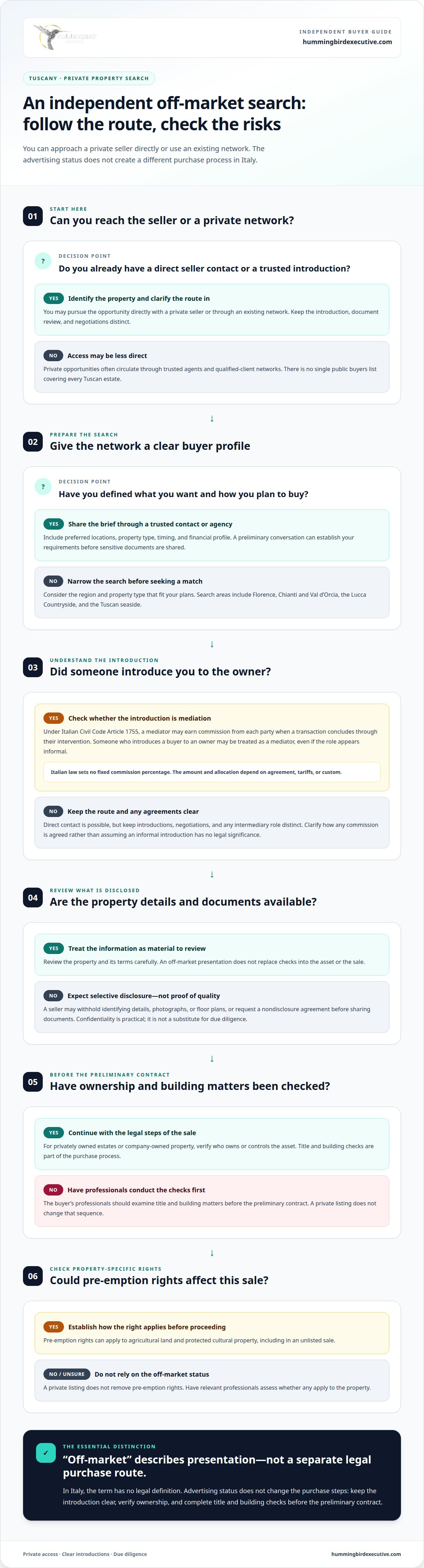
Yes. A foreign buyer can pursue an off-market estate in Tuscany directly with a private seller or through an existing network. The process is to identify the property, have professionals conduct title and building checks before the preliminary contract, then complete the legal steps of the sale. Advertising status does not change those steps.
“Off-market” has no legal definition in Italian property sales. It describes how a property is presented, not a separate transaction category. For an off-market estate in Tuscany, a seller may prefer a private listing to limit exposure, manage viewings selectively, or keep photographs and floor plans from circulating. Buyers may hear about an opportunity before public promotion, while the seller retains control over disclosure.
Confidentiality is practical, not a substitute for due diligence. A seller may withhold identifying details or request a nondisclosure agreement before sharing documents. Italian notaries are not an introduction channel for private properties; their professional confidentiality obligations govern information learned through their work. Keep introductions, document review, and negotiations distinct.
The route also affects the parties’ legal relationship. Under Italian Civil Code Article 1755, a mediator may earn commission from each party when a transaction concludes through their intervention. Italian law sets no fixed commission percentage; the amount and allocation depend on agreement, tariffs, or custom. Someone who introduces a buyer to an owner may be treated as a mediator, even if the role appears informal.
For privately owned estates or company-owned property, verify who owns or controls the asset and have relevant professionals examine title and building matters before signing the preliminary contract. Pre-emption rights can apply to agricultural land and protected cultural property, including in an unlisted sale. A private listing does not remove them.
Examples of properties in the off-market portfolio
Tuscany’s private-property spectrum includes working estates, restored country homes, apartments, and historic hamlets. These examples show how land, setting, and existing amenities distinguish one investment from another.
Smaller properties are part of the same regional landscape. Near San Gimignano, a two-bedroom apartment has a garden and shared pool. Buyers can compare privacy, upkeep, and intended use rather than relying on property size alone.
For sellers, a discreet sale can mean controlling how a listing is circulated and when photographs, floor plans, or identifying details are disclosed. Buyers may encounter unlisted opportunities through trusted agent networks and qualified introductions. When assessing an estate, consider how amenities such as a vineyard, annex, or pool support its intended use and plans for local excursions. The Pienza example combines several of these features in one property.
Purchase taxes depend on ownership structure and buyer eligibility. For a non-resident buying privately owned property, an example is 9% of cadastral value; a qualifying primary-residence purchase example is 2%. For a non-resident buying from a company, an example is 10% VAT on the full market price; a qualifying primary-residence purchase example is 4% VAT. These examples differ by seller type and buyer status, so establish which applies before comparing properties.
Access through trusted networks and due diligence
Private opportunities in Tuscany circulate through trusted agents and qualified-client networks. Access often begins with a buyer profile rather than a public listing.
Benefits of Off-Market Access
Buyers may hear about investment opportunities before public marketing begins, while sellers retain control over exposure. Access can be selective: photographs, floor plans, and sensitive documents may remain private until the buyer’s requirements have been assessed.
Search areas include Florence, Chianti and Val d’Orcia, the Lucca Countryside, and the Tuscan seaside. Maremma offers a distinct coastal setting: an estate in Massa Marittima is 15 kilometers from Scarlino’s port and Punta Ala’s shores. Location, land, and intended use help buyers judge whether an introduction merits further attention.
Agents, Brokers, and Private Sale Networks
Private sales are handled through trusted agents, specialized agencies, and networks connecting qualified clients with property owners. There is no single public buyers list covering every Tuscan estate; each network controls its own introductions and disclosures.
To seek access, prepare a clear brief covering preferred locations, property type, timing, and financial profile. A preliminary conversation can establish those requirements before sensitive documents are shared. This gives the network a basis for matching opportunities and deciding what information to release. Request an introduction through a trusted contact or an agency active in private property transactions.
Due Diligence and Deal Risks
The central risks are incomplete property information, unclear ownership, building issues, and rights that affect a sale. Before the preliminary contract, the buyer’s professionals conduct title and building checks. Private circulation does not replace that review or change the legal steps required for a purchase.
Pre-emption rights can apply to agricultural land and protected cultural property, including in an unlisted sale. Buyers should also understand whether an intermediary’s introduction constitutes mediation and how any commission was agreed. Treat confidentiality arrangements as limits on disclosure, not as evidence of title, condition, or legal compliance. A carefully documented process matters as much as access.
Tuscan luxury real estate market
Tuscany’s luxury real estate spans historic wineries, coastal estates, and countryside properties. Compare location, usable space, condition, and permitted use before treating asking prices as comparable.
Renovation, Heritage, and Use Restrictions
For a historic estate, assess its building status, heritage protections, and existing permissions before planning renovations. These factors shape which works and uses are feasible. For agricultural land, clarify its current use and any rights that may affect a sale; Italian law recognizes pre-emption rights for tenants and neighbouring farmers over agricultural land.
Protected cultural property carries a separate consideration: Italy’s State has a pre-emption right under Article 60 of Legislative Decree 42/2004. Ask your professionals to review title, building records, planning documents, and any heritage status before committing to a design or investment plan. A private sale does not remove these considerations.
Estate Prices by Area, Size, and Condition
There is no single useful price for a Tuscan estate: location, land, built area, restoration, and operating features all influence value.
The Maremma estate also has a total built surface of 2,633 square meters, over 1,360 square meters of restored living space, and more than 1,600 olive trees. Those details make clear why buyers should compare the whole asset, not only its asking price or bedroom count.
Tuscany accounts for 32.2% of Italy’s properties valued over €1 million, while international buyers comprise 18% of Italy’s luxury property market. Treat those figures as market context, not a valuation for an individual estate. For a curated search, define your preferred area, property condition, land requirements, and intended use first.
Hummingbird Executive: platinum Membership full access to rare assets ,investments, buy surch or sale plus 25/7 dedicated concierge services world wide at no extra charge,
Hummingbird Executive offers a natural next step for buyers seeking discreet access to rare property and investment opportunities. Platinum Membership provides full access to rare assets and investments for buying or selling, alongside 25/7 dedicated concierge services worldwide at no extra charge. For a search shaped by privacy and selectivity, this offers a single point of access across rare assets without treating a private introduction as a substitute for independent legal and building due diligence.
Gold Membership offers white-glove services seven days a week during opening hours. Free access to white-glove service worldwide is also available during opening hours. The appropriate option depends on the level of access and support that fits your search.
For a discreet conversation about access to rare assets, contact Hummingbird Executive.
Define your next move
The next decision is not simply which property to pursue, but what role you expect it to play. Clarify whether your priority is a private residence, a long-term investment, or an estate whose land and buildings serve a broader purpose. This brief gives each opportunity a clear measure.
Keep the search selective. Define your preferred setting, acceptable condition, and intended use before considering individual properties. Treat discretion as one element of the process, alongside informed assessment and a clear record of decisions. This helps distinguish an estate that fits your aims from one that only appears rare.
An off-market estate in Tuscany may suit a considered approach, particularly when your priorities are precise and your next steps deliberate. If you’re ready to explore a private search, contact Hummingbird Executive and share the asset profile you have in mind. A measured beginning can open the way to a more focused conversation.
Frequently Asked Questions
Does an off-market sale still go through a notary?
Yes, an off-market sale still follows the ordinary Italian property-transfer process, including the formal deed stage. The notary is not a source of private-property introductions; that is separate from the notary’s role in completing the transfer. Keep the notarial process distinct from the search, and ensure transaction documents reflect any intermediary’s involvement and declared fee.
How can a buyer reach a property that is not listed?
Access an opportunity through a private introduction, a trusted agent, or a network that works with qualified buyers. Make your brief specific: identify the areas, property type, intended use, and timing you can accommodate. For example, a buyer seeking a restored vineyard estate near Chianti can state those priorities before requesting confidential material, allowing a seller or network to assess the fit.
How can an “off-market” claim be checked?
Ask what the seller means by “off-market,” since the term has no legal definition in Italian property sales. Establish whether the property has been publicly advertised, and request a clear account of how the opportunity reached you. Independently review ownership, title, and building documentation; a private presentation alone does not establish the property’s legal or physical condition.
Is an off-market sale cheaper or more expensive?
Neither outcome follows simply because the sale is private. The asking figure reflects the property and the seller’s position, not an automatic off-market discount or premium. Compare relevant features such as location, land, usable space, condition, and included buildings. A restored country home and an agricultural estate serve different purposes, so their asking figures should not be treated as direct comparisons.
Is an off-market sale free of commission?
No. A fee may be due when a mediator’s intervention leads to the deal; privacy does not remove that possibility. Before proceeding, establish who made the introduction, what role they performed, and how any commission was agreed. The deed records whether a mediator was involved and how the fee was paid under Article 35, paragraph 22.
Is off-market property cheaper than listed property?
Not inherently. A private sale describes how an opportunity is circulated, not a reliable measure of its value. Compare the estate with properties of similar location, condition, land, and permitted use, then assess what is included in the sale. A limited viewing process or confidential presentation does not, by itself, mean the seller will accept less.


