A public market isn’t the only route to an investment, but private opportunities call for careful scrutiny. Unlisted assets are investments or other high-value holdings not traded on a public exchange. How to get access to unlisted assets depends on the asset, transaction structure and investor eligibility. Routes can include a fund, a private offering or a direct transaction.
Privacy and rarity may be part of an asset’s appeal, but limited liquidity and disclosure can make it harder to assess and exit than a publicly traded investment. Capital can be lost, too. Access alone does not determine whether an opportunity is suitable.
This article explains what unlisted assets include, how access works in the United States and internationally, and what to examine before committing capital. It covers practical trade-offs, including how assets may be valued, why a sale can take time and what limited information means for your assessment. The goal is to clarify both the opportunity and the conditions attached to it.
Key Takeaways
- Assess how unlisted holdings fit alongside liquid investments, including the time you may need to hold them.
- Distinguish private company shares, funds and other assets by how they are valued, accessed and eventually sold.
- Understand the investor eligibility and verification requirements that can apply to private offerings in the United States.
- Examine the offering documents, valuation approach and manager’s track record to identify material risks and information gaps.
What are unlisted assets?
Unlisted assets sit outside public exchanges, so investors cannot rely on a continuous listed price. Examples include private-company shares, property, infrastructure and private equity funds. Because an unlisted holding may not be priced or sold each trading day, its place in a portfolio depends in part on the investor’s time horizon and need for liquidity.
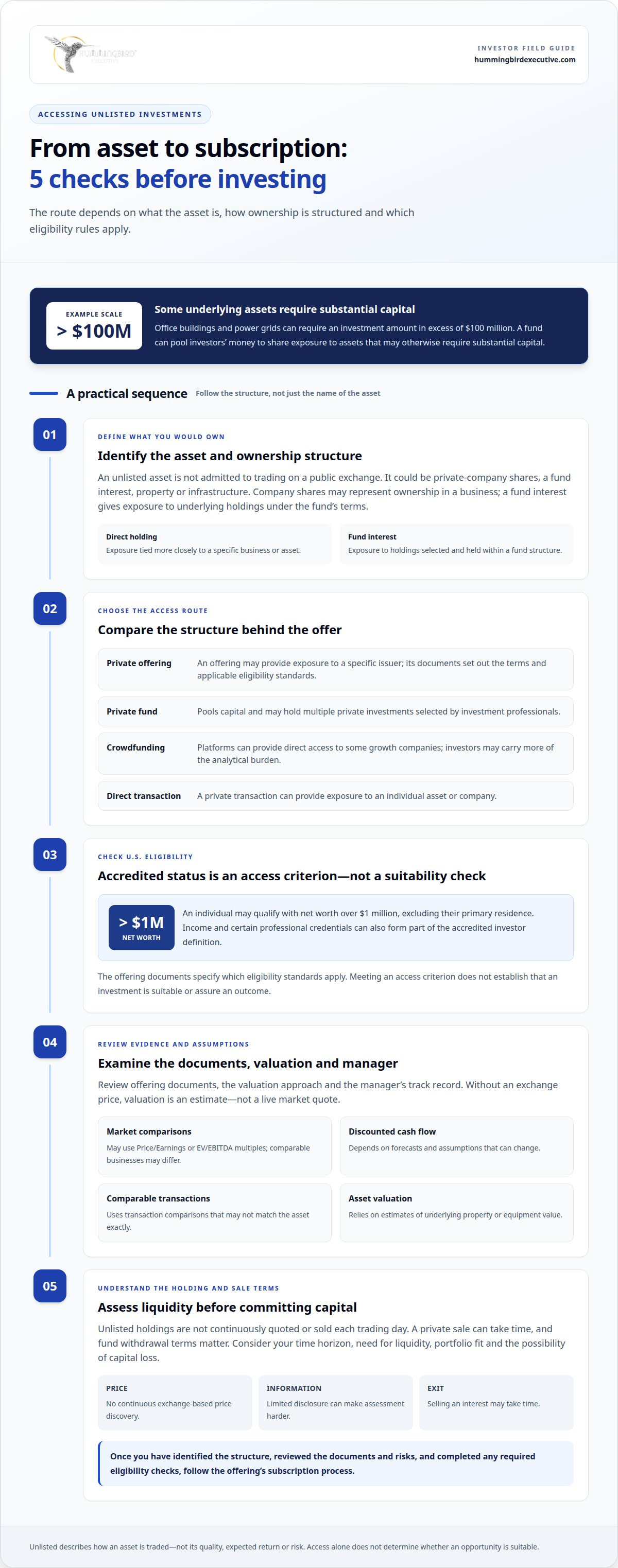
Access to substantial assets can involve pooling investors’ money through a fund. This structure allows participants to share exposure to holdings that may otherwise require substantial capital. Office buildings and power grids, for example, can require an investment amount in excess of $100 million. A fund can also hold interests across several unlisted companies selected by investment professionals, rather than a single asset.
Superannuation portfolios may include unlisted assets to diversify exposure beyond listed markets and pursue returns over a longer investment horizon. This approach also brings distinct considerations: underlying assets may require operational management, valuations may rely on appraisals or models, and selling an interest can take time. Unlisted shares are not continuously quoted, but that does not remove the risk of capital loss.
Infrastructure illustrates the trade-off. A power grid is a physical, operational asset, not a share traded continuously on an exchange. Its valuation and performance depend on the asset and its management, while investors may gain access through a fund. Before treating that exposure as liquid, understand the fund’s holdings, valuation approach and withdrawal terms.
For U.S. retirement savers, a policy development widened discussion of alternatives: on August 7, 2025, President Trump issued an executive order seeking to make it easier for defined contribution plans, including 401(k) plans, to include alternative asset classes. The order did not itself make every unlisted investment available through every plan; access depends on the plan’s investment options.
To invest in an offering, identify the asset and structure, review the documents and risks, complete any eligibility checks, and follow the subscription process. In the United States, crowdfunding platforms can provide direct access to some growth companies. Depending on the offering, private investments may also be arranged through financial intermediaries or direct transactions.
Definition of unlisted assets
An unlisted asset is an investment not admitted to trading on a public exchange. The term describes how an asset is traded, not its quality, expected return or risk. Shares in a privately held company, for example, are unlisted, while shares admitted to a public exchange are listed. An unlisted investment may change hands through private transactions, but it lacks exchange-based price discovery and the continuous quotation associated with listed shares. Before considering how to get access to unlisted assets, identify the ownership structure.
Unlisted assets take different forms. An investor might hold shares in a private company, an interest in a fund or a stake in property, and each carries different rights. Company shares may represent ownership in the business; a fund interest provides exposure to underlying holdings according to the fund’s terms. Understanding how to get access to unlisted assets also means knowing what you own and which rights attach to it.
Valuation is another key distinction. Without a public exchange price, an unlisted company may be assessed using market comparisons, discounted cash flow, comparable transactions or asset valuation. A market comparison may use Price/Earnings or EV/EBITDA multiples. Each method relies on assumptions: comparable businesses may differ, forecasts can change, and asset-based calculations depend on the value of underlying property or equipment. The result is an estimate, not a live market quote.
These valuation methods relate directly to investment objectives. A company seeking growth capital, for instance, may remain privately held while investors assess its prospects through financial statements, business plans and valuation assumptions. A fund can pool exposure to several such companies, while a direct investment ties the investor more closely to one business. In either case, distinguish estimated value from the price that might be achieved in a future private sale. This matters when comparing an unlisted holding with listed securities, planning for liquidity and assessing whether the structure suits your intended holding period.
How can accredited investors access unlisted assets in the United States?
In the United States, accredited investors may encounter unlisted assets through private offerings, funds, crowdfunding platforms or direct transactions. The route depends on the asset and offering structure. A private equity fund, for example, pools capital and invests in privately held companies, while a direct offering gives investors exposure to a specific issuer.
Accredited status is one access criterion, not a recommendation or assurance of suitability. According to the U.S. Securities and Exchange Commission, an individual may qualify with net worth over $1 million, excluding their primary residence. Income and certain professional credentials can also form part of the accredited investor definition. An offering’s documents specify which eligibility standards apply.
Crowdfunding platforms can provide direct access to some growth companies, but may involve less professional intermediation and place more of the analytical burden on investors. A private fund offers another route, typically selecting and holding multiple private investments within one structure. Compare the underlying assets, liquidity terms, valuation process and investment objectives to assess which format fits.
Rule 506(c) allows an issuer to generally solicit an offering, subject to its conditions. Under Rule 506(c), the company must take reasonable steps to verify that investors in the offering are accredited investors, according to the U.S. Securities and Exchange Commission. This verification is distinct from simply accepting an investor’s self-certification. The issuer’s process may require supporting documentation or another reasonable verification method.
Before subscribing, read the offering memorandum, subscription agreement and risk disclosures. Identify the issuer, ownership rights, fees, transfer restrictions and any planned exit mechanism. Complete the stated eligibility and subscription process, including required verification and funding steps. Keep copies of executed documents and understand how ongoing reporting will be provided. For a private-company investment, consider whether its business model, financial position and planned use of capital align with your objectives. Access depends on the offering’s terms and investor eligibility; an available route does not make every investment appropriate.
Investors may access some growth companies through crowdfunding platforms, as well as through private offerings, private funds or direct transactions.
How can investors verify an unlisted asset offering and its manager?
Start with the offering documents, then compare their claims with independent records and supporting evidence. Unlisted companies do not face the same disclosure requirements as listed companies, so rigorous analysis matters. Treat missing details as a reason to investigate the claim, not as proof of misconduct.
Examine the investment memorandum, subscription agreement, financial statements and risk disclosures. Confirm the issuer’s legal identity, ownership structure, use of proceeds and investor rights. For a property offering, establish which entity owns the asset and how investors participate. Check that the stated risks reflect the proposed strategy, including debt, concentration and transfer restrictions.
Assess a manager’s experience through verifiable transactions, not reputation alone. Review prior investments, realized exits and how underperforming assets were handled. Compare stated results with supporting records, distinguishing realized proceeds from projected or unrealized valuations. The manager should be able to explain how its investment process relates to the specific asset and its operating plan.
Scrutinize the valuation method and its assumptions. Examine the evidence supporting projected income, expenses and resale demand. For an unlisted company, market comparisons may use Price/Earnings or EV/EBITDA multiples, while discounted cash flow depends on forecasts. Consider whether changing key assumptions would materially alter the stated value. This helps show how much the valuation relies on estimates rather than observable market prices.
Review the practical mechanics before committing capital: subscription conditions, reporting arrangements, distribution priorities, transfer restrictions and possible exit routes. Confirm that the documents explain who makes decisions, how conflicts are addressed and what information investors receive after closing. Keep a record of the materials reviewed and reconcile inconsistencies before signing. A polished presentation is no substitute for evidence about ownership, operations or execution.
For a discreet route to rare-asset opportunities, review private asset opportunities and consider whether the asset, structure and manager align with your objectives.
Hummingbird Executive: platinum Membership full access to rare assets ,investments, buy surch or sale plus 25/7 dedicated concierge services world wide at no extra charge,
Hummingbird Executive offers a route to explore rare assets and investments for purchase or sale through platinum Membership. Members receive full access and 25/7 dedicated concierge services worldwide at no extra charge. This may suit investors seeking a discreet point of access while considering private opportunities, without treating access itself as a substitute for reviewing each asset’s structure, valuation and risks.
Hummingbird Executive’s Gold Membership provides white-glove services seven days a week during opening hours. Free access to white-glove service worldwide is also available during opening hours. The right option depends on the level of access and assistance sought. Any unlisted asset still warrants careful consideration of liquidity, disclosure and potential capital loss before you commit.
For a discreet conversation about exploring rare assets and investments, contact Hummingbird Executive.
Make your next move deliberate
When deciding how to get access to unlisted assets, start with the role you want each holding to play, not the appeal of a particular opportunity. Consider how much capital can remain committed, how you would respond to a delayed exit and what information you need to decide with discipline. These priorities help you assess an opportunity against your wider financial objectives.
Before proceeding, define the questions that matter most. Clarify what ownership means, what could change the asset’s value and how you would monitor its performance over time. A measured decision may mean declining an unsuitable structure rather than pursuing an appealing opportunity.
If you are considering rare assets or investments and would value a discreet route to explore them, contact Hummingbird Executive. Approach the next opportunity with clarity and confidence.
Frequently Asked Questions
What are unlisted assets, and what types are available to investors?
Unlisted assets include private-company interests, real estate, infrastructure and certain luxury holdings. Investors may gain exposure directly, such as through shares in a private business, or indirectly through a fund holding several investments. Rare tangible assets can include yachts, private jets, premium properties and luxury cars. The structure determines whether an investor owns an asset, holds shares in an entity or participates through a fund.
What risks, fees, and tax considerations come with unlisted assets?
Key risks include loss of capital, difficulty selling an interest, limited reporting and valuations based on estimates rather than frequent market transactions. Fees may arise at the fund or transaction level, so review offering documents for management charges, performance-related fees and other expenses. Tax treatment can vary by asset, investment structure, income and jurisdiction. Keep records of transactions and distributions, and assess tax consequences using the relevant documents before investing.