Access is granted, not assumed. The criteria for joining an exclusive buyers club typically include an application and approval process, eligibility or fit, membership fees, and available capacity. Some clubs also require a sponsor or recommendations from current members, while ongoing dues and spending minimums shape the longer-term commitment.
That selectivity is part of the appeal, but it can make the practical requirements difficult to assess before applying. This guide explains how to evaluate your fit, budget for entry costs and recurring obligations, and understand how portfolio scale and availability may influence access. It also clarifies what to consider when a club’s membership opens a route to rare assets and private opportunities, so you can weigh the commitment with care.
Key Takeaways
- Assess the club’s application, approval standards, membership limits, and any sponsorship expectations before weighing access.
- Budget separately for the initial joining cost, recurring dues, and any minimum spending or activity-based charges.
- Compare initiation terms with the membership rights they provide, including whether an equity stake or transfer rights apply.
- Consider how your asset interests and portfolio scale align with the opportunities available through a members-only network.
What Are the Requirements of a Private Member’s Club?
Private-club entry can involve an application, sponsor, fees, a waitlist, and membership limits. Requirements depend on the club’s purpose and rules.
Applications and Sponsorship
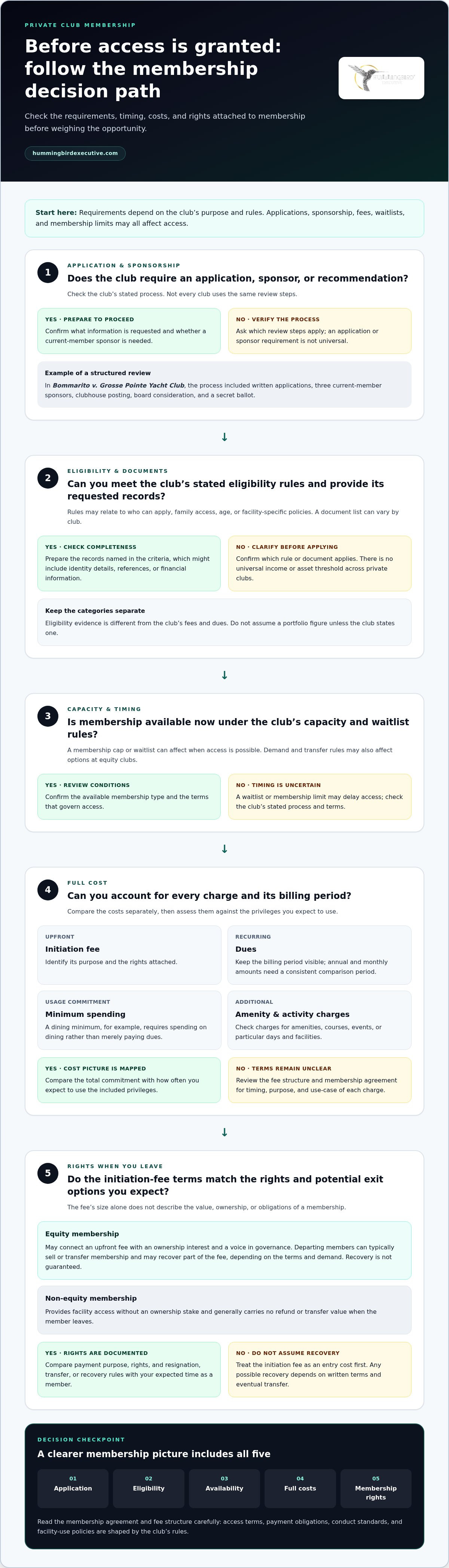
An application and sponsorship process lets a private club assess prospective members before granting access. A waitlist or membership cap can affect timing, while a sponsor requirement may shape eligibility. In Bommarito v. Grosse Pointe Yacht Club, the process included written applications, three current-member sponsors, clubhouse posting, board consideration, and a secret ballot. The example shows how a structured review can govern membership.
Eligibility and Approval Standards
Eligibility rules define who may apply, while approval standards guide the club’s decision. These terms matter to individuals and families because age limits or amenity-specific policies can affect access; a 10-year-old beginner, for example, may face restrictions on using a golf course. In the United States, Title VII of the Civil Rights Act of 1964, as amended, bars discrimination based on race, color, religion, sex, and national origin. Title I of the ADA is among federal laws providing an exemption for qualifying private membership clubs.
Required Documents and Financial Proof
Required documents are the records a club uses to review an application; there is no single list for every membership. This matters when preparing a complete submission: an application might request identity details, references, or financial information, depending on its stated criteria. No universal income or asset threshold applies across private clubs. Rather than assume a portfolio figure, distinguish eligibility evidence from a club’s separate fees and dues.
Club Models, Local Rules, and Consumer Risks
An exclusive buyers club typically grants members access to curated purchasing opportunities, unlike a buying club organized around group purchasing or a loyalty program that rewards transactions. This distinction matters because membership terms, access, and charges can differ. Local rules also vary: a resort or social club may set its own eligibility and facility policies. Risks include unclear access terms, dues, and additional charges for services or events; review the membership agreement and fee structure before joining.
Separate budgeting for initiation fees, dues, and minimum spending
Build a club budget in separate lines: initiation fee, recurring dues, minimum spending, and charges for amenities or courses. This prevents an attractive membership from obscuring its full annual commitment. Compare each charge by timing and purpose, then consider how often you expect to use the privileges included.
Initiation fees vary by club and membership structure. These figures describe different club contexts, not interchangeable estimates. Equity membership can also connect an upfront fee with governance rights, while non-equity access does not provide an ownership stake.
Recurring dues need a separate calculation. Keep the billing period visible in your comparison: an annual amount and a monthly amount aren’t directly comparable until both are assessed over the same period. Include any separate dining minimums or activity charges.
Plan-day pricing should also be evaluated apart from fixed dues. Identify whether a charge applies to a specific day, event, or facility, and whether it sits alongside minimum spending. For example, a member who visits courses regularly may face a different total from one using mainly social amenities. The relevant figure is your expected cost based on the privileges you’ll actually use.
Members must follow the club’s governing rules, including payment obligations, conduct standards, and facility-use policies. Purchase commitments depend on the membership terms; a dining minimum, for instance, requires spending on dining rather than merely paying dues. Before joining, map each obligation to its billing period and use case. That gives you a clearer view of recurring commitments, including charges beyond the initiation fee.
Initiation fees
An initiation fee is an upfront payment for admission to a club, and its terms matter as much as its size. At an equity club, that payment may accompany an ownership interest and a voice in governance, so compare it with the rights attached. A high entry cost alone does not describe the value or obligations.
Ask what happens to the initiation fee if you leave. At equity clubs, departing members can typically sell or transfer membership and may recover part of the fee. That possibility depends on membership terms and demand, so it should not be treated as guaranteed resale value. A friend’s experience may offer context, but your own agreement governs your rights.
Non-equity membership works differently: it provides facility access without an ownership stake, and generally carries no refund or transfer value when the member leaves. Someone joining for access to dining or courses should distinguish those privileges from capital ownership. The fee purchases a defined membership relationship, not necessarily an asset that can be sold later.
Before committing, compare the written terms in a consistent sequence. Identify the payment’s purpose, the rights it confers, and the rules for resignation, transfer, or recovery. Then assess whether those terms fit your expected time as a member. A short intended tenure can make a nontransferable payment less attractive than one with explicit transfer provisions.
Membership demand can also affect how an equity interest changes hands. If a club caps membership, available places and transfer rules may influence a departing member’s options. Treat the initiation fee as an entry cost first, and any potential recovery as conditional on the club’s terms and the eventual transfer. That distinction keeps the decision grounded in documented ownership rights, not assumptions.
Portfolio size and availability
Portfolio size and access are related, but they answer different questions. A buyer’s holdings may shape the scale of assets they seek, while availability depends on what is being offered and whether it fits their requirements. Someone seeking a yacht and a family property, for example, has different priorities from a buyer focused on one asset category.
There is no universal portfolio threshold that applies to every exclusive buyers club. The criteria for joining an exclusive buyers club may depend on its structure and focus, while each opportunity has its own terms. A larger portfolio does not by itself secure a particular asset. Distinguish membership eligibility from whether an opportunity suits your objectives, timing, and intended use.
Availability can change as sellers’ plans and transaction terms change. A private opportunity may be presented to a limited audience, with details varying by asset and country. Consider the category, location, and acquisition priorities together. The criteria for joining an exclusive buyers club should be weighed separately from whether a specific opportunity aligns with your requirements.
Families should also distinguish private asset access from country club privileges. Dining, recreation, and family access may follow membership rules, while a buyers club centers on opportunities to acquire or sell assets. Country club rights do not automatically establish access to every asset, just as membership does not guarantee a specific property opportunity.
To assess fit, define the assets you seek, the jurisdictions that matter, and whether you may also sell. Then compare those priorities with the access model and terms. Hummingbird Executive’s platinum Membership provides access to rare assets and investments for buying or selling, with dedicated concierge services worldwide. Explore access to rare assets to consider whether this model aligns with your objectives.
Hummingbird Executive: platinum Membership full access to rare assets ,investments, buy surch or sale plus 25/7 dedicated concierge services world wide at no extra charge,
Hummingbird Executive’s Platinum Membership provides full access to rare assets and investments for buying or selling, alongside dedicated concierge services worldwide at no extra charge. It may suit ultra-high-net-worth individuals and family offices seeking private access across asset categories, with support tailored to their objectives.
Gold membership offers white-glove services seven days a week during opening hours. The distinction is one of access and service level, so consider whether your priority is access to rare assets and investments or white-glove assistance during operating hours.
For a discreet next step, visit Hummingbird Executive to explore the membership options.
Set Your Next Acquisition in Motion
The decision is not simply whether to join. Consider how you want a private network to support your acquisition strategy, from the assets you are prepared to pursue to the discretion you expect throughout the process. Define those priorities first. Clear objectives make it easier to judge whether the criteria for joining an exclusive buyers club align with the way you intend to buy, sell, and access opportunities.
For buyers considering a more curated route to rare assets and investments, Hummingbird Executive offers a point of entry through its membership options. Share your priorities and explore whether its approach fits your objectives.
Contact Hummingbird Executive today to begin a considered conversation about your next move.
Frequently Asked Questions
What is the cost of Membership?
Membership terms vary by club and access level. There is no universal structure for every exclusive buyers club. To understand the commitment, distinguish any initial joining requirements from recurring obligations and service-specific terms. Compare the full membership structure, not just one headline feature.
What are the eligibility requirements to join an exclusive buyers club?
Eligibility depends on the club’s purpose and membership rules. A buyers club may assess whether your acquisition interests align with its focus, while a social or country club may use different standards. Consider the kinds of opportunities you seek, relevant membership categories, and any geographic or access conditions. Requirements differ between clubs, even within the same broad market.
Do exclusive buyers clubs require referrals, invitations, or a membership application?
Some clubs use applications, referrals, invitations, or a combination; these are not universal requirements. A referral may introduce an applicant, while an application provides information for formal review. Before preparing materials, identify which route applies and whether recommendations must come from current members. Treat sponsorship as a procedural requirement where stated, not as a substitute for meeting eligibility standards.
How much does membership in an exclusive buyers club cost?
There is no standard membership structure across exclusive buyers clubs. Requirements depend on the club’s access model and any stated obligations. For a useful comparison, distinguish the terms tied to membership from those tied to particular opportunities or services. A single headline feature may not reflect the full commitment.
What benefits and services do exclusive buyers clubs offer?
Benefits can include access to private purchasing opportunities, a curated member network, or assistance coordinating relevant services. The mix depends on the club. For example, a buyer seeking a rare asset may value direct access and tailored support more than social amenities. Compare the practical access a membership provides with your objectives, rather than relying on exclusivity as a benefit by itself.
How do you apply to join an exclusive buyers club?
Begin by identifying the membership category that fits your purpose, then follow the club’s stated application route. Prepare any requested background information and referrals, and review the membership terms alongside the application. If the club uses a waitlist or approval review, account for that stage in your planning. A considered application should make your intended use of membership clear.