Wealth management reaches beyond the portfolio. A high-net-worth asset management concierge brings together wealth coordination and tailored lifestyle support, helping organize complex personal and asset-related matters. It can align the people, decisions, and logistics surrounding wealth while leaving financial choices in the individual’s hands.
Investment advice and lifestyle management are related, but they are not interchangeable. Concierge support can coordinate around assets, priorities, and daily demands without replacing legal, tax, or regulated investment professionals. The aim is a more discreet structure for decisions, responsibilities, and access across a complex personal landscape. This article explains what concierge support for ultra-high-net-worth clients can involve, how it may connect with family-office functions, and when personal organization is valuable. It also explains why these services are reserved for a select group and what a considered service model can look like.
Key Takeaways
- Understand how concierge support can coordinate lifestyle needs with family-office priorities while keeping financial, legal and tax advice distinct.
- Recognize which personal and asset-related responsibilities can be brought into a more organized, discreet structure.
- Assess whether a selective service model fits the complexity of your assets, responsibilities and preferred level of support.
- See how access to rare assets and dedicated concierge support can complement broader personal organization.
Q: What is a concierge service for ultra high net worth clients?
A high-net-worth asset management concierge brings wealth coordination and lifestyle assistance into one discreet service relationship. Its scope can connect personal priorities with financial and asset-related decisions.
White-Glove Wealth Support
This model combines wealth coordination with practical assistance around a client’s assets and personal affairs. It can be valuable when responsibilities involve multiple advisers, significant holdings, and decisions that need to stay aligned. For example, a family managing investments, real estate, and an estate plan may benefit from a central point of coordination while retaining separate legal and investment advice.
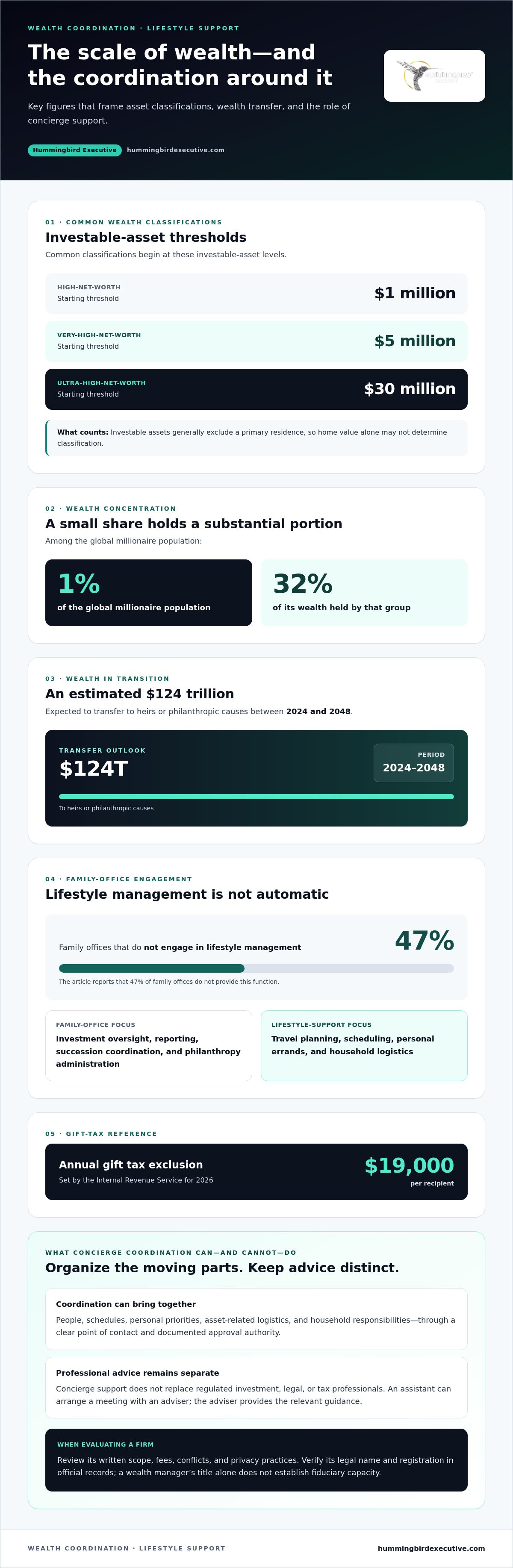
Common wealth classifications use investable assets: high-net-worth typically begins at $1 million, very-high-net-worth at $5 million, and ultra-high-net-worth at $30 million. Investable assets generally exclude a primary residence, so home value alone may not determine classification.
Ultra-wealthy individuals represent 1% of the global millionaire population and hold 32% of its wealth. An estimated $124 trillion is expected to transfer to heirs or philanthropic causes between 2024 and 2048. The Internal Revenue Service sets the annual gift tax exclusion at $19,000 per recipient for 2026.
Concierge Models and Service Offerings
Concierge models range from coordination connected to wealth management to dedicated lifestyle support. The distinction helps clients identify whether they need support organizing financial relationships, personal logistics, or both. A clearly defined scope also separates administrative coordination from investment decisions and legal or tax advice.
Services can include scheduling, errands, restaurant reservations, personal shopping, and travel arrangements, as well as coordination around valuable assets. Investment strategies and asset classes vary by mandate; wealth management may address marketable investments alongside alternatives such as private equity, real estate, and rare assets.
When evaluating a firm, review its written scope, fees, conflicts, and privacy practices, then verify its legal name and registration in official records. A wealth manager’s title alone does not establish fiduciary capacity; assess the role and duties set out in the engagement.
In the United States, private banks, registered advisers, family offices, and specialist concierge firms operate from financial centers and serve clients across locations. Costs depend on scope, staffing, asset complexity, and service access; fee details are provided after a quote request.
Family office engagement with lifestyle management
A family office coordinates financial and administrative responsibilities around a household’s wealth, while lifestyle management addresses practical needs that shape daily life. The functions can work together without becoming interchangeable. For example, a family office may oversee investment reporting and succession planning, while lifestyle support coordinates travel or household schedules. This arrangement gives individuals a clear route for requests that touch both personal and financial concerns.
Engagement varies. Forty-seven percent of family offices do not engage in lifestyle management, so this support isn’t inherent to every family-office arrangement. Where it is included, the family office may manage requests directly or coordinate with dedicated concierge professionals. The distinction matters: families can establish who handles sensitive information, who authorizes commitments, and how preferences are carried across generations.
Concierge support may focus on individual requests, such as a restaurant reservation or travel arrangements. Support connected to a family office can place those requests within a broader understanding of household priorities. A trip involving several family members, for instance, may need to align with calendars, property use, and business commitments. An ongoing relationship can reduce repeated explanations and keep arrangements consistent with agreed preferences.
Family office services may include investment oversight, consolidated reporting, estate and succession coordination, philanthropy administration, and support with valuable assets. Lifestyle management can complement this work through travel planning, scheduling, personal errands, and household logistics. Clear boundaries matter: an assistant can arrange a meeting with an adviser, while the adviser provides financial, legal, or tax guidance.
Families can clarify the arrangement by identifying a lead contact, documenting approval authority, and defining what information may be shared. A next-generation family member might need separate access to schedules while investment reporting stays restricted. For individuals whose needs also involve rare assets, rare-asset concierge support can be a relevant complement to broader household coordination.
Personalized organization and simplification
Personal organization starts by turning recurring requests into a clear system. A household can group responsibilities by calendar, property, family member, and approval level, then assign each item to an assistant or adviser. For example, a shared schedule can separate business travel from family commitments while limiting visibility of sensitive financial appointments to authorized people. This structure helps high-net-worth individuals reduce fragmented instructions and maintain a considered record of preferences.
Personal assistant and concierge services can coordinate scheduling, errands, restaurant reservations, personal shopping, styling, and entertainment. Travel assistance may cover business and personal itineraries, including first-class flights and private jet or yacht charters. Continuity is valuable: an assistant familiar with a preferred itinerary format can prepare future trips using established details, while the individual retains approval over bookings and commitments.
Lifestyle management can also protect time for financial oversight. People who use lifestyle management services have 45 per cent more free time to manage their finances. In practice, an assistant might consolidate meeting requests with wealth advisers, organize documents for a family discussion, and reserve time to review portfolio reports. During an intergenerational wealth transfer, the same organizational discipline can help coordinate family meetings and keep administrative tasks distinct from legal or investment advice.
AI-powered personalization can organize requests around stated preferences, such as travel times, dietary choices, or meeting windows. A useful workflow allows the individual to correct recommendations, control what information is retained, and reserve sensitive decisions for human review. Software might suggest an itinerary based on approved preferences, for example, while an assistant confirms details and the traveller authorizes changes. Tailored service should mean thoughtful organization, not opaque automated decisions.
To simplify coordination, define a single point of contact, record permissions, and specify which requests need direct approval. Advisers can then receive relevant scheduling or document support without access to unrelated personal details. That separation makes daily coordination more precise and keeps the individual in control.
Concierge service for a select group of clients
Concierge arrangements are designed for clients whose personal, financial, and asset-related responsibilities call for coordinated attention. Selectivity can reflect the complexity of requests, the need for discretion, and the service model. For example, an entrepreneur preparing a business sale may need financial advisers, family representatives, and personal logistics coordinated around important decisions.
A clear engagement begins with the client’s priorities and approval boundaries. One household may want help arranging travel and coordinating access to rare assets, while another may prioritize family scheduling and administrative organization. The service should clarify which requests it coordinates, who authorizes commitments, how personal information is handled, and where financial advisers remain responsible for advice.
Availability is another point of distinction. Elite concierge services offer 24/7 availability, while other arrangements operate within defined hours. The relevant question is whether coverage matches the client’s actual needs, including international travel, time-sensitive transactions, and family commitments. A written service scope helps distinguish a continuous response model from support limited to operating hours.
A concierge pilot at an anonymized mid-sized registered investment adviser involved ten top clients and ran for six months. Retention among that cohort rose by 7% after the six-month pilot, while average revenue per client increased by 12%. Advisor time spent on operational tasks dropped by 20% during the same pilot. These results illustrate why firms may reserve enhanced coordination for a selected client group, while not establishing an expected outcome for every engagement.
For an individual, the practical test is whether coordination addresses recurring complexity without obscuring accountability. Map the requests that consume attention, identify the people involved, and establish which decisions remain exclusively yours. If discreet support around rare assets and personal priorities would be useful, explore dedicated concierge support as a possible next step.
Hummingbird Executive: platinum Membership full access to rare assets ,investments, buy surch or sale plus 25/7 dedicated concierge services world wide at no extra charge,
Hummingbird Executive offers a platinum Membership for individuals seeking access to rare assets and investments, with support to buy or sell. It includes dedicated concierge services worldwide at no extra charge, suited to clients who want asset access and concierge support within one membership. The service is described as 25/7.
Gold membership provides white-glove services seven days a week during opening hours. Free access to white-glove service worldwide is also available during opening hours. These options offer distinct arrangements for those seeking membership-based access or concierge support during operating hours.
For those seeking access to rare assets and investments, including support to buy or sell, Platinum Membership is the relevant next step. Review the membership details and consider how its support aligns with your needs. Visit hummingbirdexecutive.com to explore Hummingbird Executive’s offerings.
Set the Terms for Your Next Step
The next decision is not how much support to add, but which responsibilities to delegate. A high-net-worth asset management concierge arrangement works best when its boundaries reflect your priorities: what may be coordinated, what requires your approval, and which decisions remain with your financial, legal, or tax advisers. Set out those expectations in a concise brief before beginning a new relationship.
Your brief can also identify where discretion matters most, from handling sensitive personal information to coordinating access to rare assets. Clear boundaries give you a practical way to assess whether the service fits your working style, rather than relying on broad promises.
When you’re ready to consider support aligned with rare assets and concierge coordination, contact Hummingbird Executive to explore the next step. A well-defined arrangement can make complex responsibilities easier to direct, while leaving important choices firmly in your hands.
Frequently Asked Questions
How can a concierge offering be marketed without sounding transactional?
Present the offering as a considered way to reduce friction, not as a catalogue of requests or perks. Explain the situations it addresses, such as coordinating travel around a demanding business calendar. Describe scope and access precisely, then use a specific example to show how the service fits. Avoid urgency, inflated promises, and treating discretion as a decorative benefit.
How should firms staff and train a high-net-worth concierge function?
Staff should combine sound judgment, careful communication, and disciplined follow-through. Training should cover information handling, client preferences, escalation routes, and role boundaries. Use practical scenarios, such as a travel change involving several family members or a request touching a financial decision. Staff should know when to coordinate logistics and when to refer a matter to the responsible adviser.
What KPIs indicate success for a concierge program?
Track whether requests are completed accurately, resolved without unnecessary handoffs, and handled within the service’s stated commitments. Pair operational measures with client feedback, repeat engagement, and retention trends. Review complaints and corrections as well as positive responses; a high completion rate can conceal recurring errors. Group results by request type to see whether travel coordination, scheduling, or asset-related support creates the greatest value.
What are practical first steps for firms interested in launching a concierge program?
Begin by identifying the recurring client requests the firm can responsibly coordinate. Define eligible clients, service boundaries, approval processes, and escalation contacts before selecting a delivery model. Then test the workflow with a limited group, recording request type, handling time, follow-up, and client feedback. Use those observations to refine training and procedures before expanding the program.
What compliance risks and client privacy issues should be considered?
Key risks include sharing personal information too broadly, unclear consent, unmanaged conflicts, and staff straying into regulated advice. Restrict access by role, document permissions, and record material decisions and referrals. Hummingbird Executive’s secure platform does not use cookies, and personal information is never sold. Privacy practices should be understandable and consistent across every interaction.
What does “luxury concierge services financial” mean in practice?
The term generally describes concierge support connected to a client’s financial life, rather than a distinct financial product. For example, an assistant may organize documents for an adviser meeting or coordinate logistics around a major asset decision. The concierge handles practical arrangements; financial advisers remain responsible for recommendations. Clear role boundaries help clients understand who is coordinating a task and who is providing advice.