The rarest watch is sourced through precision, not persistence. Sourcing rare limited edition watches starts with a clear brief, a careful authenticity assessment and access to collectors and specialist dealers. Production runs can range from 25 pieces to a few thousand, but a smaller edition alone doesn’t make a watch more desirable.
It’s understandable to focus first on the reference or edition number. Yet the right acquisition also depends on condition, provenance, originality and how well the watch suits your collecting priorities. This guide explains how to define a brief around reference, condition, year and budget; assess details such as the case, dial and movement; and pursue sourcing rare limited edition watches through private, direct relationships. The aim is a considered search, with each decision grounded in the watch itself rather than scarcity alone.
Key Takeaways
- Assess originality across the movement, case, dial and finishing; an edition number alone can’t establish a watch’s desirability or condition.
- Build a focused brief around the reference, acceptable condition, production year and budget before approaching collectors or dealers.
- Treat box and papers as useful provenance, not the sole test of authenticity; older watches may have changed hands without their original documents.
- Compare a rare piece with its intended production details, paying close attention to dial elements and signs of refinishing, over-polishing or replaced components.
- For a broader search across rare assets and investments, Hummingbird Executive’s platinum Membership includes access to search, buy or sell, with 25/7 dedicated concierge services worldwide at no extra charge.
Authentication and high-value transactions
Counterfeits, altered parts and undisclosed damage are central risks when acquiring rare watches. A timepiece may have a refinished dial, an over-polished case or a swapped movement, even when its serial number and presentation appear persuasive. Treat these as separate inspection questions, not as one general authenticity check.
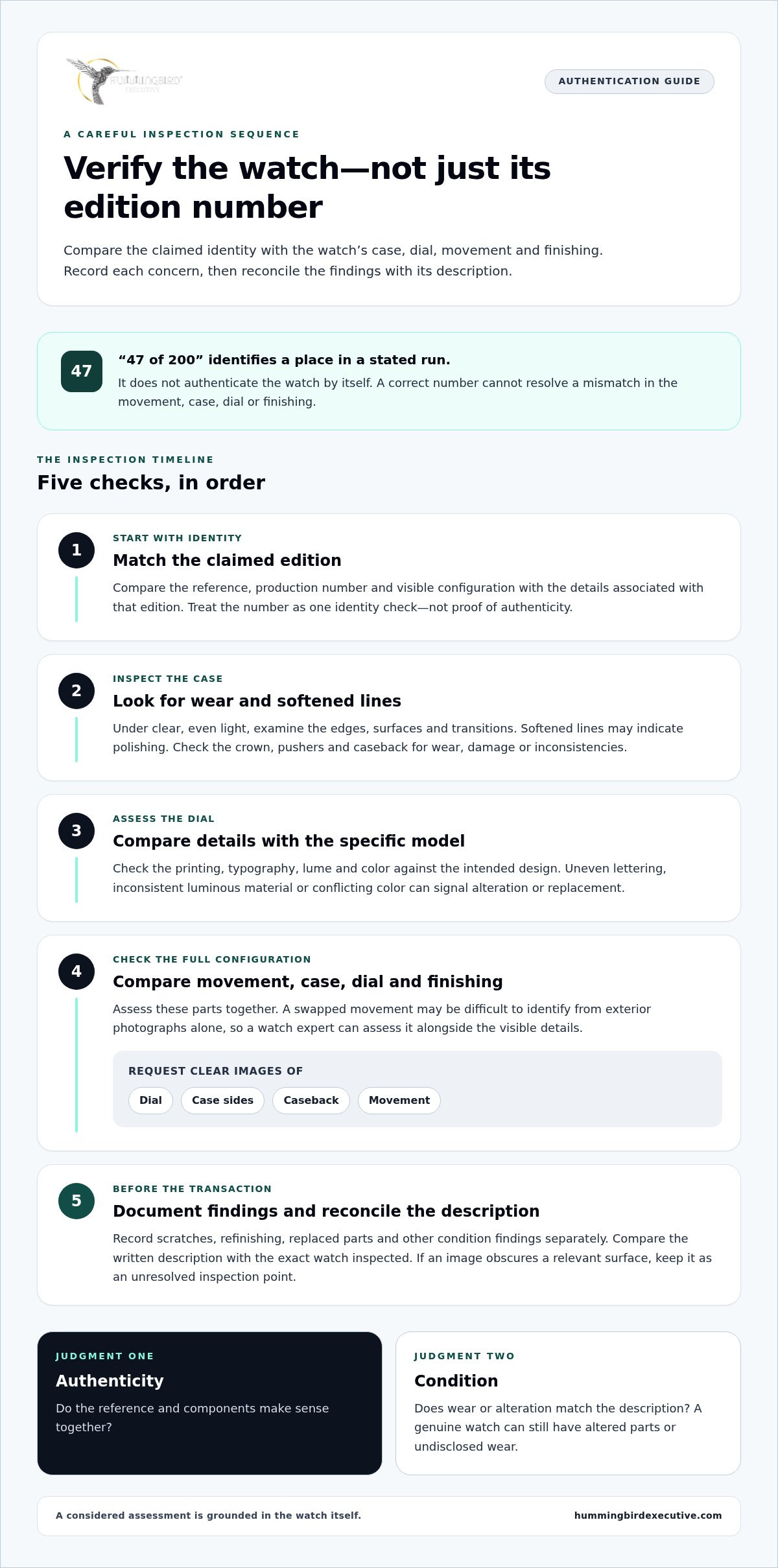
Start with the watch’s identity. Compare its reference, production number and visible configuration with the details associated with that edition. For example, an individual number engraved as “47 of 200” identifies its place in a stated run, but doesn’t authenticate the watch by itself. The movement, case, dial and finishing must also make sense together. A correct number cannot resolve a mismatch elsewhere.
Inspect the case under clear, even light. Examine its edges, surfaces and transitions for softened lines that may indicate polishing. Look closely at the crown, pushers and caseback for wear, damage or inconsistencies. On a limited-edition luxury watch, these details can show whether its condition matches the description. Record each concern separately rather than letting an attractive overall appearance outweigh it.
Assess the dial separately. Check the printing, typography, lume and color against the specific model and edition. Uneven lettering, inconsistent luminous material or a color that conflicts with the watch’s intended design can signal alteration or replacement. A watch expert can assess these details alongside the movement, where swapped components may be difficult to identify from exterior photographs alone.
Professional watch authentication involves a sequence of comparisons, not a glance at the box. Ask for clear images of the dial, case sides, caseback and movement, then compare them with the claimed reference. For an in-person inspection, assess the same areas directly and note any differences from the description. If an image obscures a relevant surface, treat that as an unresolved inspection point.
Before a high-value transaction, tie the assessment to the exact watch you are seeking. A careful sequence helps:
- Match the reference and production number to the claimed edition.
- Compare the movement, case, dial and finishing as one configuration.
- Document scratches, refinishing, replaced parts and other condition findings.
- Reconcile the written description with the inspected watch before proceeding.
This method supports informed decisions in a global search, where photographs and descriptions may be the first evidence available. When sourcing rare limited edition watches, keep authenticity and condition as separate judgments: a genuine watch can still have altered parts or undisclosed wear. Consider both, especially when rarity makes a particular example difficult to replace.
Private collectors and dealers as potential sources
A rare reference can emerge through a private collector, a specialist dealer or a watch-focused sale. Each route offers a different view of condition, provenance and edition history.
Dealer and Collector Networks
Begin with the exact reference and edition details, then share them across relevant dealer and collector networks. A specialist dealer may know which example has entered the market, while a private collector may consider a discreet sale outside public listings. Compare each lead by the watch’s configuration, condition, completeness and ownership history. A wholesale network can broaden the search, but the individual watch still requires its own assessment.
Auction Houses and Online Marketplaces
Specialist watch auction houses and online marketplaces focused on collectible timepieces can help identify candidates. Compare catalogues for reference-level descriptions, clear condition details and photographs of the dial, case and movement. Auction catalogues may show several examples; an online listing may feature a privately held watch. Neither a listing nor its photographs alone establish authenticity or reveal every alteration.
Scarcity needs context. Limited-edition runs can range from 25 pieces to a few thousand, and 500 pieces is one possible production size. An edition of 50 isn’t automatically more desirable than an edition of 500. Collector interest also reflects the design, historical association, condition and completeness. Treat the production number as one research point, not a ranking of quality or future value.
Vintage and modern references attract different collecting priorities. A sought-after vintage mechanical watch may appeal for its period details and ownership history. A modern Patek Philippe edition may interest a collector focused on a specific reference or design. In either case, compare the watch with its intended configuration, then record which features matter most before broadening the search.
Condition, rarity, brand, edition size and completeness all influence a limited-edition watch’s value. Strong condition and original components can support desirability, while box, papers and provenance add useful context. No single factor determines value on its own; the relationship between these details and collector demand matters more than the edition number in isolation.
Personal meaning can change the brief. For a sentimental watch, scratches and wear may be part of its story, making emotional connection more important than pristine condition. Note which signs of use you find acceptable, then distinguish them from damage or changes that affect the watch’s integrity. This helps you assess candidates consistently, whether they come from a dealer, an auction catalogue or a private collector.
How do you verify authenticity?
Authenticity depends on consistency between the watch, its production details and its documentation. For a limited edition, compare the claimed production year and dial configuration with those of the exact reference.
Boxes, Papers, and Service Records
Original boxes, papers and service records help establish a watch’s history, but their value lies in their details. Match serial and reference information across the documents and watch, then compare dates with the stated production year. Papers may be absent even on genuine older pieces: many owners did not retain them 20 or 30 years ago. Their absence alone doesn’t establish that a watch is counterfeit.
Use the model’s production history to test the timeline. For example, the Patek Philippe Aquanaut 20th Anniversary Ref. 5168G launched in 2017; a claimed production year should fit that release history. Compare the dial and configuration with the specific edition, since a correct box cannot make an incorrect dial original. For Audemars Piguet, verify that the reference and edition details align with the watch’s stated production.
Safe Online and Auction Purchases
For an online or auction purchase, review the catalogue description, photographs and documentation as one record. Compare the stated reference, production year and edition with the watch shown, then identify any gaps between the description and images. Before bidding or completing a transaction, establish the condition and document trail for the specific piece rather than relying on the listing title alone.
- Match the reference and production year to the edition’s history.
- Compare the dial and visible configuration with the claimed model.
- Reconcile papers, service records and serial details with the watch.
- Keep the listing description and transaction records with your ownership documents.
After purchase, store the watch securely and keep its box, papers and service records together. Most fine mechanical watches benefit from professional servicing every five to eight years; maintenance, spare parts and expert support also matter to long-term ownership. For insurance, organize the watch’s identifying details and purchase documentation so you can describe the piece accurately in your records.
Completeness is useful, but it doesn’t replace an inspection of the watch itself. A box and papers can support provenance, while consistency in production year and dial can help establish whether the set belongs together. A disciplined document review gives you a clearer basis for comparing pieces sourced online, at auction or through private channels.
Defining a watch brief by reference, condition, year, and budget
A precise brief gives a specialist a clear search mandate. Start with the reference, then separate essential requirements from preferences. A discontinued reference may require a broader search than a current model. Specify acceptable condition, production year, dial, material and budget boundaries. This keeps the search focused on pieces that meet your collecting priorities.
Use the exact reference wherever possible. If you’re looking for a particular edition, note its production year and distinguishing dial or material details. If several references could suit you, rank them rather than treating every option equally. State whether the original configuration matters and identify acceptable variations. This gives a specialist a practical way to compare candidates without mistaking a similar model for your intended piece.
Define condition separately. Describe which marks you’ll accept, whether polishing is acceptable and whether you prefer original components to later replacements. For a sentimental watch, scratches and wear may form part of its story, so pristine condition may matter less than personal connection. If originality is your priority, examine those same marks alongside the case, dial and movement.
Fit the brief to your wrist, not only to the reference. Case diameter is one factor; height, lug-to-lug length and weight also affect whether a watch remains comfortable over time. As a broad size guide, small watches have cases under 31 mm, medium watches measure 31 to 39 mm, and large watches exceed 39 mm. A display that appeals visually may feel different in daily wear.
- Reference: State the preferred reference and acceptable alternatives.
- Year: Define the production years that fit your collecting aim.
- Condition: Rank acceptable wear, polishing and component changes.
- Preferences: Specify dial, material, completeness and wrist fit.
- Budget: Set a firm ceiling and clarify which trade-offs matter most.
Price and year filters help narrow a search, but work best together. A budget ceiling can shape whether you prioritize condition, completeness or a particular production year. Don’t treat the lowest asking price as the decisive criterion; compare each candidate with its reference, condition and documented configuration. This makes differences between two examples easier to assess.
Before sharing the brief with a specialist, mark each requirement as essential or flexible. For example, keep the reference and dial fixed while allowing visible wear, or prioritize a particular year while considering alternate materials. A clear hierarchy lets the search expand thoughtfully without losing direction and gives you a consistent basis for reviewing each candidate.
Curated rare and limited-edition pre-owned watches
A curated shortlist compares specific models against a collector’s priorities, rather than treating rarity as the sole measure. Consider the Audemars Piguet Royal Oak Offshore “LeBron James” Edition: its production was limited to 600 pieces in 2013. That figure establishes scale, but a useful comparison also considers its design, edition context, originality, condition and completeness. The number tells only part of the story.
Anniversary models show how purpose shapes collectability. The Patek Philippe Nautilus 40th Anniversary Ref. 5711/1P was limited to 700 pieces worldwide and released in 2016. The Audemars Piguet Royal Oak Ref. 15202ST marked the Royal Oak’s 50th anniversary. Compare each model’s relationship to its milestone, then consider whether that connection matters to your collection. A coherent reason for seeking a reference is more useful than a production figure alone.
Design-led editions offer another point of comparison. The Audemars Piguet Royal Oak Concept Black Panther Flying Tourbillon was limited to 250 pieces in 2021. The Cartier Crash limited edition from 2021 was made in platinum and limited to 50 pieces. These examples differ in material, design and production scale. Their figures don’t establish a universal ranking; they help identify which characteristics distinguish one watch from another.
Other references make a production brief more precise. The Cartier Santos 100 Carbon Limited Edition was limited to 500 pieces, while the Panerai Radiomir 1940 PAM 690 “Blue Dial” was also limited to 500 pieces. The Breitling Navitimer 1959 Re-Edition was limited to 1,959 pieces. Comparing these models shows why edition size alone can’t explain desirability. The edition’s design, historical reference and relevance to your preferences also belong in the assessment.
Use a consistent shortlist method. Record each model’s reference, production limit, edition purpose, material, condition and completeness. Then rank the attributes that matter to you, such as a particular dial, a milestone connection or an original configuration. This helps distinguish a watch that is merely scarce from one that fits your collecting thesis, and gives a specialist a precise brief.
Curated pre-owned searches can include historically inspired editions, anniversary models and watches distinguished by technical or design features. The OMEGA Speedmaster “Silver Snoopy Award” 50th Anniversary had a limited run of 1,970 pieces. Treat each named edition as a research lead, not an automatic endorsement. Compare its defining features and documentation with the individual watch before deciding whether it belongs on your shortlist.
The practical takeaway is disciplined selection: shortlist models by meaningful attributes, then assess each individual example on its own merits. If you’re ready to explore rare assets and investments through platinum Membership, access rare-asset opportunities with dedicated concierge services worldwide.
Hummingbird Executive: platinum Membership full access to rare assets ,investments, buy surch or sale plus 25/7 dedicated concierge services world wide at no extra charge,
Hummingbird Executive’s Platinum Membership provides full access to rare assets and investments, with expert assistance in sourcing, buying, or selling, plus 24/7 dedicated concierge services worldwide at no extra charge. For collectors whose focus extends beyond a single timepiece, this membership offers a streamlined route for sourcing rare limited edition watches and alternative luxury assets. Gold Membership provides white-glove services seven days a week during opening hours.
Bring your priorities into focus: the specific reference sought, acceptable condition, production year, and documentation. These details help frame the acquisition process around your collecting objectives. For membership information, visit Hummingbird Executive.
Make the Next Acquisition Deliberate
A rare watch can mark more than a collecting milestone. It can express a point of view: a lasting interest in a design, a maker or a particular moment in horological history. Before beginning another search, consider what you want the next piece to contribute to your collection. That intention can help distinguish a compelling opportunity from an appealing distraction, especially when an example appears unexpectedly.
Approach sourcing rare limited edition watches as a considered acquisition, not a race to secure the next available piece. A concise mandate gives the search direction while leaving room for an exceptional candidate that meets your priorities in a different way. The result is a collection shaped by discernment and personal meaning, not scarcity alone.
For a discreet next step, contact Hummingbird Executive to discuss your collecting objectives. Your next acquisition can begin with clarity.
Frequently Asked Questions
Looking for a Watch That Seems Impossible to Find?
A tightly defined search can reveal options that broad browsing may miss. Start with the exact reference, then identify acceptable alternatives, condition, documentation and preferred transaction route. For example, decide whether a related reference would meet your collecting objective or whether only one configuration will do. A precise brief helps distinguish a genuine candidate from a superficially similar model.
How long does the sourcing process take?
The timeline depends on the reference, condition requirements and how rarely suitable examples change hands. A commonly available watch may be found in days or about a week, while a very rare piece may take weeks or months. A brief limited to one reference, year and configuration can narrow the search but also reduce the number of candidates. Flexibility can widen the field.
Is there a fee for the sourcing service?
Hummingbird Executive provides private access to rare assets and investment opportunities through membership, with dedicated concierge support. Its members can pursue rare watches through private, direct relationships with owners and decision-makers. Membership is reserved exclusively for ultra-high-net-worth individuals and the qualified few.
What makes a watch limited edition, and how can its production run be verified?
A limited edition is defined by a restricted production run or by a model whose available examples have declined over time. Runs may range from 25 pieces to a few thousand, so the label alone says little about desirability. Compare the stated edition number with brand documentation and the reference’s production history. An engraving such as “47 of 200” identifies a numbered piece, but doesn’t verify the entire watch.
Where can I find rare limited-edition watches from authorized dealers, brands, and reputable secondary-market sellers?
Begin with a brand boutique or authorized dealer for current models and brand-led production information. For discontinued references, consider specialist watch dealers, private collectors, auction catalogues and established secondary-market platforms. Search by reference rather than broad model name, since similar versions can differ in dial, material or edition. Treat each listing as a lead, then assess its documentation, condition description and transaction terms before proceeding.
How can I verify a limited-edition watch’s authenticity, serial number, provenance, and original paperwork?
Compare the serial and reference details on the watch with its papers, service records and stated production history. Then assess whether the dial, case and movement fit that reference. Provenance should form a coherent ownership record, not just a collection of documents. Older watches may lack original papers, so assess documentation alongside the physical watch. A watch specialist can examine features photographs don’t reveal.
What prices do rare limited-edition watches sell for, and how can I research recent comparable sales?
Prices vary with the reference, condition, originality, completeness, provenance and buyer demand. To research comparables, look for completed sales of the same reference and edition, not just current asking prices for related models. Record the sale date, condition, included papers and box, and any disclosed restoration. Differences in these details can make two apparently similar results poor comparisons. Production numbers alone don’t predict appreciation.
How can I negotiate, arrange escrow or payment, and insure shipping when buying a high-value watch?
Base negotiation on the specific watch’s condition, completeness and comparable completed sales. Before payment, put the agreed reference, condition, included documents, delivery terms and any inspection arrangement in writing. If escrow is proposed, understand who holds the funds and the release conditions before transferring money. Agree with the transaction parties on secure handling, tracking, delivery confirmation and insurance before shipping.