What if the first test of an off-market opportunity isn’t the asset, but the person bringing it to you? Building trust with an off-market broker begins before you share sensitive details or commit to a next step. A private opportunity may be difficult to verify through public sources, and unclear representation or compensation can leave you unsure whose interests are being served.
That caution is well placed. Discretion matters, but it shouldn’t replace evidence. A credible process makes room for verifiable information, clear incentives, and deliberate disclosure, so you can assess an opportunity without relying on reputation or polished claims alone.
This guide explains how to examine a broker’s identity and authority, clarify their role and compensation, and set sensible boundaries around personal and financial information. It also outlines how to structure the process, from the first introduction to further diligence. Hummingbird Executive’s private marketplace provides a discreet route to off-market assets, with concierge support through its membership tiers. The aim is not to promise certainty, but to help you proceed with greater clarity and control.
Key Takeaways
- Building trust with an off-market broker starts with confirming identity and authority before sharing sensitive information.
- Clarify the broker’s mandate and compensation so you understand their role and whose interests they represent.
- Review evidence in sequence, then disclose only what’s proportionate to the next step.
- Compare brokers by evidence quality, role clarity, confidentiality, communication, and familiarity with the relevant asset category.
- Use a decision record to track claims, supporting evidence, unresolved points, and next actions. Hummingbird Executive’s private marketplace and membership concierge support offer a structured route to rare off-market assets.
Why Building Trust with an Off-Market Broker Requires More Than a Referral
An off-market broker is an intermediary who facilitates opportunities circulated privately rather than through public listings. Private circulation may suit a seller or owner seeking controlled exposure, but it can leave a buyer with fewer public details to use when assessing the opportunity. Discretion should shape how information is shared, not remove the need to understand who is involved, what authority they hold, and how the transaction is expected to proceed.
Trust in an off-market broker rests on verifiable evidence, clear incentives, and controlled disclosure. A referral can establish a credible introduction. It cannot, by itself, establish that a specific asset exists, that the person presenting it is authorised to act, or that the stated mandate is current. Treat these as separate questions and seek appropriate evidence for each before advancing a decision.
What changes when an opportunity is not publicly marketed?
Private circulation can limit readily available information without implying wrongdoing. An owner may have legitimate reasons to restrict early disclosure, while a buyer can still expect essential facts to become verifiable at the appropriate stage. Confidentiality protects sensitive details; it shouldn’t become a blanket reason why basic questions about the asset, the intermediary’s role, or the proposed process cannot be answered.
The evidence needed also depends on the asset. A property, private jet, yacht, or collectible has different ownership records, condition considerations, and provenance questions. The relevant due diligence should reflect the asset category and transaction, rather than relying on a generic claim that an opportunity has been “checked.”
Why reputation alone is not enough
A respected introduction and polished credentials provide context, not transaction-specific proof. They may help establish who brought the opportunity forward, but they don’t independently establish the broker’s authority, the seller’s intent, or the accuracy of every claim. Building trust with an off-market broker means distinguishing what can be verified now from what requires further review as the process develops.
Clear communication supports that distinction. The intermediary should be able to explain their role, the basis for presenting the opportunity, and what information can be shared at each stage. If other parties are involved, their roles should be clear too. Written responsibilities and incentives help you understand whose interests may be served without requiring you to disclose more than the next step calls for.
A measured process protects privacy and decision quality. Establish the identity and role of the people involved, understand the basis of the opportunity, then share information proportionately as the evidence develops. A referral may open the door. Verification supports the decision to proceed.
How to Build Trust with an Off-Market Broker Through Evidence and Disclosure
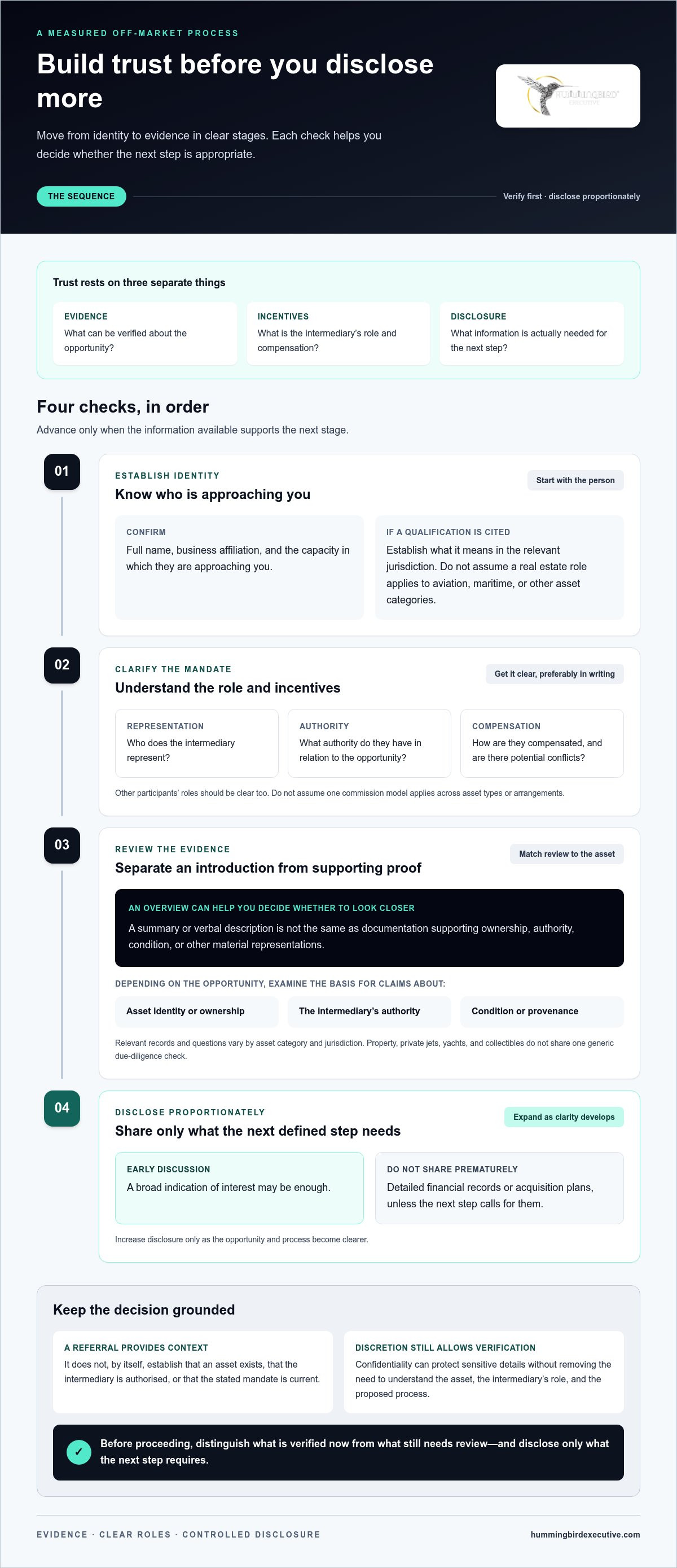
Use a sequence, not a leap of faith. Each step should give you enough information to decide whether the next is appropriate, without requiring you to expose sensitive details prematurely. Building trust with an off-market broker is a gradual exchange: establish clarity and evidence first, then disclose proportionately.
- Establish identity. Confirm the individual’s full name, business affiliation, and the capacity in which they’re approaching you. If they describe a professional qualification or role, establish what it means in the relevant jurisdiction. The U.S. Bureau of Labor Statistics outlines the duties of real estate brokers, but real estate roles shouldn’t be assumed to apply to aviation, maritime, or other asset categories.
- Clarify the mandate. Ask who the intermediary represents, what authority they have in relation to the opportunity, and how other participants fit into the transaction. Ask for a plain explanation of compensation and potential conflicts. Don’t assume a single commission model applies across asset types or arrangements.
- Review the evidence. Separate introductory material, such as a summary or verbal description, from documentation that supports material claims. Depending on the opportunity, this may mean establishing the asset’s identity or ownership, the source of the intermediary’s authority, or the basis for a stated condition or provenance. What is relevant varies by asset and jurisdiction.
- Disclose proportionately. Share only what’s needed for the next defined step. Early discussions may require a broad indication of interest, not detailed financial records or acquisition plans. Expand disclosure only as the opportunity and process become clearer.
Trust grows when each claim has a proportionate, reviewable basis. A preliminary overview can help you decide whether an opportunity merits attention; it isn’t the same as evidence supporting ownership, authority, condition, or other material representations. This distinction lets you consider a private opportunity while reserving judgment until the relevant support is available.
Clarify the role before sharing more
Ask for roles and responsibilities to be stated clearly, preferably in writing. An intermediary may introduce parties, represent a seller, act for a buyer, or coordinate parts of a process. Don’t leave the role to inference. Written clarity about authority, compensation, and any interests that could affect the intermediary’s position gives you a sounder basis for deciding how to proceed.
Let evidence set the pace
Verification doesn’t require unrestricted circulation of confidential records. It requires a defined next step and a suitable basis for assessing the claims relevant to it. If records are sensitive, agree on what information is needed and how it will be shared before disclosing more. Hummingbird Executive’s private marketplace offers a structured setting for exploring off-market assets, with concierge support through its membership tiers.
How to Compare Off-Market Brokers Without Mistaking Access for Trust
An introduction to a private opportunity can be valuable, but access alone doesn’t establish that an asset is authentic, appropriately valued, or suited to your objectives. To compare intermediaries, look beyond the number or rarity of opportunities they describe. Focus on whether their process makes claims, roles, and privacy practices understandable and reviewable.
Use the same criteria for each conversation. Record what the intermediary can show, explain, and document instead of relying on confidence or broad assurances.
| Criterion | More verifiable signal | Persuasive but unsupported language |
|---|---|---|
| Evidence quality | Claims are specific, attributable, and supported by relevant material as the process advances. | “Fully vetted” or “guaranteed genuine” without a clear explanation of what was reviewed. |
| Role clarity | The intermediary explains whom they represent, the scope of their authority, and how compensation or other interests work. | “We handle everything” without identifying who is responsible for each role. |
| Confidentiality | They explain what information is requested, why it’s needed, and how disclosure is limited. | “Completely confidential” with no practical explanation of information handling. |
| Communication | Answers remain consistent, unknowns are acknowledged, and next steps are defined. | Urgency or repeated assurances take the place of clear answers. |
| Asset-category familiarity | Experience is relevant to the type of asset and transaction, with specific, attributable examples where appropriate. | General claims of a broad network or luxury-market expertise without relevant detail. |
Which credibility signals are meaningful?
Specific experience matters when it relates to the asset and transaction in front of you. A history with premium property, for example, doesn’t automatically demonstrate familiarity with aviation or maritime transactions. Treat testimonials, status, and network size as useful context, not proof of a current mandate or a particular asset’s claims.
Notice how an intermediary handles uncertainty. Consistent answers, relevant documentation, and a willingness to distinguish what is known from what remains open are stronger signals than polished certainty. Building trust with an off-market broker depends on the quality of the process, not simply on access.
How should privacy and conflicts factor into comparison?
Compare how clearly each intermediary describes whom they represent and whether their interests could differ from yours. A confidentiality statement is only one part of the picture; by itself, it doesn’t establish how information is handled or what protections apply. Look for practical explanations of what’s requested, who may receive it, and why it’s necessary. The aim is disciplined disclosure, not disclosure on faith.
A Practical Due-Diligence Checklist for Working with an Off-Market Broker
A concise written record turns an informal introduction into a process you can review. For each material statement, note what was said, what supports it, what remains unresolved, and what you’ll do next. This keeps questions, evidence, and disclosure decisions connected as the opportunity develops.
Before sharing sensitive information
- Define the request. Record what information is requested, who will receive it, why it’s needed, and how it will be used. If the purpose or recipient is unclear, pause before sharing.
- Disclose in stages. Start with what’s necessary for the current step. Share more detailed financial, identity, or acquisition information only as the process and need become clearer, using an appropriate secure channel for sensitive materials.
- Keep an account. Save material representations, documents received, and written confirmations of agreed next steps. Note who provided each item and when, so you can distinguish a broker’s statement from supporting documentation.
Before proceeding with an asset
Map the proposed sequence from introduction to verification and transaction documentation. Identify which claims come from the intermediary and which asset details have separate supporting records. The relevant checks depend on the asset: ownership and condition questions for a property, for example, differ from those concerning a yacht, private jet, or collectible.
Document your assessment in a simple decision record:
- Claim: What has been represented?
- Supporting evidence: What document or other source supports it?
- Unresolved point: What remains unclear or unverified?
- Next action: What is the next proportionate step, and who is responsible?
Legal, tax, ownership, and regulatory considerations may vary with the asset, jurisdiction, and parties involved. Flag them early and obtain jurisdiction-specific professional advice where appropriate. This checklist helps organize questions; it isn’t a substitute for legal or tax advice.
Building trust with an off-market broker is easier when every next step has a recorded purpose and an evidentiary basis. Hummingbird Executive’s private marketplace brings together off-market opportunities across rare asset categories, with concierge support available through its membership tiers.
Hummingbird Executive’s private marketplace and concierge support provide a structured route to off-market opportunities.
How Hummingbird Executive Supports a More Discreet Off-Market Process
Hummingbird Executive provides a private marketplace for buying and selling rare off-market assets, including premium properties, yachts, private jets, and luxury cars. Buyers can explore opportunities across asset categories, while sellers have a private route to present assets beyond broad public circulation. Marketplace access is a starting point, not a substitute for assessing an opportunity and its supporting information.
Private asset access with concierge support
Membership combines marketplace access with concierge support. Platinum membership includes full access to rare assets and worldwide dedicated concierge services available 24/7 at no extra charge. Gold membership includes white-glove service seven days a week during opening hours. These membership tiers offer distinct service terms for members looking to search, buy, or sell.
Concierge support provides a point of coordination as members consider opportunities and next steps. It doesn’t replace transaction-specific verification, establish an asset’s value, or assure availability or an outcome. Those judgments depend on relevant evidence and the details of each transaction.
A considered next step for buyers and sellers
Discretion works best when it accompanies clarity. Hummingbird Executive’s privacy-focused platform does not use cookies and does not sell personal information. As with any digital service, consider what information you share, why it’s required, and how the process will handle it.
Across a private transaction, trust develops through clearly understood roles, proportionate disclosure, and decisions supported by reviewable information. That approach complements a marketplace spanning property, aviation, maritime, and automotive assets, where the relevant questions and evidence can differ by category. If you’re considering Platinum membership, weigh its rare-asset access and concierge support against the way you expect to buy or sell.
See Hummingbird Executive’s private marketplace for information about its membership and concierge support.
Proceed with Clarity and Discretion
Building trust with an off-market broker is not a matter of accepting access at face value. It comes from confirming roles, assessing evidence relevant to the asset, and sharing sensitive information only as the process requires. A measured sequence helps preserve privacy while giving you a sounder basis for each decision.
Hummingbird Executive’s private marketplace spans premium properties, yachts, private jets, and luxury cars. Membership options include concierge and white-glove support with distinct service terms: Platinum includes worldwide dedicated concierge services 24/7, while Gold includes white-glove service seven days a week during opening hours. The platform does not use cookies and does not sell personal information.
Use the same considered approach as you explore private opportunities: clarify what is being represented, distinguish claims from supporting evidence, and keep disclosure proportionate. When you’re ready to explore a discreet route to rare assets, visit Hummingbird Executive’s private marketplace.
Frequently Asked Questions
How do you know if an off-market broker is legitimate?
Assess the intermediary through verifiable identity, a clearly explained role, and evidence supporting material claims. Confirm their business affiliation and, if they claim a regulated professional status, check that credential with the relevant authority in the applicable jurisdiction. Ask how they obtained authority to present the opportunity and whom they represent. A referral, impressive network, or polished profile can provide context, but none alone proves a particular mandate or that an asset is genuine.
What should you verify before working with an off-market broker?
Start with who the intermediary is, what role they hold, and the scope of their authority in the transaction. Clarify compensation and any interests that could affect their position. Then assess the opportunity itself: confirm its identity, ownership, and material representations using evidence appropriate to its asset category and jurisdiction. Keep a record of claims, supporting documents, unresolved questions, and agreed next steps. This sequence helps you assess each issue without disclosing more than needed.
Is an off-market property or asset automatically a good investment?
No. Private circulation describes how an opportunity is presented, not its quality, authenticity, value, or suitability for your objectives. Assess the asset on its own merits, including relevant ownership, condition, provenance, and financial considerations. The appropriate diligence varies for a premium property, yacht, private jet, or collectible. Treat claims about rarity or limited access as claims to examine, not evidence of investment potential, and don’t assume that privacy implies an advantage or likely return.
Can you build trust with a broker before sharing financial information?
Yes. Building trust with an off-market broker can begin with questions about identity, role, mandate, and process that don’t require detailed financial disclosure. Ask why information is requested, who will receive it, and how it will be used. Share progressively as a defined next step requires it, rather than providing sensitive records at the outset. A measured intermediary should be able to explain the purpose of each request and the process before seeking deeper disclosure.
What questions should you ask an off-market broker about their role?
Ask whom they represent, what authority they have in relation to the asset, and whether other intermediaries or principals are involved. Clarify what they will do in the transaction and how they’re compensated, including any interests that could differ from yours. Request that material responsibilities and terms be put in writing. Roles and compensation can vary by transaction, so don’t assume a universal commission structure or a particular legal duty based solely on a title.
How can a buyer protect confidentiality during an off-market transaction?
Limit disclosure to information needed for the current stage. Before sharing identity or financial details, clarify the purpose, recipient, and intended use, and agree on an appropriate channel for sensitive materials. Keep track of what you provide and to whom. Confidentiality language can help explain expectations, but it doesn’t by itself establish secure handling or legal protection. Review the specific process and applicable arrangements rather than relying on a general promise of discretion.
What is the difference between a private marketplace and an off-market broker?
A private marketplace is a platform or environment where buyers and sellers can access opportunities that aren’t publicly advertised. An off-market broker is an intermediary who facilitates or presents private opportunities and may have a specific role in a transaction. The terms describe different functions, though they can intersect. Hummingbird Executive operates a private marketplace for rare assets, including properties, yachts, private jets, and luxury cars, with membership options that include concierge support.