The finest yachts in the world rarely appear on public brokerage portals. They trade in silence, transferring between owners without marketing campaigns or public announcements. For serious principals, buying a yacht before it’s listed isn’t merely an advantage; it’s the standard protocol for securing pristine maritime pedigree without market noise.
You already recognize the compromise of conventional listings. Public databases are frequently picked over, pricing often reflects speculative competition, and expressing commercial interest exposes your personal balance sheet to unwanted scrutiny. A public transaction turns an intimate capital allocation into a competitive spectacle, stripping away your negotiating leverage.
Discreet acquisitions require a disciplined architecture. This guide reveals how ultra-high-net-worth buyers secure premier vessels through private channels before open-market exposure occurs, protecting personal privacy while anchoring negotiations to intrinsic asset value. We examine the mechanics of confidential sourcing networks, structured pre-market technical due diligence, and closing protocols engineered to preserve absolute transactional discretion.
Key Takeaways
- Mastering the protocols of buying a yacht before it’s listed insulates your capital from public bidding frenzies while securing prime shipyard builds before broad market visibility.
- Rigorous technical verification relies on auditing class certification histories, refit logs, and naval architectural integrity rather than superficial sales collateral.
- Structured private treaty frameworks protect principal anonymity from initial contact to closing through robust bilateral non-disclosure agreements and targeted letters of intent.
- Strategic buyers bypass informal broker gossip and ghost listings by insisting on verified owner mandates and definitive proof of vessel availability.
- Accessing premier off-market tonnage requires specialized private consulting infrastructures engineered around complete data security and vetted global relationships.
Why Acquire a Yacht Before It Is Publicly Listed?
Public multi-listing services (MLS) represent a visible fraction of global superyacht transactions. The elite tier of the maritime sector trades through quiet private treaties, where vessels transfer between principals without public marketing campaigns. Entering this silent market changes how capital is deployed. When buying a yacht before it’s listed, you bypass speculative bidding environments, preserving complete transactional discretion from initial inquiry through closing.
Discerning owners prioritize unlisted transactions for definitive commercial reasons. Flagship vessels operating in high-demand charter programs risk significant charter booking cancellations if the market perceives an impending sale. In other instances, family offices and institutional owners conduct corporate restructurings that necessitate absolute confidentiality. Premier European shipyards also favor private transfers, ensuring their bespoke custom hulls remain associated with stability rather than prolonged open-market exposure.
The Limitations of Public Brokerage Listings
A vessel entered into public brokerage databases becomes exposed to broader market fatigue. As months accumulate on multi-broker platforms, brokers and prospective purchasers routinely infer hidden mechanical flaws or distressed circumstances, regardless of the vessel’s actual condition. Public listings also force your acquisition team to compete against speculative retail offers, which artificially distorts asking prices.
- Loss of anonymity: Inquiries on public platforms often alert industry observers to your entry into the market.
- Stale valuation benchmarks: Public listings frequently reflect historical asking prices divorced from intrinsic asset worth.
- Compromised negotiating posture: Transparent interest signals allow competing brokers to orchestrate artificial urgency.
The Competitive Edge of Quiet Asset Procurement
Operating outside the public domain secures an uncontested negotiating perimeter. Rather than reacting to public counter-offers, you engage directly with motivated sellers through verified private channels. This privacy-first structure allows both parties to tailor closing terms, negotiate equitable escrow arrangements, and establish flexible delivery locations without industry gossip interfering with the transaction timeline.
Understanding these private protocols offers dual-sided clarity. Principals who master confidential acquisitions naturally develop a strategic perspective on how to sell a superyacht privately, realizing that privacy protects balance sheets whether allocating or liquidating capital. Navigating the modern yacht market demands this disciplined approach. Sourcing vessels through verified private networks ensures that every negotiation is anchored in technical merit and certified maintenance histories rather than public retail hype.
Evaluating Off-Market Vessels: Selection Criteria and Verification
Public listings come with curated marketing packages and polished imagery. Off-market vessels, by contrast, demand independent technical verification before any commercial commitment is initiated. Without public records to cross-reference, evaluating a private prospect requires rigorous scrutiny of its engineering condition, shipyard pedigree, and operating history. For family offices buying a yacht before it’s listed, due diligence is not a post-offer formality; it’s the foundation of the negotiation.
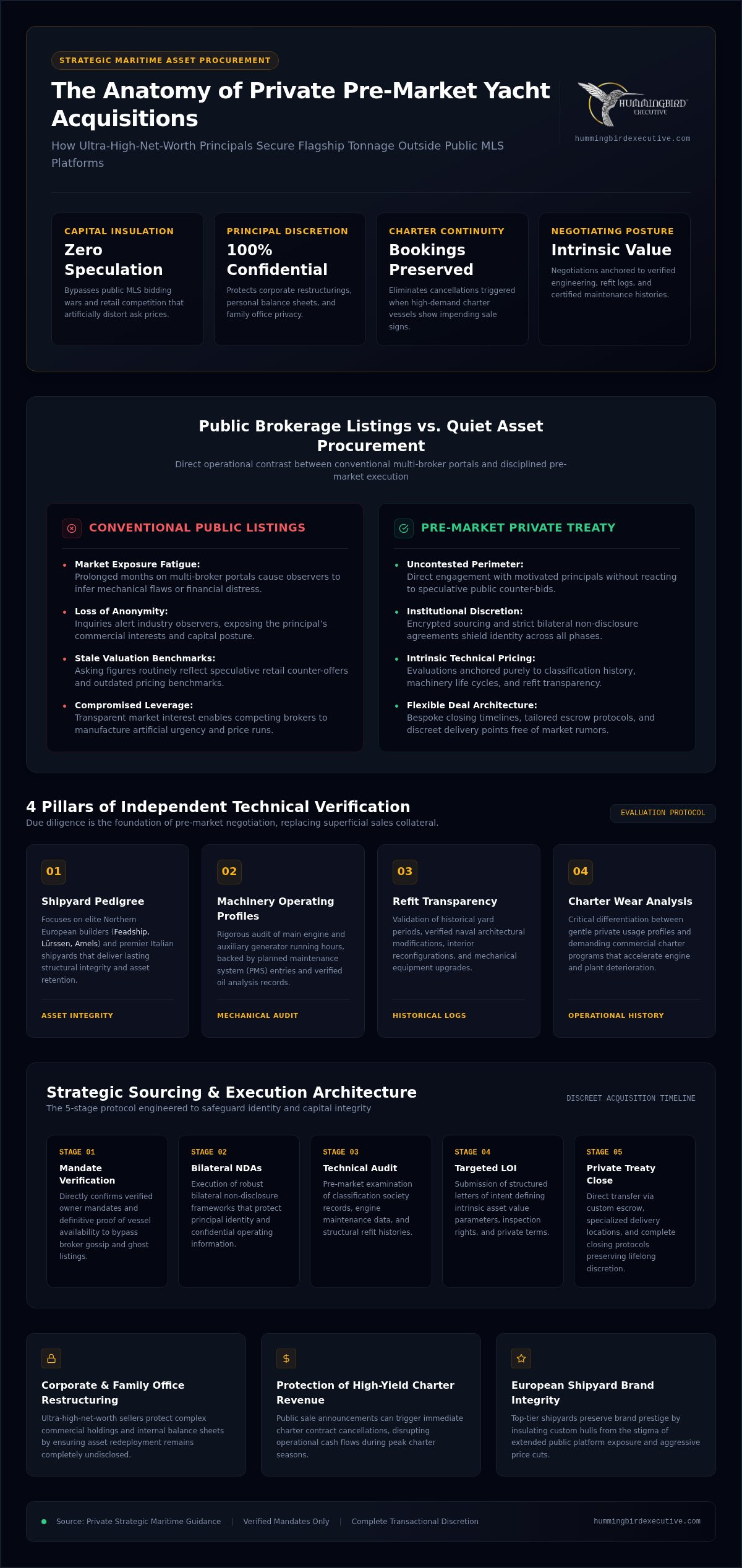
A disciplined assessment framework examines four interconnected pillars:
- Shipyard pedigree: Northern European builders (such as Feadship, Lürssen, and Amels) or premier Italian yards carry enduring structural integrity and residual value retention.
- Machinery operating profiles: Precise logs of main engine and auxiliary generator running hours, alongside oil analysis reports and planned maintenance system (PMS) entries.
- Refit transparency: Verification of yard periods, structural modifications, interior overhauls, and equipment upgrades.
- Charter wear: Careful separation between low-impact private usage and high-hour commercial charter programs that accelerate wear on mechanical plants.
Pedigree, Classification, and Engineering Audits
Classification societies provide the ultimate verification of seaworthiness. Maintaining a yacht in full class with bodies like Lloyd’s Register, ABS, or RINA confirms the hull and machinery comply with strict structural criteria. When assessing unlisted vessels, your engineering team must verify special survey cycles, shaft withdrawals, and drydock compliance records. Frameworks aligned with the International Yacht Brokers Association (IYBA) establish standard procedural ethics, yet private transactions require deeper independent propulsion and stabiliser audits before drafting binding terms.
Ownership Structures and Flag State Due Diligence
Superyacht ownership commonly resides within special purpose vehicles (SPVs) registered across jurisdictions like the Cayman Islands, Bermuda, or Malta. Sourcing an asset discreetly requires a clean audit of this legal wrapper. The transaction must ensure absolute delivery of clear title, verified through maritime lien searches, international registries, and confirmation that all crew contracts, yard bills, and vendor liabilities are fully extinguished.
Taxation and cruising permissions require equal clarity. Verifying whether a vessel holds EU VAT-paid status or operates under the Temporary Admission regime prevents severe fiscal complications upon handover. Reviewing the vessel’s compliance history against international standards like SOLAS and MARPOL protects your operating parameters worldwide. For buyers seeking uncompromised clarity through every phase of this vetting process, working with a discreet advisory team like Hummingbird Executive ensures every private prospect undergoes comprehensive legal and mechanical due diligence before capital is committed.
The Anatomy of a Private Pre-Market Yacht Acquisition
Private treaty transactions follow a structured protocol designed to eliminate commercial exposure. Standard retail purchases rely on published listing forms and open-ended contingencies. When buying a yacht before it’s listed, the entire sequence operates under strict procedural firewalls that safeguard capital and principal identity from initial contact to delivery.
A private transaction advances through five distinct phases:
- Phase 1: Bilateral Non-Disclosure Execution: Binding non-disclosure agreements (NDAs) protect both parties before specification sheets, maintenance logs, or corporate ownership details are exchanged.
- Phase 2: Targeted Letter of Intent (LOI): A detailed term sheet establishes preliminary valuation, escrow milestones, timeline allowances, and jurisdictional preferences.
- Phase 3: Controlled Physical Access: Private viewing windows are scheduled during scheduled maintenance lay-ups or quiet shipyard intervals, avoiding crew disruption.
- Phase 4: Independent Technical Audit: Comprehensive underwater hull inspections, fluid sampling, and sea trials under full load conditions.
- Phase 5: Escrow Funding and Protocol of Delivery: Settlement of title transfer, deletion from previous flag registries, and physical handover.
Non-Disclosure Agreements and Discretion Protocols
Standard brokerage agreements rarely protect principal identities from maritime industry gossip. In off-market acquisitions, bilateral NDAs must incorporate robust non-circumvention clauses and clear remedies for confidential data leakage. Intermediaries, marine surveyors, and crew operate under explicit confidentiality boundaries. This legal framework ensures family offices can evaluate mechanical assets thoroughly without signalling their capital allocations to the broader brokerage community.
Condition Surveys, Sea Trials, and Escrow Mechanics
Surveying a private vessel demands discreet operational coordination. Haul-out inspections are scheduled at private shipyard facilities rather than commercial marinas where an unlisted vessel’s presence invites immediate speculation. Once a Memorandum of Agreement (MoA) is executed, standard practice dictates a 10% purchase deposit held in an independent escrow account within established maritime legal jurisdictions, typically incurring escrow management fees between 0.5% and 1.5% of the transaction value.
Sea trials run under rigorous contractual thresholds, evaluating main engines, auxiliary power, and stabilisers at maximum continuous rating (MCR). Technical acceptance remains strictly conditional on clear title delivery, the absence of maritime liens, and complete classification society sign-offs, completing the disciplined methodology of buying a yacht before it’s listed.
Mitigating Pitfalls in Unlisted Superyacht Transactions
The private market offers unparalleled discretion, but it operates without the standardized filters of public exchanges. Informality creates exposure. Unvetted intermediaries routinely circulate “ghost listings”, vessels that aren’t genuinely for sale, to test theoretical pricing or harvest buyer profiles. When buying a yacht before it’s listed, establishing strict operational safeguards prevents administrative paralysis, distorted asset valuations, and costly due diligence on phantom opportunities.
To insulate your acquisition team, insist on these baseline protections before allocating resources:
- Direct owner mandates: Reject introductory circulars unless accompanied by written confirmation that the intermediary holds direct, verifiable authority from the beneficial owner or their appointed family office.
- Breakup fee structures: Incorporate mutual performance penalties within preliminary agreements, preventing uncommitted sellers from withdrawing once you commit capital to technical haul-outs and surveys.
- Engineering discovery provisions: Mandate contractual price adjustments or unilateral deposit return rights if cosmetic refits conceal deferred structural or mechanical maintenance.
Filtering Inauthentic Intermediaries and Speculative Leads
Informal digital messaging channels and unlicensed facilitators represent a growing vulnerability in off-market transactions. Middlemen often pass vessel specifications through extended chains of contacts, adding informal markups or distorting critical operational data along the way. Genuine principals don’t float multi-million-euro assets through casual networks. Direct transactions require vetted, closed communication channels where every party is identified, authenticated, and bound by enforceable non-circumvention terms.
Establishing Fair Asset Valuation Without Public Data
Determining intrinsic value without public multi-listing comparables requires institutional analysis. Public asking prices often reflect seller optimism rather than executed settlement figures. In the private market, valuation hinges on three core metrics: actual replacement build costs, current shipyard slot availability, and documented mechanical depreciation.
With Northern European custom shipyards often booked several years in advance, an immediately available, fully classed vessel commands an intrinsic delivery premium. This premium must be measured against upcoming capital expenditures, such as ten-year survey requirements or mandatory emissions updates like the Mediterranean Sea Sulphur Emission Control Area (Med SOx ECA) regulations. To navigate these opaque valuation metrics and filter out speculative listings before deploying capital, consult with Hummingbird Executive to access vetted off-market maritime assets through secure, authenticated private channels.
Securing Pre-Market Maritime Assets Through Hummingbird Executive
Traditional brokerage platforms rely on public intake funnels and consumer-grade tracking scripts that compromise buyer confidentiality before due diligence begins. Hummingbird Executive operates on a fundamentally different philosophy. As a private global consulting firm and asset hub, the firm provides vetted principals with quiet access to unlisted maritime assets, private aviation, prime real estate, and rare collectibles. The entire platform functions on a privacy-first, zero-cookie architecture that never sells data. For ultra-high-net-worth buyers, buying a yacht before it’s listed becomes a seamless, secure endeavor rather than an administrative hazard.
Hummingbird Membership Tiers for Global Investors
Access to institutional-grade, off-market inventory requires structured representation. Hummingbird Executive aligns with client operational requirements through distinct membership tiers:
- Platinum Membership luxury concierge: Grants full access to rare assets, private investments, and buy search or sale execution, reinforced by 24/7 dedicated concierge services worldwide at no extra charge.
- Gold Membership luxury services: Delivers tailored white-glove advisory support seven days a week during opening hours.
- Free Access White-Glove Service: Allows qualified principals to experience bespoke global advisory standards during opening hours worldwide.
Engaging the Concierge for Bespoke Vessel Sourcing
Retaining a dedicated partner streamlines the acquisition corridor. When buying a yacht before it’s listed, principals submit a confidential procurement brief detailing target length overall (LOA), preferred shipyard pedigree, interior layout requirements, and scheduled cruising grounds.
Hummingbird Executive activates its international advisory network across the Western Mediterranean, the Caribbean, and key Northern European shipyards, matching parameters directly against verified private holdings. Each prospective vessel is audited for clear title, class standing, and engineering integrity before presentation, ensuring your team reviews only actionable, unencumbered opportunities. Take command of your maritime acquisitions and Explore Hummingbird Executive Memberships to secure premier vessels behind an impenetrable shield of privacy.
Mastering the Silent Maritime Market
Acquiring a premier vessel should never require compromising your personal privacy or submitting to speculative bidding wars. As market dynamics reward decisive buyers, buying a yacht before it’s listed remains the benchmark strategy for family offices seeking exceptional naval craftsmanship on equitable commercial terms. Success demands an unyielding commitment to structured due diligence, direct owner verification, and absolute informational security.
Hummingbird Executive provides the silent infrastructure necessary to access these private corridors with confidence. Operating on a strict zero-cookie platform that never tracks or monetizes your data, our ecosystem bridges vetted investors with extraordinary off-market assets across yachts, private aviation, and luxury estates. Through our Platinum Membership, principals command 24/7 dedicated concierge representation worldwide, ensuring bespoke maritime requirements are identified, verified, and executed with complete discretion.
Step beyond public MLS databases and anchor your next acquisition on your own terms. Explore Private Maritime Opportunities with Hummingbird Executive.
Frequently Asked Questions
Can you buy a yacht before it is listed on public brokerage websites?
Yes. Many premier vessels transfer privately between principals through direct networks before public exposure. When buying a yacht before it’s listed, transactions proceed as quiet private treaties managed by specialized advisors, allowing buyers to secure premier shipyard inventory without navigating crowded public listings or bidding competition.
How do off-market yacht purchases protect the buyer’s financial and personal privacy?
Off-market acquisitions keep negotiations away from public databases, press releases, and multi-broker exchanges. Strict non-disclosure agreements bind all parties, ensuring your commercial interest, identity, and wealth profile remain shielded. Ownership structures like corporate SPVs and private escrow setups ensure no public paper trail links your family office to the acquisition.
What documents are required to initiate a pre-market yacht purchase negotiation?
Private transactions require a bilateral Non-Disclosure Agreement (NDA), a targeted Letter of Intent (LOI) outlining commercial parameters, and a proof of funds issued through private banking channels. Once preliminary terms align, parties draft an official Memorandum of Agreement (MoA) supported by independent maritime escrow instructions.
Are pre-market yachts cheaper than publicly listed vessels on the open market?
Pre-market yachts aren’t necessarily discounted, but they avoid retail price inflation. Sellers save on public brokerage marketing expenses, while buyers avoid artificial bidding wars. The resulting price reflects verified engineering condition, class status, and intrinsic asset worth rather than speculative multi-broker markups.
How are sea trials and marine surveys conducted confidentially during an unlisted acquisition?
Inspections are arranged during scheduled refits or private shipyard lay-ups to avoid industry speculation. Independent surveyors and technicians sign strict confidentiality agreements before boarding. Haul-out slots are booked discreetly, and sea trials operate under standard operational profiles without commercial sales signage or visible marketing teams.
What role does an executive concierge platform play in private maritime transactions?
A specialized concierge firm acts as a silent gatekeeper and facilitator. They cut through informal broker chatter, authenticate direct owner mandates, and vet vessel records before presentation. This allows principals buying a yacht before it’s listed to evaluate verified opportunities through a single secure advisory channel without exposing their personal identities to the market.
How does Hummingbird Executive safeguard confidential client information during asset transactions?
Hummingbird Executive operates a secure, zero-cookie digital architecture designed from the ground up to prevent data tracking or monetization. Client identities and transactional parameters are never shared or sold. Through dedicated tiers like the Platinum Membership, members receive 24/7 global concierge representation, ensuring end-to-end operational confidentiality across every asset acquisition.