The highest yields in high-value automotive capital aren’t captured under the theatrical spotlights of public auction houses. While Monterey’s record-setting 2026 season captured global headlines, the most compelling investment opportunities in rare automobiles exist almost entirely behind closed doors. Public rostrums create permanent tax visibility, inflated intermediary margins, and searchable digital trails that irrevocably compromise your personal privacy.
You likely already recognize the growing structural risks of open bidding. Compromised documentation, restamped engine blocks, and aggressive retail speculation have turned public venues into operational liabilities for serious wealth. Preserving capital across market cycles requires tangible, portable assets anchored by indisputable historic provenance rather than auction-floor momentum.
In this guide, you’ll discover how sophisticated collectors evaluate, source, and secure Tier-1 automotive assets discreetly away from public view. We outline the precise valuation framework that separates consumable sports cars from blue-chip historical investments, providing a clear roadmap to acquiring verified historic machinery entirely off-market.
Key Takeaways
- Identify premier investment opportunities in rare automobiles by prioritizing verified historic documentation and production scarcity over public auction speculation.
- Execute forensic-level provenance audits, verifying original chassis, gearbox, and factory build sheets to insulate capital from restamped components and title defects.
- Bypass punitive buyer premiums and permanent digital paper trails by transacting through discreet, off-market channels that protect personal privacy.
- Preserve long-term valuation through disciplined conservation protocols, maintaining dedicated climate-controlled storage between forty and fifty percent relative humidity.
- Leverage private membership networks and dedicated white-glove concierge facilitation to access institutional-grade collections closed to the public retail market.
Evaluating Blue-Chip Automotive Assets: The 2026 Alternative Investment Landscape
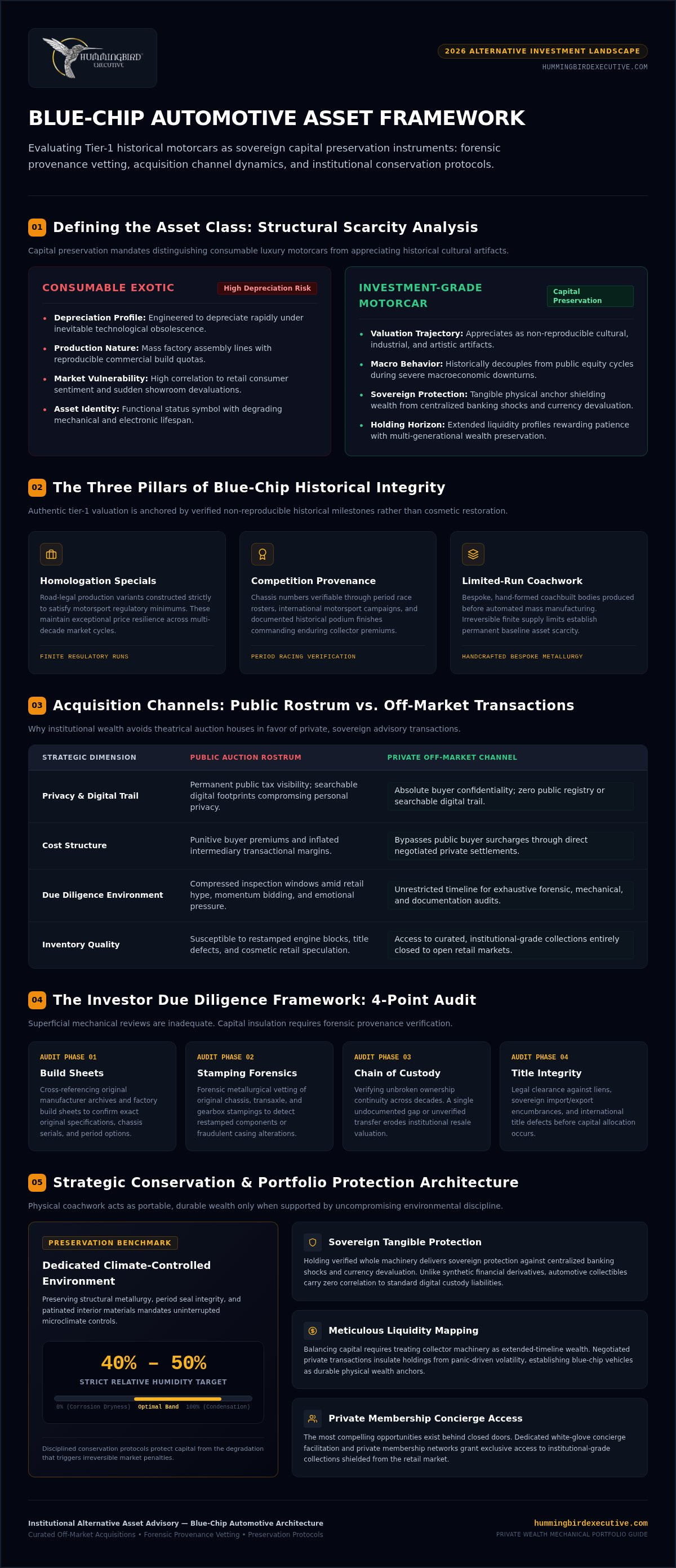
True tangible wealth demands absolute independence from conventional equity cycles. High-grade collector cars occupy a distinct category within private alternative portfolios, historically decoupling from public equities during severe macroeconomic downturns. Yet, capital preservation requires strict discipline. While factory showrooms push modern supercars that suffer catastrophic initial depreciation, institutional collectors concentrate capital on machines anchored by finite build numbers, historic motorsport campaigns, and documented provenance.
Tangible ownership delivers sovereign protection. Holding whole, physical machinery shields private wealth from centralized banking shocks, currency devaluation, and digital custody liabilities. Assessing these mechanical holdings mirrors institutional underwriting, where uncompromised historical integrity represents the sole defense against capital impairment.
Defining the Asset Class: Consumable Luxury versus Investment Grade
The distinction between a consumable exotic and an investment-grade motorcar comes down to structural scarcity. Understanding what defines a classic car in the modern era requires looking past cosmetic allure. Authentic blue-chip status demands non-reproducible historical significance: competition homologation runs, bespoke coachwork by vanished master artisans, or documented participation in period international racing.
Production sports cars are engineered to depreciate as technological obsolescence takes hold. In contrast, vetted historical machinery appreciates as cultural artifacts. Serious collectors integrating these machines into broad wealth strategies frequently reference our institutional guide on private luxury car collection investment to establish rigorous balance sheets across mechanical classes.
- Homologation Specials: Road-legal variants built strictly to satisfy motorsport regulatory minimums maintain exceptional price resilience across decades.
- Documented Competition Provenance: Chassis numbers tied to verifiable period race results command enduring collector premiums.
- Limited-Run Coachwork: Bespoke, hand-formed bodies produced before automated mass manufacturing create irreversible, finite supply limits.
Historical Performance Metrics in Modern Portfolio Construction
Institutional portfolio construction treats blue-chip machinery as a core pillar alongside prime real estate, fine art, and marine assets. High-performing investment opportunities in rare automobiles function on extended liquidity timelines, rewarding patience with multi-generational capital preservation. Because automotive collectibles carry zero correlation to synthetic financial derivatives, they provide an unmatched physical anchor within sovereign holdings.
Balancing capital across these physical assets demands meticulous liquidity mapping. Unlike high-frequency digital assets, premier collector vehicles require private, negotiated transactions that insulate your position from panic-driven volatility. When structured through discreet family offices or private advisory desks, physical coachwork acts as portable, durable wealth that quietly outlasts monetary cycles.
The Investor Due Diligence Framework: Vetting Rarity, Provenance, and Authenticity
Superficial mechanical inspections are entirely inadequate for six- and seven-figure vehicle transactions. Evaluating legitimate investment opportunities in rare automobiles requires forensic scrutiny that mirrors institutional art provenance audits. As highlighted in a global collectible car market analysis, asset values hinge directly on demonstrable authenticity and verifiable historical continuity. A single undocumented repair, incorrect transaxle stamp, or broken chain of custody can erode valuation by forty percent overnight.
Protecting capital mandates a four-stage audit protocol before executing any binding agreement:
- Phase 1: Factory Archive Reconciliation: Authenticate original build sheets and verify mechanical matching numbers across the engine block, transmission, and chassis stampings.
- Phase 2: Custodial Title Reconstruction: Map an unbroken chain of ownership from the original factory delivery manifest down to the current registered title holder.
- Phase 3: Forensic Material Diagnostics: Conduct non-destructive metallurgical analysis and ultrasonic paint thickness mapping across all structural chassis points and body panels.
- Phase 4: Marque Historical Validation: Engage marque-certified historians to cross-examine period competition entries, factory service logs, and historical racing photographs.
Verifying Mechanical Originality and Matching Numbers
Restamped engine casings and reproduction chassis plates represent the primary hazard in modern private trades. Unscrupulous dealers routinely grind down period replacement blocks to replicate original factory numerical fonts. Detecting these alterations requires metallurgical casting examinations, X-ray fluorescence testing, and deep macro-photography to identify molecular variations in engine stamp pads. Even minor non-period modifications compromise an asset’s blue-chip trajectory, turning a preserved historical specimen into an ordinary, highly modified runner.
Forensic Provenance and Historic Race Documentation
Documentation establishes value. Authentic racing history demands unyielding proof: period race manifests, signed scrutineering tags, and uninterrupted photographic records from international motorsport events. Retaining pristine documentation authored by recognized marque archives confirms the car’s physical presence on specific grids. For global collectors seeking vetted access without the vulnerabilities of public dealing, reviewing acquisitions through private advisory consultation ensures every prospective chassis undergoes rigorous institutional verification before funds ever move.
Acquisition Channels Compared: Public Auctions versus Private Off-Market Transactions
Public auction houses market spectacle rather than capital preservation. While the theatrical gavel falls at major sales events generate global headlines, they inflict substantial structural frictions on buyers and sellers alike. Aggregated buyer premiums, which often reach ten to twelve percent above the hammer price, instantly impair your entry basis. Add vendor commissions, cataloguing fees, and compulsory transport costs, and an acquisition must appreciate considerably simply to break even.
Beyond excessive fee structures lies the risk of digital permanence. Every bid, reserve price, and failure to sell remains permanently catalogued in public databases. When a vehicle fails to meet its reserve publicly, the market brands it as “burned.” This digital footprint handicaps future valuation and negotiation leverage for years. Consequently, premier investment opportunities in rare automobiles increasingly bypass public rostrums entirely.
The Hidden Liabilities of Public Auction Houses
Auction houses operate under severe physical constraints. Prospective buyers typically receive forty-eight hours to examine a vehicle, usually under restrictive conditions where mechanical disassembly or extensive metallurgical testing is impossible. Bidders are forced to rely on catalog descriptions drafted by the auction house itself, an entity legally representing the seller’s commercial interest. This compressed timeframe creates immense operational risk, leaving critical questions around originality unresolved until long after funds clear.
- Permanent Digital Footprints: Public serial numbers and realized prices remain permanently indexed, exposing transaction values and collector identities to unwanted scrutiny.
- Compressed Inspection Windows: High-pressure auction settings rarely allow comprehensive chassis-up diagnostics by independent marque historians.
- Basis-Impairing Premiums: Aggregated buyer and seller transaction costs create immediate headwinds against net portfolio returns.
The Strategic Architecture of Off-Market Deals
Discreet private treaty transactions eliminate the compromises inherent to public sales. Conducting transfers through private channels preserves total collector anonymity, preventing speculative market front-running and keeping personal holdings shielded from public tax indexing. These confidential mechanics mirror the protocols detailed in our strategic guide on how to sell a superyacht privately, where privacy serves as the primary currency.
Private bilateral acquisitions grant complete control over the due diligence timeline. Purchase agreements can include rigorous contingency clauses, third-party escrow arrangements, and non-destructive laboratory testing of critical running gear. When capital transacts privately, price formation reflects pure asset value rather than auction-room adrenaline. The most coveted investment opportunities in rare automobiles trade this way: silently, deliberately, and strictly peer-to-peer.
Strategic Portfolio Management: Preservation, Curation, and Capital Protection
Acquiring blue-chip machinery represents only the initial phase of asset stewardship. Sustaining value across decades requires rigorous curation and mechanical discipline. Unlike passive financial assets, physical rolling sculpture is vulnerable to atmospheric corrosion, seal dry-rot, and mechanical stagnation. True capital protection demands an institutional facility protocol that treats historical machinery with the precise environmental care afforded to museum-grade fine art.
Environmental stability prevents costly conservation interventions. Storing blue-chip machinery requires dedicated facilities equipped with commercial desiccant dehumidification systems. Relative humidity must remain strictly between forty and fifty percent at all times. When moisture levels exceed fifty percent, ferrous metals begin micro-oxidizing; drop below forty percent, and delicate Connolly hides and period rubber gaskets shrink and split.
- Microclimate Regulation: Maintain baseline ambient temperatures between sixty-five and sixty-eight degrees Fahrenheit alongside active humidity management.
- Mechanical Exercise Schedules: Conduct scheduled static wheel rotations and fluid circulations to prevent transmission flat-spotting and hydraulic system corrosion.
- Specialist Agreed-Value Underwriting: Establish bespoke insurance coverage featuring agreed valuation clauses, unlimited transit riders, and diminishing deductible provisions.
Museum-Grade Storage and Climate Management
Long-term mechanical stasis degrades engines faster than steady, sympathetic road use. Preserving the integrity of prime investment opportunities in rare automobiles requires active preservation routines. Dedicated microprocessor-controlled battery tenders must maintain baseline electrical system integrity without overcharging delicate period wiring harnesses. In addition, facility fire prevention demands clean-agent gaseous suppression systems such as Novec 1230 rather than water sprinklers, ensuring an overhead discharge never causes structural or cosmetic water damage to delicate alloy coachwork.
Global Transit, Customs, and Estate Structuring
Executing international acquisitions requires specialized cross-border logistics. Irreplaceable chassis should transit exclusively via temperature-controlled air freight, avoiding the humidity shifts, salt air, and vibrational stress of oceanic maritime containers. Transiting borders for preservation, restoration, or private exhibition requires navigating temporary import carnet documentation and verifying current international customs import duties on historic vehicles before cross-border transport begins.
Sovereign wealth demands clean legal architecture. High-value automotive portfolios should be integrated into multi-jurisdictional family trusts or dedicated holding entities to optimize tax efficiency and simplify intergenerational inheritance. For collectors seeking tailored guidance on executing secure global acquisitions, connect with Hummingbird Executive to coordinate end-to-end asset procurement and cross-border delivery.
Accessing Exclusive Automotive Opportunities: Private Concierge and Membership Portals
The world’s most significant historical motorcars never see a showroom floor, nor do they surface in public auction catalogues. Tier-1 collectors, family offices, and sovereign wealth custodians transact exclusively through private channels. These peer-to-peer exchanges require established relationships, verified liquidity, and complete mutual discretion. For capital allocators pursuing premier investment opportunities in rare automobiles, access depends entirely on confidential representation capable of bridging the gap between private sellers and qualified buyers.
Operating beyond public scrutiny shields portfolios from market distortion. Dedicated private concierges manage each acquisition lifecycle end-to-end, executing forensic provenance validations, structuring cross-border escrows, and orchestrating secure transport logistics. This institutional framework protects both buyer identity and transaction value across multi-asset portfolios spanning rare coachwork, marine craft, private aviation, and institutional real estate.
The Hummingbird Executive Private Hub: Complete Discretion
Digital privacy is non-negotiable when transacting high-value assets. Hummingbird Executive operates on a proprietary platform architecture engineered entirely without tracking cookies, eliminating the digital footprint common to standard web platforms. Personal identities, capital capabilities, and asset inquiries are never catalogued, monetized, or indexed by search engines. Collectors seeking an uncompromising layer of operational confidentiality can examine the Platinum Membership luxury concierge framework to understand how private asset access is secured without digital exposure.
Membership Tiers Tailored to Global Asset Allocators
Engaging off-market inventory requires advisory structures aligned with distinct operational requirements. Hummingbird Executive facilitates access through structured membership tiers designed for international collectors:
- Platinum Membership: Delivers complete access to rare assets, acquisitions, private searches, and divestments, supported by dedicated concierge services worldwide at no additional fee.
- Gold Membership: Provides comprehensive white-glove facilitation seven days a week during standard operating hours, coordinating private treaty negotiations and asset vetting. Review the Gold Membership luxury services framework for dedicated regional allocation.
- Free Access White-Glove Service: Grants entry-level access to white-glove services worldwide during business opening hours to review available off-market opportunities.
Securing genuine investment opportunities in rare automobiles ultimately demands an invisible hand. Initiating a discreet acquisition request through a private Hummingbird advisor ensures your capital moves quietly, securely, and strictly on your own terms.
Mastering the Future of Discreet Automotive Acquisition
Capturing genuine enduring value in physical machinery requires looking beyond public auction spectacle. Sustainable portfolio alpha belongs to collectors who pair forensic provenance audits with disciplined, off-market execution. When you transact privately, you insulate personal wealth from permanent digital indexing, basis-impairing premiums, and public speculation.
Hummingbird Executive safeguards your transactions through a zero-cookie security architecture designed to eliminate digital tracking entirely. Whether sourcing unadvertised historic collections or orchestrating cross-border transport, our dedicated global concierge serves as your invisible partner across the automotive, aviation, and maritime spheres.
Discretion remains your greatest strategic advantage when evaluating premier investment opportunities in rare automobiles. Apply for Platinum Membership to access private off-market automotive opportunities and curate your tangible portfolio with absolute confidence.
Frequently Asked Questions
How do rare automobiles perform as alternative investment assets compared to public equities?
Blue-chip collector motorcars historically demonstrate low correlation to broader equity indices, functioning as durable capital preservation vehicles during macroeconomic volatility. Unlike paper assets or synthetic instruments, tangible machinery possesses physical utility and intrinsic historical value. Prime examples anchored by motorsport heritage and verified provenance act as inflation hedges. They provide sovereign security while appreciating independently of monetary policy shifts, though they require longer liquidity horizons than liquid equities.
What is the difference between purchasing an investment-grade car at auction versus off-market?
Public auctions subject transactions to heavy buyer and seller premiums, compressed inspection windows, and searchable digital records that permanently index your purchase price. Off-market transactions eliminate these frictions entirely. Purchasing privately protects collector anonymity, removes intermediary markups, and allows comprehensive forensic due diligence without artificial auction deadlines. Most high-value investment opportunities in rare automobiles trade exclusively through these private conduits to maintain confidentiality and price integrity.
How does an investor verify that a classic vehicle possesses authentic matching numbers?
Authentication requires cross-referencing mechanical stampings against original factory build sheets and marque archival ledgers. Specialists conduct non-destructive metallurgical testing, X-ray fluorescence analysis, and macro-photography across the engine pad, transmission casing, and chassis plates. This forensic examination detects restamped fonts, altered numerals, or reproduction components. Partnering with certified marque historians ensures the vehicle retains its original mechanical running gear rather than later period replacements.
What ongoing maintenance and storage protocols are required to preserve automotive value?
Preservation requires housing vehicles within dedicated, climate-controlled environments that maintain relative humidity strictly between forty and fifty percent. Baseline temperatures must remain stable to prevent seal shrinkage, interior leather drying, and ferrous corrosion. Operational regimens should incorporate scheduled fluid cycling, static tire rotations, and microprocessor battery tenders. Using clean-agent gaseous fire suppression systems rather than water sprinklers eliminates catastrophic water damage risks during facility emergencies.
Can modern limited-production supercars be considered investment-grade vehicles?
Only a tiny fraction of modern supercars attain true investment-grade standing. Most modern exotics suffer steep initial depreciation as succeeding models introduce faster technology. To command lasting collector interest, contemporary vehicles must feature strictly capped production allocations, manual transmissions, or direct motorsport homologation ties. Evaluating modern investment opportunities in rare automobiles requires separating short-term showroom speculation from genuine, long-term historical significance.
How does Hummingbird Executive guarantee privacy during high-value automotive acquisitions?
Hummingbird Executive protects client discretion through a secure platform architecture engineered entirely without tracking cookies. Member inquiries, capital parameters, and acquisition activities are never tracked, monetized, or indexed by search algorithms. Transactions execute via confidential private treaties and dedicated escrow frameworks. By acting as an invisible partner between verified parties, the firm prevents digital exposure, shielding your personal identity and portfolio holdings from public scrutiny.
What membership tier is required to access private off-market automotive opportunities?
Access begins with the Free Access White-Glove Service, which allows private collectors to explore available opportunities during standard business opening hours. For active sourcing and transaction execution, clients select between the Gold and Platinum tiers. The Gold Membership provides white-glove support seven days a week during opening hours. The Platinum Membership delivers complete access to off-market acquisitions, bespoke searches, and dedicated concierge services worldwide at no extra charge.