The most prestigious 50-meter berths in the Mediterranean aren’t found on public reservation portals; they’re secured through quiet, private handshakes long before a vacancy is ever announced. You’ve likely realized that finding a berth for a newly acquired superyacht has become an exercise in navigating a closed ecosystem where demand vastly outstrips visible supply. The frustration of being told a marina is at capacity, while prime slips sit empty, is a common symptom of a market that prioritizes relationships over public listings.
It’s understandable to feel that the lack of transparency in lease pricing and the complexity of 2026 maritime regulations add unnecessary friction to your ownership experience. This guide serves as your strategic blueprint for securing a home port for the next five to twenty years through off-market channels. We’ll detail how to leverage discreet global networks to find a permanent residence for your vessel that aligns with your broader asset management goals. You’ll learn how to maintain absolute privacy while ensuring your yacht remains a secure sanctuary, supported by the invisible hand of a 25/7 concierge who operates within the world’s most exclusive maritime circles.
Key Takeaways
- Treat your home port as a strategic maritime asset that preserves long-term resale value and enhances the global marketability of your vessel.
- Navigate the acute shortage of 50m+ slips by utilizing private, off-market channels for finding a berth for a newly acquired superyacht.
- Learn to distinguish between Right to Use ownership models and complex leasehold structures like ‘Ammodiation’ in high-demand European waters.
- Optimize your operational profile by matching technical requirements with a geographic hub that supports your specific one-season or two-season cruising itinerary.
- Access a protected inner circle of maritime real estate through the 25/7 facilitation provided by the Hummingbird Platinum Membership.
The Strategic Importance of the Home Port: More Than a Mooring
A superyacht is often viewed as the pinnacle of mobile luxury, yet its true utility and market value are anchored by its home port. In the current 2026 climate, finding a berth for a newly acquired superyacht is no longer a post-purchase checklist item; it’s a critical component of the acquisition itself. A foundational understanding of a berth reveals that it’s far more than a physical space. It’s a strategic maritime asset that serves as a secure extension of an owner’s private estate. Without a guaranteed slip in a premier location, the vessel’s operational flexibility is severely compromised.
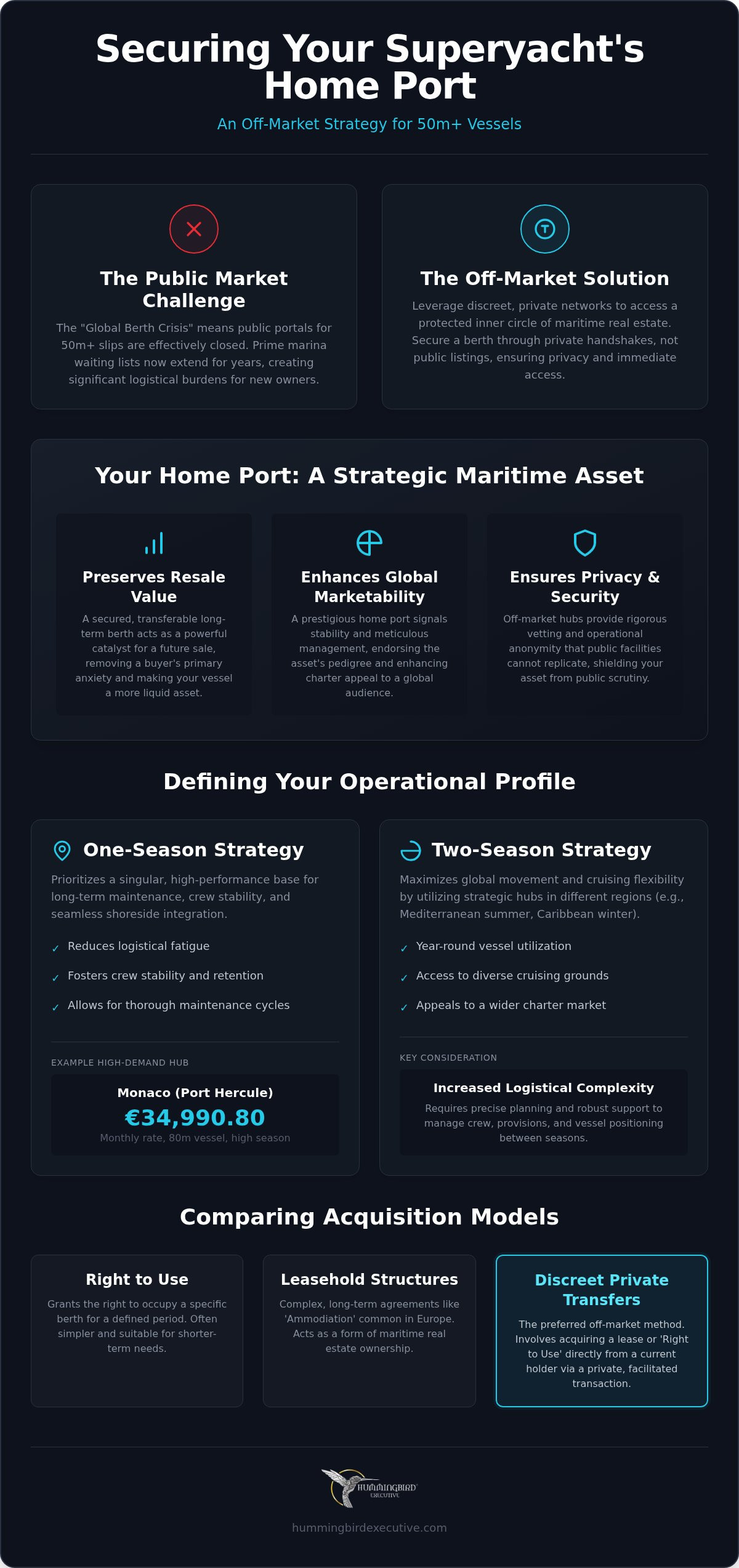
The “Global Berth Crisis” of 2026 has fundamentally shifted the landscape for vessels over 50 meters. Waiting lists in prime Mediterranean hubs like Monaco or Porto Cervo now extend years into the future. A reactive approach often leaves owners in secondary locations, which degrades the vessel’s charter appeal and complicates crew retention. High-tier crew members prioritize berths in locations with established infrastructure and social connectivity. Conversely, a prestigious home port signals stability and meticulous management to the global market. It functions as a silent, powerful endorsement of the asset’s pedigree.
Berth Acquisition and Asset Liquidity
The presence of a long-term, transferable lease significantly impacts the ease of a future exit. When the time comes to execute a strategy on how to sell a superyacht privately, a secured berth acts as a powerful catalyst for the transaction. It removes the buyer’s primary anxiety: where to put the boat. We define the ‘berth-yacht synergy’ as a primary driver of maritime portfolio growth. By securing a strategic location, you aren’t just docking a vessel; you’re insulating your capital against the volatility of the spot-market. This foresight ensures that the vessel remains a liquid asset rather than a logistical burden.
Privacy and Security in the 2026 Maritime Landscape
For the ultra-high-net-worth individual, visibility is a liability. Public marinas, while convenient, often lack the rigorous vetting required to maintain absolute discretion. Finding a berth for a newly acquired superyacht through off-market channels ensures that the vessel’s home base remains shielded from public scrutiny. Private concierge lenses evaluate security not just by gate height, but by the marina’s operational culture and its commitment to member anonymity. These off-market hubs provide a level of operational security that public facilities simply cannot replicate. Hummingbird Platinum members rely on this “invisible hand” to facilitate access to these protected enclaves, ensuring their maritime lifestyle remains an entirely private affair.
Defining the Operational Profile: One-Season vs. Two-Season Strategy
The efficiency of a yacht’s operation depends on the precision of its initial profiling. When finding a berth for a newly acquired superyacht, the owner must first reconcile the vessel’s technical footprint with its intended global movement. For vessels exceeding 50 meters, technical constraints such as draft depth and beam width are non-negotiable gatekeepers. In 2026, marina suitability also hinges on compliance with updated IMO standards, including the prohibition of PFOS-based firefighting foams and stricter fuel flashpoint certification. A strategic hub must accommodate the physical hull and the complex power requirements of a modern, data-heavy maritime asset, where specialists like Virtuser provide turnkey private 5G and LTE solutions necessary for secure, high-stakes connectivity.
The One-Season Home Port Protocol
A one-season strategy prioritizes a singular, high-performance base for long-term maintenance and crew stability. Hubs like Port Vauban in Antibes or Port Hercule in Monaco remain the gold standard for this approach. In 2026, Monaco’s monthly rates for an 80-meter vessel reach €34,990.80 during the high season, reflecting the premium placed on these established Mediterranean centers. This model reduces the logistical fatigue of constant relocation. It allows for more thorough shoreside integration, where the marina serves as a seamless extension of the owner’s lifestyle. Selecting a base also involves evaluating shoreside facilities, ensuring guest transfers and lifestyle amenities are within a protected, high-security perimeter. Finding a berth for a newly acquired superyacht in these high-demand zones requires activating private networks long before the vessel arrives.
The Two-Season Global Rotation
Owners seeking year-round utility often adopt a two-season circuit, rotating between the Mediterranean summer and the Caribbean or Middle Eastern winter. This rotation requires meticulous coordination with private aviation logistics to ensure guest arrivals are as effortless as the vessel’s repositioning. While the Caribbean remains a traditional winter choice, Dubai has emerged as a significant year-round hub for superyachts in 2026. Navigating the transitions between international maritime jurisdictions, such as the EU’s 18-month temporary admission rule for non-EU yachts, requires expert oversight. For those managing a global rotation, the facilitation of a Platinum Membership ensures that every transition is handled with the quiet efficiency of a silent partner.
Comparing Acquisition Models: Ownership, Leases, and Private Transfers
The legal architecture of maritime real estate differs fundamentally from terrestrial property. Finding a berth for a newly acquired superyacht requires a nuanced understanding of how “ownership” is defined in international waters. In most premier jurisdictions, you don’t purchase the seabed; you acquire a Right to Use (RTU) through a long-term concession. This is particularly prevalent in the Mediterranean, where the concept of “Ammodiation” governs the French and Spanish coastlines. These are administrative contracts that grant exclusive use of a specific slip for a set duration, often requiring the owner to navigate complex local maritime laws that vary significantly between Port Vauban and Porto Montenegro.
Long-Term Leaseholds and Right to Use
Standard leasehold durations in established hubs typically span 10 to 20 years. Securing a long-term position in a developing or recently renovated hub offers a strategic advantage, as it locks in access before demand reaches its peak. It’s vital to vet the marina’s management and financial stability before committing capital to a lease. A lease’s “tail-end” value must also be considered; as the expiration date nears, the asset’s liquidity decreases unless there’s a clear path to renewal. Smart owners treat these leases as depreciating assets that offer high operational utility, balancing the cost against the certainty of a guaranteed home port in a crowded market.
The Off-Market Transfer Advantage
The most coveted berths rarely appear on public maritime portals. Instead, they circulate within a protected inner circle of owners and facilitators. Utilizing a platinum membership luxury concierge allows for the identification of private lease transfers that never reach the open market. These member-to-member introductions bypass the traditional “brokerage premium” and provide access to slips in marinas that claim to be at 100% capacity. This discreet search protocol ensures that finding a berth for a newly acquired superyacht remains a private transaction, shielded from the public eye. By facilitating these direct swaps, the “invisible hand” of a concierge service maintains the exclusivity and security that high-profile owners require. This model prioritizes precision and speed, moving from the identification of an opportunity to the finalization of the contract without the noise of a public listing.
The Discreet Search Protocol: A 5-Step Guide to Finding a Berth
Securing prime maritime real estate requires a methodology that mirrors private equity acquisition rather than standard property rental. Finding a berth for a newly acquired superyacht is a high-stakes endeavor where the most desirable opportunities never reach the public eye. We operate a structured, five-step protocol designed to move from initial requirement to final transfer with absolute discretion and precision.
Step 1: Establishing the technical and privacy requirements. This phase involves a deep audit of the vessel’s 2026 compliance, including Polar Code documentation for yachts over 300 GT and the specific power draw of onboard systems. Step 2: Activating the private network. We leverage long-standing relationships with port captains and marina developers to identify upcoming vacancies. Step 3: Conducting rigorous due diligence. This goes beyond the physical slip to include the marina’s operational history, local security culture, and the financial health of the management entity. Step 4: Negotiating terms through a discreet intermediary. By shielding the owner’s identity, we avoid the inflated pricing often applied to high-profile principals. Step 5: Finalizing the maritime legal transfer. This ensures all ‘Ammodiation’ or Right to Use contracts are legally sound and that the crew is seamlessly onboarded into the new hub’s ecosystem.
Identifying the ‘Silent’ Inventory
The global shortage of 50-meter plus berths has created a shadow market where transactions occur in the quiet spaces between public announcements. The best berths are sold before they are vacant. Accessing this silent inventory requires monitoring lease expirations in hubs like Porto Montenegro or Port Vauban years in advance. By maintaining a constant dialogue with maritime gatekeepers, we identify slips that are about to become available due to private sales or fleet upgrades. This proactive intelligence allows our members to secure a strategic position while the rest of the market is still waiting for a public listing that will never arrive.
The Intermediary Advantage
Direct negotiation between an owner and a marina often results in ‘luxury tax’ pricing, where the principal’s profile dictates the terms. Using a professional facilitator ensures that the focus remains on the asset’s technical requirements and the fair market value of the lease. A discreet intermediary also vets the neighborhood and local infrastructure to ensure the home port aligns with the owner’s wider lifestyle strategy. Throughout this process, we maintain a secure, no-cookie digital footprint to protect your privacy from data scrapers and public tracking. To initiate a private search for your vessel, you may engage our maritime concierge team for a confidential consultation.
Seamless Maritime Integration via Hummingbird Platinum Concierge
Hummingbird Executive operates as the ultimate invisible hand, ensuring that the logistical complexities of ownership never disrupt the owner’s experience. Finding a berth for a newly acquired superyacht is rarely a standalone event; it’s a strategic move within a broader maritime asset management plan. Our role is to facilitate this transition with a level of precision that matches the caliber of the vessel itself. By operating behind the scenes, we ensure that every detail, from technical vetting to legal finalization, is resolved before it requires the owner’s attention.
The Platinum Maritime Hub
Platinum members gain exclusive access to a private investment marketplace where rare maritime opportunities are curated and vetted. This hub serves as the primary conduit for identifying off-market slips and long-term lease transfers that are otherwise invisible to the public. Beyond finding a berth for a newly acquired superyacht, our team assists with the immediate needs of a new asset, including the recruitment of specialized crew and the implementation of 2026-compliant safety protocols. We prioritize absolute privacy, utilizing a secure, no-cookie platform to manage all high-stakes communications and asset data.
The synergy between gold membership luxury services and high-stakes maritime logistics allows for a truly unified approach to asset management. Many of our members view their yacht as one pillar of a diversified portfolio. Integrating maritime assets with other high-value holdings, such as a private luxury car collection investment, ensures that every asset is managed with the same rigorous standard of care. Our 25/7 promise means that as your needs evolve, our support remains constant and unflappable, providing a sense of absolute reassurance in a volatile global market.
Beyond the Berth: Comprehensive Concierge Support
True integration extends well past the marina’s gates. We coordinate the entire arrival experience, from private jet transfers to the home port to the management of shoreside real estate for the owner’s party. This end-to-end facilitation removes the friction typically associated with cross-border maritime movement. Whether you’re transitioning from a Mediterranean summer to a Middle Eastern winter, our team handles the cross-border regulations and global logistics with silent efficiency. This unified, secure approach ensures that your maritime lifestyle remains a protected sanctuary, managed by professionals who have accounted for every detail in advance.
Securing Your Position in the 2026 Maritime Landscape
Finding a berth for a newly acquired superyacht is no longer a matter of public inquiry; it’s a high-stakes acquisition of rare maritime real estate. Success in this environment requires a shift from reactive booking to a proactive, portfolio-based strategy that treats the home port as a critical component of the vessel’s long-term liquidity. By prioritizing off-market transfers and conducting rigorous due diligence on ‘Ammodiation’ durations, owners can insulate their assets from the global slip shortage. A prestigious home port does more than provide a mooring; it preserves resale value and ensures the stability of your onboard crew.
Hummingbird Executive facilitates this transition as a silent partner, offering a protected gateway to the world’s most exclusive marinas. Through our secure, no-cookie platform, members access an off-market asset marketplace that remains invisible to the public. Our 25/7 dedicated concierge service ensures that every logistical detail, from cross-border regulations to private aviation coordination, is managed with absolute discretion. Secure your maritime legacy with Hummingbird Platinum access and ensure your vessel’s home port is as prestigious as the journey itself. Your maritime sanctuary is waiting.
Frequently Asked Questions
Is it better to buy or lease a superyacht berth in the Mediterranean?
Mediterranean “ownership” is actually a long-term Right to Use concession, often referred to as ‘Ammodiation’ in French and Spanish waters. Finding a berth for a newly acquired superyacht usually involves securing these 10 to 20 year leases rather than outright deeded property. Leasing provides necessary agility as your fleet requirements evolve, while long-term concessions offer the stability needed for crew retention and maintenance. It’s a balance of capital commitment versus operational necessity.
What are the most exclusive ‘off-market’ marinas for superyachts in 2026?
While public hubs like Monaco remain prestigious, the most exclusive marinas in 2026 are those that operate within private membership networks. Locations like Porto Montenegro and specific enclaves in Dubai provide superior privacy for 50-meter plus vessels. These hubs prioritize discretion and often manage availability through off-market maritime intelligence rather than public reservation portals. Accessing these spots requires a silent partner who understands the local gatekeeping culture and private transfer protocols.
How does the length of a yacht affect the availability of berths in prime locations?
Vessel length is the primary filter for availability in the current maritime landscape. The market for slips under 30 meters is relatively fluid, but the inventory for 50m+ yachts is in a state of acute shortage. For vessels over 80 meters, the search protocol shifts entirely to private transfers and off-market negotiations. As dimensions increase, technical requirements like draft depth and power draw become as restrictive as the physical length of the quay.
Can a berth lease be included as part of a private superyacht acquisition?
Bundling a berth lease with a private acquisition is a highly effective strategy for preserving asset liquidity. It eliminates the buyer’s primary hurdle: locating a secure home port in a saturated market. When finding a berth for a newly acquired superyacht, checking if the seller has a transferable Right to Use can significantly enhance the vessel’s marketability. This synergy between the asset and its mooring is a cornerstone of modern maritime asset management.
What are the typical maintenance and service charges associated with a prime berth?
Operating costs vary significantly by location and vessel size. For an 80 to 85 meter yacht in Monaco, high-season monthly rates reach €34,990.80, reflecting the premium for Mediterranean access. In Miami, annual dockage for a 100ft yacht averages approximately $66,000. These figures don’t include utilities, security surcharges, or local administrative fees. Owners should account for these recurring expenses as part of a wider asset management strategy to avoid unforeseen operational friction.
How can a family office maintain privacy when securing a permanent home port?
Family offices preserve anonymity by utilizing discreet intermediaries and secure digital platforms. Hummingbird Executive facilitates these transactions via a secure, no-cookie environment that ensures personal data is never sold or tracked. By managing the search and negotiation through a private concierge, the family office avoids public exposure and the “luxury tax” pricing often applied when a high-profile principal’s identity is revealed. This approach ensures the vessel’s location remains a private matter.
What happens to a berth lease if the yacht is sold privately?
The status of a lease during a sale depends on the specific Right to Use contract. Most long-term concessions are transferable to the new owner, provided the vessel fits the technical parameters of the slip. This transferability is a key driver of the yacht’s resale value and should be verified during the due diligence phase. It’s essential to vet the legal framework of the marina’s management before finalizing any acquisition to ensure the home port remains secure.
Are there specific marinas that cater better to off-market maritime assets?
Marinas that prioritize member privacy and operate within a private investment marketplace are ideal for off-market assets. These facilities often have rigorous vetting processes for all entrants and offer shoreside infrastructure designed for absolute discretion. They function less like public ports and more like private clubs, where the invisible hand of a concierge service manages arrivals and shoreside logistics. This creates a low-profile operational environment that shields the owner’s interests from public scrutiny.