In 2026, the perceived convenience of a fractional share is often a quiet concession of personal sovereignty. While the entry point of a program like Flexjet offers immediate access, it frequently comes at the cost of rigid contractual constraints and a rotating crew roster that compromises the very privacy you seek. You likely recognize that true mobility is not merely about reaching a destination; it’s about the absolute control of the environment in which you travel. Utilizing professional private jet buyer agent services has become the preferred method for those who prioritize bespoke cabin sovereignty over shared fleet logistics.
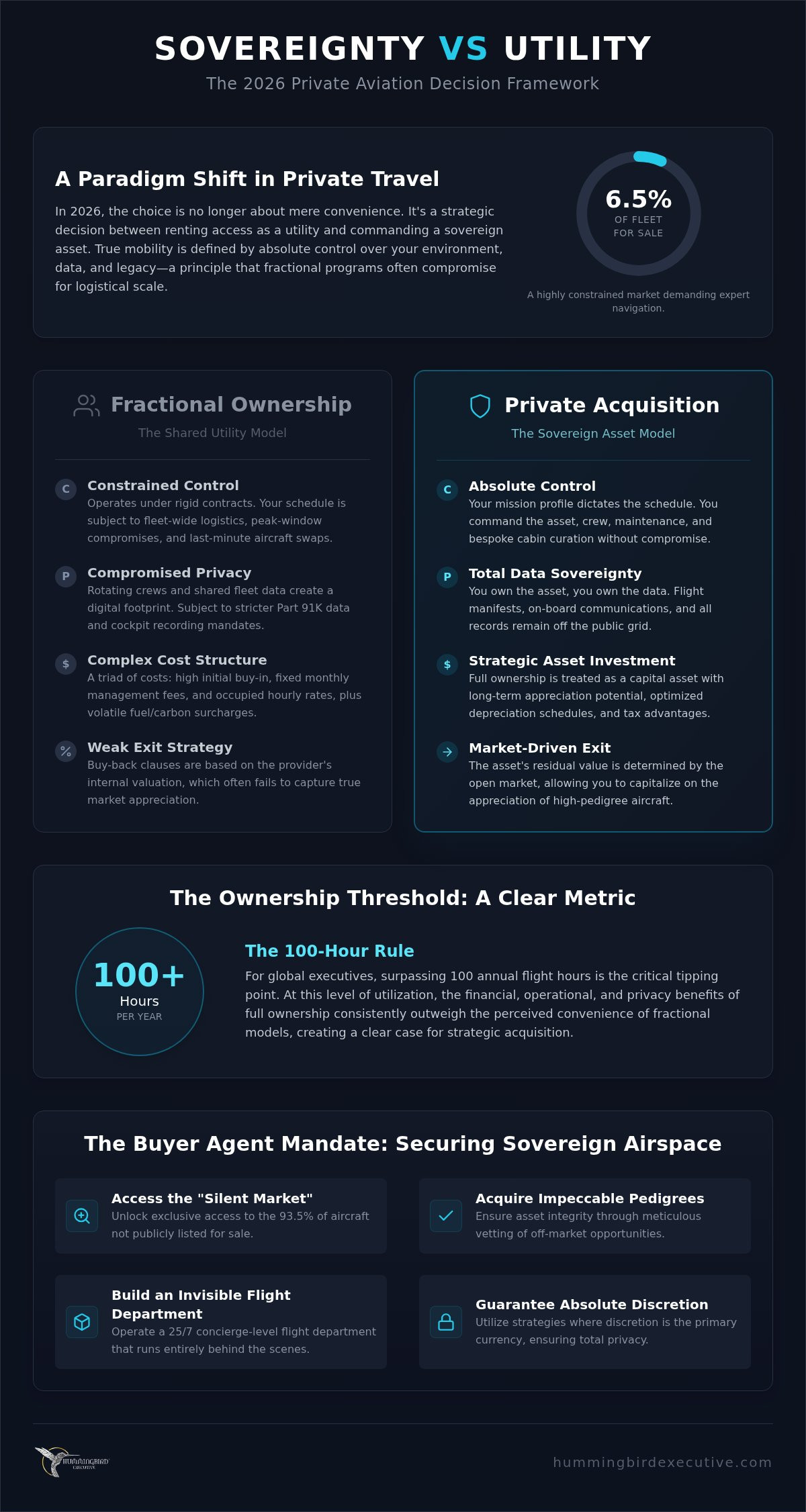
The choice between shared utility and private acquisition has never been more consequential for your tax position and asset value. This article provides a definitive analysis of fractional models versus private acquisition to determine which path secures your legacy in a market where only 6.5% of the active fleet is available for sale. We will preview the impact of the 2025 One Big Beautiful Bill Act on your depreciation schedule, the reality of residual value in the pre-owned market, and the mechanics of achieving a seamless global footprint without leaving a public trail.
Key Takeaways
- Understand why 2026 mandates a shift from aviation as a mere utility to a strategic asset that preserves your data sovereignty.
- Analyze the true all-in cost of fractional models against the long-term appreciation potential of a curated private fleet.
- Discover how private jet buyer agent services secure access to the Silent Market, ensuring you acquire off-market assets with impeccable pedigrees.
- Learn why the 100-hour rule is redefining the ownership threshold for global executives seeking optimized tax and depreciation positions.
- Explore the role of a 25/7 concierge in maintaining an invisible flight department that operates entirely behind the scenes.
Private Aviation in 2026: Sovereignty vs. Utility
The landscape of private aviation in 2026 is defined by a widening chasm between those who view flight as a utility and those who demand it as a sovereign asset. For years, the market championed shared logistics as the pinnacle of efficiency. However, a decisive shift is occurring among principals who recognize that branded fleet programs often prioritize the operator’s scale over the client’s discretion. The “Invisible Hand” of private management is replacing the loud branding of traditional providers. Private sovereignty in aviation is the absolute control over asset, crew, and data.
The Utility Trap: When Convenience Becomes a Constraint
The fractional ownership model operates on the premise of guaranteed access, yet 2026 travel patterns have exposed the fragility of this promise. During peak windows, the logistical strain on shared fleets often results in subtle operational compromises. You might find your tail number swapped at the last minute or your departure window shifted to accommodate the fleet’s broader obligations. Transitioning from a passenger in a program to the sole owner of an asset eliminates these constraints. Engaging professional private jet buyer agent services ensures that your mission profile, not a fleet manager’s spreadsheet, dictates your schedule. It’s the difference between being a customer and being a commander.
The Sovereignty Advantage: Total Control of the Environment
Total control extends far beyond the flight deck. In 2026, new cockpit voice recorder and data privacy regulations have made shared fleets a potential liability for those requiring absolute confidentiality. When you own the asset, you own the data. You control the flight manifests and the security of on-board communications, ensuring they remain entirely off the public grid. This environment allows for bespoke cabin curation that reflects your specific requirements while maintaining long-term residual value. Crew consistency is equally vital. A dedicated, vetted team provides a level of security and intuitive service that a rotating roster cannot match. The quiet facilitation provided by private jet buyer agent services allows for a level of asset vetting that public listings simply cannot offer. You gain a protected inner circle where discretion is the primary currency.
Evaluating the Flexjet Fractional Architecture
The Flexjet architecture is a study in structured access. It functions through a triad of capital: an initial acquisition payment, recurring monthly management fees, and the occupied hourly rate. In 2026, securing a 1/16th share in a super-midsize jet typically requires an outlay of $800,000 to $950,000. While the “Red Label” program offers dedicated crews to simulate the feel of full ownership, the asset remains a shared entity. You don’t hold the unique title on the official FAA aircraft registry; you hold a contractual right to time.
The Financial Predictability Myth
Fractional providers often sell “predictability” as a core value, yet 2026 has introduced variables that challenge this narrative. Fuel surcharges and mandatory carbon offset programs now fluctuate with a volatility that fixed management fees can’t mask. While “Global Interchange” allows you to switch between aircraft types for specific missions, the associated fees for upgrading can be substantial. More critically, the exit strategy for a fractional share is often its weakest point. Buy-back clauses are structured around the provider’s internal valuation, which rarely keeps pace with the appreciation seen in the private market for high-pedigree aircraft. Professional private jet buyer agent services offer a more transparent alternative by focusing on assets with clear, market-driven exit paths.
Operational Limitations of Branded Fleets
The “Closed Fleet” concept suggests exclusivity, but it’s ultimately a logistical necessity for the provider. Operations are bound by primary service areas where venturing outside these zones triggers significant repositioning costs. In 2026, the regulatory landscape has also shifted significantly. Shared operators under Part 91K face increasingly stringent data privacy and cockpit recording mandates that doesn’t always apply to private Part 91 owners. These requirements can create a digital footprint that many principals find unacceptable. If you prefer a model that prioritizes your anonymity, exploring off-market acquisition strategies is often the more prudent path.
The tactical benefit of swapping aircraft types is frequently outweighed by the loss of consistency in the cabin environment. When you own the asset, you control the data and the security protocols. Using private jet buyer agent services allows you to bypass the public inventory, which currently sits at a tight 6.5% of the active fleet, to find the specific tail that meets your exact standards for sovereignty and value.
The Sovereign Alternative: Private Off-Market Acquisition
While fractional programs offer a prescriptive utility, the most discerning principals recognize that the finest assets never reach the public eye. The “Silent Market” represents a parallel economy where high-pedigree aircraft are traded with absolute discretion, far from the volatility of public listing sites. In 2026, with active fleet inventory remaining constrained at approximately 6.5%, the public market often becomes a theater for compromise. Off-market acquisitions effectively insulate the principal from the public bidding wars that frequently inflate prices in a market where premium inventory remains below historical averages. By utilizing business aircraft transactions expertise, owners can secure assets that are vetted for both mechanical integrity and financial upside.
Sourcing via the Silent Architecture
The process of acquiring a private asset requires a level of gatekeeping that standard brokerages cannot provide. Our platinum membership luxury concierge services function as the invisible infrastructure for these rare acquisitions. This model prioritizes buyer anonymity, ensuring that your intent to purchase does not become public record before the title is secured. For those seeking specific long-range capabilities, sourcing a Bombardier Global Express off-market allows for the selection of airframes with low cycles and impeccable maintenance histories. Private jet buyer agent services provide the necessary vetting to ensure that every off-market asset meets the rigorous standards required for Part 91 operation, bypassing the picked-over inventory of the public sphere.
Aesthetic and Technical Sovereignty
Full ownership grants a level of environmental control that no shared fleet can replicate. While fractional providers offer standardized cabin tiers, private acquisition allows for bespoke interior design that serves as a tool for long-term residual value retention. You aren’t limited by fleet-wide maintenance schedules or standardized avionics suites. In 2026, upgrading to the latest cockpit standards is a matter of personal choice rather than a corporate mandate. This technical sovereignty ensures your aircraft remains compliant with evolving data privacy regulations while maintaining its status as a “one-of-one” asset. Furthermore, the 2025 One Big Beautiful Bill Act (OBBBA) has solidified the tax advantages of full ownership, allowing for 100% bonus depreciation on both new and pre-owned assets used for business. This financial leverage, combined with the ability to curate a dedicated, vetted crew, transforms the aircraft from a travel expense into a strategic pillar of your personal and professional sovereignty.
Strategic Metrics: Calculating the 2026 Ownership Threshold
The traditional 200-hour benchmark for aircraft ownership is a relic of a less sophisticated market. In 2026, it’s clear that the intersection of 100% bonus depreciation and the rise of specialized management efficiencies has lowered the strategic threshold for private acquisition to approximately 100 hours annually. While fractional providers emphasize the “occupied hourly rate,” a true all-in calculation must account for the capital depreciation and recurring management fees that persist regardless of actual usage. Private ownership, facilitated by professional private jet buyer agent services, offers a more transparent cost structure where your capital is preserved in a tangible asset rather than a depreciating utility contract.
The “deadhead” factor remains a hidden drain on fractional value. While some programs promise no repositioning fees within a primary service area, venturing outside these zones often triggers substantial operational costs. In a private model, ferry flights are managed with tactical precision, often utilizing the aircraft’s positioning to support broader logistical requirements. Unlike the rigid 60-month terms standard in fractional agreements, a private asset doesn’t lock you into a fixed timeline. You retain the power to divest or upgrade the moment the market dictates, ensuring your fleet remains a responsive tool for your personal sovereignty.
The Cost of Privacy and Discretion
Discretion is a non-negotiable metric for the modern principal. Public tail-number tracking has made shared fleets increasingly transparent to data harvesters and competitors alike. A private trust-based registration provides a layer of anonymity that is essential for secure global mobility. Our gold membership luxury services provide a strategic entry point for those seeking to navigate these complexities with professional oversight. This secure, no-cookie acquisition process ensures your digital footprint remains as invisible as your flight path.
Management and Crew Efficiency
The shift from in-house flight departments to third-party management firms is a defining trend of 2026. This move reduces the operational burden while maintaining the “Concierge Extension” that elite owners expect. There is a measurable ROI in crew loyalty. A dedicated team understands the nuances of your preferences and the security requirements of your executive team. This consistency is impossible in a shared model where the flight deck changes with every mission. Utilizing private jet buyer agent services allows you to vet not just the airframe, but the management structure that will support it. To explore how these metrics apply to your specific travel profile, we invite you to consult with our private aviation specialists.
The Hummingbird Mandate: Securing Your Sovereign Airspace
Transitioning from a fractional contract to private ownership in 2026 isn’t just a change in how you fly. It’s a strategic pivot toward total autonomy. Our Platinum Membership serves as your invisible flight department. It provides the comprehensive infrastructure of a global operation without the public footprint or rigid constraints of a branded fleet. By utilizing professional private jet buyer agent services, you secure an advocate whose only loyalty is to your personal sovereignty and asset value. This shift allows you to move beyond the “utility” phase of aviation and into a model where the aircraft is a curated extension of your private office.
The Hummingbird Secure Hub allows you to browse off-market jets in a completely no-cookie environment. Your search remains invisible to the data aggregators that track public aviation moves. Our 25/7 dedicated concierge manages the seamless transition of worldwide logistics, ensuring that your aircraft is positioned and ready the moment your schedule demands it. This level of facilitation ensures that the operational burden of whole-aircraft ownership never reaches your desk. You gain the benefits of a dedicated fleet with none of the administrative friction.
Platinum Membership and Aviation
Platinum members gain access to the world’s rarest aviation assets at no extra charge for the facilitating concierge services. Our white-glove investment concierge conducts rigorous pre-acquisition vetting, ensuring every potential airframe has an impeccable pedigree and a transparent maintenance history. This level of curation allows you to integrate your aviation strategy into a broader private luxury car collection investment or maritime portfolio. It creates a unified approach to high-value asset management where discretion is the primary currency. We ensure that your aviation assets are handled with the same level of professional distance and security as your private banking interests.
The Future of Discreet Acquisition
The Silent Market remains the only true defense against the volatility of the 2026 pre-owned market. While public prices fluctuate based on inventory scarcity, off-market transactions occur in a protected ecosystem. Initiating a private search for specific models, such as a Gulfstream GIVSP or a Bombardier Global Express, requires a partner who operates behind the scenes. Private jet buyer agent services provide the gatekeeping necessary to filter out distressed assets and focuses on tails with low cycles and high residual potential. Securing your seat in our private hub is the first step toward reclaiming your sovereign airspace. The roadmap for 2026 is clear: move away from the constraints of shared utility and toward the security of a private, sovereign asset.
Reclaiming the Command of Your Global Mobility
The choice between fractional utility and private sovereignty is ultimately a decision of where you place your trust. While shared programs offer a temporary convenience, they cannot replicate the security, data privacy, and bespoke environment of a wholly-owned asset. In 2026, the strategic threshold for ownership has shifted. Principals now recognize that the true value of aviation lies in the absolute control over one’s schedule and surroundings. Utilizing private jet buyer agent services ensures that your transition into the Silent Market is handled with the professional distance and rigorous vetting your interests demand.
Securing a private tail is no longer just about travel; it’s about establishing a protected inner circle. Our no-cookie, privacy-first asset hub and 25/7 dedicated concierge support provide the invisible infrastructure necessary to manage a global fleet with effortless efficiency. You gain exclusive access to the off-market silent architecture where the world’s rarest aviation assets are traded away from the public eye. We invite you to secure your sovereign airspace with a Platinum Membership and step into a world where your privacy is the primary currency. Your future in the skies is ready for curation.
Strategic Aviation Intelligence: Frequently Asked Questions
Is fractional ownership considered a true asset on a balance sheet in 2026?
Fractional ownership is legally structured as a contractual right to flight time rather than a title to a specific, tangible airframe. While it represents a significant capital commitment, it lacks the liquidity and appreciation potential of a whole asset. In 2026, auditors often classify these agreements as right-of-use assets under lease accounting standards. Private ownership allows the principal to hold a tangible title, which provides a more robust position for those prioritizing long-term asset value.
What is the minimum flight hour requirement to justify buying a pre-owned jet privately?
The threshold for private ownership has shifted to approximately 100 hours per year in 2026. This change is driven by the permanent 100% bonus depreciation reinstated in 2025 and the increased efficiency of specialized management firms. While fractional providers suggest 50 hours as an entry point, the all-in costs and loss of asset control at that level often favor private acquisition for those seeking bespoke cabin sovereignty and predictable long-term costs.
How does Flexjet’s “Red Label” service compare to a dedicated private crew?
Flexjet’s “Red Label” offers an assigned crew to a specific tail, yet these teams remain part of a larger corporate pool. A dedicated private crew, sourced through private jet buyer agent services, operates exclusively for your mission profile. This results in a higher level of intuitive service and security. Your team understands your specific protocols and preferences, which is a level of consistency that even the most premium shared models cannot guarantee.
Can I sell my fractional share before the 60-month term ends?
Most fractional contracts include a 60-month term with limited liquidity. While you can exit early, it usually triggers substantial remarketing fees and is subject to the provider’s internal valuation. This often results in a lower return than the broader market would dictate. In contrast, a privately owned asset offers indefinite liquidity. You retain the power to sell or upgrade the moment market conditions favor your position without being bound by a provider’s buy-back clause.
How does the “Silent Market” protect my privacy during a jet acquisition?
The “Silent Market” ensures your acquisition remains entirely off the public record. By bypassing public listing sites, you prevent data harvesters from tracking your tail number and flight patterns before the purchase is finalized. This architecture protects your anonymity and prevents the price bidding wars common in the public sphere. Our secure, no-cookie platform further reinforces this discretion, ensuring your digital footprint is as invisible as your flight path during the entire process.
What are the 2026 tax benefits for private jet ownership vs. fractional shares?
The 2025 One Big Beautiful Bill Act (OBBBA) solidified 100% first-year bonus depreciation for both new and pre-owned aircraft used for business. While fractional shares qualify for some deductions, whole-aircraft ownership allows for a more aggressive tax position. You can deduct the full purchase price in the first year if the asset is used more than 50% for business purposes. This financial leverage often makes private acquisition the more strategic choice for high-net-worth principals.
How does Hummingbird Executive vet off-market aircraft for its members?
We utilize a white-glove investment concierge to conduct rigorous, multi-point vetting on every off-market asset. This process includes a deep analysis of maintenance histories, cycle counts, and ownership pedigrees. We prioritize aircraft that have been maintained under Part 91 standards with impeccable records. This level of gatekeeping ensures that our members only access assets with high residual potential and mechanical integrity, bypassing the distressed or high-cycle inventory often found on the public market.
Can a Platinum membership replace a traditional flight department?
A Platinum Membership functions as an “invisible flight department” for the global executive. It provides the infrastructure needed to manage worldwide aviation logistics without the overhead of an in-house team. Our 25/7 dedicated concierge manages everything from positioning to security protocols. By utilizing private jet buyer agent services within this membership, you gain a partner who facilitates every aspect of ownership, allowing you to enjoy the sovereignty of your aircraft with none of the administrative friction.