What if the challenge in acquiring a rare asset abroad isn’t finding it, but keeping every part of the transaction aligned? A cross-border luxury asset acquisition can involve private discovery, multiple jurisdictions, currency exposure, and complex ownership and delivery considerations. For buyers who value discretion, a fragmented process can create as much concern as the asset itself.
Those concerns call for preparation. A considered acquisition depends on clear priorities, controlled information-sharing, and the right questions being addressed before a commitment is made. Private access can reveal opportunities beyond public listings, but it does not replace careful evaluation or jurisdiction-specific advice.
This guide covers the main stages and workstreams, from defining your objectives and assessing an asset to planning transaction steps across borders. It explains how private marketplace access and concierge coordination can help keep multiple parties aligned, and where independent legal, tax, financial, and technical advisers fit into the process. The aim is a more coherent path to an informed decision, with privacy and due diligence treated as priorities from the outset.
Key Takeaways
- A cross-border luxury asset acquisition involves distinct stages, from opportunity discovery and evaluation to transaction coordination and delivery planning.
- Use a clear transaction sequence to keep decisions moving, while allowing for differences in asset type, structure, and jurisdiction.
- Organize identity, ownership, condition, terms, and transfer records so each diligence workstream has a clear purpose and responsible party.
- Before substantive negotiations, define your mandate, decision-makers, funding readiness, preferred jurisdictions, and asset priorities.
- Hummingbird Executive members can access private asset opportunities. Platinum membership provides full search, purchase, or sale access and dedicated worldwide 24/7 concierge support.
What Cross-Border Luxury Asset Acquisition Involves, and Why Coordination Matters
A cross-border luxury asset acquisition is the purchase of a high-value asset where the parties, ownership structure, or transaction steps involve more than one country. The process involves more than locating an opportunity. It can include assessing the asset, coordinating the transaction, and arranging the practical steps required after an agreement. Each stage may involve different records, decision-makers, and jurisdictions.
Understanding the stages helps keep the work organized. Asset discovery identifies an opportunity. Evaluation considers whether it fits the buyer’s priorities and merits further review. Transaction coordination aligns the people, documents, and decisions needed to move forward, while post-agreement logistics cover the steps to complete the transfer and take possession. These workstreams connect, but they are not interchangeable.
Several considerations can intersect. An asset may be located in one country, owned through an entity in another, and acquired by a buyer whose funding and reporting arrangements involve a third. Currency movements may affect the amount ultimately paid, while documentation, privacy preferences, and transfer arrangements shape how information and decisions are handled. The broader language of Mergers and acquisitions can help frame transaction structures, although an individual asset purchase may follow a different path. The goal is a coordinated process, not an assumption that every acquisition follows the same template.
Which luxury assets may involve cross-border acquisition?
Luxury properties, private aircraft, yachts, and luxury vehicles can all be acquired across borders. Each category calls for records and review suited to the asset. A property transaction may center on ownership and property records; an aircraft, yacht, or vehicle may involve different technical records, inspection needs, and transfer logistics. The relevant details depend on the asset and transaction, so a general checklist should be adapted rather than treated as a substitute for category-specific evaluation.
Why private opportunities require more than discreet discovery
A non-public opportunity can provide a more controlled route to discovery, but limited public exposure does not prove ownership, condition, or suitability. Confidentiality and careful evaluation can coexist. Share sensitive information deliberately, define who may participate in decisions, and allow time for independent review before making a commitment. Private access is an entry point, not a conclusion.
This distinction is useful when considering property opportunities. A guide to off-market properties explains how private discovery differs from a public listing. In any asset category, a composed process connects access with informed assessment and clear transaction planning. That discipline helps buyers track the moving parts without confusing discretion with reduced diligence.
How a Cross-Border Luxury Asset Transaction Moves from Discovery to Closing
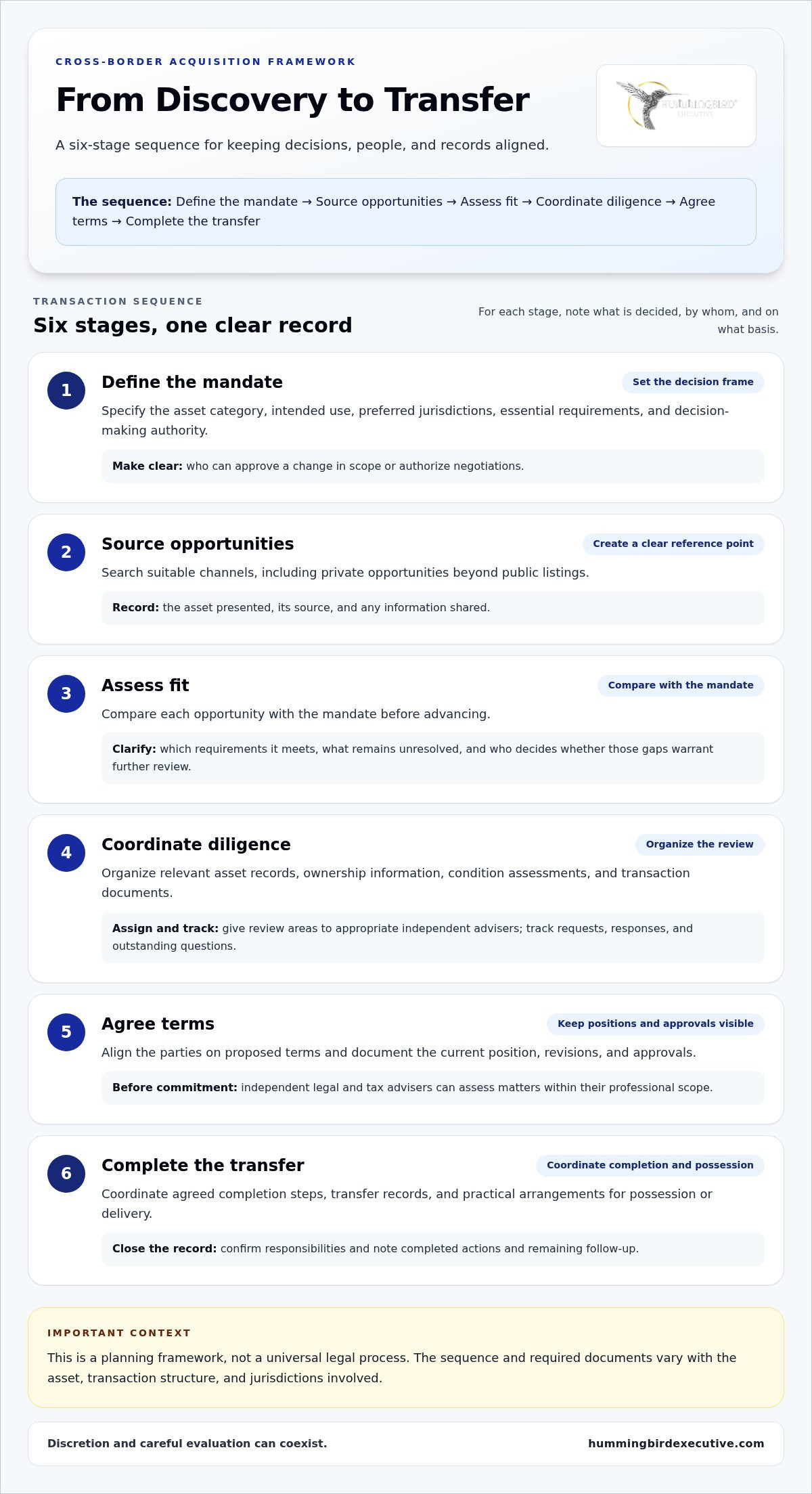
A cross-border luxury asset acquisition benefits from a deliberate sequence and a clear record of what has been decided, by whom, and on what basis. The stages below offer a planning framework, not a universal legal process. The sequence and required documents vary with the asset, transaction structure, and jurisdictions involved.
In brief: define the mandate, identify opportunities, assess fit, coordinate diligence, agree terms, and plan the transfer. Adapt each stage to the transaction.
- Define the mandate. Set out the asset category, intended use, preferred jurisdictions, essential requirements, and decision-making authority. Record who can approve a change in scope or authorize negotiations.
- Source opportunities. Search through suitable channels, including private opportunities beyond public listings. Record the asset presented, its source, and any information shared so the review starts from a clear reference point.
- Assess fit. Compare each opportunity with the mandate before advancing. Note which requirements it meets, what remains unresolved, and who will decide whether those gaps warrant further review.
- Coordinate diligence. Organize relevant asset records, ownership information, condition assessments, and transaction documents. Assign review areas to the appropriate independent advisers and track requests, responses, and outstanding questions.
- Agree terms. Align the parties on proposed terms and document the current position, revisions, and approvals. Independent legal and tax advisers can assess matters within their professional scope before a commitment is made.
- Complete the transfer. Coordinate the agreed completion steps, transfer records, and practical arrangements for possession or delivery. Confirm responsibilities and keep a final record of completed actions and remaining follow-up.
Set the acquisition mandate before reviewing opportunities
A concise mandate protects focus. Specify the asset category, intended use, and preferred jurisdictions, then separate essential requirements from preferences that could be reconsidered. For example, a buyer seeking an asset primarily for personal use may weigh its suitability differently from a buyer assessing it chiefly as an investment. Name the decision-makers and define who can authorize next steps. This clarity reduces unnecessary circulation of information and keeps the search aligned with the buyer’s priorities.
Coordinate diligence and transaction readiness
Diligence is easier to manage when every request has an owner and every response is logged. Maintain a central record of asset documents, ownership information, condition assessments, transaction drafts, questions, and approvals. Limit access to the relevant parties. Independent legal, tax, financial, and technical specialists can review matters within their respective disciplines; keep their advice distinct from the buyer’s decision-making authority. Aircraft transactions have their own considerations, explored in this private jet acquisition guide.
Concierge coordination can help keep parties and next steps aligned, while professional advisers handle their specialist workstreams. Buyers seeking private access to rare assets and coordinated support can explore Hummingbird Executive membership.
How to Balance Privacy, Due Diligence, and Jurisdictional Complexity
Privacy and due diligence are complementary. A buyer can limit who sees sensitive details while still arranging appropriate checks on identity, ownership, asset condition, and transaction terms. In a cross-border luxury asset acquisition, the practical aim is controlled information-sharing, not anonymity or exemption from applicable requirements.
A workstream map clarifies who is responsible for each review and which records to organize. The precise scope depends on the transaction. Qualified advisers should determine the legal, tax, and regulatory questions that apply.
| Workstream | Purpose | Responsible party | Records to organize |
|---|---|---|---|
| Identity and ownership | Understand the parties and how ownership is held or transferred. | Buyer and seller, with independent legal advisers reviewing relevant details. | Identity information, ownership records, and documents relating to the proposed transfer. |
| Asset condition | Assess the asset against its represented state and the buyer’s requirements. | Buyer, supported by an appropriate independent technical specialist. | Available asset records, inspection findings, and questions requiring resolution. |
| Transaction terms | Clarify the parties’ agreed position and record proposed changes and approvals. | Buyer and seller, with legal and financial advisers addressing their respective areas. | Draft terms, amendments, correspondence, and approval records. |
| Transfer arrangements | Coordinate the steps for completing the transfer and arranging possession or delivery. | Transaction parties and their relevant advisers or coordinators. | Completion documents, transfer instructions, and records of agreed responsibilities. |
What privacy can, and cannot, mean in a private transaction
In practice, privacy may mean restricting opportunity details to relevant participants, sharing personal information deliberately, and keeping transaction communications organized. It does not mean concealing information from people who need it for appropriate checks or bypassing obligations that apply to the transaction. Hummingbird Executive states that its platform does not use cookies and that personal information is never sold. These statements concern the platform and personal information; they are not a guarantee of confidentiality in every aspect of an acquisition.
Which cross-border questions require jurisdiction-specific review?
Ownership arrangements, document requirements, tax treatment, currency exposure, and transfer logistics can each raise questions that depend on the countries and parties involved. Requirements vary by asset, jurisdiction, and transaction structure, so a property purchase, aircraft transfer, or yacht acquisition may call for different records and professional review. Qualified legal, tax, and regulatory advisers can assess the relevant position. Coordination helps keep their questions, findings, and required decisions visible to the buyer.
Keep a controlled record of who received sensitive information, which checks remain open, and who has authority to approve the next step. Discretion is strongest when it is deliberate and paired with a clear diligence trail.
A Practical Preparation Checklist for International Luxury Asset Buyers
Preparation gives an international acquisition a disciplined starting point. Before substantive negotiations, clarify the buyer’s objectives, decision-making authority, and supporting records. This reduces avoidable ambiguity when an opportunity spans several parties or jurisdictions. Use the checklist below to organize the process, then tailor it to the asset and transaction.
Information to organize before entering discussions
Prepare a concise acquisition brief that distinguishes firm requirements from preferences. Keep it practical enough to guide a search and precise enough to support a clear decision when an opportunity is presented.
- Mandate: State the intended use, preferred asset category and jurisdictions, essential requirements, and preferences that can be adjusted.
- Decision authority: Identify who can assess, approve, or negotiate, and define who has authority to make a commitment or revise the brief.
- Information sharing: Set an appropriate channel for sensitive material and clarify which participants need access to particular details.
- Funding and ownership records: Organize relevant documentation for review by financial and legal advisers. Keep records orderly and share them through suitable channels.
- Priorities: Record the factors that will determine fit, such as intended use, asset characteristics, and practical requirements, so comparisons remain consistent.
Clear responsibilities matter. If several family members, representatives, or entities are involved, agree how questions will be resolved and where final approvals will be recorded. This preparation helps keep the cross-border luxury asset acquisition aligned with the buyer’s mandate while limiting unnecessary circulation of details.
Questions that keep a transaction aligned
As discussions progress, use a single controlled record to track what is known, what remains open, and who is responsible for each follow-up. Update it as documents arrive and decisions are made.
- What information has been verified, and what is still based on a representation that requires review?
- Which documents are outstanding, who will provide or assess them, and what decision depends on them?
- Are proposed terms recorded accurately, including revisions and the parties’ latest position?
- Who owns each next step, and who must approve it before the transaction advances?
- Which questions require independent legal, tax, financial, or technical advice given the asset and jurisdictions involved?
Independent advisers can assess specialist matters within their fields. Their input is especially relevant when ownership structure, tax treatment, funding arrangements, asset condition, or transfer planning requires professional judgment. Keep their findings distinct from the buyer’s decision record so the advice informs the decision without obscuring who is responsible for making it.
For buyers considering a maritime asset, a private superyacht sale guide offers a related perspective on a discreet transaction. To bring private asset discovery and concierge coordination into your acquisition planning, explore Hummingbird Executive membership.
How Hummingbird Executive Supports Discreet Cross-Border Asset Acquisition
A cross-border luxury asset acquisition involves more than an introduction to an opportunity. It also calls for a considered way to explore a search, purchase, or sale while coordinating the people and practical steps involved. Hummingbird Executive connects members with private opportunities across luxury asset categories and provides concierge support according to membership tier. Each asset merits individual evaluation, and access does not guarantee a particular asset or completed transaction.
A private marketplace across luxury asset categories
Hummingbird Executive’s marketplace focuses on opportunities that are not publicly advertised. Members can explore property, yachts, private jets, and luxury cars through a private platform for transacting rare assets. This provides a route to discovery beyond public listings, while buyers and sellers assess whether an opportunity fits their objectives. Private discovery is a starting point, not a substitute for appropriate review.
- Property: Opportunities for buyers considering an international real estate acquisition.
- Yachts: Maritime assets explored through a private transaction context.
- Private jets: Aircraft opportunities for those assessing a potential purchase or sale.
- Luxury cars: Vehicles considered as part of a wider search for rare assets.
Across these categories, member access supports a search, purchase, or sale journey. Buyers retain responsibility for informed decisions and appropriate independent advice. The marketplace connects members with private opportunities; the merits and terms of each transaction depend on the specific asset and parties.
Concierge support shaped around the membership tier
Concierge support can help keep communications and practical coordination aligned as a buyer explores an opportunity. Hummingbird Executive’s membership options distinguish full access with dedicated concierge assistance from white-glove service during standard opening hours.
- Platinum membership provides full access to search, buy, or sell rare assets and investments, with dedicated worldwide concierge services available 24/7 at no extra charge.
- Gold membership offers white-glove service seven days a week during standard opening hours.
- Free Access White-Glove Service provides complimentary white-glove service worldwide during business opening hours.
Concierge coordination can reduce friction between parties and keep next steps visible. Legal, tax, financial, and technical questions remain matters for appropriately qualified independent advisers. Membership provides access and support within its stated framework, rather than a promise of a specific asset, investment result, or transaction completion.
For a closer view of private asset access, explore Platinum membership. It is a practical next step for buyers considering whether this approach and level of concierge support fit their search.
Set the Next Acquisition in Motion with Clarity
Turn a broad interest into a considered mandate: identify the asset you’re seeking, the role it should play, and the priorities that will guide your decision. With those parameters in place, private discovery can be more focused, and each opportunity can be assessed on its own merits. A well-planned cross-border luxury asset acquisition begins with intention and gives each person a clear role in moving it forward.
For members seeking a broader search, Platinum provides full access to search, buy, or sell rare assets and investments, alongside dedicated worldwide concierge support available 24/7 at no extra charge. Hummingbird Executive also states that its platform does not use cookies and that personal information is never sold. These policies provide context for considering how you prefer to explore private opportunities, without replacing careful transaction planning.
When you’re ready to explore private asset access and coordinated support, explore Hummingbird Executive membership and find the membership level that fits your search.
Frequently Asked Questions
What does cross-border luxury asset acquisition mean?
Cross-border luxury asset acquisition means purchasing a high-value asset through a transaction involving more than one country. For example, a buyer may live in one country, acquire a yacht located in another, and transact with an owner based elsewhere. The term describes the international dimensions of the purchase, not a single legal structure. Identifying the countries involved early helps the buyer determine which records, advisers, and transaction arrangements need attention.
How does a private asset acquisition differ from a public-market purchase?
A private acquisition is explored through direct introductions or opportunities that aren’t publicly advertised, rather than through an open listing or exchange. This can change how information is shared and how discussions begin, but it does not establish the asset’s value, condition, or ownership. A buyer should still evaluate the opportunity independently and document the basis for decisions. The main difference is the route to discovery, not the need for a considered purchase decision.
Which documents are commonly reviewed when acquiring a luxury asset internationally?
Documents vary by asset and transaction, but a review may include records identifying the asset and its owner, available condition or inspection information, proposed transaction terms, and documents needed to record a transfer. Buyers may also need to organize identity, ownership, and funding information for appropriate review. Create a document register that notes each item, its source, the reviewer, and any unresolved question rather than assuming there is a standard package. Qualified advisers can identify jurisdiction-specific requirements.
Can a buyer acquire a luxury asset in a country where they do not reside?
Potentially, but whether and how a non-resident may acquire a particular asset depends on the asset, ownership structure, and relevant jurisdictions. Residence alone does not answer questions about documentation, permitted ownership arrangements, tax treatment, or transfer procedures. Before making a commitment, have qualified legal and tax advisers assess the specific countries and structure involved. Keep their advice tied to the proposed transaction, since an answer for one asset or location may not apply to another.
How should buyers think about currency exposure in a cross-border acquisition?
Start by identifying the currencies used for the purchase, related payments, and any later expenses. Consider how exchange-rate movements could affect the funding plan. Record the currency and timing assumptions behind internal approvals, and revisit them if the transaction schedule or terms change. A financial adviser or relevant financial institution can explain available approaches and their implications. Do not treat an exchange rate observed during early discussions as fixed for a later payment.
Does a private sale remove the need for due diligence?
No. A private sale describes how an opportunity is presented or negotiated; it does not establish that the asset, seller, or proposed terms have been verified. An introduction to an unadvertised vehicle, for example, does not by itself confirm ownership or condition. Distinguish information supplied by a party from findings reviewed independently, and keep unresolved questions visible before proceeding. Appropriate legal, financial, or technical advisers can review matters within their professional scope.
How can a buyer keep an international acquisition discreet?
Approach discretion through deliberate information handling, not by avoiding appropriate review. Limit circulation of sensitive details to people who need them, use an agreed channel for transaction documents, and keep a record of who is authorized to receive updates or approve decisions. Avoid sharing identifying material earlier or more widely than necessary. These practices can help manage exposure, but no process can promise absolute confidentiality, and required checks should not be treated as optional.