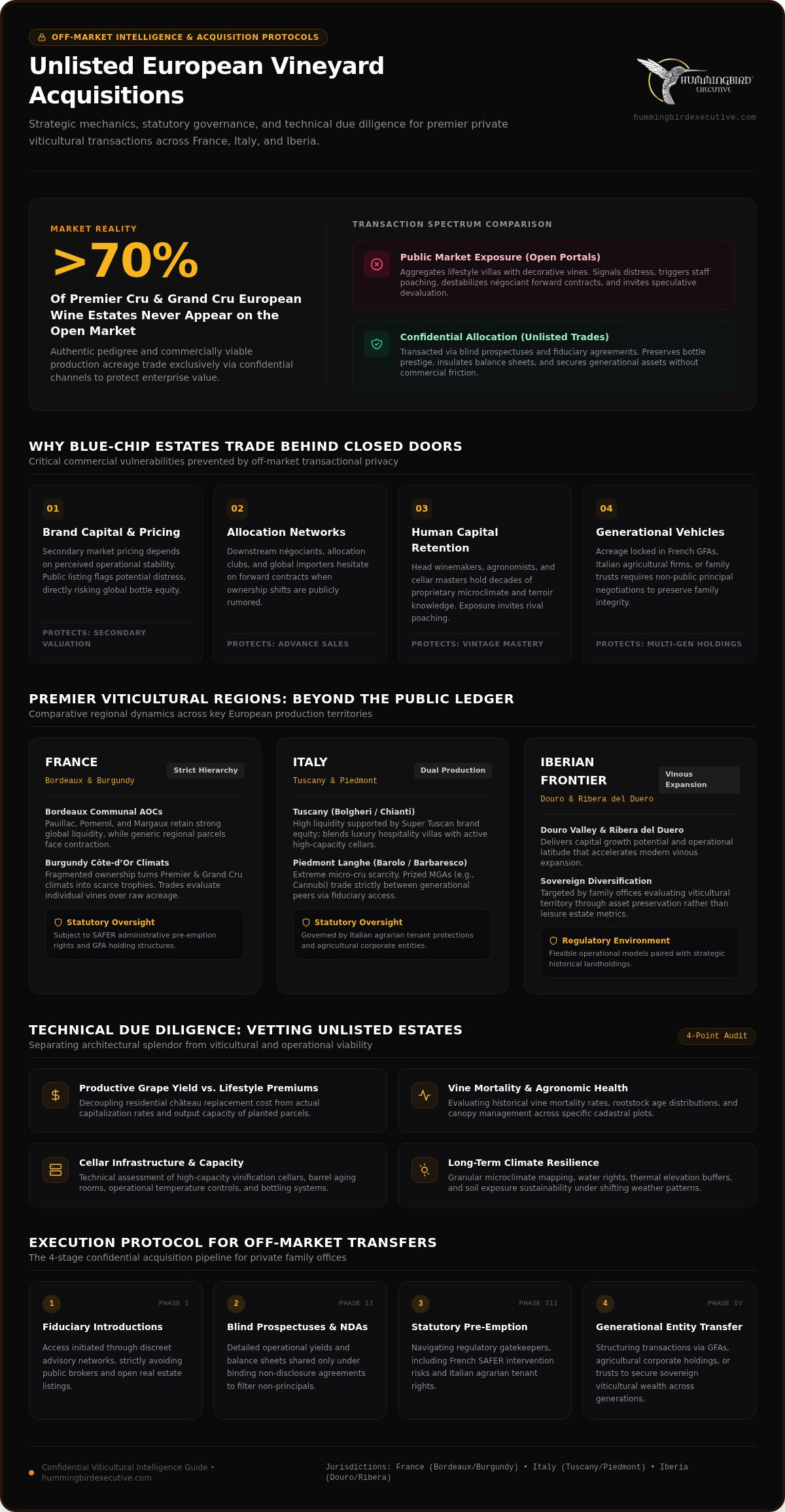
More than 70 percent of premier cru and grand cru European wine estates never appear on an open real estate market. For private collectors and family offices seeking unlisted vineyard properties Europe, authentic pedigree trades strictly behind closed doors. You already recognize that a public sale notice invites commercial speculation, unsettles delicate allocation networks, and compromises the hard-won prestige of an iconic label. In high-stakes viticulture, complete transactional privacy isn’t merely a preference; it’s essential enterprise preservation.
True access requires understanding how these heritage landholdings change hands outside the public eye. This 2026 guide details how elite European vineyard estates trade privately and outlines the exact protocols needed to execute confidential viticultural acquisitions. We explore the statutory land protections governing France and Italy, the rigorous due diligence separating productive grape yield from lifestyle premiums, and the discreet ownership structures that secure sovereign viticultural wealth across generations.
Key Takeaways
- Explore why blue-chip estates trade exclusively via confidential channels to protect distribution pricing and brand capital.
- Discover the institutional mechanisms required to access vetted unlisted vineyard properties Europe without public market exposure.
- Examine technical due diligence frameworks covering vine mortality rates, cellar infrastructure, and long-term climate resilience.
- Understand statutory pre-emption rights across key jurisdictions, including administrative oversight from France’s SAFER to Italian agrarian tenant protections.
- Learn how discreet membership advisory models secure tangible viticultural assets within a privacy-first transactional environment.
The Mechanics of Europe’s Secret Viticultural Market
Unlisted vineyard properties Europe are privately held, non-indexed viticultural estates transacted entirely outside public market clearinghouses. While open real estate portals regularly aggregate lifestyle villas with decorative vines, commercially viable production acreage never surfaces on public ledgers. Classifying an estate as unlisted means its balance sheets, operational yield, and cadastral parcels remain strictly confidential throughout the acquisition lifecycle. Premier domaines avoid public sale announcements to insulate their asset value. In fine wine, the perception of stability directly supports secondary pricing, meaning an exposed listing risks signaling distress or operational fracture to global collectors.
Brand Equity and Commercial Confidentiality in Viticulture
Public exposure immediately destabilizes an estate’s commercial framework. When rumors of an impending sale circulate, downstream négociants, international importers, and allocation clubs often hesitate on advance purchases, fearing shifts in winemaking style or distribution philosophy. Maintaining bottle prestige requires an uninterrupted commercial narrative.
Operational continuity is equally fragile. Head winemakers, cellar masters, and senior agronomists hold decades of proprietary institutional knowledge. Their granular mastery of microclimates and regional terroir dictates vintage quality and critic scoring. If public marketing triggers anxiety among staff, rival estates quickly move to poach critical talent. Conducting transactions strictly behind closed doors safeguards these foundational labor relationships, protects existing forward contracts, and prevents speculative devaluation across global markets.
The Information Asymmetry of Off-Market Acreage
Historic European winemaking families rarely subject their heritage to open bidding. Instead, transfers occur through discreet introductions, blind prospectuses, and binding non-disclosure agreements designed to filter out casual inquiries. A significant portion of prime continental acreage is locked inside multi-generational holding vehicles, such as French Groupements Fonciers Agricoles (GFAs), Italian agricultural companies, or private family trusts.
Navigating these vehicles requires institutional precision. Conventional brokers rely on open advertisements, whereas private advisory models work through quiet fiduciary relationships to negotiate transfers directly between principals. For investors seeking authentic unlisted vineyard properties Europe, this closed ecosystem eliminates public scrutiny, ensures price integrity, and secures generational assets without commercial friction.
Evaluating Premier Viticultural Regions: Beyond the Public Ledger
Acquiring unlisted vineyard properties Europe requires separating architectural splendor from viticultural viability. European jurisdictions vary widely in regulatory frameworks, capital requirements, and asset liquidity. Where one region offers rigid statutory protections that secure multi-generational scarcity, another provides operational latitude that accelerates modern vinous expansion. Discerning family offices evaluate these territories through the lens of sovereign diversification rather than leisure real estate.
Bordeaux and Burgundy: Legacy Terroir and Appellation Hierarchy
France presents a bifurcated landscape governed by strict statutory classifications. In Bordeaux, communal AOCs like Pauillac, Pomerol, and Margaux retain sustained global demand, while generic regional parcels face market contraction. A primary diligence objective is decoupling the residential château’s replacement cost from the actual capitalization rate of its planted parcels. Across Burgundy’s Côte-d’Or, fragmented ownership models turn premier cru and grand cru climats into finite balance-sheet trophies. Here, private parcel trades often evaluate individual vines rather than broad acreage.
Tuscany and Piedmont: Super Tuscans and Langhe Precision
Italy balances rigorous disciplinary rules with flexible production categories. In Tuscany, prime estates in Bolgheri and Chianti Classico offer liquidity supported by globally recognized Super Tuscan label equity. Many private estates seamlessly integrate luxury hospitality villas with active, high-capacity cellars. Further north in Piedmont’s Langhe, Barolo and Barbaresco micro-crus represent extreme scarcity. Historic family domains trade strictly between generational peers, where access to unlisted plots within prized Mentioni Geografiche Aggiuntive (MGAs) like Cannubi requires trusted fiduciary introductions.
The Iberian Frontier: Douro Valley and Ribera del Duero
The Iberian Peninsula delivers capital efficiency coupled with modern infrastructure. Key advantages include:
- Douro Valley: Grade-A terraced parcel inventory within classified DOC boundaries, commanding distinct port and dry-wine export demand.
- Ribera del Duero: High-altitude limestone plateau plots delivering drought resilience and exceptional concentration.
- Operational Modernisation: Advanced temperature-controlled cellars and integrated solar installations built to manage Southern European heat dynamics.
Securing these rare holdings demands silent representation. Private investors seeking off-market allocations across these historic regions rely on discreet acquisition advisories to identify verified production acreage without alerting competing buyers.
Technical Due Diligence: Vetting Unlisted Wine Estates
Technical assessment separates productive viticultural enterprises from capital drains. When acquiring unlisted vineyard properties Europe, buyers face a fundamental structural choice between direct asset purchases and corporate share transfers. Direct land transfers convey clear title to physical terroir and facilities, yet trigger regional pre-emption reviews. Acquiring equity in an operating entity preserves administrative momentum, but demands exhaustive forensic audits into legacy debt, commercial contracts, and environmental compliance. Discerning principals examine the silent market guide to off market properties to calibrate confidentiality protocols against institutional risk exposure.
Agronomic Terroir and Vine Density Audits
Visual canopy health often obscures underlying agronomic deficits. Due diligence requires rigorous parcel audits verifying rootstock vitality, clonal selections, and historic yield consistency. A pivotal metric is the missing vine rate, known regionally as the taux de manquants. Here, untracked mortality from trunk diseases or mandatory rogueing can shrink productive acreage by up to 30 percent relative to official cadastral surveys.
Fiduciary teams must reconcile physical plantings against statutory databases, such as France’s Casier Viticole Informatisé or Italy’s Schedario Viticolo, to confirm clean planting authorisations. Verifying frost defense infrastructure, subsoil drainage networks, and sanctioned water extraction rights ensures long-term operational resilience against shifting European climate pressures.
Cellar Infrastructure and Aging Stock Valuation
Cellar facilities and inventory represent substantial capital allocations. Evaluating these components requires precise physical and financial metrics:
- Processing and Effluent Compliance: Inspecting gravity-fed fruit reception lines, temperature-controlled fermentation systems, and dedicated wastewater treatment facilities to verify adherence to strict environmental discharge standards.
- Forensic Stock Valuation: Conducting independent laboratory assays and physical barrel counts to distinguish maturing bulk liquid from high-margin bottled library stock.
- Brand and IP Integrity: Auditing registered international trademarks, appellation label approvals, and historic merchant distribution agreements across major export markets.
Navigating European Statutory Pre-Emptions and Legal Gatekeepers
European viticultural acquisitions require rigorous legal structuring to avoid statutory intervention. Continental farmland remains strictly protected to preserve national agricultural heritage and prevent excessive land concentration. When acquiring unlisted vineyard properties Europe, buyers must navigate administrative gatekeepers who hold legal authority to review, delay, or preempt transactions. Overlooking these mechanisms can invalidate contracts or trigger public scrutiny that erodes transactional privacy.
Managing Agricultural Pre-Emption Rights and Approvals
State agencies and neighboring landholders hold substantial legal leverage across the continent:
- France and SAFER Oversight: For direct asset sales, the regional Société d’Aménagement Foncier et d’Établissement Rural (SAFER) exercises a statutory two-month pre-emption window. SAFER can step into the buyer’s position or demand downward price revisions. While share deals historically bypassed this scrutiny, France’s Loi Sempastous now mandates formal administrative screening for corporate share transfers involving significant agricultural acreage.
- Italy’s Agrarian Priorities: Under the diritto di prelazione agraria, qualifying tenant farmers and adjacent cultivating landowners hold a 30-day priority right to match purchase terms. Overlooking formal notifications can grant these parties a statutory one-year right of redemption to retroactively claim the title.
- Spain’s Parcel Retractions: Adjacent agricultural owners retain a nine-day statutory redemption right on transferred rural plots measuring under one hectare under Civil Code provisions.
Cross-Border Wealth Structuring and Estate Succession
Mitigating these statutory hurdles requires tailored holding structures aligned with international estate planning. Sophisticated family offices frequently separate land ownership from commercial viticulture. In France, this involves pairing an asset-holding Groupement Foncier Agricole (GFA) with an operational entity such as a Société Civile d’Exploitation Agricole (SCEA).
This division insulates prime production acreage, satisfies regional agricultural codes, and eases cross-border wealth transfer. Continental jurisdictions enforce forced heirship rules, which can complicate estate transitions for non-resident owners. Structuring unlisted vineyard properties Europe through compliant multi-tiered corporate entities balances regional agricultural regulations with generational succession objectives. To secure discreet transactional representation through compliant acquisition structures, connect with Hummingbird Executive.
Securing Private Allocation: The Hummingbird Advisory Approach
Securing private agricultural allocations requires an intermediary that operates entirely outside conventional commercial channels. Hummingbird Executive functions as a discreet facilitator for sovereign investors, institutional principals, and private family offices. To guarantee transactional confidentiality from the very first engagement, the firm operates a privacy-first platform engineered without third-party tracking cookies, ensuring zero digital exposure during preliminary asset inquiries.
The Privileged Architecture of Membership Access
Acquiring off-market viticultural estates is facilitated through structured membership tiers designed for distinct operational demands:
- Platinum Membership: Delivers unrestricted access to ultra-rare tangible assets and private market investments. Backed by dedicated around-the-clock concierge oversight across global jurisdictions, investors utilize the platinum membership luxury concierge for seamless, end-to-end acquisition management at no extra charge.
- Gold Membership: Provides tailored transaction support through white-glove services available seven days a week during opening hours. Principals leverage gold membership luxury services for structured daytime negotiations, regional dossier reviews, and diligence management.
- Free Access: Extends essential white-glove service worldwide during opening hours, allowing qualified buyers to initiate exploratory criteria and establish preliminary acquisition mandates.
From Mandate Execution to Operational Stewardship
Securing unlisted vineyard properties Europe begins with an exact, bespoke sourcing mandate. Rather than presenting recycled or stagnant market portfolios, advisory specialists conduct targeted private searches based on specific appellation hierarchies, vine age distribution, and soil chemistry profiles. Every prospective holding is audited before an introduction occurs.
Once a target estate aligns with the mandate, dedicated concierge managers oversee the acquisition lifecycle. They coordinate independent oenologists, master viticulturists, and cross-border corporate structuring counsel under strict non-disclosure covenants. This managed approach ensures that administrative notifications, statutory filings, and entity formations proceed without commercial disruption. Exploring confidential acquisitions via Hummingbird Executive private consulting provides qualified buyers with protected access to sovereign European landholdings, preserving both capital and heritage.
Preserving Generational Pedigree Through Private Viticultural Sourcing
Acquiring unlisted vineyard properties Europe represents a definitive strategy for sovereign wealth diversification and tangible heritage preservation. Navigating strict statutory pre-emptions across continental jurisdictions, auditing productive vine density against lifestyle premiums, and protecting allocation pricing require rigorous institutional discretion. When managed properly, these finite terroir assets deliver enduring stability across economic cycles.
Hummingbird Executive safeguards your transactional pathway through a dedicated global concierge network managing discreet off-market transactions. Supported by a private tier architecture supporting cross-border asset acquisitions, our cookie-free secure platform ensures complete investor privacy from the opening mandate to legal conveyance. You don’t have to navigate complex European rural governance alone. Explore unlisted European asset opportunities with Hummingbird Executive and secure your family’s viticultural legacy.
Frequently Asked Questions
Why are the most prestigious European vineyards never listed on public real estate portals?
Public sale announcements signal operational distress or ownership instability, which directly threatens secondary bottle pricing and delicate merchant allocations. Fine wine derives immense value from perceived scarcity, continuity, and prestige. When an impending sale becomes public knowledge, downstream distributors hesitate on forward commitments, competitors attempt to recruit key cellar staff, and brand capital erodes. Private transactions insulate the estate’s commercial standing entirely.
Can foreign non-EU citizens legally purchase unlisted vineyard properties in Europe?
Yes, non-EU buyers can legally purchase unlisted vineyard properties Europe across prime jurisdictions, including France, Italy, and Spain. While direct agricultural land acquisition is permitted, transactions face administrative vetting regarding ultimate beneficial ownership and regional land-use rules. Structuring acquisitions through tailored domestic holding entities ensures complete regulatory compliance, tax efficiency, and smooth approval from statutory agricultural oversight authorities.
What is the function of SAFER in French vineyard property acquisitions?
SAFER functions as the French state-backed agricultural agency tasked with monitoring rural land transactions and preventing speculative concentration. Holding statutory pre-emption rights during direct asset transfers, SAFER maintains a two-month review window where it can intervene, purchase the land, or mandate price revisions. Under the recent Loi Sempastous, SAFER also reviews significant agricultural share transfers that exceed regional size thresholds.
How is bottled inventory and aging barrel stock valued during an off-market sale?
Physical inventory is evaluated separately from raw land valuation through forensic cellar audits and independent laboratory assays. Maturing bulk wine resting in barrels or vats is priced using regional bulk commodity indices and certified vintage quality. Bottled library inventory and ready-to-ship stock are valued using historical ex-cellar wholesale realization rates, deducting bottling and distribution overheads while factoring in verified provenance.
What is the operational difference between a hobby vineyard and a commercial estate?
The distinction lies in commercial viability, processing infrastructure, and statutory classification. A hobby vineyard typically spans limited acreage and relies on local cooperatives or external facilities for processing, functioning primarily as a residential amenity. A classified commercial estate operates self-sufficient winemaking cellars, holds certified appellation rights, commands active international distribution channels, and employs dedicated full-time agronomic personnel.
How does an off-market acquisition protect the commercial wine brand during a transition?
Private transfers prevent market speculation that can disrupt distribution agreements and downstream customer confidence. Off-market protocols ensure that annual harvest cycles, merchant allocations, and vintage release schedules proceed without operational hesitation. By negotiating under strict non-disclosure covenants, new ownership preserves relationships with master winemakers and commercial partners, guaranteeing continuity before any formal announcements take place.
How does Hummingbird Executive protect client privacy during international land acquisitions?
Hummingbird Executive operates a privacy-first platform engineered entirely without third-party tracking cookies, ensuring total anonymity during preliminary inquiries. Client identities remain shielded behind dedicated fiduciary representation. Whether accessing assets through Platinum Membership with 24/7 dedicated concierge services worldwide, Gold Membership with white-glove support seven days a week, or Free Access during opening hours, mandates for unlisted vineyard properties Europe remain strictly confidential.